Art is Process Work is art
The new type of art will be more like a power station, a producer of new energy
Alexander Dorner (1893 -1957)
Prologue: About the use of language in this thesis
What is language? Is it the right grammar, the perfect syntax, elegant formulations? Is language expressing truth? Is it even possible to write about music, about perceptions, about essence or arts in a language which follows the common standard? Many philosophers have thought about this. It is a huge and endless topic. Do we need special language to express something that barely can’t be expressed? Is the way to use language crucial for the message we want to share?
There are many ways to use language. Some writings use a different sort of language to express something numinous like for example writings about silence. Reading John Cage’s work Silence is difficult, in the sense that we can’t catch it with our linear understanding of language. James Joyce’s language in Finnegan’s wake or in Ulysses is difficult to understand because he creates expressions that didn’t exist before. In all these works you stumble, have to read sentences twice or more times to feel the world behind the words. In this way, you are walking on the path to non-linear perception.
What has all this to do with my diploma thesis?
My mother language is Swiss German and also music. My diploma thesis was written in a flow that went along with my research of music, art and Process Work, and through all this, coming home to my true self. I didn’t follow English language rules because this would have disturbed my nonlinear flow. I was in a creative writing flow.
Writing about music and arts, about coming home, about essence, is quite impossible. Despite this impossibility I tried. The language in this paper is close to essence, close to music, close to arts in general. Art cannot be understood in a linear way. Art can help everyone to reconnect with the non-linear and creative realm which for me is the source of everything.
The way I write might irritate you. You might stumble over an unfamiliar use English sentences – being stopped, catching the energy behind the words, catching the essence of what I want to tell you. Essence as an arena beyond polarities – to use the words of Chinese philosopher Lao Tsu: The Tao that can’t be spoken. To speak about the Tao that can’t be spoken is an endeavor that must fail. But perhaps with use of language – even though incorrect from a standardised viewpoint, we become a surfer in an arena that is beyond standard. Here we can at least be closer to the Tao that can’t be spoken. Here we reach freedom. We are free to become a sculptor of language with mystery meaning. Language becomes creative and language becomes a dream door to our inner experiences. The goal is to find a language that is as congruent as possible with essence and art. If art is beyond the ordinary, then language has to follow.
My language style creates a dialogue with you as reader. I would like to invite you to walk along this journey with me. In every sentence I imagine my reader, as if you would be here in my music studio or walking with me in nature listening to all the sounds. I imagine I am speaking directly with you. Writing in this way as a sort of musical dialogue, helps me to stay close to music, my creativity and to the Tao that can’t be spoken.
For these reasons I chose not to edit out my natural style of expression.
Gratitudes
My first very big thanks from the depth of my heart goes to Ellen Schupbach. As my main coach and mentor for this diploma paper, she guided me with a deep trust for all that wanted to come out of me. I am looking back at an unbelievable journey. This journey with Ellen is characterized by passion and love for what the process reveals. For me Ellen Schupbach is a model of the deepest curiosity and love for everything that comes along in life. She supported me to explore my deepest home, and to express it in this thesis. She inspired me to enter a long and intense journey. My transformations through the study and though this diploma paper is due to her.
I could not have completed this thesis without my guiding team, Drs Ellen and Max Schupbach, and Dr Josef Helbling. In every moment of my study I felt their big support.
I will not forget fascinating discussions about questions in my work with Josef, that encouraged me to deepen my thinking and Process Work knowledge. I appreciated his incredible knowledge and his tireless commitment.
I can’t find accurate words to express my gratitude to Max Schupbach. I encountered a master, an inspiration, a genius, and a teacher who through lectures, classes, seminars and coaching sessions transformed my life as a human being, as a farmer, as an artist and a Process Worker. This paper is one of the results.
A deep thank goes to all my peers in the Deep Democracy Institute, especially to those I studied regularly with, and who I had supportive discussions with about my thesis: Andrea Fink-Kessler, Brigitta Joost, Simone Brecht, Petra Voss.
Brigitta Joost was my first reader and helped correct my English in first draft. Writing in English was challenging for me. I am so grateful to Brigitta for those first corrections. The discussions with her let me clarify parts that were not yet understandable.
I am deeply grateful for Nader Shababangi and Julia Wolfson. They supported me during the study and the exam phase. They in particular helped me in the last phase of bringing this thesis to its final form with their incredible knowledge and experience.
Huge thank goes to the Deep Democracy Institute (DDI) faculty. I am aware that studying with DDI depends on a team that works well together, and I felt the collaboration through all the years. I felt especially so much supported during my exams. Also, I am deeply grateful for all the organizing teams around the world. The seminars and the Intensives nourished me for my diploma thesis in so many ways. I adore the organizers, who dedicate their knowledge and practical sense to the DDI and the participants of the seminars with heartful attitude.
The DDI organizational teams in the various locations around the world allowed me to learn in many seminars in so many countries. These teams are indispensable for us as DDI students to learn in DDI and complete our studies.
That I am here with my diploma thesis goes also back to Dr Lane Arye. Through Lane and the study of Unintentional Music, I started to walk this amazing path. He gave me this sense of the awesome and mysterious path of music and Process Work. Ruby Brooks was my therapist during the study with Lane. I am deeply grateful for my work with her. She taught me a deep but also playful access to Process Work. With her, my struggles became my gifts.
For many years I have been connected with Process Work. I send my deepest thanks to Drs Arnold and Amy Mindell. This incredible impulse transformed my life and my music. What a privilege to live in a time with such an impulse! I bow to Arny and Amy for their life work!
Part 1: From art and music to Process Work to coming back home
Chapter 1: Basic idea of my thesis
Introduction
As a participant of the annual Deep Democracy Intensive in Barcelona in 2015, I had the opportunity to work on an exercise with the title:
You, your organisation, the spirit
With a trusted peer I entered a zone that was like a timeless world.
The message that came to me from the experience was
Music as the way back home
This sentence accompanies me every day since then, and not only when I am making music; also in life generally. The way back home is a mantra for me to align my everyday life to the fact that every day, every experience in my life is somehow somewhere on the way back. Whether to death, to new life, to the unknown, to love, to new music, to creativity, life is a process of dying and rebirth.
My diploma thesis is largely based on experiences in my personal life. So it may be helpful for you, dear reader, to know some details about me. I am a classical and experimental musician in my sixties. I grew up in Switzerland where I am still living. In the middle of my life I met my partner, a biological farmer from the mountains. For about 25 years we managed our farm in the Swiss alps. We made cheese in the traditional way. I continued to work as a musician.
On the alps I developed a new kind of music, inspired by nature. Throughout my professional life, I have taught piano, given concerts and workshops and trained pianists to teach piano. In my thirties I met Process Work. Individual study with Lane Arye allowed me to integrate Process Work in the realm of music. I am a long-time student of the Deep Democracy Institute (DDI) where I am able to expand my skills. I feel very privileged to study with DDI.
During recent years I was in a very special situation, because my husband got cancer. This was now an extraordinary situation: the life with him on the farm, ever more work that rested on my shoulders, deep love, panics, fears, doubts, care, hope, and transformation within me and my husband, and in our relationship: My mantra the way back home always gave me trust in difficult moments. I am not surprised that the mantra came to me in the midst of this extreme situation.
The mantra reminded me every day, that we are all on the way back home, home to ourselves, to our true self. Making music by following this mantra gave me access to a very special music. Every tone I played was meaningful and I used music more and more, as a guide for my everyday issues.
Many times, throughout my life, music has been my consolation in difficult situations. Particularly during these recent years, music and sounds in their diverse expressions were my guides to another world beyond everyday issues. Music supported me to work with my life with a quality that is essence-like.
The following chapter has an overview of the paradigm of Process Work, so here is just a short description. First, Process Work works with a constant flow of information. Some of the information we like and some we dislike. Furthermore, Process Work says that we perceive three levels of life at the same time: The everyday life called consensus reality, the dreamland level and the essence level (Arnold Mindell 2012, 15). On the consensus reality level, life is so-called “real”. There you say for example: “I” I am a woman. Everybody can agree to this.
In the second level called dreamland, I experience life in a different way. I am not only what I believe myself to be. At this level polarizations arise, and I realize that I am also what I believe to be “Not me”. The outer world is at the same time my inner world. I am what I think of as me, and also something more. I can say, “I am a woman”, but I sometimes am more “male-like”, which can create conflicts because as a woman I don’t fulfil the expectations of the majority worldview around me.
The third level, the essence level, is a world beyond polarities. We experience it as a non-dualistic world. This is an area before a first manifestation. Laotse (Laotse 2010) calls it “the Tao that can’t be said, an experience of one-ness. On this level, I feel for example suddenly at home in a certain landscape, or I am playing music that catapults me out of the fragmentation of being a woman or not woman, because music is beyond gender.
This essence level plays a crucial role in my work. Music is there, silence is there, inspiration of art is there, closeness to death is there, the forces of nature are there. Everybody is able to perceive it, but we all have a tendency not to notice it or to forget it from time to time, especially in moments that we are identified with our everyday reality. Although this essence level often remains invisible, at times avoided, it is in the background of manifestation.
Working and being with this essence world allowed me to accompany my husband until his death. I discovered in general a deeper aspect of creativity, and an experience of being at home and connected to my true self – a space without borders, where everything comes back to, and from where all is going out.
My experience of discovering the essence level in Process Work was one of the most inspiring aspects of my studies. It became a deep inspiration for my life, for me as musician and farmer and for working with people. Working with the essence quality revealed a deep sense behind all my issues, troubles, fragmentations. I discovered a home there and this inspired my life in a powerful way and life got much richer, more meaningful and my confidence in life increased.
As more and more I discovered new aspects of music and arts with Process Work and how they brought me home to my true self, a deep longing I had carried inside me for years woke up again and knocked at my door to be explored.
Coming back home
Coming back home in my mind means a world beyond everything, beyond everyday life – a world that is bigger and larger than what I experience in my daily life.
Back home also means a world where life and death – the life here on earth and the life in an immaterial dimension – come together, and are in a deep relationship to each other. Back home means a point from which all goes out and all comes back. Living at home means living our true self, because our true self is a resident in both worlds – on earth and in a dimension beyond matter. Back home also means going away from home to struggles and fragmentation, and then coming back again. Back home is not static. It is a lifelong movement. Every time I come back again, this back home is deeper than before: richer with insights, with deeper feelings, thoughts and awareness of the different dimensions moving us. I imagine myself coming home at the end of my actual incarnation being nothing more than yet another back home.
I made the experiences of coming back home in music, in arts and in Process Work. Therefore my diploma work focuses on these three areas. My goal is to also make these experiences accessible for everyone who wishes for it.
First, I want to tell you some stories about experiencing this back home personally in my life, which is already a short introduction to how I will go through this diploma paper. It will be very personal because I will share with you my life experiences. Through this I will understand better my own life, the creativity and the coming home aspect. I also hope this will inspire others to discover this mysterious essence of being and coming back home.
When I speak out the word home, or hear it, a special atmosphere accompanies this word for me. With coming home, a deep breath and many memories like a tableau of my life appears. When I was a child and a teenager, the youngster of a big family, every Sunday all my sisters left the house. I remained alone there, in a house full of unspoken tensions, but with many possibilities to escape from these tensions: music, nature, animals, space, being uncontrolled.
Being alone, tears came, and I played piano, mostly music of Johann Sebastian Bach – a music of consolation and deep spirituality. In this world I felt at home. No longer feeling the tensions of the everyday life in the family, no longer having a specific physical form. I was within the tones and the musical energy. Lost to everyday life I arrived in another world beyond time and space. In these years, music was my survival strategy and my deep home. Another home in these situations was walking in nature with my dog. There every feeling was welcomed. Nature embraced everything.
After the early death of my mother music became an even deeper need for me. Music embraced my deep grief. In the school choir singing the requiem of Wolfgang Amadeus Mozart, I sang with all my inner devotion for my mother, and I was sure of her being there listening. During the Gymnasium years, I enjoyed my small city with all the cultural possibilities – theatres, exhibitions, concerts and jazz clubs. There was my world. There I felt free space, feeling the groove of a theater, concert hall, club, museum, gallery. In this world I forgot all the issues of my life – school, family problems and relationship issues.
In this atmosphere I found a larger frame for every issue as a part of the whole of life. In art every issue can be shaped into a work of art. No longer fragmented, I felt deeply at home in my true self. Home was in this world beyond everything. I felt total freedom and my decision to become a professional musician was no longer reversable.
Early in my studies I noticed a big interest to share my experiences with other people. I played chamber music, I tried out many things that were offered, from jazz dancing to bodywork to composition studies. I blossomed. Although I also had many troubles in my everyday life, I had a world to come home to. The composer Makiko Nishikaze (Drees 2008, 18) whose home also is music, speaks about “sanctuary”. This term best expresses what I feel when I say back home.
Not only music was my home. As I mentioned earlier, all cultural expressions such as visual arts, dancing, lyrics, poetry and theater attracted me. Each of these worlds were my home too. I went to exhibitions as often as possible and museums also became a home.
In the art world I noticed that every experience – whether positive or negative – can be expressed through art and music. This was my home. Studying the connections between different arts such as music, visual art, writing and theatre, I got ever more convinced that this was my path to something wanting to be explored.
In my music study with my teacher, I realized that music has a direct connection to myself. In the piano sessions where I worked on the great classical piano pieces, I felt the connection between how I played the music and how I felt my personality. My teacher’s words to me were like an arrow to the core of myself, and often I felt naked. “Through music the soul gets loud” (Henck 1994, 15). Music became my guide into myself – a guide to transformation and to coming home to my true self.
I had experiences of no distance between music and me. These were experiences of transformation, of arriving at a new level of expression – coming home, breathing deeply and feeling freer than before, not only in music but also in life. I experienced artists like John Cage, Joseph Beuys, Marina Abrahmovich and many others as inner teachers, whose works guided me again and again back home to myself. In different phases of my life I encountered the works of some of these artists I will introduce here as part of my diploma thesis.
Each one had something crucial to say to me and gave me a huge gift for my life process and my way of coming home again and again. The specialty of each of these artists is their deep trust in the creativity of every person. Each one researched into an unknown visionary realm. What they have in common in their art is the conviction that Art is a key to life, a key to the creativity in everyone and that art belongs to everyone everywhere. Art no longer belongs to the privilege of a wealthy upper-class in western culture.
When I met Process Work, I discovered access to a world that had the same effect on me as music and art. By chance I began therapy with a student of the process-oriented school in Zurich and I read my first book by Arnold Mindell: The Year One (Arnold Mindell 2019b).
Amazed, feeling at home, I discovered another world of coming home.
Why?
Until this moment I had experienced many things in music and in teaching music. I had developed a deep aim in my teaching: music and art belong to everyone who wishes it. When people asked me if I had talented students in my classes, I didn’t understand the question. I experienced my students as owning different capabilities. One pupil was able to play very fast, another expressed music that touched one to tears, and others came to the lessons to have interesting discussions with me on music, art, life and personal problems.
I experienced coming home through music as a gift that either was there or not, but I did not know how to influence or interact with this experience. Sometimes I felt stuck in working on music and stood in front of a wall. No way to get through. Studying so many ways of interpreting music, many critical voices, expectations and harsh teachers in my life had the effect that I sometimes lost this feeling of home.
What a fate and luck for me in meeting Process Work. A new key to be able to work through music, exactly in those situations where I had difficulties. I found a key to go through walls in a totally new way. Process Work became a deep access to embrace all the needs of my piano pupils and students as well as my own. There again I met this phenomenon of coming back home.
I would like to share an example that shows the deep effect that Process Work had on my musical life. Once I worked with my therapist on my stage fright. As often happens in Process Work, working on symptoms meant discovering the symptom-maker causing the symptom, in order to send a message to follow. In my case it was a trembling symptom and the symptom maker – I call it the trembler – sent me the following message:
Leave the conventional music path and develop your unique one. Otherwise I will tremble you until the end of your life.
This was a clear and strong statement and forced me to seek out the unknown on my path as a musician.
Some years later, meeting Lane Arye founder of Unintentional Music for the first time at a seminar (Ayre 2002, 7) I worked with him publicly in the middle of the seminar group. He noticed a subtle trembling as I had previously experienced. While not intense stage fright as before, still the symptom appeared even though with less intensity. Lane encouraged me to follow the trembling and I entered into a musical explosion. This experience was one of my deepest feelings of coming home. I felt free to express. I felt at home and forgot the audience completely. I felt my deepest true self. I even felt who I am. It was incredible. In this moment I knew in the depth of my heart that following my own approach to music, following my unique path would become my way of coming home.
My deep wish with this work
I had the possibility to enjoy this for just myself and be happy at home. But a deep wish was always with me. What I experienced I wished for everyone. I was deeply convinced that music and arts belong to everyone on earth, and also to the whole universe.
I never wanted these experiences for my own joy only. Whenever I learned something from special artists and from Process Workers, I brought it directly into my piano and music teachings. In these moments my students met an excited and enthusiastic teacher with the mission to spread what she just learned and discovered.
For this reason and because it’s my nature, I will share with you the contributions of these artists and of Process Work in general to my way of coming home. In my thesis I will show how using Process Work skills can assist to facilitate the process within the realms of art and music, and how the realms of art and music can be used to enhance personal work on your everyday problems. I hope that bringing together music, art and Process Work might offer new ways to re-discover your own true self and home. I will offer exercises to explore art, music and Process Work to serve this purpose.
Coming back home, the true self and Deep Democracy
I mentioned above that my understanding of home and true self is connected with the essence level. But it is more than this. It is not the essence level only that brings me back home. Experiencing home and true self requires the flow between the three levels of awareness: consensus reality, dreamland and essence – and through this awareness the sense of Deep Democracy.
Arnold Mindell describes in his book Leader as Martial Artist (Arnold Mindell 2014a, 5) the entire self as a sense of Deep Democracy:
… [that]special feeling of belief in the inherent importance of all our parts of ourselves and all viewpoints in the world around us… Deep Democracy is our sense that the world is here to help us become our entire selves, and that we are here to help the world become whole.
In this paper you will meet the two terms Process Work and Deep Democracy. For better understanding I will here try to clarify both terms.
Arnold Mindell, physicist and Jungian analyst brought together quantum physics, spirituality, anthropology and psychology in a new paradigm called Process Work. Process Work is practiced today in many ways. In the eighties while researching Process Work research, he coined the term Deep Democracy to describe the awareness of the multidimensionality of life: the everyday objective reality called consensus reality, the subjective reality called dreamland and the force behind everything which he called the essence.
Deep Democracy is more than a democracy where the majority has the power. Deep Democracy includes every viewpoint and every level of awareness within groups and individuals. Every viewpoint means also every dimension. Mindell speaks of the entire self as containing the multidimensional being of every person and of the group. In his view, the world becomes whole through the awareness of every dimension.
My childhood dream, my life myth
A final and key component of my journey that now culminates in this work relates to my childhood dream. I will briefly explain the concept of a childhood dream and then share my own dream as it relates to my life path and experience of finding home. The childhood dream and its connection with the life myth was formulated first by the founder of depth psychology Carl Gustav Jung (Jung 2010). He discusses many examples of children’s dreams and explore the meaning for the whole life:
Furthermore, it lies in the nature of the earliest dreams of childhood that one usually does not get related associations: they are a manifestation of a part of the unconscious, standing alien in time. These early dreams in particular are of the utmost importance because they are dreamed out of the depth of the personality and, therefore, frequently represent an anticipation of the later destiny (Jung 2010, 1)
Jung coins the difference between individual consciousness and the collective unconscious:
Children’s dreams are often extraordinarily important because the infantile consciousness is still weak, so that such dreams can surface uninhibited from the collective unconscious. Consciousness is this time, this here and now.
The unconscious, on the other hand is an eternity, a timelessness, and has no intentions regarding the here and now. The childhood dream shows us two sides of our personality, one that goes along with our culture and one that is alien to our culture or identity. In our childhood these forces appear in dreams in a powerful archetypal image, therefore often frightening and overwhelming. (Jung 2010, 80)
Building on Jung’s foundation, Mindell describes the childhood dream in this way (Arnold Mindell 1993 47):
If powerful allies appear as antagonists in your earliest dreams, your myth is to confront an ally, whether you agree to this encounter or not.
The idea to add the experiences with my childhood dream in my thesis journey became crucial for me. Through the seminars in the Deep Democracy Institute I got very excited about the childhood dream and its meaning, as a pattern, called the life myth, that goes with us throughout our whole life. Sharing my life experiences here required that I integrate my life myth.
The childhood dream or early childhood experiences are like a life melody. This melody is present one’s entire life and continually reveals new aspects of the same polarity that appeared in the early dream in one’s childhood. Through my life’s thread, my life melody became much clearer to me and now in my sixties, looking back over a long life, many seemingly disconnected puzzles came together into a big picture. I love the idea to support also others top discover this special view on their life, so I am sharing my life myth with you:
In my childhood dream I dreamed repeatedly that I am a child going on my way home. Behind a hedge about 10 men are waiting to grab me. I have a huge fear of them. They are dressed in black and wear black hats. I begin to run. Just at the moment I am reaching out for the door of my home, they grab me, and I wake up.
One aspect of my childhood dream that is connected with my diploma work is the following: The child wants to go home, she knows the home, it is familiar, there she feels secure. But the ten men don’t allow it. In the last moment they grab the child by her foot and she can’t go home.
Now we could ask: Why is the diploma work if about coming home if in the dream the ten men don’t allow it? It could mean that going home is not the topic of my life.
Through exploring the dream, I realized that the ten men grab me to seek always a home. This home is not a local home in the world. It is a home in the unknown. Home as I described earlier.
When I look over my life, I realize that whenever I wanted to settle down, the ten men came and pulled me into a new world. Not in the sense of travelling or moving a lot geographically from one place to another. It had more to do with feeling home through enlarging my consciousness – letting go of what was too comfortable. Going back home into the world was always in a new way and it was always about sharing my experiences with the world. The ten men challenge me until today to explore music, arts and Process Work all the time, making new experiences, getting new insights and finding my home in ongoing transformations. This belongs to my life myth and comes out of my childhood dream.
Throughout the thesis I will refer to this dream and speak of the ten men as an aspect of myself that pushed me forward in life: going out of the house and seeking another home. Whenever you will meet the “ten men”, think of this aspect.
My goal with this diploma thesis
My thesis explores different paths to coming home to the true self. It describes my own personal, ongoing journey in coming home to my true self, with a hope to show that coming home through music, art and Process Work is possible for everyone. You need not be an artist, a musician or a Process Worker to embark on this journey! I feel a deep mission to make my experiences accessible for everyone, so I will create exercises and ways to experience art, music and Process Work together.
The purpose of these exercises is to work in a creative way to find the true self as a home beyond polarities. The exercises follow the experiences of the three levels of awareness: everyday reality, dreamland and essence world. In particular arts and music are grounded in essence world and so they allow us to enter deeply into the world of essence and bring back insights and gifts for our everyday reality. In this sense my diploma thesis is a user’s guide to coming home to your true creative self.
The exercises will be a central point of my journey. This thesis in its core is an experimental journey and wants to invite you not only to witness as a reader but also to experiment with it yourself using the exercises. You can use them as they are, or as springboards for your own experiences. I am convinced that experiencing art, music and Process Work and especially the essence behind everything requires discovery through our own experience. Process Work itself is a phenomenological approach, based on lived experience.
Through this journey I want to study and explore especially the essence aspect of the three levels of Deep Democracy as the force behind everything and particularly the force behind arts in general, as home. Art is timeless, it leads us to our home, which has no boundaries. My thesis study led me to redefining what is an artist, a human being, a seeker or a Process Worker. For such a long time these questions have been on my mind. I felt a longing and hope to update and redefine my attitude to what is an artist, seeker, human being or Process Worker.
Letting go of my partner was one of the reasons for this redefining process. Being at zero point, everything had to be redefined in my life. I re-connected with the timelessness of music, arts and Process Work and realized in this space without beginning and end and without boundaries, that I was in contact with everything. I would love to share this with you and love to support your creativity leading you into the non-local home from the depth of my heart.
At the end of the thesis you will find a glossary with short explanations for terms I am using.
Chapter 2: Stability of the process – Process Work from an artist’s view
Tout bouge, il n’y a pas d’immobilité. Ne vous laisser pas vous terroriser par des notions de temps périmées. Laisser tomber les minutes, les secondes et les heures. Cessez de résister aux métamorphose. Soyez dans le temps- soyez stable- soyez statique avec le mouvement. Pour une stabilité dans le présent. Résistez à la faiblesse apeurée d’arreter le mouvement, de pétrifier les instants et de tuer le vivant. Arreter-vous de toujours réaffirmer des “valeur”, qui s’écroulent quand meme. Soyez libre, vivez. Arreter–vous de “peindre” le temps. Laissez tomber la construction des cathédrales et les pyramides qui s’écroulent quand meme comme des tartes. Réspirez profondément. Vivez à présent, vivez dans et sur le temps, pour une réalité belle et totale1
Hulten 1992
Jean Tinguely was an internationally renowned Swiss artist. His artworks are mostly sculptures in movement. He belonged to phenomenon kinetic art. He was both an artist and artisan. This allowed him to connect with many people, not only the highly educated and academics.
I encountered the quote from his “Pour la Statieque” at the beginning of this chapter at an exhibition hosted by the Palazzo Grassi in Venice, Italy. Again in a crisis, I journeyed to Italy seeking some answers for my life. Jean Tingueley’s statement uplifted me right away. When I read it, something in me understood completely, although I had difficulties putting it into words. My friends didn’t understand what I tried to say after my journey. Today I would say this was an experience and an understanding on an essence level. The essence level can barely be described in words. It can be sensed through atmosphere and a vague sense of oneness as I described in the introduction. When I try to speak about this, my hands begin to move. It is easier to describe it with a hand movement, because the realm of essence is far away from words. I will now explain some general Process Work theory, the three levels of experience and Deep Democracy in more detail.
Process Work
Process Work was founded by Arnold Mindell and is based on a ongoing flow of information. Ongoing flow can be compared with a river. Imagine a river and try to follow it. The river becomes large when there is no boundary, and narrow when there is a ravine. The river jumps like a waterfall and speeds up when it passes a slope. The river remains a river and at the same time is ever-changing. If weather changes the topography, the river follows and changes its shape. The process-like quality of the water in the river is the flexibility to change with what happens. The obstacles in nature, the changes of topography and so on, are pieces of information that change the shape of the river and force the water to flow with these changes.
During my years as a farmer on the Swiss alps, every spring I noticed the changes of the river from wintertime. Every year this was a new and surprising experience. The river had changed its identity a little, and at the same time remained the same river. Thinking of this process-like behavior, I read the quote of Tinguely as a pictorial description of the Process Work paradigm. He speaks about not resisting to change and of the movement of time. Time means change. Generally, he proclaims movement as the only stable fact. He urges us not to resist change. When people ask me what process means, I often tell them that process is something that happens by itself, but there is a choice to follow it or not. If you don’t follow, the process happens anyway in this or that way. Tinguely describes it like this:
Laissez tomber la construction des cathédrales et des pyramides qui s’écroule quand meme comme des tartes.
He says that if we don’t move, the process moves and changes our frozen identities like cakes, which crumble anyway. As I understand it, he speaks about an identity which is fluid and is able to follow change when change wants to happen. It seems easy how Tinguely describes it. In our everyday reality it can be hard work because it requires crossing edges, meaning letting go old identities.
The edge is an important fact in Process Work. The edge is a wall between a process I like and which is familiar to my previous identity, and a process which is new, unknown and changing my identity. Mindell calls these structures primary process – or U – for the familiar process and secondary – or X – for the unknown and future identity. (Arnold Mindell 2017) We will see later how these structures arise. You will get to know some possibilities for dealing creatively with them.
Back to how I first understood this quote of Tinguely. I called it essence level. This is one aspect of a three-dimensional approach to all our experiences as Mindell teaches us. Let’s have a look at this approach and then compare it with the quote of Jean Tinguely.
Three levels of experience
If we look at our everyday life, we often experience something like this:
I believe what I see. I believe in the existence of what is visible, audible, touchable. This can be seen as a fact and therefore seems real. A table is a table, a human being is a human being, what I hear is something that sounds in my ears and normally I listen to somebody in a way of focussing on the so- called real content.
This is the first level – the consensus reality. This level depends on the group I belong to. Different societies define differently what is real. The group creates factors which most of the people agree to. This forms the identity of the group. There are always members who don’t share this identity. They are different and become outsiders.
An example: In Switzerland there was an artist named Harald Nägeli (Wikipedia n.d.) He was one of the first to spray his art on walls of houses in Zurich, namely in downtown Zurich, where you find beautiful old houses. He did it at nighttime because it was illegal. The court sentenced him but he escaped to Germany and got the support of the famous Joseph Beuys (Wikipedia 2019). Nägeli became internationally renowned. The art world admired his drawings. Indeed they were so lucid, I personally liked them very much. Although he got huge support, the agencies and courts issued him with an international warrant of arrest, and he had to go back to Switzerland. He was in prison for six months. Afterwards he moved permanently to Germany and his art became internationally highly accepted.
What is the process structure of this story? We have the identity of the agencies, courts and a large amount of people: “This is something we don’t allow”, says the official voice of the mainstream. “Spraying on houses doesn’t belong to us. We don’t want it. Nägeli is crazy, he is not an artist”. This was a well-accepted reality in those days in Switzerland. Tinguely describes the constructions of cathedrals and pyramids that “crumble like cakes”. Here Nägeli was creating a new form of art that became a big success.
If we would work on these two sides we could say for example that there are two parts. Let’s say one part is the agency and the other part is the artist. Now Mindell teaches us the following structure: For everyday reality this is real. From a different perspective, when we step into something like dreaming (he calls it dreamland), these two parts can arise anywhere. In every day consensus reality, we see the agency and the artist as personified roles. But these two parts – we can also say roles – could even arise in ourselves. Did you ever do something that was forbidden, but your creativity was stronger than the given realm?
Process Work also says, that Nägeli is a secondary process – an X – for the mainstream (Arnold Mindell 2017). The X calls us from the future and shows us something new to develop, in this case a new kind of art, that becomes mainstream after the process is completed. Max Schupbach calls the X the emerging phase (Schupbach 2007b). The X is in the beginning phase – an emerging phase of manifestation. It appears in simple information and has not yet arrived as the identity of a person, or a group or country. We can say that the X or the secondary process shows us the future.
Do you dream of a more creative life but there is a voice inside you that says that this is impossible? Here we reach the dreamland where we are connected with the role of Harald Nägeli and the Swiss agencies of that time. It is like a night dream, only experienced in the brightness of day. Mindell says that we are dreaming 24 hours a day throughout our whole life (Arnold Mindell 2000). Behind the consensus reality lies dreamland. There is no border between the two except at our edge which does not allow the connection. Working with the edge is a huge part of the process. This is working on the relationship between everyday, consensus reality and dreamland and – as in this case – following the process that is happening. Nägeli became famous despite the critics and the courts who judged him. And he also helped a new way of art to be established. This process wanted to happen, and nothing could stop it.
Now having discussed two of the three levels (consensus reality and dreamland) we can ask, why did this process want to happen? What is the force that moved Harald Nägeli towards his so- called dangerous art? At this point we meet the third level: the essence level. Returning to Tinguely, he makes the point “Pour une réalité belle et totale” translated as “For a beautiful and total reality”.
Can we say that the drawings of Nägeli brought up more beauty and playfulness into the city of Zurich and eventually changed some citizens? Today graffitti has become an art that has arrived in the mainstream. We can say that the forces that moved Nägeli to draw on house walls is grounded in the third level, a level beyond everything. It can barely be sensed and is not visible. An area that is there as a possibility to be picked up by somebody. I don’t think that the drawings of Nägeli arose as a rational decision. I imagine, something flirted with him, as Mindell would say.
In my simple imagination I would say that there are endless possibilities in the air, a world beyond borders, beyond polarities, beyond everything that is in my everyday mind. When the time comes, one of the possibilities contacts me and sends me an idea. Or is it me looking for it? Which came first? What is the force that moves me? We can’t answer this, because both sides are entangled with each other. Was it a force that wanted to incarnate, looking for somebody to realize it and the artist Nägeli took it up?
Let’s have a taste of Arnold Mindell’s teachings on lucid dreaming (Arnold Mindell 2000):
An artist senses the dreaming in the canvas, paper and stone and knows that everyday reality is not only concrete Michelangelo called sculpting a
process of bringing out the form that already exists inside the stone. Artists and aboriginal people have developed the ability to see the Dreaming, that is, the power behind the figures you see in your nighttime dreams and everyday reality.
Mindell further on writes about the relationship between aboriginal science and modern physics:
While modern physics and Aboriginal Science differ, they also share certain ideas. Indigenous people speak about dreamtime as the root and essential power from which everything else comes; quantum physicists speak of an invisible mathematical entity called the quantum potential from which reality arises
Arnold Mindell 2000
What exists before being formed, before being verbalized can be seen as the essence of everything. An essence exists behind everything in our everyday reality – like materia: clear thoughts, clear decisions etc. This is called the essence or sentient level of experience, which means sensing what is barely noticeable. Dreaming requires an ability to sense a world beyond physical form, beyond polarity. This ability we can see in indigenous people around the world, like aboriginals and shamans of all cultures, generally people who live very close to nature. Artists are often are gifted with this sense also. Naturally everyone has this ability, but often it is marginalized. Process Work brings it again to the foreground.
On our journey through this diploma thesis we will encounter music, arts and Process Work as entangled worlds, coming back to our true self and to a reality “belle et totale”. We will furthermore understand more and more why contemporary art and music mostly are not yet understandable. They are created directly from the essence world, modelling a futuristic aspect as a secondary process of the mainstream.
Joseph Beuys said that everyone is an artist (Adriani, Konnertz, and Thomas 1988). Through working through this thesis you can get to know how you are an artist and how you are your own future, coming back to your true total self that you forget from time to time. Through the relationship between your primary and secondary process and your own essence, you become the creator of your life, bringing the world forward through your true self.
How the process communicates: channels, signals and presignals
What Tinguely doesn’t say is how the process communicates. For this we need the science of process in which Arnold Mindell teaches us the science of signals. Every process that wants to be explored arises in different channels. Signals announce the channel in which the process appears. I subjectively experience whatever I am experiencing through various channels: auditory, visual, proprioceptive (body sensing), movement, relationship and the world channel.
Every channel has an inner and outer aspect. You hear something from outside or from inside. For example you might hear a debate in your head. In Prtocess Work terms you are experiencing it through the inner auditory channel (Arnold Mindell 2011).
The process shows itself first through signals (Arnold Mindell 2011). These are little information pieces, often incomplete. For example: Somebody invites you for dinner, one part in you says yes and another part shows through movement a signal of resistance by shifting back a little. This going back is a piece of information you are not aware of, because you are identified with being nice. Exploring the movement signal might bring out a side of you that is not so related with others. If you were to pick up this side and become aware of this signal, you could answer:
Oh, thanks for inviting me, that is really nice, but I would like to come another time because actually I feel not so related at the moment and so dinner will be probably be boring for both of us.
Imagine the change in our society, if we would pick up such signals? I guess it would mean more freedom and more fluidity!
The signal in Harald Nägeli’s story for example, arose in the world channel, which you will easily understand. The whole process happened in public. This is what is meant by the world channel.
There are also pre-signals. These presignals come from the essence level and are barely noticeable. Mindell calls such a pre-signal a flirt (Arnold Mindell 2012). We met this in the story of Nägeli when I discussed the forces, the possibilities, that pick us up. The training of picking up the essence world with its flirts makes us very sensitive. Creativity will follow if we explore these flirts. I have to say that I always compose and create music through flirts rather than brooding over a sheet of paper. This makes the work much more fluid.
Amy Mindell writes:
Flirts are the first way in which the Essence world arises in our awareness….Flirts are quick, evanescent, nonverbal sensations, visual flickers, moods and hunches that suddenly catch our attention. The moment we notice a Flirt that has captured our attention we have caught the tail
Amy Mindell 2005, 23–24
of a creative process in the midst of unfolding.
Flirts and the essence world will play an important role in this user’s guide to coming home through music.
Now it is time to experience one of the basic concepts of Process Work with a little exercise in U and X. I described in this chapter U and X as primary and secondary processes. For now I want to express this again as simply as I can: U is something you like, something you can say that’ s me and X is something you don’t like or you say that’s not me.
Back to practice
Now I will give a demonstration of this from my own practice. First I will describe the exercise. You can then do it yourself and have a personal lived experience of the theoretical concepts I have been describing.
Exercise 1: Basic Experience 1 – Taste of u and x
In this exercise I invite you to experiment with your u and your x, meaning with something you like and something you don’t like, simply put. You will then have the opportunity to explore in which channels you are having the experience of u and x.
To demonstrate how I did the exercise, I have inserted my responses in italics as an example.
1. Think of something you like at the moment (u)
I feel a sort of happiness I have been missing for a long time
2. How do you know that you like this?
In my body I feel much space and breathing
3. Channel: Try to discover the channel in which you have this experience.
Body feeling or proprioceptive channel
4. Think of something you don’t like at the moment
Pain in my toe, because of an accident
5. How do you know it is painful? (find the channel)
Tension in the toe, I experience it as something that wants to explode
6. Channel: Try to discover the channel in which you have this experience.
Body feeling (tension) but also movement (explosion)
7. Follow the experience in the channel you noticed the thing you don’t like. (We will call the thing you don’t like ‘x’)
I will use the movement channel to express my ‘x’. Now I am experiencing a movement – something like exploding. The exploding energy gives more space. Aaah. I notice more space for what I want for myself.
In this exercise you have the possibility to experience two streams in yourself at the same time. At first, there is a conflict, because there is something you like and something you don’t like. Then, exploring the channels to discover how you notice these experiences, brings your dreamland to the surface. For me, breathing and space is one role, while tension and explosion is a second role. Now you can play with these two roles. Explosion is further away from my identity. Exploring explosion through movement allows me to experience myself in a different way: fighting, standing for my point of view, freeing and being creative, being myself, bringing my energy into my everyday life.
This experience is a little example from a phase in my life when I was under big pressure. Exploring and unfolding explosion helped me to access what I really wanted and allow myself to stand for this.
I want to show you with this exercise that behind your everyday life a dreaming stream always is present. Whenever you want you can step into this realm and bring the dreaming to your everyday life. Try it out!
Chapter 3: Process Work, Deep Democracy, arts and music – beauty in totality
We are now beginning a journey into arts, music Process Work and Deep Democracy – coming back home to our true self. We will step into the world of several artists of the late 20th and early 21st century. We will follow their works and their inherent contributions in the way to coming home. But first, I would like to discuss some fundamental thoughts on the relationship between art, music, Process Work and Deep Democracy and why I personally speak of art and music whenever I speak of Process Work and Deep Democracy (Arnold Mindell 2014a, 5)
The essence level and the collapse of time (Einbruch der Zeit)
In the 20th century, arts and music went through fundamental changes. We will see how music and arts were a spearhead for the changes at a time when the mainstream still lived in an old realm of awareness. Music and the arts were shocking, not understandable. Jean Gebser wrote of a necessity of our time:
Der Einbruch der Zeit in unser Bewusstsein: dieses Ereignis ist das grosse und einzigartige Thema unserer Weltstunde. Es ist ein neues Thema und damit eine neue Aufgabe. Seine Realisierung durch uns bringt eine gänzlich neue Weltwirklichkeit mit sich: eine neue Intensität und befreiteres Gewahrwerden, und damit die Überwindung der Wirrnisse, welche vordergründig unserer Welt das Gepräge zu geben scheinen2
Schübl, Hämmerli, and Gebser 2015, 443
He further argues, that this huge issue has to do primarily with a new understanding of time:
…dass Zeit, die mental-rationale Zeit, ein teilendes Prinzip und ein Begriff ist Unserem bisherigen Bewusstsein liegt von allen möglichen Zeitformen der mental-rationale Zeit-Begriff am nächsten3
Schübl, Hämmerli, and Gebser 2015
Jean Gebser continues on the process to uncover a new understanding of time (Schübl, Hämmerli, and Gebser 2015, 443):
Was aber freigelegt wird ist mehr als der blosse Begriff Zeit es ist das Achronon, also das Frei-und Befreitsein von jeder Zeitform; es ist die Zeitfreiheit
He writes that our times require a new consciousness. He sees our time in transition to a new consciousness which he explores in different areas including the arts and music.
Reading Jen Gebser’s Ursprung und Gegenwart I always had the feeling that I have reading
Arnold Mindell’s Quantum Mind (2000). Why?
In his chapter on Einstein’s Detachment from time, Mindell quotes Einstein (2012 p 297):
People like us, who believe in physics, know that the distinction between past, present and future is only a stubbornly persistent illusion … Time must expand and shrink for the velocity of light to remain the same
Although I am not good in physics, I understand this in a musician`s way. In music, time always expands and shrinks depending on the musical process. You can compose a music piece that has no beginning and no end. You can slow down the feeling of time or you can tighten the time.
Mindell writes:
Yet many native peoples wait for the time to be right. Some people such as Hopi do not even have a word for time but speak instead of that which is manifesting or that which is manifest. There is no past, present, or future.
Timing is important; it can be experienced as a relentless unfolding from one point to another, or as something that stops, pauses, expands, and shrinks according to the circumstances and the culture
Arnold Mindell 2012, 297
Listen to a piece music – for example a symphony of Gustav Mahler. Listen to the beginning on youtube. You follow the flow of the music, the changing time, going forward and going back in the same piece. You forget time, but you are in time, but not in the mental-rational sense of time. You are following the expansion, the shrinking of time, pauses and stillness. Listening to music you step into another level of experiencing time.
In order to experience time as something endless, check the following music on youtube:
- Maraba Blue by Abdullah Ibrahim
- And In a Landscape by John Cage
- Deep Listening, by Pauline Oliveros
In my work teaching music, I realized in recent years some changes occurring in many people. Many have difficulties to shift from consensus reality time to another time approach to step into the music’s time. Often it is necessary to prepare the atmosphere, slowing down from everyday pressure, leading the student to a sort of timelessness. On the other hand, I also notice in many people (myseldf included) a need for music that slows down; music that emphasizes timelessness. I conclude from this that we live in a time in which it is time to work on this time approach. The times are leading us to step over the edge from rational time to what Gebser called Zeitfreiheit: spiritual freedom.
Its easy to understand how music shapes time differently than our everyday time. When you listen to a concert, you forget your everyday life. You are in another time zone. After the concert you may say:
Oh! I have the feeling that the concert lasted hours
If you are doing something you love, you forget the seconds and you live in another time. Process Work language might say that you live in essence land and time.
Gebser uses the term Einbruch der Zeit – for the collapse of time (Schübl, Hämmerli, and Gebser 2015), meaning the change in the mental-rational aspect of time. He says this is relevant beyond a defined space. He noticed something larger, something like a revolution or evolution of awareness. This Einbruch der Zeit he recognized in a special way in arts and music. This revolution or evolution of awareness is comparable with Arnold Mindell’s approach in various books and especially in Quantum Mind (Arnold Mindell 2012) which you read above in the quotes.
You can recognize some similarity between Mindell and Gebser, which helps to understand life from another approach to time. Remember Jean Tinguely’s quote: “Tout bouge, il n’y a pas d’immobilité. Ne vous laisser pas vous terroriser par des notions de temps périmées. Laisser tomber les minutes, les secondes et les heures”.
Tinguely also speaks of another understanding of time. Music and arts are arenas where it is possible for anyone experimenting with these aspects, not only through reading and thinking, but also creating with tone and material extensions of awareness. At this point music and arts meet Process Work and Deep Democracy in their quality of enlarging consciousness and awareness.
Coming back to Gebser’s Einbruch der Zeit:
He speaks of detachment from time, as Mindell does in the earlier quote from his book Quantum Mind. In music and arts the aspect of time has been worked on for a long time all over the world. You can think of some music, for example ancient Indian music, Gregorian music in Europe in the Middle Ages, and old shamanistic percussion music: Music that uplifts you into another state, free of everyday time.
Gebser speaks of different ways to understand time. He speaks of a fourth dimension as time – practiced in arts and music since around the beginning of the 20th century in Europe, when a huge awakening transformed the traditional arts and music of European cultures in a radical way.
For example, Picasso drew a human being from different sides at the same time. When we look at something, we see in one moment one side and need some time to step to another side to see the other side of an object. Picasso draws the wholeness of a person. He shows with his paintings, that the everyday awareness is fragmented, not real in the material sense. Picasso draws the wholeness of a person. The colors he uses are colors also of moods, atmospheres.
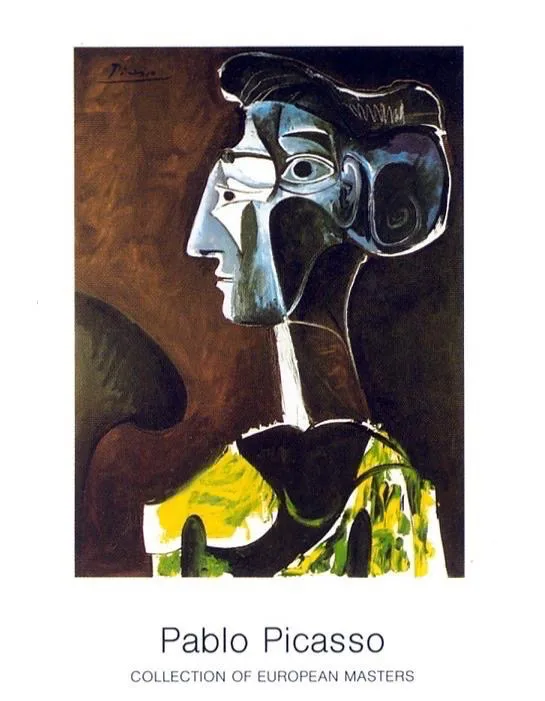
In the Introduction and in the section on the fundamentals of Process Work and Deep Democracy we saw that there is more than the everyday realm of reality. It is the multi- dimensionality that shows us what is real. To understand the wholeness of a group we need all voices and every level – Deep Democracy in that moment. We need as Picasso shows, to view from the back and from many sides to recognize the full reality.
Something similar happened in music at the beginning of the 20th century. Until this time, we had the Major-Minor tonal system as a harmonic structure in classical music. It was a hierarchical system. It collapsed in several steps at the same time as the so-called abstract style emerged in the arts.
Schönberg spoke of the emancipation of the dissonance and proclaimed against the old system twelve free tones relating to each other in a free way (Schoenberg, Stein, and Cohen-Levinas 2011, 104). There were a number of other composers who stepped into a completely new understanding of space and time. For the public it was shocking.
What does this mean for us and for our understanding of how Art and Music are related with Process Work and Deep Democracy? We can say that art and music – like quantum physics and depth psychology – opened up the realm to experiencing the mystery behind everyday life. Gebser speaks of “Aperspektivität” and “Achronon”, (Schübl, Hämmerli, and Gebser 2015, 443) meaning giving up the former pattern of understanding everything, not only in music and arts but in all areas of life.
I conclude this chapter by saying that Arnold Mindell’s Quantum Mind, Jean Gebser’s Ursprung und Gegenwart and contemporary art and music with its incredible artists, shows us ways of following new journeys of awareness for coming home to our real true self, to our wholeness.
At this moment I would like to share with you some of my favorite music, working in another understanding of time.
The works of Schönberg and Webern, written in the beginning of the 20th century, express music in such a short time, that time seems suspended:
- Arnold Schönberg: 6 Kleine Klavierstücke (Schonberg 2008)
- Anton Webern: 6 Pieces for Large Orchestra, Op.6 (Webern, n.d.)
Debussy leads you into music which requires letting go, to locate what you hear:
- Claude Debussy: Jeux (Debussy 2016)
Lili Boulanger went in a similar direction but passed away much too early. In awe I love her works written in her very young years. She was a pioneer as woman in a world of male composers.
- Lily Boulanger: D’un soir triste (Boulanger 2012)
The following music from other cultures and time periods also has another approach to time. From Indian music I learned the endless of time ands space:
- Zakir Hussain and Rakesh Chaurasia: EtnoKraków Rozstaje ROZSTAJE (Zakir Hussein and Chaurasia 2015).
Hildegard von Bingen was a wonderful healer and composer in the Middle Ages. Her music leads me directly to the essence.
- Hildegard von Bingen: Hortus Deliciarum (Hildegard von Bingen 2017)
Back to practice
I do not want to end this chapters without inviting you to have a little experience with your voice or with whatever sound objects are right where you are.
Basic Experience 2: u and x and music
- For a moment, stop whatever you are doing in your everyday life
- Sit or stand comfortably, take a few breaths
- Try to open your mind a bit
- Is there anything you are enjoying in this moment?
- Describe it and enjoy it
- Find a sound for this, something short (Short melody, rhythm, noise )
- Is there anything uncomfortable for you, something you don’t like, something bothering you or disturbing you right now in this moment? Describe it and find a sound as mentioned above
- Now, combine the two sounds and create a little piece of music in your own creative way. There are no special rules for how to do this!
- How does this music speak to you? Any insights?
My insight when I did this exercise: The music is the essence beyond polarity. There I notice a vitalising quality, making me light and flexible.
The first U music I called Balcony – it is a music of space. The repeat motif expresses support for the here and now without any direction.
The second X music I called Pressure – it expresses going forward, push, energy. This music requires more energy in my body. There is a direction.
The combination of both the X and U music expresses the vital fluidity. Singing this, my body feels “in the groove”, full of a physical presence and makes me awake.
It helped in my everyday life to live my days more congruently, I felt more self confidence feeling the combination of these two energies in and through my body.
At this point, I invite you to listen to a little demonstration – a short music piece I composed with these X and U elements. My hope is that this will encourage you to try out the exercise, even if you don’t have any formal musical knowledge.
- Listen to Soundcloud (Schatzmann 2018c)
- Balcony (Schatzmann 2018a)
- Pressure (Schatzmann 2018b)
- U and X (Schatzmann 2018d)
Here are my personal reflections on Soundcloud:
- What I like: Sitting on the balcony, endless time, summer
- Disturbance: Inner pressure of coming projects
- Combination: In Balcony my voice is calm, a bit endless, a sort of monotony. In Pressure, the musical motif is a sort of pushing noise. In X and U the musical motif of pressure changes with the voice of Balcony back and forth, unfolding this process musically the voice develops another timbre, more singing with chest voice, that means for me more energey but in a relaxed expression.
- Insight for my everyday reality: Pressure stimulates, and the relaxation influences the pressure to be more joyful.
Part 2: Artists and their impulse for coming back home
Chapter 1: Introduction
I will now invite you to follow a journey through the lives and works of three special artists who have been crucial for me in my development. My goal here to study these artists together, and their particular approaches to coming home.
As I mentioned, when I speak about art, I speak about Process Work, and I speak about Process Work whenever I speak about art. Furthermore, I mentioned that art and music, as well as Process Work have always carried me back home. Now I want to study how these artists and their works can be a way back home for anyone interested, and how their approach is connected with Process Work and Deep Democracy.
At a glance I can say that the sculptor Joseph Beuys created a new concept of art with the possibility for anyone to follow the freedom that comes from creativity. Therefore, I will explore how being free and creative can be understood as being home.
A second artist, the composer John Cage turned the approach of western composing upside down. He allows us to experience our world and ourselves as a music cosmos. Within this cosmos everything is connected through sound – building a huge harmony. We can say that coming home to the world of sound –which has no boundary – is a sort of home.
We will meet Marina Abrahmovich who founded a revolutionary way of performance with live models in confronting situations, which show ghosts of society. She teaches us about crossing edges again and again for our never-ending transformation and letting go of our fears through facing our pains directly and ruthlessly.
I will also discuss some statements about art by the author Max Frisch, who very precisely expresses in words the essence of art and how art is available for everyone. Reaching our freedom of consciousness and sensory experience through this, we experience a sort of home from where we become artists in life.
In the chapters about Marina Abramovic and Max Frisch, I include Worldwork’s special group process format. Worldwork was developed by Arnold Mindell as a model to work on collective transformation (Schupbach 2007a). In these chapters we will study the potential for transformation and awareness raising within some art approaches – especially the performance art. The artist can be seen momentarily as a special sort of Worldworker – someone who works publicly on topics that she sees as relevant for society. She shows through her work the different sides of a situation, especially marginalized ones. To me, this means that the artist represents a sort of “big love” (Schupbach n.d.), which I will expand on in these chapters.
I realized in my personal music work as well as through my study of the artists discussed here, that art can be a group process for community building in a larger sense – sometimes very directly, sometimes indirectly. I will discuss performances of Marina Abramovic that became a group process and I will show in the chapter about Max Frisch how we can understand group process in how the field reveals awareness and sensory perception through our freedom of consciousness.
All these expressions of art are deeply connected with Process Work, guiding us back home to our true self.
Chapter 2: Joseph Beuys and everyone is an artist
The first artist I want to discuss is Joseph Beuys, sculptor, who lived 1921 -1986. In this chapter, I will explain Beuys’ view of what art is, and describe some of his life situations to study why he developed his new approach to art. I will present my own experiences with his approach, and how it was home for me. I will also explore the connection of his art to Process Work and Deep Democracy. I have created exercises for you to experience yourself as creative being and being at home, through your own creativity and being an artist in life.
For many years Josef Beuys was like an inner teacher for me. Inner teacher means that I never met him in person, but he was my teacher through his works. His approach supported my deep longings about art, music and life. First, I was amazed about his art. Then I received deep impulses for my music teaching and for myself as musician. Since I discovered Process Work I felt a connection between his approach to art and some aspects of Process Work. Now I want to study it in these pages. I want to explore this connection and how his idea of art is a way of coming home to the true self.
His most famous formulations of art are:
everyone an artist
Beuys and Bodenmann-Ritter 1988
and
art = human being = creativity = freedom
Marx 2009
These formulas already give us a little taste of how he understood art. Everyone as an artist doesn’t mean that everyone should become a professional painter, musician, dancer or poet. Beuys emphasized the potential of creativity in everybody and stated that art is a creative force that is able to change the world. How this is a way back home to our true self is the central question of this chapter.
Let us first follow some life stages of Joseph Beuys, and some of his many statements.
‘Ferner punkt’ and essence world
During World War II Beuys served in the navy. In an interview, he spoke about this time as a navy soldier (Joseph Beuys – Jeder Mensch Ist Ein Künstler (Portrait) 2011, 14.3). He liked it because it gave him a perspective from the outside, an overview. He didn’t like war, but he did like to fly, because he loved being far above the earth:
Ich fange ja auch heute oftmals Diskussionen damit an, indem ich sage, stellen Sie sich vor, Sie seien an einem sehr sehr fernen Punkt und schauten auf die Erde herunter. Was würde Ihnen am allerwichtigsten scheinen, vom Allerwichtigsten dann zu den Details. Also immer zuerst das Unmittelbare, Hervorstechendste, Allerwichtigste und dann annähern an die Details.4
The ferner punkt (translation: farthest point) can be understood as a sort of essence world in Process Work terms. There is not yet polarity therefore Beuys can say “there you recognize the most important, the most obvious” and I add, this area is a non dualistic perspective like the essence level in Process Work terms.
After an air crash as a soldier, which he survived, he told the following story:
Tatars picked him up and healed him. This was an initiation experience (Joseph Beuys – Jeder Mensch Ist Ein Künstler (Portrait) 2011, sec. 13.54): He didn’t speak in much detail about it. Therefore, some believe that this could be a legend. For me it’s not important if this story is a legend or not. From a Process Work perspective, I say that it is true on a certain level. It’s true that in the real world, he had an air crash on Crimea island, but it’s not for certain that Tatars picked him up and healed him. Therefore experts discussed it endlessly. As an alternative view, I ask, who knows what happened during his air crash? Could it have been an experience on another level, an experience in a parallel world, like a shamanistic journey? From this journey it seems that he was inspired, and what were probably his inner experiences appeared later in his art, especially concerning the material he worked with and his view of how an idea incarnates.
First, he studied science but he wasn’t satisfied. Then he tried out the path through art, looking for answers to his questions. After a huge and dangerous crisis, he continued his work as a sculptor, and he developed a revolutionary approach to sculpture. He didn’t want the finished form, but he wanted to sculpture process to lead to autonomous forms. The term sculpture he enlarged to philosophical and socio-political areas.
His works have something shamanistic and more and more he used the form of actions and performances to sculptor processes. In Europe and the USA the Fluxus movement shocked society with a new art called “Performance Art” and “Fluxus” (Harlan, Rappmann, and Schata 1984, 55) and brought important impulses for new expressions in art. As a member, Beuys significantly influenced this movement.
Very famous actions happened during Documentas, a recurring international exhibition in Kassel, Germany. A large amount of 7000 basalt stones and oak seedings were placed on the grounds of the Documenta. People could buy an oak and a stone, and the trees were planted all over the city. Today we can still see the stones and oaks. Generally, Beuys worked with materials that had the qualities of change and transformation.
He created many works, actions, discussions and speeches. He also co-founded the Green Party in Germany, the Omnibus für Direkte Demokratie – a travelling public awareness initiative – and many other projects.
Now we will look at some of his convictions and visions for art in our research coming home to our true self and combine it with aspects of Process Work and Deep Democracy.
Josef Beuys strongly criticized traditional academic principles and artists, who are settled in a comfortable bubble. One of his strong statements is the following (Burckhardt 1994, 55):
Wenn du ein waches Auge hast, kannst du sehen, dass jeder Mensch ein Künstler ist. Ich war jetzt in Madrid und habe gesehen wie die Männer, die bei der Müllabfuhr arbeiten, grosse Genies sind. Das erkennt man an der Art wie sie ihre Arbeit tun und was für Gesichter sie dabei haben. Man sieht, dass sie Vertreter einer zukünftigen Menschheit sind. Und ich habe etwas bei den Müllabfuhrleuten gesehen, was ich bei den Scheisskünstlern vermisse, denn Künstler sind zum grossen Teil opportunistisch, sie sind Arschlöcher, das muss ich jetzt auch mal sagen. Die Künstler sind die reaktionärste Klasse.
Eigentlich gibt es ja keine Klassen mehr, aber die Künstler sind so reaktionär, dass sie schon fast wieder eine neue Klasse bilden.5
This is a very provocative statement of Beuys and I cite it here is because I want to emphasize that he postulated a new term of art: Der “erweiterte Kunstbegriff” – an expanded concept of art. Former ways that artists were viewed were no longer relevant for him. He rejected the term genius as belonging to a few famous and widely acceptable artists in society, for instance those from earlier times in the 18th, 19th and 20th centuries.
Still today we pay homage to the old understanding of genius, which to my mind isn’t wrong. But this attitude marginalizes the potential within everyone to be a genius in his or her unique way. It especially marginalizes the possibility of freedom in everyone as the impulse for creativity, as Beuys says in his formula art = creativity = human being = freedom.
The identity of a lonely artist was no longer useful for Beuys because it was disconnected from the requirements of the present times. In his mind every human being is an artist and a genius and has the potential to change the world with this inner genius. Beuys proclaimed this potential as art.
During my music studies in 1980s, his views and convictions and his strong statements were a revelation even though they could not yet from my perspective, be formulated globally. From the Deep Democracy point of view every viewpoint and every role is important. The lonely artist is as a role – for instance artists like Joseph Beuys. But being frozen in the belief system of the artists in the 18th and 19th century of western culture, marginalized new ways of art. This is why during my music studies as a student, the work of Beuys nourished me for my own path.
At the time, I was studying music and couldn’t endure these old patterns of artists. I often felt I was coming from a strange planet. After my basic music studies, I realized that I was at the beginning of a new and long journey to somewhere or nowhere. Again, I posed the question: Does it make sense? For whom? Is my musical work l’art pour l’art – just art for art’s sake? I was seeking another approach that also included my connection to the world, with all it’s issues; and included my connection to seeking who are we here, where are we going and especially how to better treat the planet, living beings and ourselves. Put differently: I was seeking a way back home to an inner truth and Beuys was my teacher for a specific part of my journey.
From pure perception to concept
Let’ s study now how Beuys imagined the source of everything. Beuys speaks again (Joseph Beuys Harlan 1988):
Kunst ist das Element im Weltinhalt wo der Mensch erfährt, dass es der Punkt ist, aus dem heraus etwas in die Welt kommt, aus dem heraus etwas produziert wird, das immer neu ist, also evolutionär6
And from a video I picked up this (Joseph Beuys Über Den Erweiterten Kunsbegriff 2016):
Art or creativity is the point from where all the phenomena come from. This is the area where something comes into the material world from something extrasensory, from an area which is not yet in the material world. This has something to do with thinking and with freedom.
Why freedom? Because in this area we are free, not yet bound to a certain identity or belief system and not yet involved in everyday’s complications and interests. How Beuys describes this area can be compared with the essence level of Arnold Mindell. The essence level and also Beuys’ description above, is an area beyond polarities, beyond the struggles of our everyday life. This essence world is an area of freedom in the deepest sense.
Compare it with the intentional field – a term Arnold Mindell created when he worked on the connection between physics and psychology. Amy Mindell speaks about Arnold Mindell’s study in her book The Dreaming Source of Creativity: (Amy Mindell 2005)”:
He described this field as a generating, creative force that is always present within and around us.
In this area of creative force, Beuys not only sees Freedom but also Thinking.
Beuys had a deep connection to Rudolf Steiner, the founder of anthroposophy. He studied the work of Steiner and used it partially as a background to his art. In his doctoral dissertation titled Philosophy of Freedom, Steiner explores the essence of thinking and freedom (Steiner 2018). He says that perception needs thinking, because thinking allows us to become aware of what we perceive. Beuys concluded that thinking transforms our perceptions into concepts.
With Arnold Mindell we can say, that we win something and lose something – namely the Tao that can’t be spoken (Arnold Mindell 2012, chap. 2). The meaning of theTao that can’t be spoken is that in the very moment that we reflect on something in the essence level, we partially disconnect from it. Mindell describes that when for example, we count the sheep in a meadow we in a way lose the sheep – the sheep in its essence.
Steiner and Mindell teach us about the entanglement between perceiving and thinking and how this relationship gives us the possibility of freedom. Therefore, Beuys speaks of thoughts as already being a sculpture (Harlan, Rappmann, and Schata 1984, 61). For him, perception is the basis for a thinking process and the thinking process is a sort of sculpture. We can see here the essence level as a world of pure perception, which then differentiates through the thinking process. In Process Work as I understand it, the emphasis is more on awareness than on thinking. I feel Steiner’s term of thinking is comparable with awareness in Mindell’s process-oriented sense.
Beuys and the fluid identity
Beuys said that art, how it is practiced during the time of these discussions from the 1960s to 1980s is something living in a niche, a special planet, where only a few people have access, and has a whole history of privilege. Many people were excluded from art. Beuys in contrast wanted to step through his art into the center of the world, into the middle of society.
He postulated that the creativity of everyone is the force for transformation in the world. This was his erweiterter Kunstbegriff – his expanded concept of art. He combined his motto everyone an artist together with his formula Art is Human Being is Creativity is Freedom. We can say that Beuys worked with a fluid identity of ongoing transformation. This is creativity and a sculptural process of freedom, that changes the world in every moment.
Beuys further said (Harlan 2011, 13):
… therefore is, what I sculpture, not fixed and completed. The processes go on: chemical reactions, fermentation processes, rottenness, dehydration
He emphasized process and transformation in working with materials that always change, like fat and oil. In the Kunsthaus Zurich there is a room with the work Olivestone (Klophaus 1993) a wonderful sculpture with two huge stone vessels filled with olive oil. Recently I read, that the museum changed the oil through a complicated and expensive procedure. What a misunderstanding about Beuys! I think he would never have agreed to doing that. I imagined the place with this oil, changing itself continuously, smelling stronger and stronger and penetrating the walls so that the idea can spread out. It’s a powerful image of how visions incarnate and spread out.
He emphasized process and transformation in working with materials that always change, like fat and oil. In the Kunsthaus Zurich there is a room with the work Olivestone (Klophaus 1993) a wonderful sculpture with two huge stone vessels filled with olive oil. Recently I read, that the museum changed the oil through a complicated and expensive procedure. What a misunderstanding about Beuys! I think he would never have agreed to doing that. I imagined the place with this oil, changing itself continuously, smelling stronger and stronger and penetrating the walls so that the idea can spread out. It’s a powerful image of how visions incarnate and spread out.
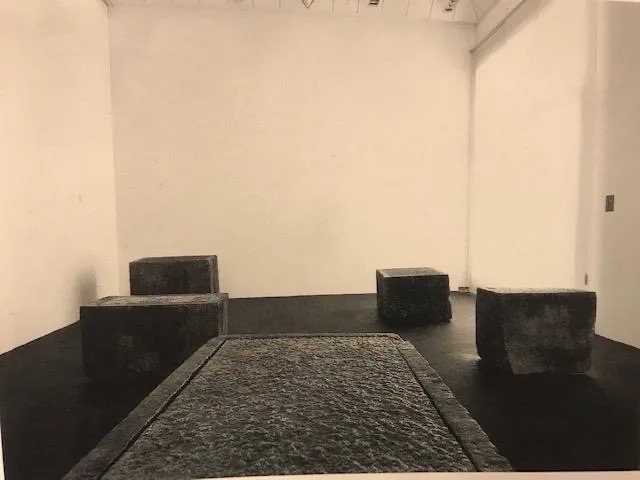
To summarize, Beuys is interested in the potential of all human beings. His emphasis is freedom, transformation, movement, thinking processes and processes of awareness. Nothing is completed but always in an ongoing flow. Do you recognize the description of Process Work, from the Introduction? Later we will study the connection between Beuys, Process Work and Deep Democracy.
We can say that Beuys’ expanded concept of art is working on the process from creative essence to the sensory grounded manifestation in our everyday life. For Beuys this is art with a new meaning. This includes also the term utopia – which he often mentions, because of the essence quality where creativity begins and where the aspect of freedom of every human being lives. Beuys worked with utopias and wanted them to be realized. He had a very intense personality and gave his life for this utopia of erweiterter Kunstbegriff and everyone is an artist.
The approach of Joseph Beuys was a crucial impulse for my own work. If everyone would be included in the world of arts, I concluded that then everyone belongs to this world, everyone is invited to create, to be part of a creative world. This impulse was a huge motivation in developing my path with music and with teaching music. I felt at home, inviting everyone to play piano, to find her or his own music and way of playing the instrument. Therefore, improvisation got a big space in my work. I also concluded that practicing music would prepare everyone to be more creative in his or her life. It was not necessary to make much progress in piano playing as in the traditional way. It was crucial, that every musician working with me, got the possibility to discover the deepest creativity and through this, coming home to the true self.
The expanded concept of art was a guidance for me personally to an enlarged understanding of working in the area of education. Beuys speaks of the creativity of the human being as the only revolutionary force (Harlan, Rappmann, and Schata 1984, 59). Studying his work brought me to my own way of teaching music. If I would be able to support my students towards their deepest creativity in music, I imagined they could use the force of their creativity for their life process.
The relationship between Beuys and Process Work, Deep Democracy and Worldwork: sculpting the world
I already mentioned that the three levels consisting of essence, dreamland and consensus reality are comparable to Beuys’ view of how an idea incarnates. Now we go a step further in exploring this connection.
About social sculpture, Beuys emphasizes that his formula is a way of creating and changing the world. I conclude from this that the creativity of everyone builds a social sculpture. If we follow his formula, Art = Creativity = Human Being = Freedom, is it possible to still resist change, is it possible to say, Oh, I can’t do anything! The formula of Beuys requires our whole being. But how to be creative? How to be free, how to be a human being that fills out this formula without being forced into something? Exactly at the point of these questions and troubles fortunately Process Work entered my life.
The paradigm of Process Work and Deep Democracy was a bridge for me to bring my creativity to everyday life, to the performance stage and to my teaching in an incredibly joyful way. Applying Process Work, I am following an endless flow of information – familiar and unfamiliar. Every fragment of information, every role, every voice and atmosphere are important. This allows us to be free in every situation, even if we notice that we are not free, we still have the freedom to notice that.
The ongoing experience through all the levels of awareness and the intentional field as a home for everything that wants to emerge, was an awesome way to feel this formula of Beuys in its essence. Arnold Mindell writes (Arnold Mindell 2014a):
Deep Democracy is our sense that the world is here to help us become our entire selves, and that we are here to help the world to become whole.
I experience the connection between Beuys, Process Work and Deep Democracy in the following way:
My understanding of Beuys is that he sets important impulses, and I see Process Work and Deep Democracy as a necessary and awesome requirement and way for being an artist by becoming aware of every viewpoint, not only those I like. This creates a feeling of being home by being whole and not fragmented. What I create then appears through this feeling of being at home. Process Work and Deep Democracy opened a door to a deeper and wider understanding of the meaning behind everyone an artist. Through following Beuys’ approach to art, I learned from Deep Democracy to allow every voice in me to create something, in team work to allow every viewpoint. Deep Democracy is a wide frame and enables a deep approach to everyone is an artist. In this sense I now feel in a new way at home again.
My conclusion
The human being as a creator, creates together with the world family the big world sculpture, full of diversity, freedom, stuckness, power and so on, in a permanent transformation in every moment. This image behind my acting in this world as a human being brings my deepest wishes into the world. I also feel a responsibility being this co-creator of the world. Saying that we are responsible for the world is not new, but imagine that the world is a sculpture whose shape begins in the supersensory world – in the Kabbalah called kether (Leuenberger 1984), in Taoism called Tao (Laotse 2010) and in the Process Work paradigm it is called essence. From this creative, super-sensory source, the essence of the sculpture moves through the different levels.
In the Kabbala for example, kether moves through the path of the Tree of Life. In Process Work the sculpture moves from essence to dreamland to everyday life. Essence echoes through all the dimensions, just like a tone with its overtones – the sound that is audible in our material world, and has overtones reaching out into a dimension in which it is no longer audible, but still is a sound.
This image connects me with a huge feeling of co-creating as a part of the world family, that includes animals, nature, earth and universe. This is a material and spiritual sculpture and we are the co-artists building this sculpture anew every day.
Here I feel at home again – at home cocreating, feeling the responsibility of every human being seeking again and again our true home, staying in all the dimensions, feeling it and forming it. All this can be seen as art and everyone is the artist co-creating the world. Through art, everyone is on the way back home to their true deepest self.
Art and the world channel
Is every human being an artist? Beuys speaks about the garbage collectors in Madrid as artists and beings of the future. What could he mean with this? Beuys tells us that art is creativity. He also says, that creativity is the main force for the world, in this sense everybody can be an artist. This brings me to the following questions:
If we follow the paradigm of Beuys, can we say art and music are no longer necessary because creativity alone is art? What are the criteria and the requirements of being an artist in life and being free to create, being our true self to create something directly from our essence, from our being at home? How to be sure that this approach doesn’t end in in arbitrarily making just anything, and calling it art? Asked differently, is baking a cake art?
Art has always been shared with the world, with the public. Beuys too always speaks of art in terms of changing the world. In Process Work we speak of the world as a channel. Therefore, I say that art is connected with the world channel.
We are used to seeing painters, musicians, actors and poets that work publicly as artists. But do we also see farmers, teachers, crafts people, garbage collectors etc. as artists? Beuys would say yes, in the sense of seeing them as world changers. Changing the world is an innate concept in Beuys’ art.
You can imagine for example farmers who take a different path than the traditional way of farming. When I felt I was stuck in an everyday routine on my farm I became frustrated because something art-like was missing. In such a moment, my partner and I would create something new, something unknown and share it with the world. In such a moment I again felt at home. I felt the art behind farming and art was and is my home. So baking something in itself is not yet art, but with an idea behind it, that makes a difference in the world baking can be seen as art. Art wants to be shared and wants to make a difference, the home of art is fluid and therefore connected to ongoing change.
Making cheese as art
I am thinking of an example of a so-called mundane work, that can be seen as art. My partner and I created a new kind of cheese and called it formaggini. This was absolutely unknown in our mountain area. We worked with a group of farmers in a store for tourists with our hand made products. The other farmers didn’t understand us with this little cheese. They expected that no- one would buy these formaggini. But the world reacted differently. Customers were amazed and visitors came to us to learn on our alp how to produce formaggini themselves.
The visitors began to expand their identity through farming, nourishment and their possibilities to support biological farming as a customer. In this way we changed the world around us a little bit. To me, this was an act of art, and these formaggini were in this moment works of art.
We challenged the world around us to change, and different roles arose and created conflict. Our home was meant to change something, to step out of a routine, to try something unknown that initiated new energies. Now this change that we made has become something normal and mainstream. Other farmers now too make formaggini. The world changed in everyday life and the identity of the valley I live in changed at least in a small way in how to make cheese. In this sense it changed something in the mainstream. I would say that the moment of formaggini as art is now over. The formaggini art is now history in my area. Time to create again something unknown to change the world a little and to create a new home again and again.
The garbage collectors and our everyday artistic attitude
What now about the garbage collectors?
When Beuys speaks about the garbage collectors, could it be that he noticed something full of life, something meaningful in their attitude, staying close to their work as something important in their lives and others’ lives. In this moment a sculpture builds. Could it be that Beuys, watching these workers became aware of the topic of garbage in the world and experienced a new insight, that changed something inside him? Did he see in this moment a work of art in the garbage collectors and what this work can change? Could it be that he had the insight, that this art includes the observer who notices this aspect of art in everyday life? We can’t ask Beuys anymore, but we can follow this idea and dream into this garbage collector aspect, saying for example:
Art begins as a quantum flirt behind something I notice in the midst of everyday life. This flirt is something that stops me, and brings a bigger something towards me, with a force that is behind all manifestations. This can happen with traditional works of art but also in areas that we don’t normally see as art. So the force behind everything is art. From this perspective I can say that living with the attitude art can be everywhere, requires a sort of attention that includes the three levels of awareness: Every day consensus reality, subjective dreamland and creative essence.
Practicing art and Process Work
Now the following question arises: How can we experience ourselves as artists, as co-creators and sculptors of our everyday world? How can we prevent ourselves from falling into the same trap in every discussion about art saying, “This is good to read about, but I am not talented, I am not creative.” What to do?
First answer: If everyone is an artist and this approach doesn’t need the traditional forms of art, there is no way to escape. We are human beings, therefore we are artists and as human beings we are also connected with the three levels of awareness from the creative source, and therefore we are artists.
Second answer: Doing art in the so-called traditional areas is possible for everyone. These areas are a wonderful way to directly access the essence level, because this is the home of art.
From my viewpoint there is no Process Work without music, dance, poetry, theatre, painting, drawing, performance etc. and there is no artistic expression without the process of information flow. Process Work is the way to let the process of information unfold in a creative way.
Summary
Through an expanded understanding of art we discover ourselves as creative human beings.
As creative beings we connect with our freedom.
In the midst of everything we can feel at home, being connected with our essential quality as a co- creator of our world.
Back to practice
Process Work offers us incredible tools to experience our creativity. Out of many books, one I want to refer to is Dreaming Source of Creativity (Amy Mindell 2005). In it you will find many exercises to discover your creativity.
From the approach of Josef Beuys, I suggest two exercises for you to try: Utopia Training, and Embodiment of a Vision.
The first one, Utopia Training is a little exercise for learning to move with more fluidity between different levels of awareness. This is connected to Beuys’ idea mentioned above – the ferner punkt (farthest point) – which to me is a synonym for the essence level. This exercise can be used especially when you miss inspiration and excitement in your everyday life.
Utopia Training, sculpting your world
- Look at your everyday life and think of an area where you miss inspiration and excitement.
- Take a few breaths, relax, allow yourself to get dreamy, foggy.
- Imagine being very far away from the earth, or far away from your everyday life situation.
- Look around. What do you notice? Is there something that seems special and attractive to you? Is it the whole scene or a certain aspect?
- Try then to let go of the boundary between you and this area until you feel you are the area itself. Forget your everyday life. (This might take a little time). Now become this place. You are now this place.
- As this place (which is you), which characteristic or quality do you notice yourself being? Enjoy it. This place is full of creativity without boundaries. As this place, explore your quality that differs from your everyday self. Be now this new quality, enjoy it, move it, let it sound.
- From this new perspective look at the issue you thought of in step 1. Is there a main point, an overall aspect that you as this place notice? What is the most important point from your perspective now? What is the inspirational aspect?
This aspect may be something bigger than you are usually able to realize in everyday life. Don’t worry, you are now this new self for a moment and not a being in everyday life. - After giving enough space to what this new self is telling you, create as this self some next steps coming closer to inspiration, ideas, realizations. What could change in the world by realizing these steps?
- Try to sculpture this now in a sort of artwork:
Take some material to form, find a sound to build a piece of music, invite people to share your idea, write a poem, make a performance etc.
Exercise: Embodiment of a vision
This exercise wants to give you an opportunity to explore your inner artist and to realize with this inner artist your visions and plans. Here, I mean art as a journey that begins in a super sensory world. The essence level in Process Work or Beuy’s ferner punkt can support you to transcend your everyday mind, coming home to yourself, and from there create a vision. The exercise has two parts and you can work on it through a period of two or more days for deepening your visions. The exercise helps you find a big plan or a big vision. It also can be used for deep changes in your life.
Part 1:
- Think of a plan, a vision or a dream that you can’t realize because either you didn’t think it was possible, or the time wasn’t right yet to go ahead with it. Something remained vague, something stopped you, there wasn’t enough will and energy. But you now want to go for it.
- The vision, the plan: Look first at the overall vision, this can be vague, a feeling, an inner picture, or something else. Make some notes, then put them aside.
- Let yourself drift to a place that is very far away from your everyday life (Beuys’ ferner punkt).
- Look around this place, enjoy the special quality. Feel, move, sound the quality and more and more become this quality. As this place with this special quality, you are the force behind your vision. What is it like to be this force? What is its distinctive character?
- As this place, as this force look at your vision. What is the most important reason to realize this vision or plan? What is behind it? What is the essence of the vision or plan?
- Now as this force choose a media and – still being this force yourself – shape the essence of your vision. Paint, sound, move, write as this force. If sound: make a tape or write the score of the music, if you move, make a movie. As this force, you are the artist creating a work of art.
- Give yourself enough time to create this artwork. You as this artist are far away from your everyday self, you fly beyond edges and create like a famous artist. You are now the artist and this artist is the creator, that brings the source of the vision into an audible, visible, tangible shape.
- After finishing. Leave it for at least one day.
Part 2:
- The next day, look at, listen to or read what you created as if you were an observer, not the creator. Let your inspirations arise as if you are in an exhibition, in a concert or a performance.
- Try to find out which part of this artwork is not like your everyday self. Perhaps bigger, crazier, stranger etc. What is the difference between you and this special part of your work of art? Notice the artist who created this. Describe this artist as if you are describing her for an advertisement.
- Who is this artist, what is her quality? Imagine why the public adores this artist.
- Create a hand movement for the special quality of this artist and repeat it till you get a sort of insight, how your inner artist supports you in your everyday life and in realizing your vision.
- Celebrate the birth of your new inner artist, dance it, move it, sing it etc
- What are the next steps to realize your vision?
To test this exercise, I asked Ruth, a friend, architect and artist to work on it with me.
She didn’t do the first part because her vision was already set, but she was interested in the second part of the exercise. Her vision is to realize an exhibition for her works of art. This is new for her and edgy because she is an architect and until now she created only in her private time.
Here is what she found out:
Part 2
Mit dem Fokus, herauszufinden, was in meinen Werken andres als in meinem Alltag als Architektin, Planerin steckt, sehe ich, dass dank der Einfachheit, von der meine Werke geprägt sind, das Spielerische, Intuitive und das Organische und das Schöpferische ganz stark zum Ausdruck kommen. Ich sehe auch das Lustvolle, das Witzige, die kindliche Freude am Spiel und erfahre die Leichtigkeit, nichts falsch machen zu können.
Daraus entwickle ich eine Handbewegung, dieses Spielerische, was ist es? Ich bewege mich, ich bewege meine Hände, daraus entsteht ein Ballspiel. In diesem Ballspiel bewege ich mich kindlich freudhaft, fühle mich schwerelos, die ganze Welt liegt mir wieder zu Füssen.
Translation:
With the focus to find out how my works are different from my professional life as an architect, I see that through simplicity which characterizes my work, playfulness, intuition and an organic and creative element arise strongly. I notice the sensual, funny and childlike joy. Experiencing lightness allows being freed from the critic. There is nothing wrong about my work.
Through this insight I organically develop a hand movement in which I notice a ball game I often played in my childhood. I feel like a child, weightless. The whole world again lies at my feet.
Ruth’s vision and her message brings playfulness back to people. She works with everyday material. The artwork is beautiful in a special way and the ball game which many people remember from their childhood brings back this feeling of joy and light heartedness.
You will read more on her experience with her project in a second exercise she did with an exercise in the chapter about John Cage.
Chapter 3: John Cage – Deep Democracy and the Tao of music
John Cage is the second artist who gave an important impulse for my journey to coming home and the unfolding process of my childhood dream. John Cage was a composer, who lived and worked in the 20th century. He is one of my favorite composers and can be compared with Joseph Beuys, although he was a very different artistic personality. Both John Cage and Josef Beuys opened a new door in the 20th century to art and music.
For my topic, the phase of John Cage’s work that is most important to this thesis, is when Cage started to compose with the Tao and included noises as sounds from the moment, treating them as music.
In this chapter I will give you an overview of the most important aspects of the music of John Cage for my research into being home. I will travel with you through some musical works, and let you experience through a listening process how his music offers a possibility to be home. I will tell you what I learned from John Cage for my life process and about the connection b between his work, Process Work and Deep Democracy that I discovered. I will also show how you can use the sounds from everyday life for your life process. There are two exercises at the end of the chapter.
I knew works of John Cage already during my music studies, but only afterwards Cage became very important to me, my life, my music, my music teaching and my own composing process. Last but not least I got to know and appreciate him in depth when I had my first encounters with Process Work.
Let’s first listen to Cage himself and get a little taste of his way of composing (Kramer 1999, 20):
Wo immer wir auch sein mögen, zumeist hören wir Geräusche. Beachten wir sie nicht,stören sie uns. Hören wir sie an, finden wir sie faszinierend(…) Sollte das Wort Musik heilig sein und den Instrumenten des 18. und 19. Jahrhunderts vorbehalten, können wir dafür ein sinnvolleres einsetzen: Klangorganisation.7
Cage and his new definition of harmony: Deep Democracy and the Tao
Cage was a student of Arnold Schönberg – a famous composer and teacher for many young composers who became successful after studying with him, for example Alban Berg and Anton Webern. Schönberg judged John Cage as not being able to compose. He criticized him for his lack of traditional European knowledge of harmony in composing. Cage ended his studies and went on to radically transform the composing process (Neff 2015).
Cage postulated a new definition of harmony. He said that harmony is the sound and noises that you hear right in the moment: This can be traffic, birds, voices and so on.
Cage says (Nattiez 1995, 38):
The material of music is sound and silence and integrating these is composing.
He also said this:
Ich versuche nicht zwischen Musikalischem und Unmusikalischem zu differenzieren, sondern beginne beim Geräusch und benutze keine Klänge, die nicht den Charakter eines Geräusches haben. Ich gebe zu bedenken, ob diese Praktiken nicht zu einer Verbesserung der Gesellschaft beitragen könnten. Dies käme einer Demokratisierung gleich. Durch Cage’s Komposition wird bewusst, dass die ganze Welt zu Klang werden kann oder ganz einfach Klang ist8
Kramer 1999, 21
Studying the composer Cage, we have a wonderful opportunity to get to know some aspects of Deep Democracy through music. In the chapter on Joseph Beuys we discussed the importance of noticing every voice, every viewpoint in a group or an individual. We can notice in the quotes above the openness of John Cage to everything that sounds. Normally musicians are very sensitive about sound and are often disturbed by noise. Not so John Cage. For him everything is music, including silence. The whole of life is music and he listens to all sounds and to everyday noise like a musician who listen to a piece of music. This is Deep Democracy – every sound. In what is probably his most extreme piece titled 4’33” a pianist comes on stage, opens the piano sits there for 4 minutes and 33 seconds, then closes the piano and leaves the stage. In this time each member of the audience hears their own piece of music. (Cage 2006).
Cage’s works are often something like a group process, where the flow of the music is unpredictable. But let’s go first to the starting point of Deep Democracy. Working with groups, Arnold Mindell found something deeper than democracy. He developed a new way of exploring the informational field of a group. He noticed the multi-dimensional approach not only in one person or in a relationship but also in small and large groups.
In groups he discovered that marginalized and visible roles as well as ghost roles – which existed in the mood of the group, were a huge aspect of conflict resolution (Arnold Mindell 2014a). Only when all voices have the possibility to speak out and express themselves is the information complete. Through this process surprising solutions could happen. Henceforth he called it Deep Democracy (Arnold Mindell 2014a).
Going back to one of the quotes of John Cage above we can notice, that he is interested in all sounds not only the ones which are chosen intentionally. And this is a new understanding of harmony. By allowing all sound in his work John Cage developed a new kind of composition, working with the Tao by using the I Ching or by letting the Tao decide in different ways.
For example, in his work Etudes Australes he took the image of the stars on a map of the sky and formed the music from that (Cage 2013):
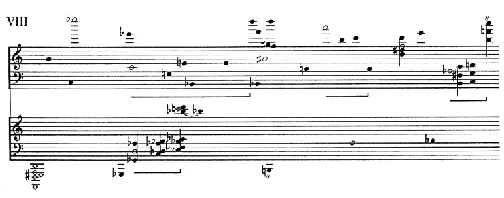
He also threw coins to plan compositions, to decide which tones were the right ones for a work. Personal preference or taste should not create the work. In Cage’s compositions it was the Tao co-creating the work. Cage wasn’t interested in excluding what didn’t belong to his own choosing, identity, taste etc. The inclusion of all sounds also those which are disliked at first, are welcomed in his understanding. We can say from a process-oriented perspective that he was seeking the Deep Democracy of music.
Another aspect of Cage was that he gave as much freedom to the musicians as possible. As an interpreter you are mostly free to shape the rhythm. He always wrote tempo free, rhythm free and many works consists of tones or chords, which are not connected to each other. Interpreting his works requires a kind of presence.
As a musician I have to move in an unknown musical territory, and so John Cage’s approach is a perfect training for the metaskill of detachment, alertness and curiosity in practicing Process Work in practicing Process Work. Metaskills are feeling-like attitudes, a term coined by Amy Mindell (Amy Mindell 2003). These attitudes aren’t bounded to expectations, they relate to the flow and go along with everything that wants to happen. If you want to train yourself in these metaskills, play or listen to works of John Cage!
John Cage was one of the American composers, who inspired the family of composers all over the world. He spearheaded the break with traditional classical forms. Contemporary music can’t be imagined without his influence.
In this chapter we could also use impulses of other composers for our journey following the process-oriented way of music and following music as a way to experience Process Work. I want to also name here: Morton Feldman, who inspired me specifically to step from one moment to the next and then enter into flow.
Working with this kind of music I began to understand a little what Arnold Mindell called “the path of crumbs” (Arnold Mindell 2012, 43). Mindell writes, that following something from one point to the other is different from “swinging with the flow”. For example, following a sound from one point to the other is different from listening to the whole musical phrase.
If you listen from one point to the next, you come to a limit of being able to notice the slightest moments. Suddenly you enter a timeless flow. The music of Feldman forces the listener to do this because there is no musical phrase. This music helps you to enter into a flow beyond everything, you enter the essence world.
Pauline Oliveros, who developed Deep Listening and composed works which give us the chance to experience this (Oliveros 2005). I could name others too and I include all these composers in my heart. To make it not too complicated, because thiw thesis is not only about music, I refer to John Cage, who in my mind is the initiator of this special direction in music.
If you are interested, you can for example see and hear the following works of John Cage:
Works where he used radio stations playing unintentionally:
Back to practice
Listening training 1, being home
This exercise supports you in enlarging your understanding of what is music and you can train to open up to unfamiliar qualities. The unfamiliar qualities in the auditory channel as in music are a very strong secondary process. If we don’t like something in music but have to listen to it, it shows us strong edges and often this is painful to bear.
- Listen to one of the recordings of Imaginary Landscape, take the one which is the least comfortable for you. (see link on previous page).
- Listen to a part of it.
- Turn off the music and describe to yourself the most unfamiliar aspect of the piece in a hand movement.
- Repeat the movement until you understand its meaning (until you understand its energy).
- Relax, take some breaths and go in your imagination to a place on earth or universe. You don’t have to know this place.
- Be there, feel the quality of the place. Can you notice a connection between the energy of your hand movement and this place?
- If yes, connect deeply, to this energy. Let go of your everyday personality and be this energy now. Who are you? How are you different from your everyday self? Enjoy this new flavour.
- Look at your everyday self from this perspective. Do you have any advice for your everyday self? What would change in your life if you were living this energy more? How could this be more home for you?
- Now listen again to Imaginary Landscape. How ist the music now different for you?
Listening training 2, being home
- Listen to a work by John Cage, for example Two2 (see link on previous page).
- Take a few breaths before starting the recording and sit comfortably.
- Turn on the music and listen
- If something is not comfortable, notice it and let it go
- Connect deeply with each sound you hear, be this music now, let go your everyday life and your everyday self, travel now as sound, tone, pause.
- You are now in a parallel world, a music world. This world is everywhere, there are no boundaries, the sound has no beginning and no end. Be this now, a being of everywhere and without borders, no beginning, no end.
- Be this music and look back to your everyday self. As this music, what message do you have for your everyday self, right now?
- Return, and meditate on the message. What could change in your life if you followed this message?
- What could be a new aspect of being home for you?
Cage and my life process
Cage came into my focus after some years of being a professional musician. Teaching piano I was confronted with the elitist world of classical music which was an unbearable discrepancy compared with the reality of the kids I taught. I realized the gap between the two worlds. I reacted first with resistance. I felt the reality of the kids on one side and on the other side I rebelled against the classical elitist attitude. I was no longer at home. I lost my sense of self – my “I am”.
I so much loved the complexity of the classical tradition and I also loved the kids making music in their own way. On one side I tried to step deeply into the core of a piece of music, being disciplined, seeking my highest capability to interpret the work. On the other side I was inspired by the vision everyone is able to make music. What to do with this polarization?
Studying the music of Cage, I met a totally new way of making music which was far away from the traditional understanding of knowledge and ability. Through the eyes of Cage even the traditional works appeared changed. Through John Cage I discovered a different attitude which allowed me to flow with the moment and at the same time I began to discover through Process Work how to also flow with the moment. On this path I didn’t lose my ability to play complex works and – at the same time – I became more able to flow with my piano students. The musical world opened into a broad spectrum.
Furthermore, the music of John Cage transformed me. His approach encouraged me to enter more deeply into my own creative process and my musical soul shyly got a little taste of being home, feeling myself in a new way in a music where one tone or silence were a whole symphony.
Being in one sound, or going from one sound to the next freely, led me to the experience of being in conversation with the sound as an independent being and a partner for me, a co-creator. In this world I noticed more and more that playing music was a way of co-creating music together with the vibrations of the sound that fulfilled the space.
I remember one concert in a church in Basel, where I played some pieces from Cage’s Music for Piano (Cage 1998). The public seemed to travel, and an atmosphere of connection with the universe was palpable. After the music ended there was silence for long minutes. In this concert I discovered a new identity of myself as a musician. An identity to travel on a shamanistic journey and take the audience with me.
My new identity as a musician was also deeply supported by Lane Arye, my amazing teacher in Unintentional Music (Ayre 2002). Cage and Unintentional Music became an inseparable pair. During this time, I also started to create music with cowbells.
Was this another appearance of the 10 men dressed in black behind the hedge, from my childhood dream?
Cage and the study of Unintentional Music led me to another aspect of my home in my true self. The gap between elite music and the kids of today disappeared. I surfed easily in all worlds, felt new possibilities creating music, playing music and teaching music.
Again, Process Work, Deep Democracy, arts and music were entangled and inseparable. When I was in one world I was at the same time in the other space. This brought me to work more consistently with Process Work tools in my work as a musician and in my life (Schatzmann 2003).
Regarding my childhood dream, Cage came forcefully into my life at the same time as the farm did, where I then lived for more than 20 years. Cage and the farm were two sides of the same coin. Just like the men in my childhood dream who grabbed me behind the door, in this case it was my husband – a farmer who grabbed me at the door as I was on my way to my familiar home. Once again pulled out of my comfort zone, I had to keep going and reach out for a new home, a new aspect of my true self and find my way home, coming closer to discovering, Who am I, am why?
Farm life was one of my deepest studies in my life and I had to learn to follow nature, to become connected with nature. The life in the mountains taught me that I have only one possibility: following what wanted to happen: weather, the animals’ rhythms and learn to constantly live with unpredictability.
This stimulated my music. Performing Cage in a concert had to do with a sort of loneliness and nakedness. I could only play through my real honest self. Working on the alps I experienced my old patterns collapsing. Once more I realized I was on an endless journey, experiencing home always in a new way. My home grew larger and larger.
Cage wanted to leave the preferences of one’s personal taste: That is why he used the I Ching for many steps in his composing process. To leave my personal preference helped me with crossing edges. It helped me working with Process Work and entering unknown areas of new energies and attitudes and opened me up for new creative processes.
For example, the not knowing phase in the beginning of a creative process supported me in looking at the white paper or the silence before creating music in a now curious way, asking, What wants to happen, what wants to be created? It was the experience of the co-creating process with something that already was in the air. As a little example, I will tell you a story of crossing an edge before a concert.
It was my very first concert with a new Solo program titled Elementar with cowbells and piano. It was a challenge for me to share this program with an audience because it combined modern classical music with my own creations for cowbells. I encountered certain people in the audience who I connected with being very critical. In the first moment I was terrified. In the second moment I remembered the co-creator of my pieces and the idea behind the program concept. I no longer felt alone and separate. I jumped and went on stage embracing the public together with my co-creator. This was one of the moments where I left a part of my personal history behind me.
This for me had something to do with the practice of the beginner’s mind. Playing and creating music without preferences led me to a new way of interpreting Music, also traditional musical works. Discovering the true nature of a certain work from this time on was my guide to the music. Let’s hear, what Shunryu Suzuki says about the beginner’s mind (Dixon et al. 2011):
The mind of the beginner is empty, free of the habits of the expert, ready to accept, to doubt, and open to all possibilities. It is the kind of mind which can see things as they are, which step by step and in flash can realize the original nature of everything.
On the farm, working with nature and animals as well as playing music and practicing unintentional music, I discovered that all experiences lead to the beginner’s mind.
The beginner’s mind as a spiritual way was one of the crucial aspects of the 10 men of my childhood dream. I was no longer going home to my familiar house but trying to be home in every moment whatever I encountered. This became a daily practice with many failures. You will agree when I say that this is the most challenging figure of the 10 men. In my life John Cage is an important key to saying yes to this learning process.
Back to practice
Let’s enter now into an amazing experience I developed from my inspiration by John Cage for everyday life.
In the following exercise I want to find out what the sound of the moment is telling me, how it can be used as a training in Deep Democracy in myself and allow me to go back to the everyday world with an expanded sense of home.
Your Issue, Your symphony
This exercise you can practice inside or outside in nature. You can try it by yourself or with somebody leading you through.
- Take some breaths and sit or stand in a comfortable way.
- Think of an issue you want to know more about, make some notes. Then put the notes aside.
- Take your time, relax and then start to listen.
- Open your ears and your whole body to all sounds and the noise of your environment. You are now an auditory organism.
- Imagine the sound you hear is a music piece with more than one voice. Try to listen to all the voices that sound right now, try to listen not only horizontally but also vertically, so that you listen to the music as a score with different voices, for example like a symphony with many actors. Enjoy the wholeness of different voices.
- You can try now to differentiate the voices. Notice the rhythm, pitch, tempo and sound color or timbre you hear and observe them in a neutral way. For example:
- What sound color do you hear?
- How is the volume or the different volumes?
- How is the pitch of the sound? High? Low? Or if more than one sound, different pitches?
- How many actors do you notice in this music?
- How is the specific quality of each voice in this symphony?
- Make a tape of your environment’s sound and/or write down a description of what you are hearing – studying every voice.
- While listening and studying, try to separate the different sounds, so that every sound expresses something unique – a role, like a figure.
- How does this music speak to you? Are there some sounds that are closer to you than others? Are there sounds disturbing you? If yes, take a disturbing sound and open up to its message for you. You can either shape shift and become this sound or listen deeply till an insight emerges. Try to do this with all voices also those who are close to you, and you love.
- How do all the sounds come together? What quality has this music as a whole, like a symphony of these different sounds? How are you connected with this symphony?
- Try now to be this whole symphony and express being this symphony in your own style: movement, imagination, a sound that includes the different voices. Is there any advice you get from this experience, for your everyday self?
Questions for your everyday self:
- What is the message of every sound referring to your issue from step 2 of this exercise?
- How can the voices support you with your issue?
- If you as your everyday self would be this music right now, who would you be in this moment? What would change in your life?
- Other insights?
Demonstration
Here is an example of the exercise when I did it with Ruth, who you met earlier. Ruth is an architect and artist preparing an exhibition of her Artworks “Hüllen”. I include comments from some of the steps of the exercise to show a possible way you could go through the steps!
Ruth’s issue in step 2 was her excitement about the exhibition, but also being nervous, fearful, and her high expectations etc. She wants to know more how to go through this process.
Steps 5 and 6: The music she listens to:
- Wind sounding in the trees, lovely, always there, constant flow, pleasant.
- Motor sound of an agriculture machine: aggressive humming, dominant, operated by somebody, in this sense controllable.
- Birds: This is the spice of the music, very lovely, diverse, brings depth into the music
Step 8: Meaningful figures within the music.
- Motor: driver, goes forward, power, the do-er
- Wind: Playful, tender, free of concern, drifting: the counterpoint to the motor
- Birds: make comments, the voices who come from outside, unpredictable
Step 9: The connections to Ruth
- Wind: My attitude to my I work
- Motor: Now you can make it, go for it!
- Birds: There will be comments, people who critique your works of art
Step 10: The message of the whole symphony
It is all there right now, you can start. Being the whole symphony calms me, the shaking of my body stops. I can put aside my nervousness, being detached.
It comes to me, it goes through me it goes out from me.
Important: The motor can be controlled. I can use it, but I don’t have to be the motor from now on till the exhibition without break, which would exhaust me. The whole symphony relaxes me.
Why this exercise?
For people who aren’t musicians, it could be a challenge listening to all voices as in a score of a symphony. Why do I emphasize to differentiate the separate voices?
I believe in this listening training as a possibility to become more sensitive to separate voices – this might be useful in a group process or in your daily work, in teams, your family etc. The Tao of all voices coming together in a certain moment is in my mind a wonderful training – being at the same time with the separate voices and the wholeness of all single sounds coming together. If you have difficulties to notice all the voices, begin with what you are hearing in the moment. If this is only one voice, that’s enough. With training your listening capability will increase.
In my own example at the end of the next chapter you will see two examples of also drawing what you hear. Find your own way of drawing it. Any way you do it is right for you.
This kind of harmony as Cage points out in his work, was his meditation. He was interested in Zen Buddhism but didn’t practice meditation in a traditional way. His path of composing can be seen as a unique way of practicing Zen Buddhism. And in the sense of Process Work, he practiced Deep Democracy in music, loving all sounds.
Summary
Accessing the Art of John Cage in a process-oriented way can be seen in my mind as an auditory training in:
- Freeing myself of preferences, loving all the voices and practicing Deep Democracy
- Coming home to my own nature, my true self, practicing beginner’s mind. Being present in the moment, loving the Tao.
- Training in differentiating the quality of sounds.
- Training of awareness.
- Learning that everything is music, also language, noise, nature sound etc. and being connected with everything is music arriving in a fluid home. Home as an endless sound.
To conclude this chapter, below is a kind of sound meditation using the Tao of momentary sound.
Morning Music at the river
Meditating while walking I tried out the exercise myself.
Step 1 – I discovered 4 voices at the same time: Birds, military jet, traffic, river
Step 2 – You can draw something like a score (next page). Then try to listen to every voice and see which one is the most X. Naturally the military jet is my X. I hate it.
First, I become aware that I live in a safe place in Switzerland. The military jet is simply training, but I live here in freedom. Do I live in freedom? Politically yes, but I realize that some issues bother me. The military jet reminds me that sometimes fighting is the right thing. To be nice is not always helpful.
Step 3 – With this insight I started my working day. The following month showed me that my life required a fighting Magdalena, crossing strong edges.
Step 2 drawings – Below you see two ways of drawing the music.
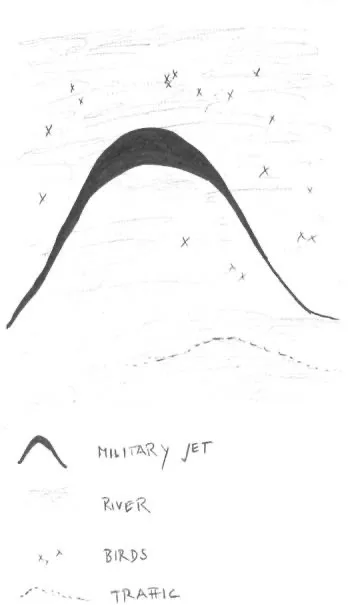
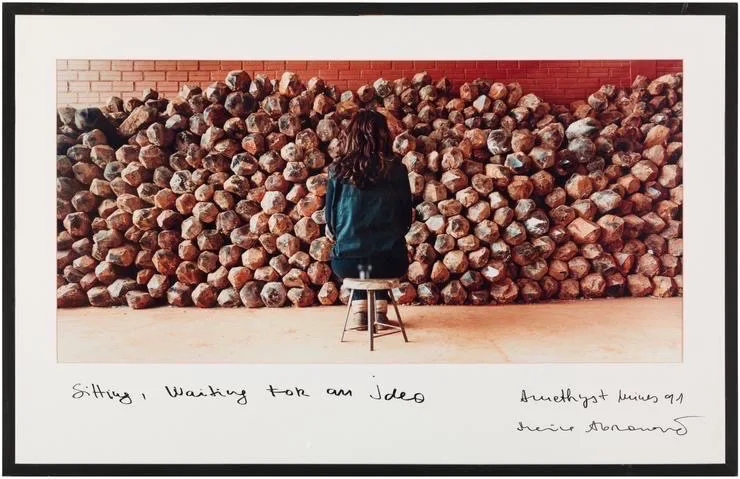
Chapter 4: Marina Abramovich and crossing edges
I begin with a quote of one of Marina Abramovic’s insights after finishing the performance The Artist is Present. It took 90 days, six days a week and seven hours a day without any break, sitting on the same chair Everybody had the possibility to sit in front of her for as long as they liked (Abramovic 2018, 32):
The sheer quantity of love, the unconditional love of total strangers, was the most incredible feeling I’ve ever had. I don’t know if this is art, I said to myself. I don’t know what this is, or what art is. I’d always thought of art as something that was expressed through certain tools: painting, sculpture, photography, writing, film, music, architecture. And yes, performance. But this performance went beyond performance. This was life. Could art, should art, be isolated from life? I began to feel more and more strongly that art must be life- it must belong to everybody. I felt, more powerfully than ever, that what I had created had a purpose.
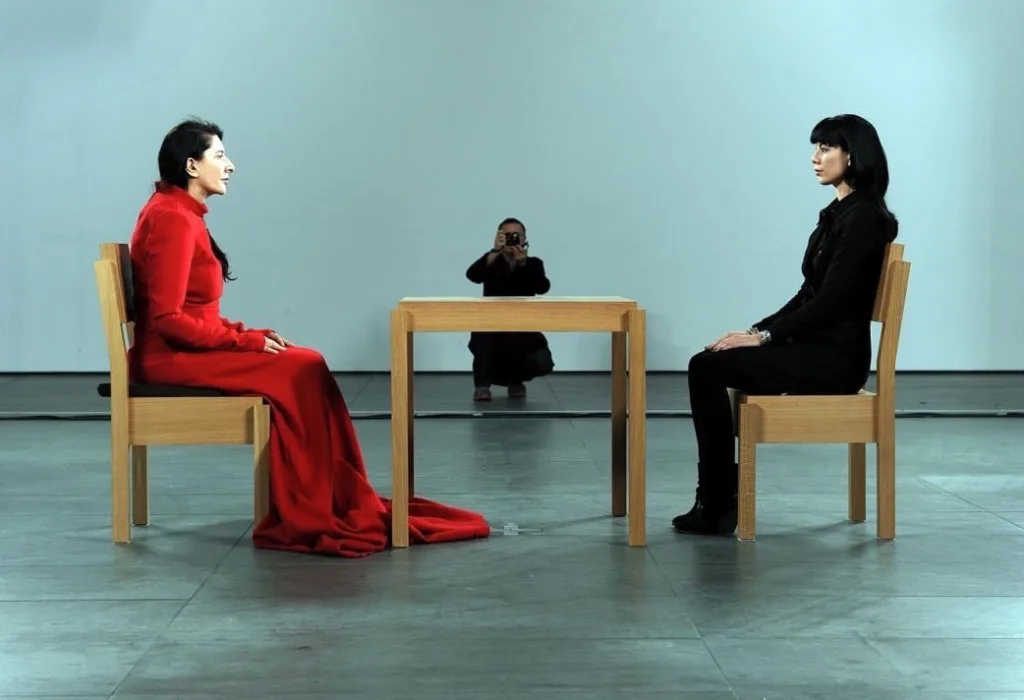
Marina Abramovic is an artist whose work crossed my life years ago during an exhibition in the Kunstmuseum Bern. I didn’t understand it really, but something attracted me. A photograph of the performance is still in my memory with the caption: Sitting, waiting for an idea. Marina Abramovic. is sitting in front of a huge pile of stones.
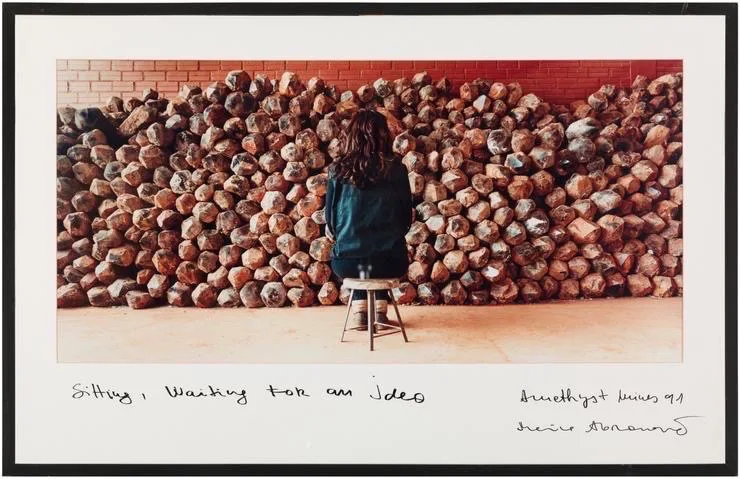
This picture is imprinted in my memory. Whenever I had to create something this picture was present and gave me the trust that something will come. Why stones? I can’t give an answer but reflecting now I think stones are a symbol of timelessness. Connecting with the timelessness of these stones shifts my mind into an essence level. The essence level contains everything, in a way that can’t be spoken. It is the point from where all emerges and to where all goes back. And there is creativity in its wholeness ready to be unfolded into an idea.
I forgot about her more or less, and then in recent years I got to know of her project The Artist is Present, and I bought the video. Again the 10 men came and grabbed me, to continue my journey. In these moments, when the men come, I get obsessed and I have to study to find out more, bringing the research into my own life and work.
At this time, I was already a formal student in the Deep Democracy Institute (DDI) and was confronted with amazing and challenging teachers. Contact with my peers opened me up to new worlds and I started to travel more again. The first step was to learn to enter an airplane. I had not flown for years because of my edge to flying. The start of my study in DDI was crossing this edge.
Now coming back to Marina Abramovic I can say that this was exactly the perfect moment to study her performance work.
In this chapter I will present some of her performances. We will study:
- How Marina Abramovic and her performances are a model for crossing edges, stepping into unknown areas and be encouraged by her to cross our own edges and to find through this process a new home within our true self.
- How her performances from a process-oriented perspective can be seen as a special form of group process, offering possibilities to discover roles and ghost roles in ourselves and in the field, towards discovering the true nature of myself, the group I am in, and the larger field.
- How we can use the performance as an inner work for our issues, crossing our edges, getting insights through a performance and sharing it with friends, the public or witnessing afterwards ourselves what happened during the performance through recording the performance. Finding home within a process, means noticing every change during the performance.
I discovered in Marina Abramovic a model for crossing edges. I am not surprised that her memoir has the title Walk Through Walls (Abramovic 2018). Let’s recapitulate the definition of the edge:
The edge in Process Work terms appears in the moment when my identity reaches its limit.
Beyond this limit something unknown starts. Usually I don’t want it and I am afraid of it. In these moments I can’t leave who I was up to now, a normal reaction we all have sometimes. Our life is full of edges and our fate often forces us to cross edges. Crossing edges are our never-ending growth in life.
To leave studies to start a profession is a natural edge. Becoming a mother for the first time is crossing an edge. Getting old or fear of illness are other edges. I could assemble here an endless list. We can wait for fate to force us to cross edges, but Process Work offers tools to work with awareness on edges and allowing changes for accessing more potential and creativity.
Art and crossing edges
In most of the performances Marina Abramovic exposed herself to situations that were scary and even risky. In one performance, Rhythm 0 in 1974, she posed naked and people could do to her body whatever they wanted. It was really threatening for her. People hurt her and she felt like an object. Her process as she tells in an interview, is to liberate her fear of pain and death, and as a model to cross this fear and find an access to the unknown beyond this fear. She imagined that through her performances people would become able to also cross their fears also (The Shocking Marina Abramovic 2014).
I will come back later to Rhythm 0. She was and is a role model for crossing edges and modelling the new home behind the edge. Edges always are the border to something unknown and the fact that I don’t cross it is fear of the unknown. Ultimately crossing edges has something to do with dying. In this sense I say crossing edges is a sort of dying. The old identity dies and gets the opportunity to find a new space to live – a new home. Following the biography of Marina Abramovic I notice that a thread running through her life as an artist, crossing all the edges she encountered and/or constellated in her performances. It is awesome to witness the changes her performances revealed over the years in a never-ending process.
In her memoir she describes a pain she got during The Artist is Present (Abramovic 2018, 313):
I had more pain than seemed the human body could withstand. Yet the moment I said to myself, Okay I’m going to lose consciousness – I can’t take it anymore – that was the moment the pain completely disappeared.
Encountering many edges during my first years of study in DDI, facing a very difficult situation with the farm, the sickness of my husband and his death, Marina Abramovic modeled for me the courage to step into the unknown, even if it means to sustain pain and experience the unknown as the guide to a new home.
I think one important aspect of doing art is crossing edges, reaching out to new dimensions, transforming myself and my work. This is life itself. If we study the history of art and music, we see all the time artists crossing edges to reach new dimensions which later become mainstream.
I think for example of Ludwig van Beethoven. He was the first composer who was a freelancer. Before him all the composers were employees of the church or aristocrats. Beethoven’s music was a model for the autonomy in composing. He brought music forward. Composers after him were already used to self-determination and no longer had to please the public. More and more artists appeared, whose art shocked the mainstream and was a spearhead for new developments in society.
In this sense art anticipates tendencies that want to arise in everyone. We can also say from this viewpoint that art is life. Furthermore, we can say crossing edges requires love or at least openness for the unknown. From the perspective of The Artist is Present and other performance experiences she went through, Marina Abramovic teaches us: Art = Life = Love.
Her approach to art leads us to feel our planet as a community. Like Joseph Beuys she expands her concept of art and gives access to something foundational that is accessible for anyone. Marina Abramovic departs from the traditional way of art.
Marina Abramovic experienced with her partner Ulay many performances where they explored relationship in many and also painful ways. With huge endurance always connected with the unknown they exposed themselves in front of visitors. Through these performances they processed topics of relationships and showed the public the depth of interactions we often try to avoid in everyday reality. After her divorce from Ulay she followed with even more energy areas of the unknown and shared these experiences with the public.
Marina Abramovic shows us endurance, high discipline, deep love, creativity without borders, willingness to stand in the unknown and openness for the numinous world. Her performances sometime border on questions of life and death.
These are in my mind the requirements for her approach to art. At the same time, I realize that these are necessary qualities for Process Workers working with individuals or with groups, no matter where in the world. And moreover, these are skills required for musicians, actors, dancers, poets, sculptors, painters and – to put it bluntly – anyone who wants to live her or his true self: Never giving up, high level of discipline and at the same time follow the creativity. Sometimes these experiences are heaven sometimes hell at the center of life.
We often see these abilities in conflict zones around the world, where are constantly living at the edge of their limits. I bow my head in respect to these people. They are often teachers for those of us privileged to live in a safe situation. But I am sure that we all experience some of these qualities, when we go through very difficult times and find energies within us that go far beyond our everyday identity. In such moments we usually have no choice. Marina Abramovic consciously decided to expose herself to limits – showing us that our possibilities as human beings are much bigger as we normally believe.
Aspects of group process in the art of Marina Abramovic
At this point I would like to explore some aspects of a Process Work group process and compare it with art – especially the art of Marina Abramovic. As a performer she developed an art that exists only in time – in the moment the performance happens. This requires an audience that participates, witnesses and co-creates the performance. She doesn’t create a fixed artwork and then shows it to the public. The artwork lives in the moment it happens. This is similar to a group process.
The group process can’t be organized, can’t be controlled, but it is a life sculpting process, it is art in action to create meaning though performance. A group process can be seen as a type of performance. At this point let’s have a look again at Deep Democracy. We touched on it in the chapter on John Cage by connecting music and Worldwork – a big part of Process Work.
How is the Performance a group process?
Deep Democracy and Worldwork
Arnold Mindell together with his colleagues developed a specific method to work with groups, called Worldwork. Within this realm he discovered what he called Deep Democracy. One format of Worldwork and Deep Democracy with groups is the so-called group process. Arnold Mindell shares his experiences and teaches us that the field of a group is a constant flow of information (Arnold Mindell 2014a). He sees the role of the facilitator as assisting the group to gain access not only to visible but also invisible, unspoken information – feelings, atmosphere, dreams and spirits influencing the field.
He describes roles that are visible and roles that are invisible, which he names ghost roles. Ghosts are roles that are present, but nobody represents them in the moment. He also says that the field has no boundary – there is no inside and outside. Every field is connected with everything.
He emphasizes in his work the non-locality of all events that occur. He speaks of Deep Democracy – which deepens our political understanding of democracy with the goal to bring all voices and states of mind within the field into the foreground. This helps to resolve conflicts, build community and bring more awareness to everything happening on the planet.
We are used to having leaders who navigate and organize groups. Many of us live in democratic systems, where people have the opportunity to vote. In a democratic system the majority wins, so problems only get partially resolved.
In Process Work there is another way offered, the path of Deep Democracy. On this path the goal of the facilitator is to bring out all the disavowed, invisible information by following the field’s information signals in present time. In this way the field is expressing itself through the participants and new insights, relationships, resolutions can happen.
Max Schupbach speaks of a self-organizing principle in every group, meaning the group has a field with a natural tendency to organize the group, so that it becomes balanced (Schupbach 2010). This tendency is often hidden in invisible structures, such as unspoken thoughts, feelings and moods which disturb the primary identity of a group. Schupbach also mentions three levels of information within any group. There is the visible information in clearly expressed positions. We can speak here of the consensus reality. This is the level we often meet in public discussions. The group process works on another level too: the dreaming level. Schupbach speaks of the emergence level (Schupbach 2007b). Here we are on the level of dreamland. Something wants to emerge, it is there but not as clear as the information pieces on the consensus reality level. Information on the dreamland level which we also can call signals, already have the potential for change and more flow. Thus repressing these signals represses also important potentials.
Then Schupbach further mentions the früh emergenz ebene: the pre-emergence level (Schupbach 2007a). This is the essence level and hardly noticeable. This level has a high potential for the group because the information emerges from a spiritual world and so has the potential for deep change. The facilitator helps the group to make the signals on all three levels visible for better solutions in teams, and in ad hoc groups exploring a topic.
These group processes can be called a kind of community building process. Sometimes a group process is necessary for conflict resolution, for better collaboration in teams and organizations. Group process can also be used as an extended form of discussion and is practiced all over the world as Worldwork, where global issues are alive in groups. According to shamanistic practice we can say that how the field changes through a group process, the world around us and worlds that are geographically far away can change. In such group processes there is a potential for co- creating the world as I already talked about in the chapter about Joseph Beuys.
Back to art: I see art and especially the format of the performance that Marina Abramovic followed as a special sort of group process.
In the performance Rhythm 0, Marina Abramovic starts to break the boundary between artist and audience by allowing the public to be a determining factor (Marina Abramovic on Performing ‘Rhythm 0′ – 1974 2017). In a gallery in Italy she put in front of her on a table many objects that the public could use on her passive body however they wanted. Among these objects were also dangerous ones, like guns, razor blades, knives and nails. Some of the visitors cut off her clothes and did other scary procedures. In this performance she opened a huge space for taboos and for the invisible potential or tendency within all of us to misuse, abuse and hurt others.
That this performance Rhythm 0 happened in a gallery, showed the double values of our so- called high culture. She crossed an edge in the way I described above and offered with her performance an insight into themselves. We all condemn violence. The performance showed the hidden violence in all of us. In his book The Year One, Mindell speaks of information clouds, which, if not followed, start to stink like garbage and also are sent to other parts of the world, so called conflict zones . The performance art of Marina Abramovic is to my mind a group process in which everybody has the opportunity to work on the invisible and explore what we all tend to repress. She mostly went into taboo zones to bring out these forbidden patterns. Marina Abramovic can be seen as a special sort of facilitator. Through her performances she facilitates many ghosts and makes them visible.
Over the course of her life she followed this thread of painful experiences in her performances. She was able to do this because – as I understand it – she had processed the topic in all its agony and beauty many times. She created many more performances which brought people together such as Generator which we discuss in the next section.
Her statement that you read at the beginning of this chapter about art being connected with love, shows her unique way of going through pain and reaching out for love. Her performance art, seen as a sort of group processes, is a community building process in which we encounter each other in our repressed areas and also in our potential for enlightenment and experiencing ourselves as being on the way back home. The art of Marina Abramovic invites us to explore home by crossing fears in groups and group conflicts and fears of ourselves. She invites us in this way to practice community building through exploring what we fear and what we yearn for. For me personally this is my ongoing training and will probably go on until the end of my life, imagining being after death in the midst of everything, home in a world where nothing is disavowed and where everything lives in the pure essence.
Over the course of her life she followed this thread of painful experiences in her performances. She was able to do this because – as I understand it – she had processed the topic in all its agony and beauty many times. She created many more performances which brought people together such as Generator which we discuss in the next section.
Her statement that you read at the beginning of this chapter about art being connected with love, shows her unique way of going through pain and reaching out for love. Her performance art, seen as a sort of group processes, is a community building process in which we encounter each other in our repressed areas and also in our potential for enlightenment and experiencing ourselves as being on the way back home. The art of Marina Abramovic invites us to explore home by crossing fears in groups and group conflicts and fears of ourselves. She invites us in this way to practice community building through exploring what we fear and what we yearn for. For me personally this is my ongoing training and will probably go on until the end of my life, imagining being after death in the midst of everything, home in a world where nothing is disavowed and where everything lives in the pure essence.
Summarizing, my insight of the art of Marina Abramovic is:
- Crossing the edge is art
- Group process is art is love.
- And this requires: endurance, high discipline, deep love, creativity without borders, willingness to stand the unknown, openness for the numinous world.
Generator, a performance by Marina Abramovic
In Kyiv Ukraine, I had a wonderful opportunity to join a performance of Marina Abramovic titled Generator (‘Generator (2014/2017)’ n.d.).
Here the short description I found in the museum:
In this work, Abramovic invites the public to experience their body, their mind and the space surrounding them, completely deprived of any sense of hearing or sight. It brings the notion of Fragile State onto the viewer’s body and mind, placing them in a position of vulnerability while concentrating on a central notion in Abramovic’s work: “nothingness”. As she said: “The hardest thing is to do something which is close to nothing.” This work was originally created at Sean Kelly Gallery, New York.
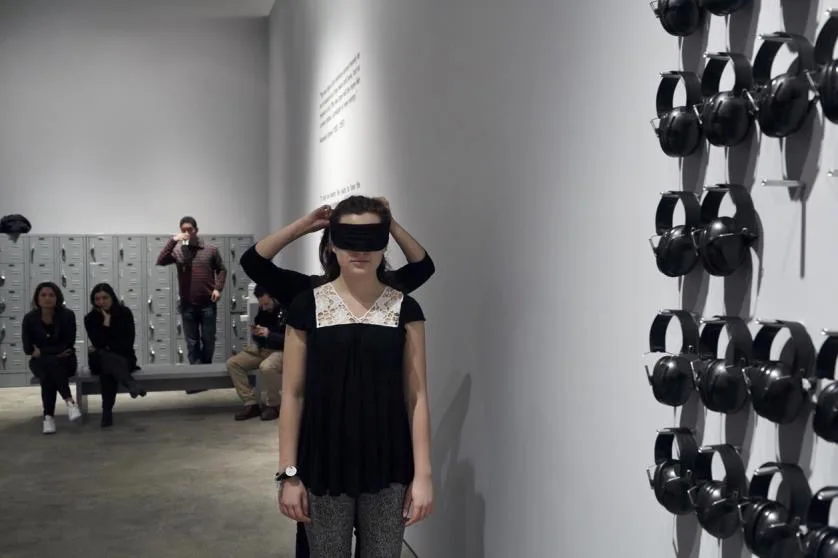
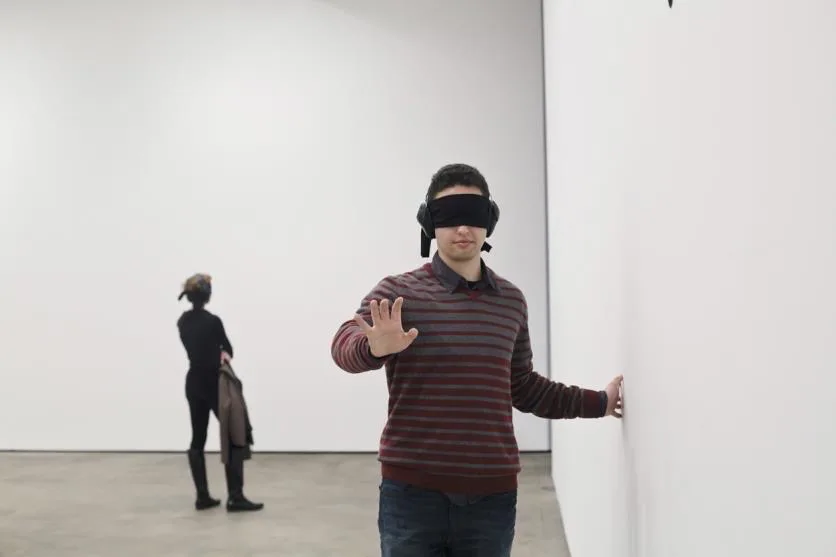
Have a taste:
My Inner work with GENERATOR
Led by a facilitator into the room, blindfold, headset. Only my body and my dreambody and the space around me.
First tiredness, slowing down, unlimited time
Walking along the walls for orientation.
Then letting go of the walls.
The body encountering with other people is something delicate, quite a little bit hurtful, surprising, terrifying. Sometimes a body touches me, like looking for orientation. Leans on me or I feel hands on my body. Both is not comfortable for me. I feel my own fragility. Realizing, that I need much space around myself. If somebody touches me, I feel it as an irritation.
Group process without words, the content is the body, how much contact is ok for me? I have to show this through my body, going away or staying. Surprisingly my facilitator told me afterwards, that I often was alone in the room. Coincidence?
Standing and sitting, leaning against the wall. Something in me needs support, being held. There I sleep for seconds.
My usual preparations for a performance don’t work anymore. It was a concept of my everyday reality, of my primary process. Being in the room without outer visual and auditory channels, I was out of the window and made unpredictable experiences. For example the following: my thinking disappears. I can’t no longer follow a concept. Instead I enter a state where nothingness, emptiness, presence, fragility are the forces. Feeling myself within my body. Sort of home. It’s the only orientation. After I don’t know how long, joy arises. Joy and a tendency to move. My body navigates the movement. There is no thinking, even no feeling in a way there is only being. In a strange way freedom. There are some rules in the performance space, that also forbid something like talking. Although I sense freedom. My body moves around its axis and more and more the body becomes balanced, which it wasn’t in the beginning. I feel calm, centered, detached.
Back to practice
As in each of the chapters about an artist, we are going now back to practice. This time I invite you to create your own performance on an issue that you want to work on. Instead of doing private inner work without being witnessed by others, your performance will be seen. In this way, through the mirror of others you can have an opportunity to learn from this. You can do a sort of community building group process and you have to allow for discussion afterwards.
In my workshops, performances had a powerful effect on the whole group as in the following example.
During a music workshop in the Swiss alps one of the participants found herself at a strong edge showing a musical performance of her inner process. After all the performances, it was her turn. She was sitting in the shelter, were the workshop took place and was totally blocked. The whole group held the space and the presence of everybody created a very intense energy.
After a long silence, suddenly she stood up and ran out of the shelter with a tool for cheesemaking. This object is like a megaphone and is also used for singing the Alpsegen. She cried and sang, no longer noticing listeners. It was a freeing performance, not only for her but for the whole group. Everybody learned from this performance. This example gave me a deep trust into this format. A performance requires my own will crossing edges and creates an intensive energy.
The performance has a certain duration that you can define before if you want. You create a performance design that you think allows an experience of your issue. Through this, the process has a defined structure but within this structure everything is possible.
Below I present an example showing you how you could create it.
Exercise: Crossing edges as a performance
1. Do you have an issue you are stuck with? Perhaps you are in a conflict, you have panic, or fear. Somewhere you feel at an edge and can’t move forward?
Reflect and make some notes especially notes about an energy that bothers you, that is scary for you. It can also be a person you are scared of.
My situation for 1: I now have to go into a decision phase about selling my farm. Many difficulties, nights without sleep. Confronted with a huge material burden, confronted with a new role I am scared of. I am the seller and have to decide, even though I don’t know if this is the right decision. Taking the responsibility.
2. Work now on the energy that is the most scary and painful for you
My response to 2: The farm with this material aspect is a huge pressure and a tremendous weight for me.
3. Try now to step into this energy, contact this energy
My response to 3: I step into the tremendous weight that presses down on Magdalena.
4. Create a performance for yourself so that you allow yourself to experience endurance, willingness to be in the unknown, high discipline, love.
My response to 4: Deciding to make a tape, because a performance needs sharing and today nobody is around.
5. Performance design: Set a time to do the performance you want to do. This will train your discipline and endurance. Be careful about setting the time. Can you assess your momentary capacity of endurance and discipline? Check this with a try out, check your endurance and then create a design that requires a bit more, so that you can cross an edge.
6. Create an idea for a life sculpture, meaning you are the sculpture.
My example for 6: I have to create something that presses on something, that wants to escape. For example I could press a part of my body onto another part for a given time of 30 minutes.
7. First make a practice, for finding out the right position
My response to 7: The first try out was really not bearable. I collapsed as you can see in the short movie. So I had to find a position that was more realistic.
8. Change some ideas for the performance so that it fits with what you want to do.
My response to 8: The second try out worked.
9. During the performance notice what happens
My response to 9: After some minutes I started to count the seconds on my watch. It was difficult to step into the experience. After a while it was sometimes possible, and sometimes I again had difficulties. I had much pain in my lower legs because of the weight lying on them. Again after a while something amazing happened: More and more I felt the weight itself and I became the weight. My body began to let go. The body connected more and more with the gravity and I became in a way the farm lying on Magdalena. Thinking was no longer possible. Something happened with my brain. It was like being connected with the earth in a deep physical experience.
10. Watch the performance
My response to 10: Strong effect of concentration, meditation energy. During the first viewing a slight soporific effect. In the second viewing some hours later:
Intense feeling of letting go, no longer being active and no longer controlling. Insight: Not doing as a possibility. The field itself can organize what wants to happen.
Before this work, I saw not doing concerning this issue as an experience of escaping. But this form of not doing has a different quality: not doing with awareness.
11. Your insights, next steps
My response to 11: Not doing as a meditation connected with practicing gravity in the body feeling. Being the weight myself. Whenever panic arises connect with not doing and gravity, contact earth, be the weight.
One day after this performance, a solution about the farm arose. Surprised?
What happened?
This performance exercise was a sort of crossing an edge. Before, I had a tendency to fight against this weight, this huge responsibility. Through this experience I could follow the pain until the moment a change happened. Being this weight, I got a deep connection to the farm and felt the farm. I loved it instead of hating this huge task.
What happened then in the field, so that a solution right after this day occurred? Through crossing my edge, the field cleared up. I no longer was the fearful Magdalena trying to escape, locked in my primary process. In my new role I reached out as a centered, grounded being, who was deeply connected with the farm and the future of the farm, accessing my secondary process. I heard myself thinking: I want this for the farm, I don’t want this. I became connected with the real seller and the owner, who knows what she has to sell and how she will do that. This new role, which before wasn’t represented, this ghost, got the opportunity to come into the foreground and became occupied during these 30 minutes of the performance. As a consequence, this role in the field helped towards a solution because the field became whole.
Now the field could change because one role had changed from a ghost role to a represented role – this role was missing before the performance.
- Weight Performance (Schatzmann 2018e)
Chapter 5: Max Frisch and the hidden force of art and Process Work
In this final chapter showcasing artists, I want to share with you my excitement about a discussion I watched by chance on TV. It was in the middle of the night. I wanted to go to sleep and as tired I was, I clicked on my laptop in a dreamy state. Suddenly I found myself in the middle of a discussion, my tiredness disappeared immediately. I felt the ten men of my childhood dream possessing me once again.
In a talk on Swiss TV in 1978 with a member of the swiss government, Max Frisch, Swiss author, shared his thoughts about poetry and arts in general (Max Frisch Und Kurt Furgler Im Gespräch (Schweizerdeutsch) 2012). Watch here.
When he talks about poetry, he also means arts in general. The discussion was about politics and arts and their different approach toward society and life in general. The text is a transcript of the discussion in Swiss dialect. I tried to write it down and partially it is original Frisch and partially there are my own words, how I understand him.
Through this chapter I will look at some statements by Max Frisch about art. I will discuss them and compare them with aspects of group processes and inner attitudes. I will study coming home through the corroding process of ideologies. Look at Andorra, a work by Max Frisch, and discuss how he finds ghosts. I will also share the feeling and longing for utopias and finding home on this endless path.
Max Frisch was a famous author in Switzerland. He shared his political views as well as his artistic literature with an international public. In my childhood I heard about him from the adults around me who criticized him strongly. As a teenager and young adult, I was so much excited about him and I read most of his books. I adored Frisch and other authors who were very political in the sixties, seventies and eighties, and I got politicized through them. This world became a sort of non-local home and the ten men pushed me out of the middle-class comfort zone.
After many years not thinking of Frisch, the discussion I found by chance brought back my excitement of how he understands arts. The central point of his statements is the question, Why does art irritates politicians? And I would add the mainstream society as well. Fritz says that arts lives in a space where people are not socially connected. Art tears up frozen states and art is connected to utopia. Art undercuts every ideology. Can you remember the statements of Tinguely in the beginning when he talked of the pyramids that crumble, or Beuys who worked tirelessly on his utopia that everyone an artist?
But let’s listen to Frisch’s own thoughts. I wrote them down from the TV program I watched in the small hours of the morning:
Poesie ist keine Flucht aus der Realität, Betäubung, Sentimentalität etc. Poesie als ein Durchbruch zu den genuinen Erfahrungen der menschlichen Existenz. Poesie macht uns betroffen, trifft uns dort, wo wir in Selbstverständlichkeiten versteinert sind. Sie reisst uns auf. (…) Poesie, Kunst überhaupt, befreit uns durch Spontaneität, das kann Glück und Schrecken sein.
Was ein Politiker irritieren kann, sind nicht die politischen Meinungen. Wenn Sie die Mehrheit im Parlament haben, so stört Sie gewiss nicht die ganze literarische Mannschaft und das ist heute im internationalen Vergleich eine beträchtliche Mannschaft.
Was irritiert?
Poesie erreicht Menschen dort, wo sie kein Amt haben, keine familiäre oder öffentliche Rolle. Sie unterwandert jedes ideologisierte Bewusstsein und insofern wird Kunst, wenn sie diesen Namen verdient, subversiv empfunden und das mit Recht. Was sie auszeichnet ist das, dass sie zweckfrei ist. Nun könnte man es anders sagen: Sie als Bundesrat regieren, Sie müssen Massnahmen ergreifen. Poesie ergreift keine Massnahmen. Es genügt, dass sie da ist und zwar als ein Ausdruck profunden Ungenügens und profunder Sehnsucht, die wir alle haben.
Poesie wahrt das, was in der Politik notwendigerweise immer wieder verloren geht, nämlich die Utopie. Wenn ein Roman eine kaputte Ehe vorführt oder die Misere durch entfremdete Arbeit, so geht der Roman aus von der Utopie, dass unser Menschsein auf unserer Erde anders sein könnte. Wie, Rezepte sind von der Kunst nicht zu erwarten und das ist immer ein Ärgernis.
Vom Pragmatiker aus gesehen ist Kunst immer unbrauchbar. Poesie sagt nicht wohin mit dem Atommüll. Und Poesie fragt nicht nach Erlaubnis. Sie ist einfach da, als Freiheit im Bewusstsein und im Empfinden, was allen möglich ist, nicht nur dem Artisten.
Jede Kollaboration zwischen Kunst und Macht endet, auch wenn sie gut ist, in einem tödlichen Selbstmissverständnis für Kunst. Kunst bleibt eine Gegenposition zur Macht.
Translation: Poetry is not escaping from reality, nor a numbness or sentimentality…Poetry as a breakthrough to the genuine experiences of the human existence. Poetry moves us. Poetry tears us open where we are frozen in situations that we take for granted. (…) Poetry, arts in general frees us through spontaneity, which can be happiness or horror. Not political views are disturbing to a politician. When you have the majority in parliament, you will not be disturbed by the whole literary team and compared today internationally that is quite a substantial team.
What irritates?
Poetry reaches people where they do not hold office, where they don´t play a role in family or society. She infiltrates every ideologized consciousness and insofar art will – if it lives up to its name – be felt as subversive and rightly so.
What sets art apart is that it has no goals. One could put it differently: You as a government member are supposed to govern, you have to take action. Poetry doesn´t take action. It is enough that it is present, present as an expression of profound insufficiency and a profound longing we all have. Poetry guards that which always gets lost again and again in politics: namely Utopia. If a novel portrays a broken marriage or the misery brought on by alienated work, the novel assumes a utopia that being human could be different on this our earth. You cannot expect poetry to supply recipes and this is always an annoyance.
From a pragmatic perspective poetry is useless. Poetry doesn’t tell us where to put the radioactive waste. And poetry doesn’t ask for permission. It is simply there, as freedom in consciousness and feeling, which is possible for everybody, not just artists. Every collaboration between art and power ends in a fatal misunderstanding of art, even successful collaborations.
Art – as Frisch reminds us – is a contradiction to power.
Some main thoughts
Art is a counterpart of power. Its home is freedom in consciousness and sensory perception. Frisch also says, that exactly this is accessible for everyone. This conviction is similar in my mind with the understanding of Beuys’ viewpoint in his formula everyone is an artist.
Frisch says that art has something to do with freedom of consciousness and sensory perception. Everything that comes from this kind of freedom can be seen as art. An encounter, a talk, a painting, poetry, a music piece, farming, business and group process. The frame is the freedom of consciousness and sensory perception. Furthermore, we have to consider that Frisch also says that art infiltrates every ideology. Art has no purpose, according to Frisch and real art cannot be found in collaboration with power.
Another thought of Frisch in this interview I watched seems also important to me:
Je klarer, absichtsloser, in jener bedingungslosen Aufrichtigkeit gegenüber dem Lebendigen, die aus dem Talent erst den Künstler macht …
Alles Lebendige hat es in sich, Widerspruch zu sein, es zersetzt die Ideologie und wir brauchen uns infolgedessen nicht zu schämen, wenn man uns vorwirft, mit unserer Schriftstellerei zersetzend zu sein.9
Alles Lebendige hat es in sich, Widerspruch zu sein, es zersetzt die Ideologie und wir brauchen uns infolgedessen nicht zu schämen, wenn man uns vorwirft, mit unserer Schriftstellerei zersetzend zu sein9.
If we now follow Max Frisch’s freedom of consciousness and sensory perception we can compare it with process work and say:
Not being free in my consciousness and in my sensory body, I am cut off from arts, cut off from the unconditional life, cut off from flow. In such moments I am at an edge to something that is art-like. Even more precisely I would say that the awareness of every state I am in has something to do with freedom of consciousness.
Noticing when I am stuck is already being free to recognize and therefore connected to freedom of consciousness and sensory perception. Here arises U and X, you remember U and X from the chapter on fundamentals of Process Work.
U is always connected with what we already know, turning up out of our past. X is always something in the future, a quality that invites us to leave familiar areas and cross edges to reach out to new dimensions.
Following freedom of consciousness and sensory perception is thus a lifelong practice and is a path of art, accessible to everyone, and in this sense everyone is an artist.
Let’s have a look at an example. Recently I told one of my peers that I have some difficulties with the president of an association I belong to. What irritated me was his ongoing monologue, that annoyed and confused me. We analyzed this as X. I also had a judgement thinking that he is not reflective, not creative, not enough related.
You see these are heavy judgements and naturally our collaboration wasn’t very amazing. With my direct behavior I shocked him. Two human beings that don’t fit together. I have to admit, that my judgments were ideological. With my peer I went through a process that can show what I mean with freedom of consciousness and sensory perception.
Unfolding his monologue style that irritated me led to a quality of being present everywhere. The next step of our work led to a gesture of embracing the planet and I heard myself saying: World let me hear you. A feeling of love arose even for this president.
First it was necessary to find out the most disturbing issue, to express honestly my judgements. Then, in the second phase, going to X, crossing an edge to the unknown, brought an expanded understanding of my own relation to the world and also to this president.
The hidden force of group process
Max Frisch was an author who participated in political life and contributed a lot to the democracy in Switzerland. Thus, I would like to emphasize group process in this analysis as a format for working with the world issues.
We met group process in the chapter about Marina Abramovic and will discuss again here in comparison with the thoughts and views of Max Frisch.
Again, I want to study the connection between being home with my life myth and childhood dream and with the input of Max Frisch. I had my very first group process experiences in Zurich at the Institute for Process-Oriented Psychology, the first Institute founded by Arnold Mindell many years ago. I had never encountered this method before.
Immediately I felt totally amazed. It was again a home feeling. I encountered a new style of interaction and I went home with a feeling of having increased courage. I remember that in the train to Bern I talked with everybody I met, obviously something had changed in me. I felt like a free bird. Today I am greedy to study this format and to learn about and initiate projects. Max Frisch reentered my life in the right moment. But I had to reflect again, on why I was so amazed by Frisch and some aspects of my past came to my mind. Let me share with you something personal:
On my farm, together with my husband we worked a lot in political areas especially in agricultural politics. I found myself challenged by him. He pushed me to talk in public, we campaigned together. We lived on the alps in the summer months with people who were interested in what we had to share. We had many discussions, many troubles, many amazing times and my sensitive musical and subtle energy got really whirled in confrontation with the world channel and all the difficulties, polarizations, failures and successes.
Often, I asked myself:
Why did you give up your sensitive life and enter such a difficult area, where there are so many problems to resolve? Why not continue playing the piano and having a wonderful time with music?
Today I am convinced when again the ten men turned up, it was again time to leave my comfort zone, reaching out to a new home and going deeper into my own self developing qualities that I had not yet experienced. During this time, arts and Process Work were crucial worlds and homes for me. Process Work taught me to always access the attitude that in everything there is something good, something that brings you forward. Art was a path, that brought all my parts together when I felt split and this enabled me to follow my visions, my utopias and bring it to my everyday life.
Today I can say that arts, which is in a way without everyday purpose, has a bridge – and this bridge is Process Work, connecting the art world with our everyday life. Yes, art has no purpose by itself, but art and especially art in connection with Process Work is able to change our lives. We will see later in this chapter, that art as well as Process Work is revealing what is hidden.
I began to write this chapter in a time where I didn’t know why, and if this was to be part of my diploma work. I noticed an obsession to understand and to reflect these thoughts and views in this talk deep in the night, finding this amazing discussion accidentally on the internet. Something caught me, and the whole next day I couldn’t let go of this talk. I wasn’t interested whether it had a purpose for my diploma paper. But I had to reflect, to write, to rewrite on and on. What the hell do I want with this Max Frisch in my diploma thesis, I asked half a year later. I asked myself if this is still current.
One voice, probably the child of the childhood dream, who wants to be home, said:
Mmm, I think it’s no longer important, why again open another window, another view? It seems difficult to deepen this and connect it with the diploma thesis.
Another voice, probably the ten men said:
But it is important to speak also in the words of Max Frisch, which are very confrontational. Do not stop your original impulse and continue working on it. You will see only by walking, if it will be part of the diploma work or not and it could be, that a sort of confrontational energy is still missing. You without confrontational energy is not your true self. Don’t go home, you will find a new and larger one.
So I began to reflect on the thoughts of Max Frisch, Process Work and particularly group process.
A new inner study of Process Work started
If somebody asks me, what I am doing and why do I study and practice group process, often I feel like a beginner and look for words, all of which are not really what I wanted to say. Why?
Questions like why we do group processes? Has it an effect? Is it helpful for the world? How can a group process be a special sort of home? A description of what is a group process is really difficult, because as I said before, in entering a group process everything becomes different than expected. Group process is like arts: From a pragmatic view, art is not useful, Frisch says. Read again what Frisch says about arts:
Poetry doesn’t tell us where to put the radioactive waste. Poetry doesn’t ask for permission. It is there anyway, as freedom of consciousness and sensation, which is possible and accessible for all human beings, not just to artists.
I said before that Marina Abramovic is a sort of a facilitator, because she enters a field and supplies information that is invisible and makes disavowed aspects visible. Through this artistic facilitation she initiates discussions, reflections and helps to change the field.
After World War II Max Frisch wrote a draft that later became the play Andorra in which he worked on the topic of the pattern of the outcast and scapegoat (Frisch 1969). At one point, Andri, the outcast in the play answers after asking why he is different from others:
… suddenly you are how they want you and that’s the evil. It is in everybody, but nobody wants to have it and the evil is in the air, but it doesn’t remain there, it must go into somebody, so that they can grab it and kill it.
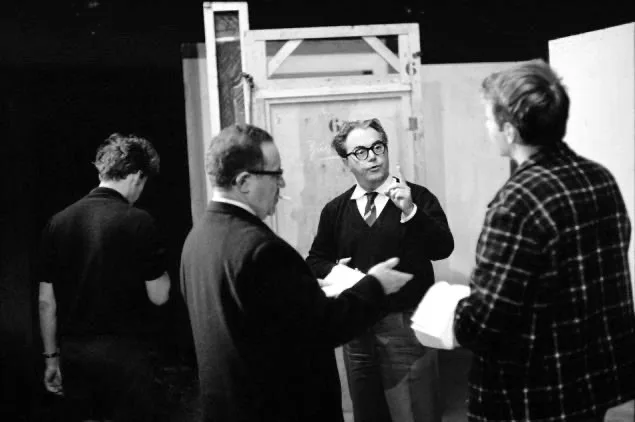
The artist formulated this and shocked the society with this play. This was written during a difficult time after World War II when people had huge difficulties to look into evil patterns in themselves. What did Max Frisch do? He shared with unconditional honesty a role that exists within all of us. In a group process, this is called a ghost role – a role which is difficult to represent and to own because of it being mostly a taboo.
Since then this role and topic is now discussed in a larger frame. These days, the ghost role of evil within all of us, is a bit more familiar, although is still a difficult subject. Artists noticed the ghost role early on. Why is an artist able to do this? Because of the unconditional honesty and the freedom of consciousness and sensation she lives in.
This is what Frisch requires of artists, but he also was convinced that this is possible for everyone. Frisch – as an artist, always expressed everything he noticed, and talked about it directly. Like a laser beam he looked at the roles and ghost roles in the society he lived in.
This laser beam ability seems to me very important for the role of the facilitator, for a team member and for my inner work. Not only when swimming within a group, within my illusions or needs, but being detached enough to sense which voices are present in the moment and to also express that. In a group process, the facilitator as well as the participants are artists during these moments, because they follow what they notice.
With training they can become more and more able to notice the invisible patterns, just like the artist. In this sense the group process can be called art. That’s the reason I was so excited about Max Frisch’s thoughts. Now I know why I need Max Frisch for my diploma thesis and why I feel at home with these thoughts.
A second thought of Max Frisch is his view of corroding ideologies. He sees art as subversive and a antithesis to power. I will now try to compare with the method of Deep Democracy. Through this paper, we saw several times the importance of all viewpoints to allow the field to express itself in its wholeness. Mindell writes in Leader as Martial Artist (Arnold Mindell 2014a):
Deep democracy is our sense that the world is here to help us become our entire selves, and that we are here to help the world become whole.
Hidden signals like ghost roles become visible. Behind every role and ghost role we can reveal the essence of the role. The whole primary structure of a group collapses and new insights and potentials arise. Arnold Mindell describes in his books, namely in Sitting in the Fire many examples of this phenomenon, that show how powerful people changed through discovering hidden information (Arnold Mindell 2014b). In this sense we can see something subversive in the Deep Democracy path.
Having a look to the original meaning of the word subversive: sub-vertere = umstürzen, untergraben/undermine. When I take the word totally neutrally, then I would say yes: The process can change everything and yes, the process is able to subvert everything. But the word subversive can be misunderstood because of the connotation to something that is rebellious.
Normally we use the term to describe intentional subversion, and this isn’t the case in Deep Democracy. Therefore, I would replace the word subversive to speaking about revealing quality. The process of Deep Democracy reveals what is invisible, what we tend to avoid and reveals the essence of the roles.
In the following example I will try to show what I mean with the revealing quality of the field. You will see, that the role of the critic remains unspoken, because the role in the field was present in the unbearable atmosphere.
It was an Unintentional Music workshop at a professional music academy. I was invited to work with students. I usually asked for somebody to work with me in the middle to demonstrate the work.
Nobody, silence, stuck atmosphere. I felt a bit nervous and waited. Nothing happened. Then I said: “The Process just started, nobody wants to play, good, let’s explore now what happens right now”.
A deep breath went through the whole group and a ghost role appeared, often connected to a school for artists – namely, the critic. That is why nobody wanted to play. Everybody had the critic within themselves and at the same time a huge fear of it.
The critic in art and particularly in performance art is something that traumatizes people. The critic is a huge and dangerous ghost role. In this seminar I wasn’t trained enough to deal with ghosts. Fortunately, the situation was so clear, that it was relatively easy to pick up the critic.
Today I see that this was an amazing example of corroding ideologies, namely the ideology or the belief system of classical music in our time. Playing music should be absolutely perfect! says the critic. After discussing the fears surrounding the critic and the critic as a role, we were able in that workshop to continue. We had a wonderful time together, full of joy and creativity.
The huge potential of the revealing quality of Deep Democracy is that it gives us the possibility to access every role that comes up. Ideologies and frozen states are characterized through the oppression of marginalized voices in a group and in individuals. The subversive or revealing power of Process Work and Deep Democracy is that the field brings it up for sure, because I can’t suppress my signals – they are stronger than my identity as in the example of the workshop described above(Arnold Mindell 2014b).
The ghost role of the critic was in every student, not only in the leader of the school. Remember the statement of Max Frisch:
It is enough that poetry is present, present as a profound insufficiency, a profound longing we all have.
Could it be that the universe uses us in a group process as channels to explore together our insufficiency and our deepest longings? In moments during a group process – for example when ghost roles come up – I often feel this insufficiency and the longing that Max Frisch speaks of. This makes me become humble and grateful. In the example above with the students, a loving atmosphere arose, everybody shared insights and feelings. Ghosts belong to everyone and the paradigm of Deep Democracy is already a corroding process of ideologies.
Back to practice
At this point again I think it’s time to practice and experience.
Doing group processes is not the easiest thing and needs training and practice. But what I want to offer here is a taste of it, that you can do with yourself. As before, I connect it with a little experience in creating a work of art.
Exercise: inner group process
- Remember an issue with a group. This may be your working group, your family, friends, sports club or whatever group. The issue can be a conflict, a collaboration, you want to explore more, a project.
- Describe the issue.
- Describe all participants you notice.
- Start a group process with yourself and let all the voices speak.
- Play all the roles, switch from one role to another, let the voices fight with each other, bringing their arguments and notice what is special, surprising, not predicted/unexpected. Follow the flow of the information that arises.
- Try to create something like a play with all the various pieces of information.
- While doing this, one part of yourself is noticing, what changes and is tracking surprising moments. One part is the participants, one part is the facilitator.
- Follow the process till something meaningful happens. For example, an insight might emerge.
- 9a. Write down the process as a story. Study all the voices and let your creativity flow till this story is no longer bound to the group members.
9b. Another possibility: Create a sound, melody, rhythm for every voice and make a tape of them all. Listen to the voices as if they are a music piece. - Create especially the insight you have as a music, poem, painting, dance …
- When you meet the group again, notice, if something has changed. Information is non local, therefore it can be, that you helped the group reveal hidden information.
This exercise is a little experiment on group process. Naturally a group process is something very complex and can’t be fully worked on in a little exercise.
But practicing this for yourself can help to access more roles that are unfamiliar to you. You will notice that all the roles are shared, and that the field is totally free sending the signals to us, even from roles that are no longer here on earth!
After having written this chapter I am convinced once more that Process Work, Deep Democracy and also group processes as a particular way of Deep Democracy is art. In the words of Joseph Beuys, we can also state that every group process is a social sculpture. Becoming a Deep Democracy facilitator, this insight is crucial for me. Starting a group process with the attitude of sculpting a social sculpture together, is a helpful guide.
Utopia: another politics, another art
At the end of this chapter I realize my deep longing for another kind of politics. Let me explain the background of this feeling.
After long years fighting for our convictions in politics, my husband and I were in a way frustrated noticing that politics went in a direction we couldn’t share any longer. He quit his political work in the parliament and non-government organizations in agriculture, that were involved in political processes. We suffered a lot and I asked myself what to do.
This was the starting moment to join the Deep Democracy Institute and it was perfect. Working on the format of the group process as I described in the chapters of Marina Abramovic and Max Frisch, I realize more and more the promise for another politics and other formats for art.
While writing this, I think of group process also as a possibility to work with people on topics of cultural events. This could be an exhibition, a concert or another cultural project. This would be another diploma thesis but I will share with you a little try out of this utopia in Part 3 under the title Hüllen.
Summary
Through Max Frisch I learned:
- Trusting what I notice and speak this out
- Doing inner group process in my everyday life
- Looking on what I notice in groups as literature, drama, poetry and through this improving my ability to switch roles and understand different roles better
Part 3: Applications
In this section I will describe some examples of my work with art, music and Process Work.
Chapter 1: Rita
Introduction
The first example will be a journey with Rita, a professional musician.
Rita is a very intelligent woman with several academic degrees: Masters degrees in music science and philosophy, a musician diploma and more. Her long-term process is that she lacks in confidence. She worked a lot on it. I know her since many years. We first worked together musically, and then once or twice I gave her sessions in unintentional music, to work with her stage fright and other struggles in making music. One time she joined a weekend workshop about unintentional music on my farm.
Now she had accepted an attractive engagement to perform her own music during a reading by a special author. This certainly was a milestone in her life.
But after some hours of saying yes to the engagement she got afraid of her own courage. That is when she called me to support her process.
Wonderful, I thought. I looked forward very much, I loved the thought, helping her to improvise for the first time in public.
Process structure
Let’s now study the process structure to learn more about what is happening – meaning, roles, ghost roles, the three levels of experience and information we gain from the world channel through her experience:
| Role: Lacking confidence Being afraid of | Role: Confident. Courage. Saying yes spontaneously |
| Channel: I am not relevant in consensus reality (CR) | CR World channel: Many academic degrees, supporters such as her professor asked for this performance |
She crossed the edge and then had a backlash.
Her primary pattern: Am I able to do that? I never did it before. I can’t. How is it done? I am nothing.
My role as her coach: To support not only her process but at the same time working musically on her project, so that the result will be good enough for a professional musician. Not an easy thing within two weeks. As a musician she – like all musicians – is confronted with critics and blocks.
I was glad to have known her for many years. This helped me to use the metaskills of trust and encouragement. I knew her abilities well.
First session
Rita didn’t know how to begin, how to enter.
Then there were the following musical edges:
I never did such a thing. Probably I can’t. I don’t know where I got this
courage to say yes to the engagement.And for me it is only possible to improvise, because for the moment I hate notated works.
Her individual process showed up like this:
I have no self-confidence anyway. I am not able to achieve my own standard.
What I play is banal. Whenever I speak in front of a group I take back my thoughts before expressing them and I tell them not to believe what I am saying.
Our work
We looked at the first text of the reading and there were some points where she had planned to play, I asked her, How does this poetry arrive to you? She said: Breathing.
So we started with breathing. Rita took her English horn from the case getting ready to play.
She entered a deep space and when I asked her, Which place on earth or in the universe has a resonance to this space? she said, My bedroom, between dreaming and waking up Doing nothing, total freedom.
She began playing the music of this space. A wonderful special music followed. She was now beyond the edge in a new space, in a new creativity.
A ground for working was laid.
Second piece, second point in the text.
Rita brought an idea here. A melody of brother Jacob from the first symphony of Gustav Mahler. This melody is very melancholic.
Now the work was much easier, because Rita had already crossed her edge and she had access to her creativity. It was fascinating to work with her, she was open and ready for her imagination.
For the third point where music was required, we followed the text again and she improvised an unknown melody, that changed constantly.
After two hours we had prepared the draft and she was ready to continue at home. I recommended to her making tapes for working on her courage, listening from outside to work on her belief system.
Second session
Rita told me that she showed her pieces to a dramatic advisor. Wonderful, I thought, She integrates the mainstream and is ready to confront her music with an audience and especially a professional one.
She told me, that she constantly stopped playing and asked the advisor for feedback. He got angry and said, Whenever I am deep in the music you stop it.
This was fabulous feedback for her. He pushed her to go forward and I noticed a new energy in her to go for it.
We worked on this edge to show her music, her edge to stand up for her creativity.
She spoke to me of an inner saboteur.
First intervention
Exploring the energy of the saboteur did not seem to be the right way. It was so brutal, very far away from her identity – too secondary, too edgy. So we continued with movement, hoping that the movement gestures could take her beyond the edge on an essence level. Rita was quiet for a long time. First I thought that she was thinking too much, but she was meditating very seriously and suddenly she showed a movement gesture which was very congruent, so I was really blown away.
The movement gesture in her words: Following my breath there emerged an arm movement that was flowing out of the pelvis forming a giving gesture with the arms and palms of the hands.
The earth spot of this movement was the couch in her therapy room. There no taboos exist. There she is free to going back into an old pattern. No musts. Everything is how it is, neither good nor bad, it is so relieving, a space of freedom.
She seemed really to be in this room and then she let this space play. It was totally touching listening to the music of this space. I got goosebumps. For her it was quite a new experience to play in this way.
Afterwards she played a whole cycle. It worked, Rita dealt with it very well and even when her inner saboteur arose she could continue playing. Her earth spot was helping her to deal with everything that arose.
Here I left the Process Work approach and made suggestions to her as a musician how she could prepare now and before the performance.
Her feedback after the performance:
I think it was really good. Where to begin? When I went at home after the session and also on the next day, I was at the same time tense and calm and relaxed. Quite something like lucky and happy. I know myself neither happy nor calm.
Today during lunch time, when I could try out in the performance room, I had a terrible surge of adrenalin. All the old patterns appeared again, the adversity of the instrument, everything that I think I am not able to do. It was only two hours till the performance. So I followed all the advice and tried out to unwind through the work we had done. I left the room during the public discussion before my performance, stepped again into the movement and this space from the last session. This sort of concentration was really new for me.
I didn’t talk a lot with the author, who read but I can describe how we were connected during the event: I sat at a certain distance from him, but in a way that we had eye contact. By the way, he is very warm hearted, awake and openminded. Then I played all three improvisations. They seemed not very courageous to me, but I knew that for the audience it is different. The first piece with the long breath and the strange sounds, then the melody of brother Jakob. The author noticed it quickly and during the music we looked at each other. Afterwards – my own melody, this was the most challenging music, but I was able to let myself play the music more or less and I didn’t look for something that wasn’t there. And again, and again without feeling abandoned, this was a huge support.
Before I began to play, I looked for the eye contact with the author. In the first piece I played right away into his words and this how it seemed to me had a very strong effect on the audience. They really thought that I acted and reacted with the words. I got a lot of feedbacks confirming this. The professor who asked me to do that performance said that she never experienced such an intense connection between the poems and the music. And this author performs readings often with accomplished musicians!
Hey, you were there, your dead Lorenz [my late husband] was there. The little son of the professor, and all was connected in deep beauty and sadness.
After some months I got the following e mail from her:
I want to share with you that I played again improvisations in a performance. It was a liturgy for good Friday. Only one day before I was asked because a musician became ill. First, I wanted to say no. But then I noticed that the work we did together really is sustainable. There was a risk, an experiment, there was only one day for preparation and I was not afraid one second. I prepared very intensively, and I knew well what was to be done. You enabled me to act and to trust, I hardly can believe it, thank you so much. It went well especially with the English horn. I had also a mouth organ with me and a small guitar. The feedback was very positive and I was focused during the music, more courageous and free of inner censorship.
I was so glad and felt the huge gift of Process Work and especially in this work the deep power of essence work and its path for coming home to the true self. When I look back, I see that we worked almost entirely on the essence level. From there it was possible for her to connect these insights to other levels. The result in the CR level of everyday reality showed that she really integrated her long-term process.
Essence work for her was the right path. As an intellectual and very intelligent person, experienced in psychological analysis, there was a missing part, she was already experienced in the analysis ( the couch in the therapy room ) and as I know her also privately I knew a bit her special non-conformist side too, but she wasn’t ready to connect it with the consensus reality level of playing a performance and standing up for it in the outer world. Essence work was her access to this connection to trusting her creativity.
Her own music came out of her true self, not disturbed by norms and fears. Her wonderful music touched the audience deeply. In my general music experiences, it is the source of the essence which touches the listeners. Making music from this home in the essence world is reminding the listener of his own home.
Chapter 2: My way to a decision
The following section is a description of my own inner work with music:
I worked on a specific issue of mine: practicing the combination of music and Process Work.
This was an issue about a decision in the field of work. I thought of quitting a particular job which has accompanied me through all of my professional life: teaching piano in a music school where kids learn to play piano. This was my everyday job for years as my basic income. In between I realized projects I without having a big pressure to earn enough money.
I loved the job and I loved the kids, teenagers and adults who learned to play the piano. Now something was knocking at the door for new experiences. Are the ten men knocking at my door again, requiring yet another new home?
took this as an opportunity to explore what turned later into Soundcloud in my diploma thesis and at the same time I hoped to show how music supports the process (Schatzmann 2018c). You can listen to the music here. Please bear in mind that this music is not meant for sharing. It is a rough musical expression. I want to show that working with music does not depend on your musical ability. Therefore, I taped it as it arose spontaneously without preparation.
December 25th 2018
December 25th 2018 One of the first days without time pressure in a long time.
To quit my job in 2020 is continuously in my mind and I want to use the Christmas vacation for working on this decision.
What I notice in the moment: Two parts in me
| Role one | Role two |
|---|---|
| Wish to experience myself differently, Now is the time to jump, later could be too late. Plan for a part of business: Creating a space here on the farm for people in the midst of change by spending some days in an apartment in my house I am offering and working with me on their change. Carry on working with people in my studio at the farm and in nature and intensify this format of practice in music coaching and Process Work coaching, giving workshops and starting or restarting with new concert formats So: many ideas, many plans | I love the kids, I am used to being secure having a job, being an employee. Perhaps it is wrong to quit before the time of retirement. I feel some fear of the unknown. What about the loss of purpose and starting again from zero and work on a new professional identity? What if I will fall in a total lonesomeness and nobody wants to work with me? |
Process structure
Role one: fear of jumping
Role two Unknown, new identity, loosing purpose
Edge: The point of no return I fear the most. Am I able to make the right decision?
Sound: A deep sound in the midst of my body with a movement that supports this coming to my own depth. Listen here (Schatzmann, n.d.).
The insight coming out of the music:
A decision is not made, a decision happens. The topic of right decision isn’t to decide but to go deeply inside.
My plan
Every day playing a free music without reflecting but letting the music happen from inside to outside.
My music diary for now has the following structure and plan:
- Free music as a meditation in action. Tape it.
- Think of the issue of the actual day and work on it with music as your inner work
- Compare the free music meditation with the concrete inner work
Free music after the work on the depth (video)
December 29th 2018
Yesterday a sudden insight while driving the car.
10 Years until my 70th birthday.
Magdalena, and you are hesitating to change your professional life? Go for it.
Who says this to me?
Then the following dream:
Somebody, a caretaker from a public school drives me in a car through a very lonely area in the forest of a mountain landscape. There we pass an altar. It is made very simply out of wood. I see that it has something Catholic. I can feel a devotional atmosphere.
We then continue our trip and arrive in a lost village like at the end of the civilization. There we see train tracks which are out of function.
I am interested in the altar. What does it mean?
Becoming the altar, sounding the altar, a highly sensitive sound arises. I caress the bells with an ivy branch. A sound at the edge of being audible. Sometimes a high bell chimes.
I am your altar, come with everything to me and become quiet, be in silence and listen. From there go out remaining in touch with me. Life is devotion!
Music: Ivy branch:
January 2nd 2019
Second day of the New Year! Finally, it is snowing after warm days. It feels homelike, remembering my childhood when snow in winter was normal. Climate change. Could it be a possibility to work on climate change in the here and now through music?
I remember Des Pas sur la Neige, by Claude Debussy. This is a piece, that connects me with the atmosphere of winter, the silence, tenderness of the sound of snow.
Steps in the snow. I go outside and step by step I am walking and listening to the sound under my shoes. This is a meditation on footprint. We know the ecological footprint – this is my first association. The meditation footprint (listen here) that I comment on with words invites me to see a wider frame of footprint on the walk. Afterwards, I meditate on the question, What do I want to print on the earth in my next and last phase of my life? (Schatzmann 2019a).
January 12th, 2019
In the midst of everyday life. Much work.
Snow outside. Remembering Des pas sur la neige, every day walking with my dog through snowy landscape. The tempo slows down.
Today I want to work on letting go and being without my rank as a teacher and leader of a music school. Feeling something free but also, I imagine being here on the farm where everything has to come out of my own initiative.
Imagine being finished with this job.
Space around my thorax, surprise for me, I expected more a feeling of anxiety of the unknown.
Earth spot:
Something like Russian Taiga. I was never there, but my imagination tells me that.
In this landscape I am a small nothing. The landscape is huge, large endless.
Becoming this landscape: Not human beings decide here what works, it’s me. The animals and the flora live when I allow it. They are completely connected with me.
Music:
This landscape sounds: Octaves only, all over the whole piano keyboard. Oneness, clarity, all tones in one tone and it’s octaves.
The music has no form, like white space. The music makes me very quiet and ready to feel, all the voices outside this white space are gone.
To connect with this music and landscape helps to listen to the inner voice, the inner life to something that is bigger than the arguments of yes or no. Listen here to Tiaga Music Wave (Schatzmann 2019b).
Summary of this musical diary:
Every time I worked on the music of my process it emphasized something from inside out. Listening deeply inside allows insights, ideas for next steps. In the music meditation I feel home, I feel my true self. I notice a big shift of attitude.
FROM INSIDE OUT is my new guide!
The weeks that followed I found myself still in yes and no, but with the experiences from before I could be relaxed, and I waited for the decision to happen. The decision really appeared after a while without working consciously on it. Some signals emerged and to my astonishment I could notice it as the decision already happened. I felt in a strange way far away from the music school. This was the decision.
The music supported me in allowing me to wait for the decision to arrive, to go step by step with Debussy: Dés pas sur la neige. The music of space, of my deepest self without influence helped me being more awake to everything that happened.
I see that essence work with music is helpful in the beginning of a process. Making a tape of the music helps to remember later on.
In my process several phases followed, also cognitive ones. The connection however never got lost. These experiences felt like an impregnation.
Chapter 3: Hüllen
A format for visitors of art exhibitions
In the chapter about John Cage I described an exercise with Ruth Hänni. She is an architect and artist. I coached her for her first exhibition, and we planned an event grounded in Deep Democracy. Unfortunately, many registered people were sick at this evening, therefore only a few people joined.
First Ruth and I had planned a group process with her artworks. Some days before we decided to do first an exercise in dyads with one of the works, expecting that this would make it easier to bring to the surface. We also discussed our fear of the unknown way that people look at works of art. We realized that we ourselves were a bit scared? and at an edge. Myself I felt the difficulty in using or misusing her exhibition for my own research, and time to work on it was short.
During the event Ruth and I demonstrated this exercise with one of her works titled Trust.
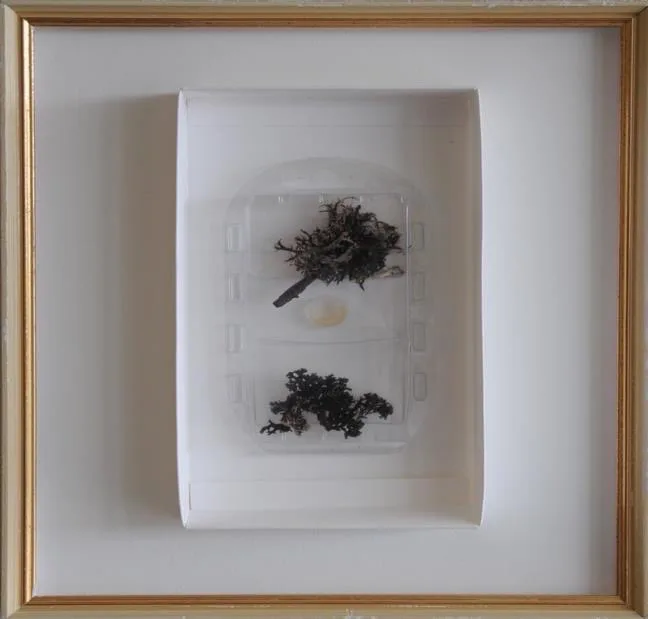
To our surprise, just as we began, a woman asked if she was allowed to say something. Sure! we answered, and this was already the beginning of a group process on the topic of trust. Everybody spoke out and we found many ghosts. For example, the ghost in business who is not caring about trust. We also found out that the young people had a very different relationship to trust than the older participants. We felt all the stories of the people and at the same time we noticed the freshness of the young people. In some way we had a group process about intergenerational aspects of trust. It was really amazing and motivated me to explore Deep Democracy even more in the direction of art.
Back to practice
Exercise: Watching Art
In dyads, triads or together in small groups
The exercise is written for dyads
- Go together through an art exhibition and choose an artwork that catches your attention, that flirts with you.
- Notice first effects, impressions. What flirts with you, what disturbs you. Exchange your impressions.
- Study the qualities that you like, qualities that you are able to locate. Describe this as roles. Is there a polarity between you? Try to stand for your role and play with these roles.
- In a next step find out something that disturbs you, something strange, something you don’t understand, or you don’t like. Can you show this in a role too?
- Go on with role playing with the roles you like and with the roles you don’t like. Try to identify also with the roles you don’t like and give them a voice. Continue to explore more and more every role and especially the role you don’t like, you don’t understand. Try to identify with it till you find an essence of that role. Play together with the essences of the roles. Let go, be creative, co-create the artwork again so that you become the co-artist of the artwork.
- Discuss what changes happened through this play? What do you take with you into the everyday life?
- How is the artwork now helpful for you feeling home in a new experience?
Chapter 4: Inner work and composing music
To finish the part on applications I would like to share a deep process with music and Process Work I had in winter 2017.
January 1st 2017
I spent a wonderful Sunday with sunny weather and a beautiful walk.
After coming home, a thought came:
Magdalena now you have time to make music, why do you hesitate all the time since Lorenz’s death?
So I prepared myself for inner work on this issue.
What was the hesitation?
Love for the hesitation. The hesitation got space. The space was very vulnerable, sensitive, so that almost every music was too loud. I could not imagine as before, to decide which music to work on now, in the sense of business as usual. I am now in a special space where the unknown for me as musician is strange, no longer my normal identity.
Realizing also that my everyday life requires from me so many rational decisions, busy with material things, with proceedings, so that I marginalized this vulnerability and looked always for space to rest.
The next step was: How can I express this with a musical gesture? I had to expect that nothing would happen.
Stepping into this vulnerable space and letting this space express itself. Suddenly I let something fall down into the piano strings. And then an amazing thing happened. It was the fade away of the sound, like dying.
And I felt the resonance to my spot where I had been the whole time.
This gave me an idea to work in this direction and the idea to take this vulnerability also more into my everyday life.
January 3rd 2017
Today I lived with my vulnerability: This awareness helped to balance between everyday life with its requirements and the care for my vulnerability.
Listen: Music Gesture Klanggeste (Schatzmann, n.d.)
Listen: Wohin geht der Klang – Where to does the sound go? (Schatzmann, n.d.)
January 10th 2017
In my studio I began now to compose a piece that connected to my past experiences with my vulnerability process. It was in a way easy. I heard the sounds that were the right ones for the moment. I composed in an associative way, not how normally classical composers work. And I realized I was feeling very familiar with composing like being at home.
Finally, I tried out some pieces on the piano, a Chopin etude for training my fingers.
Suddenly I noticed why I hesitated in playing music. Music can be too materialistic, too many tones, too physical. I am and I was in a process with a dying person who lost more and more his physical life till the transition. When I remember the moment my husband died, there is deep silence.
My process is now to create music that nourishes the process of crossing the edge of the material world and entering a larger world.
There are composers who only write quiet music: For example, John Cage, Morton Feldman, Makiko Nishikaze. I also remember the last piece of Arnold Schönberg’s 6 little pieces for piano. The last one, very slow and quiet was written after the death of Gustav Mahler.
January 14th 2017
Today it was the right moment to continue the work on my piano piece. A long walk in a winter landscape, that unfolds the world in silence.
I stepped in and noticed a sensitive space in which the tones, the musical occurrence showed itself to be noted on paper. I remembered the composer Makiko Nishikaze who said once, that she asks for the right tone and then goes back to the beginning, playing the whole piece until she gets again to the new tone or sound and asks if she really wants to stay there.
Yes something similar I recognized: Like the Tao of the tone. I also remembered John Cage who worked a lot on the meaning of the Tao in his music by using the I Ching. How does the Tao show itself in the music? Cage works through spinning the coin: Wonderful. Nishikaze through a high sensitivity. Could it be that this way can be compared with the idea of a flirt, that Arnold Mindell teaches us?
The idea of a new composing practice by using the sentient path of flirts will be my next research.
Listen to the Music Behind.
Conclusion
We are now at the end of our journey and it is time to look back.
This work was a journey of about three years of studies, breaks, experiments, discussions with others, try outs, overworking phases and inner work. A grateful feeling fulfils me, thinking of my own growth through this work. It was a way back home for myself in a fresh new way.
At the beginning of this work was the deep experience of letting go of my dead partner, exploring another way to be in contact with this soul within the essence area. This experience, finding myself in a zero point, was one of the initial impulses for my research with the question: What is being home?
In a new way I found the essence realm as the center of experiencing our non-local home, the connection of life and death, the origin of art and music and of a deep aspect of Process Work and Deep Democracy. I explored how that innate creativity, grounded in the essence of the Tao that can’t be spoken, is a deep force to shape our world.
Every manifestation of art has its roots in the essence, and every change in our lives starts there. I know now, that the white paper before creating music for example is not something that I have to fear, but the white paper is the essence, where creativity comes from.
Firstly, this work changed me as an artist. Secondly, through this work I got a frame through Process Work for working also with individuals and groups to support thrm being home as creative human being.
Thirdly, this work was a journey to find my own way how to go further with Process Work, Deep Democracy, music and art in my next phase as an artist, as a facilitator and coach.
If you as the reader got curious to try out the exercises and to experience your artist’s side within yourself, a deep hope is fulfilled.
I discovered in a new way the fluidity between the three levels: the essence, dreamland and consensus reality. Experiencing deeply the essence in every life experience opened me up for more courage in life. This experience I also noticed in my work with clients. Shaping the experiences of the essence as the home for everything through art and music is now a central point of my work. Art as one of the first manifestations of everything precedes everyday life. The integration of music and art in the field of Process Work and Deep Democracy is a beautiful and awesome way to work on the fluidity through all levels, bringing the insights and gifts to everyday life.
Combining Process Work and Deep Democracy with art and music gives me personally something very concrete at hand to be reminded of the insights, also days after working on an issue. As an observer/listener of my work of art I get the possibility to discover again and again new aspects of my process. My experiences with myself and others show that to shape the essence experience in a real work of art, whatever this may be, is awesome. Even to create works of art that express strong polarities, shows the beauty of dissonances.
Finishing this diploma thesis and summarizing my research, the new book of Arnold Mindell is just published: The Leader’s 2nd Training (Arnold Mindell 2019a).
Arnold Mindell speaks of the “sound of silence” (Arnold Mindell 2019a, chap. 7). How happy I am to read this! He says that the sound of silence is one way to work with the Processmind, at the essence level. He says further:
The basic idea is that silence has a sound – a message.
In my experience, this sound of silence is the first of something that wants to come forward. Very far away even from dreams that we can imagine. For me as a musician music is a huge window to the deepest, true self and home, bridging physical and immaterial life and in my practice the source of creating music.
Music – and I would say arts generally – are the home of everything, and this can be possible for everyone. Look at my drawing below. It was my first manifestation of a vision. The “horns” coming out from my eyes and my ears as funnels reminds me still today to look and listen to the universe. I am not a painter and in school I always was “bad” in painting. But this isn’t the point. The point is, that everyone can experience herself as an artist, as a shaper and designer of her life, through music, arts and Process Work, experiencing again and again her true home.
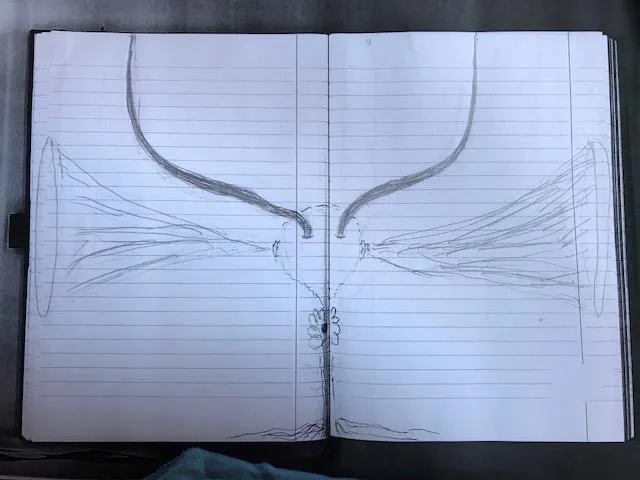
Bibliography
Abramovic, Marina. 1991. Waiting for an Idea. https://mcachicago.org/Collection/Items/1991/Marina-Abramovic-Sitting-Waiting-For- An-Idea-1991.
Walk Through Walls: A Memoir. Reprint edition. Crown/Archetype.
Adriani, Götz, Winfried Konnertz, and Karin Thomas. 1988. Joseph Beuys. Leben und Werk.
Köln: DuMont Reiseverlag, Ostfildern.
Ayre, Lane. 2002. Unintentional Music: Releasing Your Deepest Creativity. Charlottesville, VA: Hampton Roads Pub Co Inc.
Beuys, Joseph, and Clara Bodenmann-Ritter. 1988. Jeder Mensch ein Künstler. Gespräche auf der documenta 5 / 1972. 1. Berlin: Ullstein Tb.
Boulanger, Lili. 2012. D’un Soir Triste. https://youtu.be/1OERJAjoHRY.
Burckhardt, Jacqueline. 1994. Ein Gespräch. Joseph Beuys, Jannis Kounellis, Anselm Kiefer, Enzo Cucchi. Zürich: Hatje Cantz Verlag.
Cage, John. 1998. Cage: Piano Works – Volume 3. Place of publication not identified: Edition Peters.
John Cage’s 4’33”. https://www.youtube.com/watch?v=HypmW4Yd7SY.
Etudes Australes XXIV. New England: New England Conservatory. https://www.youtube.com/watch?v=o7Gzy1hGDg0&t=8s.
Debussy, Claude. 2016. Jeux. https://www.youtube.com/watch?v=R_m788t0VXY&t=393s.
Dixon, Trudy, Shunryu Suzuki, David Chadwick, Richard Baker, and Huston Smith. 2011. Zen Mind, Beginner’s Mind. Boston: Shambhala.
Drees, Stephan. 2008. Fragmen. Saarbrücken: Pfau Verlag.
Frisch, Max. 1969. Andorra : Stück in 12 Bildern. Bibliothek Suhrkamp , Bd. 101. 216.-245.
Tsd. Frankfurt a.M. : Suhrkamp,.
‘Generator (2014/2017)’. n.d. Marina Abramovic Institute. Accessed 8 September 2019. https://mai.art/generator20142017.
Harlan, Volker. 2011. Was ist Kunst? Werkstattgespräch mit Beuys. 7th ed. Stuttgart: Urachhaus.
Harlan, Volker, Rainer Rappmann, and Peter Schata. 1984. Soziale Plastik: Materialien zu Joseph Beuys. 3.,. Achberg: Achberger.
Henck, Herbert. 1994. Experimentelle Pianistik – Piano Klassische Noten Klavier. Mainz: Schott Verlag.
Hildegard von Bingen. 2017. Hortus Delicarium. https://youtu.be/G8MGiPo5IxU.
Hulten, Pontus. 1992. Jean Tinguely. Editions du Centre Pompidou.
Joseph Beuys – Harlan, Volker. 1988. Was ist Kunst? Werkstattgespräche mit Beuys. Stuttgart, Urachhaus Johannes M.Mayer,.
Joseph Beuys – Jeder Mensch Ist Ein Künstler (Portrait). 2011. Youtube: Beuys TV. https://www.youtube.com/watch?v=JjkHYQnxZTE 14.13.
Joseph Beuys Über Den Erweiterten Kunsbegriff. 2016. Beuys TV. https://youtu.be/PpBlrHscpE4.
Jung, C. G., ed. 2010. Children’s Dreams: Notes from the Seminar Given in 1936-1940. 1 edition. Princeton, N.J.; Woodstock: Princeton University Press.
Klophaus, Ute. 1993. ‘Joseph Beuys, Kunsthaus Zürich, Exhibition Catalog, Zurich’. Pro Litteris.
Kramer, Mario. 1999. Klang & Skulptur: Der musikalische Aspekt im Werk von Joseph Beuys. 1st ed. Darmstadt: Häußer, H J.
Laotse. 2010. Tao te king: Das Buch vom Sinn und Leben. Translated by Richard Wilhelm. Hamburg: Nikol.
Leuenberger, Hans-Dieter. 1984. Das Baum Des Lebens : Tarot Und Kabbala – Schule Des Tarot II. Hermann Bauer.
Marina Abramovic on Performing ‘Rhythm 0′ – 1974. 2017. Il Sapere – Youtube. https://youtu.be/kijKz3JzoD4.
Marx, Stefanie. 2009. Künstlerlegende – Joseph Beuys. 1st ed. GRIN Verlag.
Max Frisch Und Kurt Furgler Im Gespräch (Schweizerdeutsch). 2012. Zurich: Text und Bühne. https://www.youtube.com/results?search_query=%28Max+Frisch+Und+Kurt+Furgler+I m+Gespr%C3%A4ch+%28Schweizerdeutsch%29+2012%29.+.
Mindell, Amy. 2003. Metaskills: The Spiritual Art of Therapy. 2 edition. USA: Lao Tse Pr Ltd.
The Dreaming Source of Creativity: 30 Creative and Magical Ways to Work on Yourself. Createspace Independent Publishing Platform.
Mindell, Arnold. 1993. The Shaman’s Body. San Francisco, CA: HarperCollins – US.
Dreaming While Awake: Techniques for 24-Hour Lucid Dreaming. Charlottesville, VA: Hampton Roads.
River’s Way: The Process Science of the Dreambody. Portland, OR: Deep Democracy Exchange.
Quantum Mind. 2 edition. Portland, Oregon: Deep Democracy Exchange.
2014a. The Leader as Martial Artist. 3rd edition edition. Deep Democracy Exchange.
2014b. Sitting in the Fire: Large Group Transformation Using Conflict and Diversity. Florence, OR: Deep Democracy Exchange.
Conflict: Phases, Forums, and Solutions: For Our Dreams and Body, Organizations, Governments, and Planet. 2 edition. Place of publication not identified: Lao Tse World Press.
2019a. The Leader’s 2nd Training: For Your Life and Our World. S.l.: Gatekeeper Press.
2019b. The Year 1: Global Process Work: Community Creation from Global Problems, Tensions and Myths. S.l.: Gatekeeper Press.
Nattiez, Jean-Jacques. 1995. The Boulez-Cage Correspondence. Reprint. Cambridge: Cambridge University Press.
Neff, Severine. 2015. ‘Point/Counterpoint: John Cage Studies with Arnold Schoenberg’. Contemporary Music Review, Cage (re)Considered, 33 (5–6): 451–82.
Oliveros, Pauline. 2005. Deep Listening: A Composer’s Sound Practice. New York, NY: iUniverse, Inc.
Picasso, Pablo. 1963. Grand Profile. (https://www.art-galerie-shop.de/pablo-picasso-grand- profil.html).
Schatzmann, Magdalena. 2003. ‘Lehrerin Natur – Manuskript’. www.kraftortmusik.ch.
2018a. Balcony. https://soundcloud.com/magdalena-schatzmann/balcony.
2018b. Pressure. https://soundcloud.com/magdalena-schatzmann/press.
2018c. Soundcloud.
2018d. U and X. https://soundcloud.com/magdalena-schatzmann/uandx.
2018e. Weight Performance. Vimeo. https://vimeo.com/358024714/611f45bc7b.
2019a. Meditation Footprint. Vimeo. https://soundcloud.com/magdalena- schatzmann/footprint.
2019b. Tiaga Music Wave. Vimeo. Music: https://soundcloud.com/magdalena- schatzmann/taigamusicwav.
n.d. Decision. Vimeo. https://vimeo.com/359023802?utm_source=email&utm_medium=vimeo-cliptranscode- 201504&utm_campaign=29220.
n.d. Music Gesture Klanggeste Https://Soundcloud.Com/Magdalena- Schatzmann/Gesture. https://soundcloud.com/magdalena-schatzmann/gesture.
n.d. Wohin Geht Der Klang – Where to Does the Sound Go?
https://soundcloud.com/magdalena-schatzmann/klangestewohin-geht-der-klang.
Schoenberg, Arnold, Leonard Stein, and Danielle Cohen-Levinas. 2011. Le style et l’idée. Translated by Christiane de Lisle. Paris: Buchet-Chastel.
Schonberg, Arnold. 2008. 5 Kleine Klavierstücke. Rome. https://www.youtube.com/watch?v=_cmWgll8T4c.
Schübl, Elmar, Rudolf Hämmerli, and Jean Gebser. 2015. Ursprung und Gegenwart: Erster Teil: Die Fundamente der aperspektivischen Welt. Beitrag zu einer Geschichte der Bewusstwerdung Zweiter Teil: Die … des Geistigen. Zürich: Chronos.
Schupbach, Max. 2007a. ‘Ein Multidimensionales Change Management Modell’.
OrganisationsEntwicklung, no. 4: 56–64.
2007b. ‘Worldwork: Ein Multidimensionales Change Management Modell. Zeitschrift Für Organisations Entwicklung’. www.deepdemocracyinstitute.org/ddipublications.
2010. ‘Worldwork Methodology’. Deep Democracy Institute International. https://www.deepdemocracyinstitute.org/fileadmin/user_upload/PDF_DOCS/Articles/ Worldwork_Methodology.pdf.
n.d. ‘Attitudes of the Worldworker’. Deep Democracy Institute International. Accessed 7 September 2019. https://www.deepdemocracyinstitute.org/fileadmin/user_upload/PDF_DOCS/Articles/A ttitudes_of_the_Worldworker.pdf.
Steiner, Rudolf. 2018. Die Philosophie der Freiheit: Grundzüge einer modernen Weltanschauung. Mit beiden Ausgaben. 5th ed. Rudolf Steiner Ausgaben.
The Shocking Marina Abramovic. 2014. BBC Newsnight. https://www.youtube.com/watch?v=ZSz-ZhjDKuU.
Webern, Anton. n.d. 6 Pieces for Large Orchestra, Op.6. : https://www.youtube.com/watch?v=g0jCDxWvufw.
Wikipedia, Contributors. 2019. ‘Joseph Beuys, Wikipedia, The Free Encyclopaedia’. Joseph Beuys (blog). 23 August 2019. https://en.wikipedia.org/w/index.php?title=Joseph_Beuys&oldid=911091300.
n.d. ‘Harald Naegeli, Wikipedia, The Free Encyclopaedia’. Accessed 23 August 2019. https://en.wikipedia.org/w/index.php?title=Harald_Naegeli&oldid=856930772.
Zakir Hussein, and Rakesh Chaurasia. 2015. EtnoKraków Rozstaje. Crossroads Festival Krakow.
Appendix 1: Glossary
Process: The flow of information. There are two different streams of information. One is more known that we tend to like, the other is less known and we tend to dislike.
Primary + Secondary Process, U and X: Primary Process (u): The informational that we like or know well. Secondary Process (x). The information that is considered foreign and that is experienced as out of control.
Edge: The boundary between more known (primary) and less known (secondary) information. It marks the limit of our identity. Process Work offers methods to cross the edge.
Deep Democracy: Noticing every piece of information at every level: consensus reality, dreamland and essence.
Role: An impersonal behavior pattern that is non local and belongs to all of us. Roles are viewpoints, behaviors or values that are agreed upon by the mainstream group culture. In groups, roles can manifest through individuals.
Ghost role: A ghost role is a behavior pattern, viewpoint or attitude that is considered not OK by the mainstream group culture and is therefore marginalized and put to the side. It is not congruently represented in the group.
Field: Non local and local information within a group that organizes individuals who then represent these information pieces through roles and ghost roles.
Channels: The various perception of the process. How you receive and send information. The different channels are: vision, auditory, proprioception (body feeling), movement, relationship and world.
Signal: An aspect of information that appears through one of the channels.
Double signal: An aspect of the information that is unintentional. The sender experiences this information as something out of her control. This information is connected with the secondary process.
Essence level: The realm of experience beyond polarity that can only be sensed, and often appears in atmospheres and experiences that are impossible or nearly impossible to speak about. It can be referred to as the Tao that can’t be spoken.
Flirt: The essence world can be noticed through flirts, a flickering signal that is barely detectable and cannot be tracked.
Dreamland: The world of night dreams as well as fantasies, feelings, and subjective experiences of individuals and groups. These experiences cannot be measured objectively.
Consensus Reality: The measurable world of the everyday life that is considered “real” by the given culture. What is considered “real” varies from culture to culture.
Life Myth, childhood dreams: A significant early dream or early memory that shows patterns that will appear throughout your life. This could also be called the life melody or life dance.
Non locality: Originating from quantum physics, this term describes experiences that are beyond time and space and might be discovered in individuals, groups, and the world as a whole.
Major and Minor System: Scales of a tonal system in Europe that arose after the Middle Ages. The seven scales were reduced to two: Minor and Major
Harmony: Sound of two or more voices. The vertical aspect of music.
Symphony: A musical structure of a orchestral music since the beginning of the 17th century. This structure was important in the classical (18th century) and Romantic (19th century) periods of music.
Musical phrase: In composition theory: Some motifs, or gestures, like thoughts, that build a little unity. Comparable with a sentence in language.
Appendix 2: Exercises
Exercises Part 1
Chapter 2: Stability of the process
Exercise 1: Basic Experience 1 – Taste of u and x
- Think of something you like at the moment (u)
- How do you know that you like this?
- Check, in which channel do you experience this
- Think of something you don’t like at the moment
- How do you know the pain?
- Try to find out the channel in which you have this experience
- Follow the experience in the channel you noticed X.
Exercise 2: Basic Experience 2 – U and X and Music
- For a moment stop your activities in your everyday life
- Sit or stand comfortably, take some breaths.
- Try to open your mind a bit
- Is there anything you like in this moment?
- Describe it and enjoy it
- Find a sound for this, something short (Short melody, rhythm, noise ) Is there anything uncomfortable for you, something you don’t like? Bothering, disturbing? Describe it and find a sound as mentioned above
- Combine the two sounds and create a little piece of music
- How does this music speak to you? Any insights?
Exercises Part 2
Chapter 2: Joseph Beuys
Exercise 3: Utopia training, Sculpting your world
- Look at your everyday life and think of an area where you miss inspiration and excitement.
- Take a few breaths, relax, allow yourself to get dreamy, foggy.
- Imagine being very far away from the earth, or far away from your everyday life situation.
- Look around. What do you notice? Is there something that seems special and attractive to you? Is it the whole scene or a certain aspect?
- Try then to let go of the boundary between you and this area until you feel you are the area itself. Forget your everyday life. (This might take a little time). Now become this place. You are now this place.
- As this place (which is you), which characteristic or quality do you notice yourself being? Enjoy it. This place is full of creativity without boundaries. As this place, explore your quality that differs from your everyday self. Be now this new quality, enjoy it, move it, let it sound.
- From this new perspective look at the issue you thought of in step 1. Is there a main point, an overall aspect that you as this place notice? What is the most important point from your perspective now? What is the inspirational aspect?
This aspect may be something bigger than you are usually able to realize in everyday life. Don’t worry, you are now this new self for a moment and not a being in everyday life. - After giving enough space to what this new self is telling you, create as this self some next steps coming closer to inspiration, ideas, realizations. What could change in the world by realizing these steps?
- Try to sculpture this now in a sort of artwork: Take some material to form, find a sound to build a piece of music, invite people to share your idea, write a poem, make a performance etc.
Exercise 4: Embodiment of a vision
This exercise wants to give you an opportunity to explore your inner artist and to realize with this inner artist your visions and plans. Here, I mean art as a journey that begins in a super sensory world. The essence level in Process Work or Beuy’s ferner punkt can support you to transcend your everyday mind, coming home to yourself, and from there create a vision. The exercise has two parts and you can work on it through a period of two or more days for deepening your visions. The exercise helps you find a big plan or a big vision. It also can be used for deep changes in your life.
Part 1
- Think of a plan, a vision or a dream that you can’t realize because either you didn’t think it was possible, or the time wasn’t right yet to go ahead with it. Something remained vague, something stopped you, there wasn’t enough will and energy. But you now want to go for it.
- The vision, the plan: Look first at the overall vision, this can be vague, a feeling, an inner picture, or something else. Make some notes, then put them aside.
- Let yourself drift to a place that is very far away from your everyday life (Beuys’ ferner punkt).
- Look around this place, enjoy the special quality. Feel, move, sound the quality and more and more become this quality. As this place with this special quality, you are the force behind your vision. What is it like to be this force? What is its distinctive character?
- As this place, as this force look at your vision. What is the most important reason to realize this vision or plan? What is behind it? What is the essence of the vision or plan?
- Now as this force choose a media and – still being this force yourself – shape the essence of your vision. Paint, sound, move, write as this force. If sound: make a ape or write the score of the music, if you move, make a movie. As this force you are the artist creating a work of art.
- Give yourself enough time to create this artwork. You as this artist are far away from your everyday self, you fly beyond edges and create like a famous artist. You are now the artist and this artist is the creator, that brings the source of the vision into an audible, visible, tangible shape.
- After finishing. Leave it for at least one day.
Part 2:
- The next day, look at, listen to or read what you created as if you were an observer, not the creator. Let your inspirations arise as if you are in an exhibition, in a concert or a performance.
- Try to find out which part of this artwork is not like your everyday self. Perhaps bigger, crazier, stranger etc. What is the difference between you and this special part of your work of art? Notice the artist who created this. Describe this artist as if you are describing her for an advertisement.
- Who is this artist, what is her quality? Imagine why the public adores this artist.
- Create a hand movement for the special quality of this artist and repeat it till you get a sort of insight, how your inner artist supports you in your everyday life and in realizing your vision.
- Celebrate the birth of your new inner artist, dance it, move it, sing it etc.
- What are the next steps to realize your vision?
Chapter 3: John Cage
Exercise 5: Listening training 1, being home
This exercise supports you in enlarging your understanding of what is music and you can train to open up to unfamiliar qualities. The unfamiliar qualities in the auditory channel as in music are a very strong secondary process. If we don’t like something in music but have to listen to it, it shows us strong edges and often this is painful to bear.
- Listen to one of the recordings of Imaginary Landscape, take the one which is the least comfortable for you. (see link on previous page).
- Listen to a part of it.
- Turn off the music and describe to yourself the most unfamiliar aspect of the piece in a hand movement.
- Repeat the movement until you understand its meaning (until you understand its energy).
- Relax, take some breaths and go in your imagination to a place on earth or universe. You don’t have to know this place.
- Be there, feel the quality of the place. Can you notice a connection between the energy of your hand movement and this place?
- If yes, connect deeply, to this energy. Let go of your everyday personality and be this energy now. Who are you? How are you different from your everyday self? Enjoy this new flavour.
- Look at your everyday self from this perspective. Do you have any advice for your everyday self? What would change in your life if you were living this energy more? How could this be more home for you?
- Now listen again to Imaginary Landscape. How is the music now different for you?
Exercise 6: Listening training 2, being home
- Listen to a work by John Cage, for example Two2 (see link on previous page).
- Take a few breaths before starting the recording and sit comfortably.
- Turn on the music and listen
- If something is not comfortable, notice it and let it go
- Connect deeply with each sound you hear, be this music now, let go your everyday life and your everyday self, travel now as sound, tone, pause.
- You are now in a parallel world, a music world. This world is everywhere, there are no boundaries, the sound has no beginning and no end. Be this now, a being of everywhere and without borders, no beginning, no end.
- Be this music and look back to your everyday self. As this music, what message do you have for your everyday self, right now?
- Return, and meditate on the message. What could change in your life if you followed this message?
- What could be a new aspect of being home for you?
Exercise 7: Your issue, Your symphony
This exercise you can practice inside or outside in nature. You can try it by yourself or with somebody leading you through.
- Take some breaths and sit or stand in a comfortable way.
- Think of an issue you want to know more about, make some notes. Then put the notes aside.
- Take your time, relax and then start to listen.
- Open your ears and your whole body to all sounds and the noise of your environment. You are now an auditory organism.
- Imagine the sound you hear is a music piece with more than one voice. Try to listen to all the voices that sound right now, try to listen not only horizontally but also vertically, so that you listen to the music as a score with different voices, for example like a symphony with many actors. Enjoy the wholeness of different voices.
- You can try now to differentiate the voices. Notice the rhythm, pitch, tempo and sound color or timbre you hear and observe them in a neutral way. For example:
- What sound color do you hear?
- How is the volume or the different volumes?
- How is the pitch of the sound? High? Low? Or if more than one sound, different pitches?
- How many actors do you notice in this music?
- How is the specific quality of each voice in this symphony?
- Make a tape of your environment’s sound and/or write down a description of what you are hearing – studying every voice.
- While listening and studying, try to separate the different sounds, so that every sound expresses something unique – a role, like a figure.
- How does this music speak to you? Are there some sounds that are closer to you than others? Are there sounds disturbing you? If yes, take a disturbing sound and open up to its message for you. You can either shape shift and become this sound or listen deeply till an insight emerges. Try to do this with all voices also those who are close to you, and you love.
- How do all the sounds come together? What quality has this music as a whole, like a symphony of these different sounds? How are you connected with this symphony?
- Try now to be this whole symphony and express being this symphony in your own style: movement, imagination, a sound that includes the different voices. Is there any advice you get from this experience, for your everyday self?
Questions for your everyday self:
- What is the message of every sound referring to your issue from step 2 of this exercise?
- How can the voices support you with your issue?
- If you as your everyday self would be this music right now, who would you be in this moment? What would change in your life?
- Other insights?
Chapter 4: Marina Abramovic and crossing edges
Exercise 8: Crossing edges as a performance
- Do you have an issue you are stuck with? Perhaps you are in a conflict, you have panic, or fear. Somewhere you feel at an edge and can’t move forward?
Reflect and make some notes especially notes about an energy that bothers you, that is scary for you. It can also be a person you are scared of. - Work now on the energy that is the most scary and painful for you
- Try now to step into this energy, contact this energy
- Create a performance for yourself so that you allow yourself to experience endurance, willingness to be in the unknown, high discipline, love.
- Performance design: Set a time to do the performance you want to do. This will train your discipline and endurance. Be careful about setting the time. Can you assess your momentary capacity of endurance and discipline? Check this with a try out, check your endurance and then create a design that requires a bit more, so that you can cross an edge.
- Create an idea for a life sculpture, meaning you are the sculpture.
- First make a practice, for finding out the right position
- Change some ideas for the performance so that it fits with what you want to do.
- During the performance notice what happens
- Watch the performance
- Your insights, next steps
Chapter 5: Max Frisch and the hidden force of art and Process Work
Exercise 9: Inner group process
9. Remember an issue with a group. This may be your working group, your family, friends, sports club or whatever group. The issue can be a conflict, a collaboration, you want to explore more, a project.
10. Describe the issue.
11. Describe all participants you notice.
12. Start a Group Process with yourself and let all the voices speak.
13. Play all the roles, switch from one role to another, let the voices fight with each other, bringing their arguments and notice what is special, surprising, not predicted/unexpected. Follow the flow of the information that arises.
14. Try to create something like a play with all the various pieces of information.
15. While doing this, one part of yourself is noticing, what changes and is tracking surprising moments. One part is the participants, one part is the facilitator.
16. Follow the process till something meaningful happens. For example, an insight might emerge.
9a. Write down the process as a story. Study all the voices and let your creativity flow till this story is no longer bound to the group members.
9b. Another possibility: Create a sound, melody, rhythm for every voice and make a tape of them all. Listen to the voices like a music piece.
12. Create especially the insight you have as a music, poem, painting, dance …
13. When you meet the group again, notice, if something has changed. Information is non local, therefore it can be, that you helped the group reveal hidden information.
Exercises Part 3
Chapter 3: Hüllen
Exercise 10: Watching art
In dyads, tryads or together in small groups
The exercise is written for dyads
- Go together through an art exhibition and choose an artwork that catches your attention, that flirts with you.
- Notice first effects, impressions. What flirts with you, what disturbs you. Exchange your impressions.
- Study the qualities that you like, qualities that you are able to locate. Describe this as roles. Is there a polarity between you? Try to stand for your role and play with these roles.
- In a next step find out something that disturbs you, something strange, something you don’t understand, or you don’t like. Can you show this in a role too?
- Go on with role playing with the roles you like and with the roles you don’t like. Try to identify also with the roles you don’t like and give them a voice. Continue to explore more and more every role and especially the role you don’t like, you don’t understand. Try to identify with it till you find an essence of that role. Play together with the essences of the roles. Let go, be creative, co-create the artwork again so that you become the co-artist of the artwork.
- Discuss what changes happened through this play? What do you take with you into the everyday life?
- How is the artwork now helpful for you feeling home in a new experience?
Appendix 3: Links to Audios and Videos
Part 1: From art and music to Process Work to coming back home
Chapter 3: Process Work, Deep Democracy, arts and music: beauty as totality
Balcony: https://soundcloud.com/magdalena-schatzmann/balcony
Pressure: https://soundcloud.com/magdalena-schatzmann/pressure
U and X: https://soundcloud.com/magdalena-schatzmann/uandx
Symphony No. 5 Abbado by Gustav Mahler https://youtu.be/vOvXhyldUko
Maraba Blue by Abdullah Ibrahim https://youtu.be/P5CGq4ZIsME
In a Landscape by John Cage https://youtu.be/nYSLwpDukSA
Deep Listening, by Pauline Oliveros https://youtu.be/0at5DrXpJj8
Pollini Schönberg 6 Little Piano Pieces, Op.19 Live https://www.youtube.com/watch?v=_cmWgll8T4c
Anton Webern: 6 Pieces for Large Orchestra, Op.6 https://www.youtube.com/watch?v=g0jCDxWvufw
Part 2: Artists and their impulse for coming back home
Chapter 3: John Cage – Deep Democracy and the Tao of music
John Cage:
Two 2 for two pianos https://www.youtube.com/watch?v=FyF-0jFQaAY
4’33” for Solo piano https://www.youtube.com/watch?v=FyF-0jFQaAY
Works where he used radio stations playing unintentionally:
Imaginary landscape https://www.youtube.com/watch?v=oPfwrFl1FHM
Music for Piano https://www.youtube.com/watch?v=tH1a82KQu38
Chapter 4: Marina Abramovic and crossing edges
Weight Performance: https://vimeo.com/358024714/611f45bc7b
Chapter 5 Max Frisch and the hidden force of group process
Gespräch Max Frisch mit Kurt Furgler (Schweizerdeutsch): https://www.youtube.com/watch?v=vpfhM2Q_TV0&t=546s
Part 3: Applications
Chapter 2: My way to a decision
Magdalena Schatzmann: Decision https://vimeo.com/359023802
Free Music: https://soundcloud.com/magdalena-schatzmann/freemusic251218
Ivy branch: https://soundcloud.com/magdalena-schatzmann/freemusicivybranch291218
Footprint: https://soundcloud.com/magdalena-schatzmann/footprint
Claude Debussy: https://soundcloud.com/magdalena-schatzmann/debussy-des-pas-sur-la- neigewav
Taigamusic: https://soundcloud.com/magdalena-schatzmann/taigamusicwav
Chapter 4: Inner work and composing music
Magdalena Schatzmann: Music Gesture Klanggeste https://soundcloud.com/magdalena-schatzmann/gesture
Magdalena Schatzmann: Wohin geht der Klang – Where to does the sound go? https://soundcloud.com/magdalena-schatzmann/klangestewohin-geht-der-klang
Magdalena Schatzmann: The Music Behind https://soundcloud.com/magdalena-schatzmann/behind-1
- Translation: “Everything moves, there is no immobility. Don’t let yourself be terrorised by terms from times that are over. Let go the minutes, the seconds, and the hours. Stop resisting the metamorphosis. Be within the time, be static within the movement. For a stability of movement, for a stability in the here and now. Resist the weakness of stopping the movement, freezing moments and killing what is alive. Stop confirming again and again the values which crumble anyway. Be free, be alive. Stop ‘drawing’ time. Let go the construction of the cathedrals and the pyramids which crumble like cakes. Breathe deeply. Live in the present, live in and over the time, for a beautiful and total reality” ↩︎
- Translation: The collapse of the time in our consciousness: this event is the huge and unique topic of our days. It is a new topic and a new task. Its realization allows us a total new reality, intensity, and liberated awareness and therefore the overcoming of the confusion which superficially seems to characterize our world. ↩︎
- Translation: … that the mental-rational time is a dividing principle and term … Familiar to our previous consciousness the mental-rational term for time is most familiar to us. But what is uncovered is more than the mere term ‘time’, it is the ‘anachron’ which means being liberated from and free of time. ↩︎
- Translation: Normally I begin a discussion today telling the people: Imagine you were at a point far away from here and would watch the earth from this very farthest point. What would show up as the most important? From the most important then going to the details. So always the immediate, the most obvious and then going to the details. ↩︎
- 5Wenn du ein waches Auge hast, kannst du sehen, dass jeder Mensch ein Künstler ist. Ich war jetzt in Madrid und habe gesehen wie die Männer, die bei der Müllabfuhr arbeiten, grosse Genies sind. Das erkennt man an der Art wie sie ihre Arbeit tun und was für Gesichter sie dabei haben. Man sieht, dass sie Vertreter einer zukünftigen Menschheit sind. Und ich habe etwas bei den Müllabfuhrleuten gesehen, was ich bei den Scheisskünstlern vermisse, denn Künstler sind zum grossen Teil opportunistisch, sie sind Arschlöcher, das muss ich jetzt auch mal sagen. Die Künstler sind die reaktionärste Klasse.
Eigentlich gibt es ja keine Klassen mehr, aber die Künstler sind so reaktionär, dass sie schon fast wieder eine neue Klasse bilden. ↩︎ - Translation: Art is the element in the content of the world, where we experience, that this is the point, the source from where something comes into the world, from where something will be produced, which is always new, and in this sense evolutionary. ↩︎
- Translation: Wherever we are, mostly we hear noises. If we don’t notice them consciously, they disturb us. If we do listen to them, they become fascinating Should the word music be sacred and be reserved to the instruments of the 18th and 19th century, we can replace it with something that makes more sense: the organization of sound [See remainder of footnote 6 on p. 6]. ↩︎
- Translation: I don’t try to differentiate between music and no music, instead I begin with noise and I don’t use sounds which don’t have the character of noise. The author of the book Klang und Skulptur concludes: “This would be a democratization. Through the compositions of Cage, a consciousness will grow, that the world will become sound or the world is simply sound”. ↩︎
- Translation: The clearer and the more unintended, with that unconditional honesty towards all that lives, which only makes an artist out of talent… Or: Everything that is alive has an innate antithesis, it corrodes ideology and because of this we don’t have to be ashamed, if we are criticized for being corrosive in our writings. ↩︎