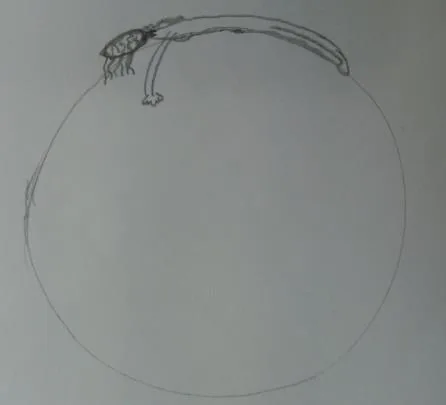
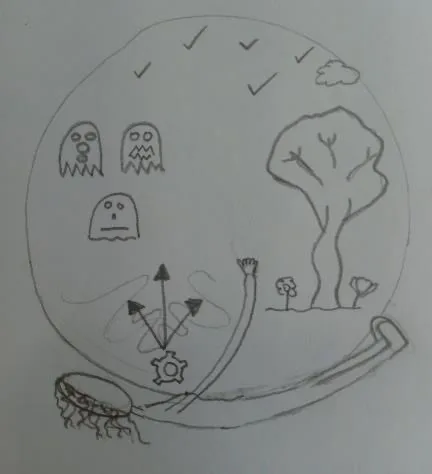
One night I had a dream where I dreamt that I trained myself to find the deepest part of myself. In the dream I behaved in a very disciplined way, nothing distracted me. The goal was to be connected with my essential being. In the dream I don’t want anything to distract me. What I do in it is to leave everything aside to focus on myself, to modify my internal atmosphere. In the dream I don’t want my critics1 to distract me from my goal.
I explored this dream with the processwork methodology in my individual therapy session with a person who helped me decipher it. The processwork methodology has a very creative way of exploring what bothers or disturbs us (in this case, it is the critics). As a result of exploring this dream, I discovered that when I approached it in a creative way, the image of Harry Potter came to me. What I found was that the dream helped me to understand that there is an energy represented in the personification of the Harry Potter character that helps me face the critics. The energy of the critics was no longer an annoying energy but a useful energy because Harry Potter becomes a character that helps me deal with my critical voices. There is something in the movement of the hands that makes magic and that allows me to control what I want to focus on. This is something that is not very common in my daily life. Doing this internal work and connecting with the energy of Harry Potter I realized that I could do magic with my magic wand and that that energy is inside me.
And that’s why I’m doing this final project. I have come to a point of inflection in my life in which I realize that my critics have taken centre stage in my day to day life. I am no longer the one who interacts with the world (with my loved ones, with the people who consult me) They are my critics! They are everywhere. I project them on other people and they are so strong that they make me see the world from their point of view. My inner world is painful and living with myself is unbearable, my critics are devastating, and they tend to leave me lonely or act as my worst enemies, criticizing me over and over again. For this reason I decided to break up with some relationships believing that the enemy is on the outside, but the relationships that I establish with other people are distorted by the constant criticism from my critics and I then don’t know how to differentiate everyday reality from my own internal reality. I wonder: How can my processmind illuminate me in difficult times? Without being very aware of it at the beginning, my processmind has led me to want to write this final project.
I want to learn to trust more in the unknown, not to have to control everything, and to be more at the essence level. With this project for my Processwork studies I intend to report my progress of exploration of the essential questions that I pose at the beginning of my research:
How can my processmind help me in my relationship with my critics?
How can I trust in myself more?
How can I trust the signals more?
To do my research I have practiced innerwork every morning for a month, I have investigate my conflicts in relationship and how this is connected with my critics, I have analyzed my childhoodreams and accessed to my processmind from biodance methodology.
The idea is to make a personal project using heuristic analysis to answer these questions. Heurism is a generic term that encapsulates a way of thinking and exploring. It requires an understanding of the process that comprises the experience of discovery that pre-empts the formulation of an hypothesis.2
How do I find my balance? What brings me out of my center? What kind of things are really difficult for me and how this is connected to my personal history. Therefore, the project is coupled with my development as a facilitator. What happens to me and to my personal psychology when I am facilitating?
I intend to explain how by connecting in a non-mental but sensory way to specific places in nature or the universe, these anchored experiences become allies. I want to explain the mess, what I could have done, how the situation challenged me, real examples of how to use that wise part of me more, and examples of when I did it right and explain what could have gone wrong.
Doing this inner work is like coming home, being able to rest. Where you arrive and there are no battles. That’s why I want to do this work. To help people get home. It is a way home, where there is no duality. In this place there is no judgment and embracing the different parts makes me feel a deep acceptance of myself.
1.1 Background
Processwork came into my life when I needed it the most. I was doing therapy with a woman and she told me that they were about to start a course in my city on processwork. I decided to go to the seminar to decide whether to do the training. I identified myself as being a victim for some time and unhappy with daily situations that disturbed me a lot and I really needed help to be able to face my difficulties.
Arnold Mindell is known for his research3 on the mind-body phenomenon; that extends Jungian analysis of dreams to bodily symptoms, promoting ideas of “deep democracy” and interpreting concepts of physics and mathematics in psychological terms4. Mindell is the founder of Processwork is a theoretical and practical model to increase awareness, developed from Jungian psychology, quantum physics and some spiritual traditions such as Taoist philosophy and shamanism.
Mindell, in his book Processmind, A User’s Guide to Connecting with the Mind of God, defines the processmind as a organizing principle. (Arnold Mindell 2010).
Mindell, with his background as a physicist and Jungian analyst, seeks to deepen the connection between quantum physics, psychology and the training of consciousness.
He began to develop methods and exercises to connect with the deepest and most essential level of the person, with the inner wisdom of what he began by calling “Big U” or the “great-being”. Later in his research and personal exploration, applying these exercises to a diversity of people in different cultures and contexts, he created the term “processmind” (mind-of-process). It refers to a type of intelligence that is not circumscribed to the “thinking mind” or to mere cerebral function, but is part of the essence of each being and is connected with a greater intelligence, with a universal wisdom. (In this writing we will refer to the “processmind” as processmind).
Amy Mindell (his sentimental and work partner) brings to it a very creative, loving, compassionate part, which has to do with meta-skills5, which add a spiritual dimension to the psychotherapeutic practice.
1.2 Some concepts about processwork “processwork”.
“The processmind is the palpable, intelligent, organisational” field strength “present behind our personal and long-term processes, as well as other deep quantum patterns behind universe processes. The processmind is an attempt to extend and deepen our call to know this field and these patterns as they are understood today in physics by connecting them with experiences and studies collected in psychology and mysticism.”6
This deep part of ourselves can be associated with a part of our body and the spirit of a specific place on Earth. Just as Earth is the basis of all forms of human and natural processes in the biosphere, the processmind is the dreaming intelligence behind all our experiences. The processmind is a key that every facilitator needs to work with all worlds and all peoples. (Arnold Mindell 2010).
What does Arnold Mindell mean with to be ‘in the phases’?
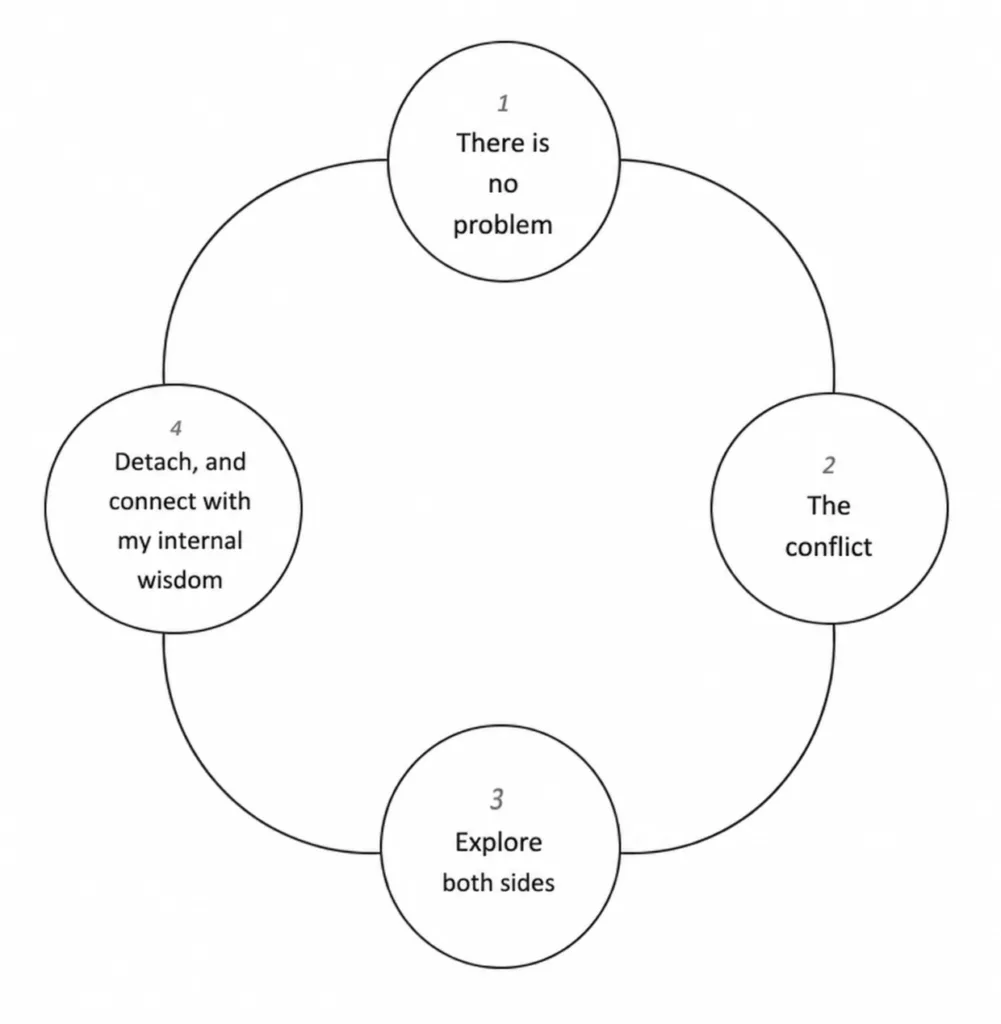
Mindell in his book Conflict: Phases, Forums, and Solutions, gives an explanation of four phases. These phases are stages in which we come and go not only with outward conflicts but also within ourselves. A person or a group can be in many phases, although often one predominates at a specific time. The idea of “phase” is that everything changes. For example, when dealing with a momentary or past conflict, the following simple description may be helpful (Arnold Mindell 2017).
Phase 1: Let’s enjoy! Here personal or relationship atmospheres are characterized by Let’s be happy! and not asking ourselves to deal with any tension.
Phase 2: Tension or conflict. We cannot avoid noticing bad moods, tension and conflict. Let’s run or fight!
Phase 3: Change of roles. Sometimes it is possible to “change roles” and dream on the “other side” of a topic or a relationship, the side that bothers us. In this phase, as in with dreams, we can imagine and sometimes even feel inside people or things that bother us.
Phase 4: Detachment, feeling how the universe moves you. Inevitably, through relaxation, detachment occurs. In these moments, our minds open up and we accept life more. Phase 4 is nevertheless a phase, which means that it will also change, and we will move to another phase, usually phase 1, hoping to avoid problems – which sometimes evolves again into phase 2 tension and / or other phases.
An example could be when we have tension between 2 parties and we focus on it doing inner work. If we get to phase 4 and let the universe move us, we can be in a more detached situation to see the two energies from another perspective.
Diagram of the phases
Arnold Mindell and the Second Training.
Phase 4 represents the detached experience, which also detaches from itself. Phase 4 is a phase and, paradoxically, also the center of all phases. Many of the techniques and ideas of this project are intended to help me access the experiences of phase 4 in the midst of tensions (this is what we call second attention). Mindell introduces the idea of “black box” as a metaphor to access phase 4. In the second attention we learn to feel the universe moving, we learn to let go of momentary events that come from outside and be closer to “our-self-that-dreams” to feel the “black box” of non-local connections. In the first part of the training you learn tools to deal with relationships and communities, to deal with phases 1, 2 and 3. It prepares you to use your own methods to deal with groups and organizations. The second part of the training is about finding phase 4 in yourself and in others and using it whenever you can. The second part of the training is not only about using your learned “science” but also your “art”, that is, not only to be a leader but to be an elder7 who is the wise one in each one of us, it is the part that knows the feelings of the black box in phase 4 (Arnold Mindell 2017).
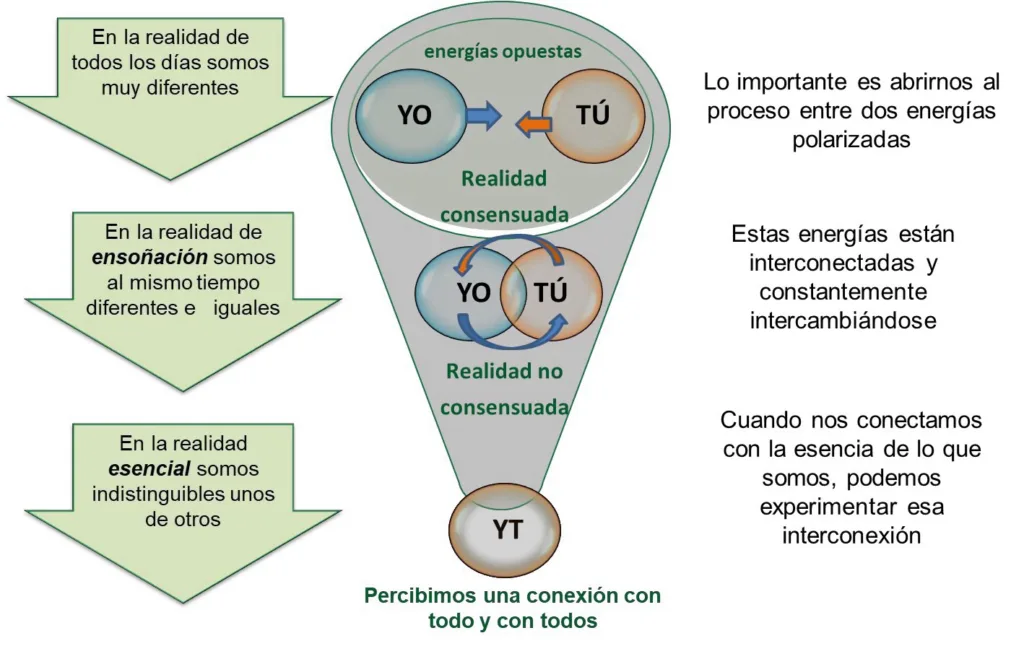
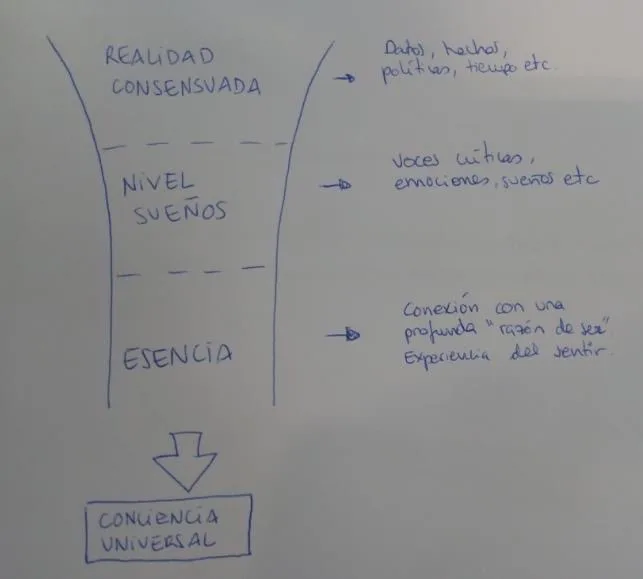
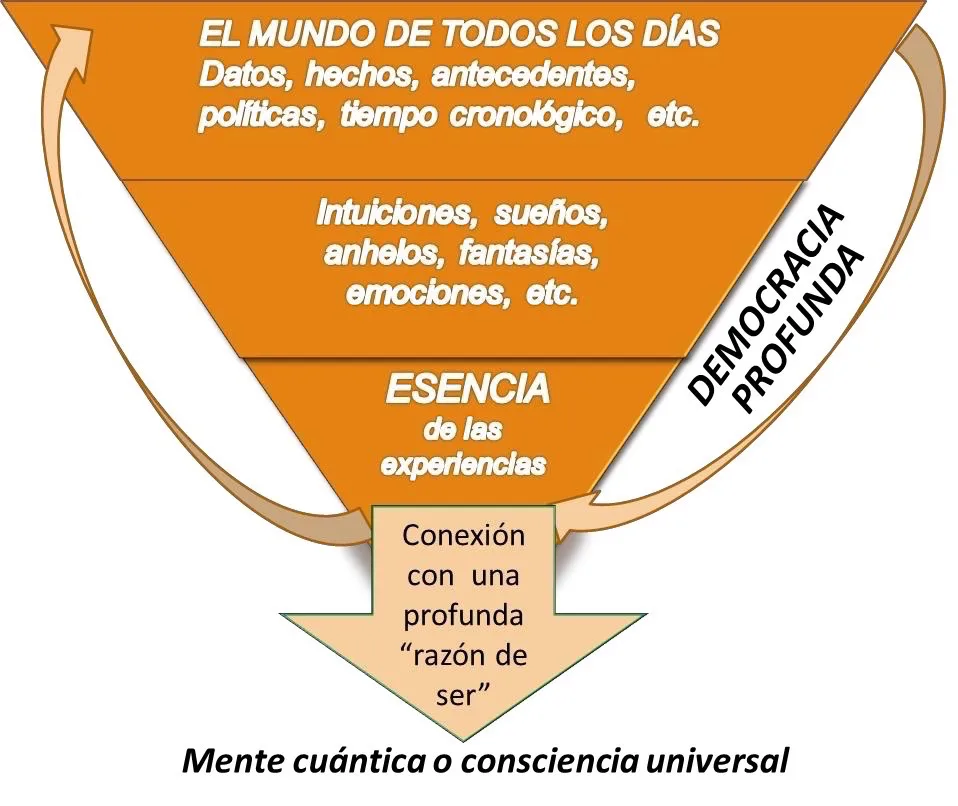
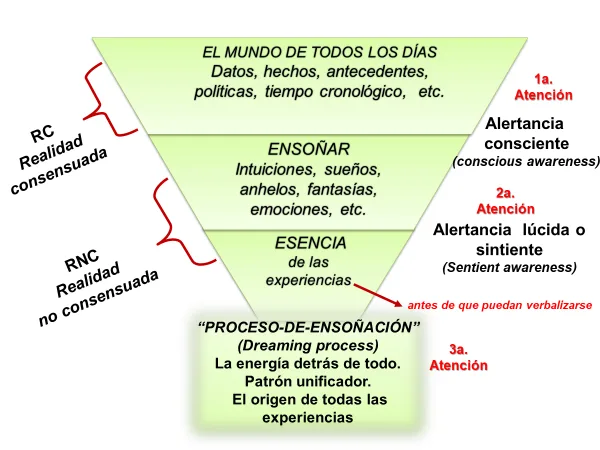
Levels of reality:
We are used to perceiving things in a certain way, but there are other ways of perceiving reality.
Consensus Reality: the top layer of deep democracy consists of the facts of the reality of each day and the problems they occupy. On the surface is the more or less agreed notion of reality for which there is “consensus”. Consensus reality sometimes depends on rigid identities. The democracy in consensual reality basically says “you are you and I am me”. Consensus reality suppresses subtle dreams and signals in communication.
Dream level: here we find dreams and double marginal signals (unconscious communication in sounds and gestures). In individuals and organizations, we can find deep objectives and basic visions here.
Essential level: the essence level of deep democracy is a set of subtle experiences and feelings that, at first, cannot be expressed in words. The Taoism of Lao Tse would call this level of deep democracy the “Tao that cannot be named.”8 It is a feeling of some magnetic or spiritual power in the air.
For example, our perception of time in consensual reality is that it is 5 o’clock in the afternoon.
At the dream level it has to do with how I am internally perceiving that hour. I can be sad, angry, happy, etc. At the essence level, time is perceived as a moment of union, belonging and well-being where everything acquires meaning.
Image taken from Lety Mendoza with permission of the author.
Chapter 2
2. My own edges with the processmind and how I faced them.
There are different types of edges or perceptual barriers which connect with the essential level: there are conceptual edges (for example: in my case thinking that this work is very “hippie” is a conceptual edge) and that is what I used to think about doing this project. Other edges may be more emotional (for example: fear of the unknown, not knowing what I will find with this work, or body edges (for example: fear of concentrating on my bodily sensations and letting myself be guided by them). The world tends to be more verbal, more auditory place, and intuition and proprioception (the perception of bodily sensations) occupy a less preponderant place.
2.1. What is an edge?
There is a way to define who we are, aspects that form a part of our known identity. On the other hand we have parts that we don’t know about ourselves, marginalized aspects that are also part of who we are, but with whom we do not identify. The edge is like a barrier that is in the middle of these parts and prevents contact with those marginalized aspects, which we need to be more complete people. The edge is usually inhabited by critics. Critics are the mental representation of the belief systems created by our own experience, by our own psychology, but they are also part of a wider question that comes from the society in which we are immersed.
For example, an edge for this case would be something that happened to me some time ago. I consider myself as very active, realistic, practical and focused and begun to have death-related nightmares -to which I didn’t give any importance- but at the same time I felt a heaviness in my body, and is lethargic and very unfocused. Obviously my experience was that my critics appeared in my head as little voices that told me that I had to get out of that state, that it was wrong to feel that way, because they made me slow down, be imprecise, etc. My edge is connected with “feeling passive, unproductive, distracted, with low energy”; connected with personal, family, social beliefs, that dismiss people who are not productive, successful, etc. These critics did not allow me to see something valuable in that state, such as the possibility that this state allowed me to slow down and connect “more inwardly” than “outwardly” to make adjustments in my life over what I had to change (die) ; as, for example in my case, let go my need for concrete and rapid results.
How do we know that we are up against an edge?
With respect to detecting edge signals in general we notice it when feeling discomfort, nerves, excitement or anxiety, or when we enter an altered state; for example, a feeling of low energy or depression or, on the contrary, annoyed, angry, confused or unclear.
For example, I have found these edges among my fellow students:
Fear that, when entering this deeper level, I connect with altered states of consciousness that I do not know how to handle.
The fear of encountering the unknown, realizing something I don’t know how to deal with.
Fear of feeling weird, crazy, new age, etc.
I have to feel productive, that I’m doing something concrete, that it serves the purposes I have and that I can see specific results.
2.2. Exploring my own edges.
In my experience so far, these have been my edges with connecting with the essential level and how I have been dealing with them:
The edge with lack of control, with letting go. An idea that has been useful to me during the project is to control the uncontrolled part (setting a specific time, for example). This is a shamanic concept: “controlled abandonment”. It lets you go through the edge in a controlled manner.
The edge with my own intensity: a edge that has to do with family and culture. In European culture (especially for women) intensity is something that has traditionally been seen as something negative. In a therapy session I discovered that part of my edge has to do with being able to distinguish when to be intense and when not. And to be very consistent with the times that I can be intense (for example, a suitable space would be in therapy, although sometimes I am against being intense in therapy. Not to be so intense with people I live with). Another idea is to be intense with my critics, with the part in which I disagree with them.
The edge with using creativity in this exploration: I have noticed it because the last part of this project has to do with exploring and expressing myself in a creative way; and
especially in the latter, I am finding it difficult to specify the creative part. When I explore it I realize that part of me wants to structure the creativity, but that is impossible! The creative part will emerge as you explore. The target of creativity will change as it develops! I cannot start the journey knowing the final result!
The edge with trusting that I can get out of the polarities and enter more easily into the essence. This part battles with my daily practices of inner work.
The edge with the idea that what I am doing is “hippie” and it is unreal, naive, etc. This edge I fight by giving space to the naive, to the little things. I wonder who is claiming that the hippie is unreal, naive, etc. I realize that it is said by an internal figure in me, a very boring businessman who is only interested in the results, not in the process and in the magic of the unknown.
The edge with being wrong: thinking that I have to do it perfectly, the pressure to do it in a brilliant way. The processmind sometimes involves “not doing”. For a few days I decide not to do interior work to become aware of the pressure. The fear of not knowing how to summarize the work well, of removing important information for its understanding. I keep dealing with it, I supervise myself, I ask for help.
The edge with confusion … of not being clear about what I have to do. There are times when I don’t understand fully what I have to do in this work. I live with my confusion, I let it be and I begin my journey, trusting that even being confused is part of the process.
Here is an example of how I worked a specific edge from my connection with processmind:
During the writing of this project, there was a specific moment in which I felt: “I am sad and I think I’m never going to accomplish this.” In this case, the edge was: “Will I be able to successfully complete my project?”
How can this thought help me write the project? The idea is to connect with the processmind and give myself advice from there. Do something useful with what is happening to me. This is the way I have to write the project.
I have to do this again and again, connect in a sensory, proprioceptive way and not from my everyday mind, which judges, divides, separates. That is why in Processwork we make a distinction between the behavior (which is linked to judgments: good-bad, useful- useless, positive-negative, etc.) and the energy (the essential force that is felt behind something that we name or experience). So it will be important throughout this project that I can detect the essential energy behind what I experience; both of what disturbs me (which we call energy “X”), and of the part of me that feels disturbed (which we call energy “U”)9
These are the steps I followed:
Note: “I am upset, I feel sad, incapable.” This is what disturbs me, what I don’t like and what is related to my critical voices. It is the energy “X” because it is unknown, I still don’t know how it can be useful, if it only disturbs me.
Stop the mind and connect internally: “What am I feeling? What is behind this feeling? How can I deal with this feeling, what is it useful for? Where do I feel this sadness and incapacity in my body? “I feel it in my chest and lower abdomen. I feel its atmosphere, its energy.
Then I put it aside and go to the processmind: “I relax, breathe deeply … I go with my relaxed mind to a part of my body where I feel at home, my centre … I feel its atmosphere … its energy. Then I visualize a place on earth that I like and that has the same energy and atmosphere of that part of my body that I feel at this moment as my centre. The image of the sea comes to me. Once there, I perceive the place with all my senses … the colors, smells, sensations, sounds … Now I look for where the disturbing energy (“X”) could also be. I try to find an environment, an atmosphere similar to the one I located in the chest and lower abdomen. I see this atmosphere in the stones below … I feel how its energy is part of the whole … I realize that there are algae and all the beings that inhabit the sea and that there is no contradiction. They have a reason for being and they are good there. The sea is not uncomfortable, there is no conflict there. They are sediment; they help to give a base from where to go deep.
Change of form: this step can be perceived as very irrational and illogical from the everyday mind, but I change my attention to the dream level, where the experience can connect me to the sea to feel as if the sea “breathes me” … and, as I get into its essence, I change shape, feeling that I am the sea, its immensity, its strength, its compassion, and now my being is connected to the processmind.
From the processmind, I ask a question: “What do I want to find from there? How can I help myself from this feeling of sadness? Is there any impulse?”
I find the following answer:
“Don’t worry, that’s part of what you’re learning. Go deep. Give it a structure and understand the dynamics, take this experience and put it in writing. Through this process you will be your own counselor of the final project”
Connected with my processmind, it is easy for me to detach myself and observe things differently.
As we have already said, the critical voices appear just at the edges, the voices which define what is right or wrong, possible or impossible, etc. those that value and judge; and, therefore, may prevent you from finding something useful beyond the edge. I invite you, dear reader, to explore yourself so that these steps also serve you.
Steps:
Take note.
Stop the mind and connect internally.
Then put it aside and go to the processmind.
Connect sensually and change shape.
From the processmind, ask a question or make a suggestion.
Chapter 3.
3. How the processmind can be a good medicine to deal with critics.
The project has the goal to inform about the progress of the exploration of the essential questions that I pose at the beginning of my research: How can my processmind help in my relationship with my critics? How can I trust more in me? How do you trust the signals more?
At the beginning of the writing of this project, I am a bit overwhelmed because I am afraid of dealing with my critics because there are too many. Although throughout my research I realize that critics are still present, they do not have the same impact because I have more resources to deal with them. It is great to feel that I am able to deal with them and they are not as rude as before. It is a pleasure to start having the feeling that I am able, in some moments, to stop their criticism and change my inner atmosphere! In a therapy session I realize that they are really different voices that come from the same critic.
3.1 Where do my critics come from?
My mother has been a person with a lot of internal oppression. She felt rejected by my biological father (he did not want to form a family with her) and she never processed that feeling, and I inherited those feelings related to grieving, anger, sadness and resentment. In my family there were many secrets (they did not tell me who my biological father was until I was 14 years old) and when things are not talked about openly, you usually feel oppressed. That is why in my case my critic is something mythical and chronic; that is, it will come back again and again as a pattern to my life and it will make me check this tension.
One objective of this work is to regain the power of the critic and for this there are different ways of doing it: have compassion for the critic, educate him (teach the critic to criticize), let the critic develop, fight with him. I am developing a critical conscience; that is, not only be the victim of the critic, but use it for something useful. Another important aspect is that I am creating a home feeling inside of me. The critic takes the feeling of home inside me and, therefore, I am transforming it. For example, when working with sadness I am creating a home feeling. I realize that the outside is not going to replace the inside. By this I mean that sometimes I find myself looking for something in the outside that will make me feel better and take away the sadness. I usually try to get rid of it. I have learn to embrace my sadness and welcome it inside of me. To go deeper into it with curiosity and from a loving attitude.
The challenge:
At the beginning of this project I do not understand what I am doing and I do not understand what I have to do. I start with the critics? Do I directly access the processmind? There are times when I connect with despair, thinking that all this will not help because I have too many critics.
After doing a therapy session I discover that the critic wants to be the guide of this final project and he is afraid that I want to reduce him to 3 simple formulas of how to deal with him. With his knowledge and strength he wants to guide this final project! He is afraid of disappearing; he becomes strong and says he is very creative. It does not want to be summarized to a model of 3 options and steps to follow. In my explorations, the critic is defined as strong, creative, and decisive and wants to be recognized for it. I tell him that I do not want to make him disappear, only to know him better, with respect. Perhaps the challenge to regain its power is to use my strength, creativity and resolution.
Normally I intend to draft the final project but other things are put on the way and take time to not do it. There are also days when I think about it, but I don’t do anything. For example, now I am writing this and I realize that 3 days ago I did not dedicate time to the final project.
I set a goal to connect with the processmind for a week, 3 times a day. The idea behind this is to have a framework. But I can’t do it for 3 minutes in a row. In that moment I have to allow myself to leave everything, and only enjoy the sense of being there. For three minutes I will not work with critics, just get out of all conflicts and allow myself to enter the processmind and notice what happens.
I have some difficulties at the moment of putting myself to carry out this practice. I realize that I have a great ability to distract myself. I have a strong addiction to food, to watch series and to look at the mobile, which very often is a clear sign of my distraction. Beyond my ability to distract me there are other deeper reasons. I discover that in my psychology there is a thought that doing what I do will not help anything, that nothing will change the things I have to work on, so why strive? Why do it if it will not help? If you will continue working on the same things! I will not get anywhere, that’s why it’s better not to do it. On the other hand, I realize that I want to do it very well and this part that pushes me so much looks for a level of perfection that demotivates my desire to continue with the project. I realize that I am fighting with a very big demon.
If my edge is to feel capable and successfully conclude my project of personal exploration, the critical voices that I detect has to do with the idea that striving will not work, what will not succeed in jumping my edges, that I will not be able to do it perfect as I would have to be. I have tried to confront my critic, find his truth, put him aside, etc. but I realize that I can’t stop his voice and his influence, not only in the motivation to move forward, but also in that what I do makes sense and can be useful for someone else. According to the phases that I shared at the beginning, I feel trapped in Phase 2. I then set out to go straight to Phase 4: detachment and connection with the essence.
I find that at this moment my place of healing is the sea, as a place in nature that connects me with my processmind. From there I can look with perspective, perceive intuitions, messages that are not necessarily logical or rational at the beginning, but that make sense when I connect with the energy of the place; and then from there, I look at the task, the life, my person, in a different way.
3.2. My progress
It has been very useful for me to carry out the exercise of connecting with my processmind for a week, 3 times a day. It helps me to make contact with a more kind, understanding part of me; it’s like a load of energy, I feel like a heart in my chest, the energy rises, becomes lighter, I trust in me and in the future … In that there is something higher that sustains me. Nothing can stop me and from here I want to transmit my love to other people. It is a state of mental clarity and very deep certainty. It is feeling at home within oneself. I have been feeling more comfortable inside of me, feeling that the future can be beautiful, with hope. I have been feeling that my inner atmosphere is changing towards a more friendly place. Like a grandmother to whom everything seems good and nothing alters it.
I have also been exploring some of the exercises in the book of Processmind10 and the book Dancing with the Ancient One11. Books in which Arnold Mindell explains the bases of his theory about this second training, explains in detail his arguments about the Processmind and proposes exercises.
As I move forward in putting the exercises into practice, I notice how each time I connect more easily with my essential part. I am feeling greater well-being, mental calmness and awareness of my own psychology. I understand that the processmind is not something that can be accessed because it is simply already there as the organizing principle. Little by little I understand what it means to revisit the disturbing energies once in the processmind, and how new understandings are opened once the two energies that initially were in tension are integrated.
It has its benefit to work with the critic confronting him; but from the level of phase 4, it has to do with working with the opposing energies, integrating them, which relaxes the critical voices because it lowers the tension and relativizes the dual gaze of the critic. Our critics always have a dual way of looking at things: good-bad, right-wrong, possible- impossible. The way we value things is fine and helps us to realize them in daily life. But it turns out that it also has to do with internal oppression and sometimes we do not even check it. It comes from an internal part that sometimes oppresses beyond helping. I have noticed that in my research I have critical voices that stop me and then when I contact and do all this experiment I discover that there is a relaxing part of the critical voices.
Another practice that I did for the project was: doing inner work every morning for one month: finding the x and u energy and access to my processmind. To help me to do this I went to a Buddhist monastery and also recorded the sessions to supervise some of the exercises with my teachers. Something that also emerges in the way of doing inner work every morning for a month, is that I learn that the energy of the critics has to be on my side. He can’t just abandon me or criticize me; therefore, when I notice a critic I confront him (see below for method) so that a useful part of his criticism is on my side, like a team.
When this does not work for me, then I contact my processmind.
I have been noticing that if my strongest visualization has been the sea, I have found that now in my exercises I no longer only connect with the sea but also with other places and elements of nature. I have noticed that at the beginning of my inner work exercises I placed my processmind always in the same place of the body and as I have progressed this place has been changing.
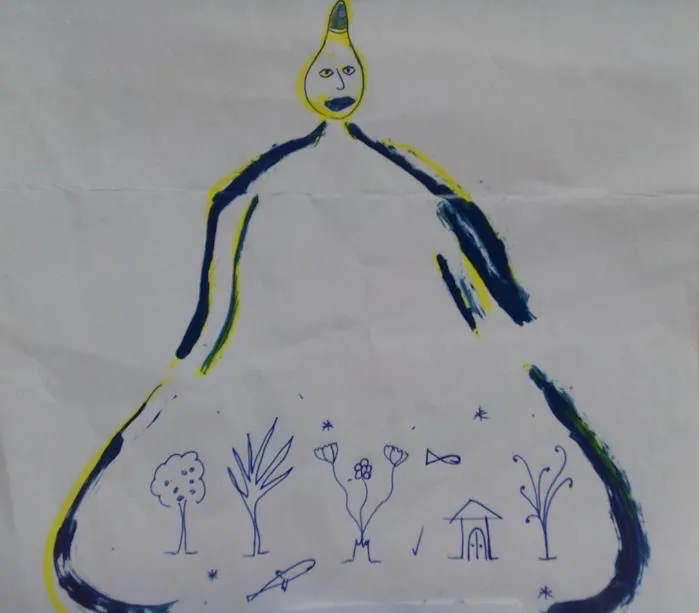
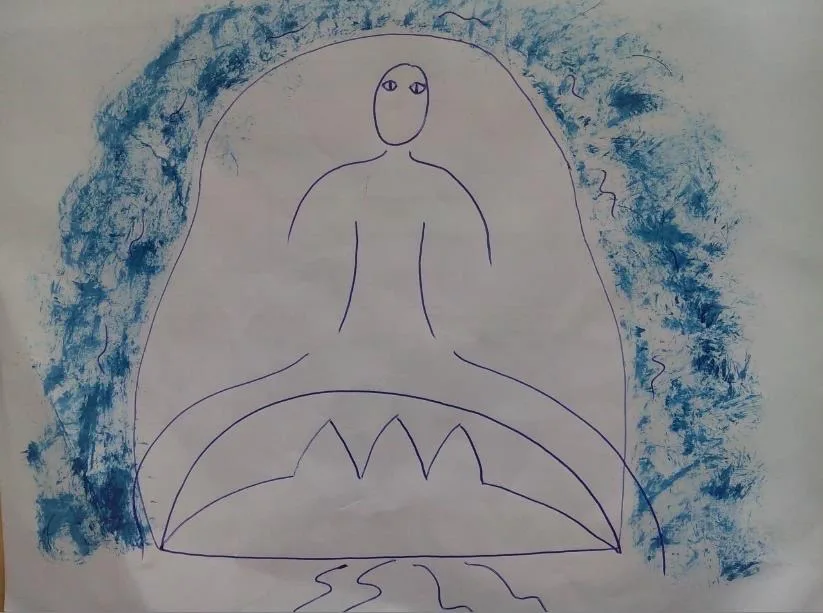
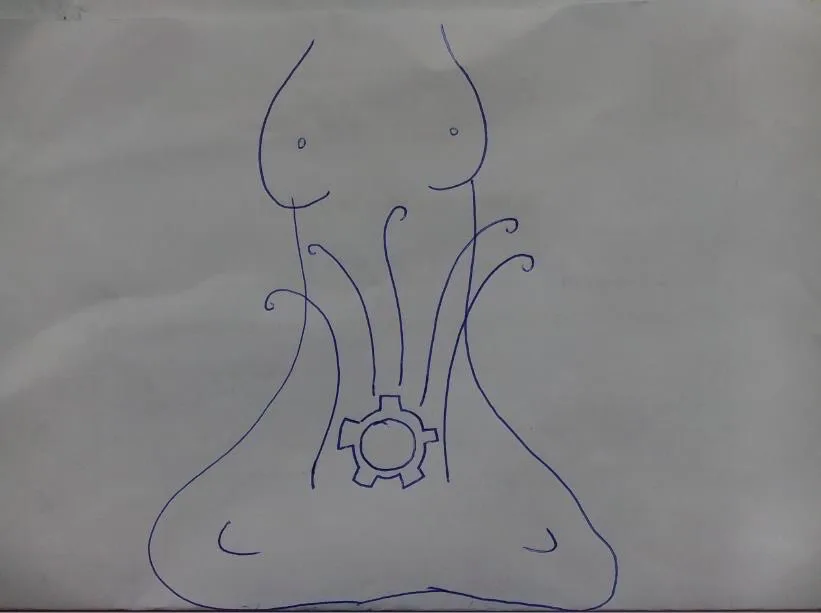
My pictures of my processmind:
A figure that embraces all my internal diversity.My internal rootsMy center (the gear) and how everything emerges from there (the fountain). In the Japanese and Chinese tradition, this region, like “Hara”is also known as the spiritual energy of one, or Ki, and the goal is to act from there.12
One way to deal with critics from the processmind is:
Dealing with the critic in a more secondary channel for the critic.
Embrace the critic.
Take the useful part.
My voices, which are always there burning, are silent when I focus on the part I feel in my body and I create a path like in the story of the crumbs in Hansel and Gretel.
I show the steps in the following example where I am in a session with my therapist:
Context of the problem:
My father does not recognize me as a daughter (he says that I am not his daughter) and my head of the city council tells me that I cannot continue working for them. I am very sad about these situations.
Deal with the critic in a more secondary channel for the critic.
Critical voices are always like a mental dialogue in the head. It helps me to connect with something that makes me feel beyond that dialogue, and I remain in the experience of feeling. That part is at the essence level. I intend not to try to suppress emotions. Sadness is a gateway to the part of me that wants to live. How do I do it? I put my hands on my chest: it’s a warm place that gives me support. I experience it as the part that has love and that takes care. In this place my critic has no strength. My critic is in the primary process, is the part he knows. That is what is behind the anger (the critic). When I let myself fall into the body experience (leaving my body to follow what is happening) the critic changes. The essence level helps me to change the level of dreams and consensus reality because the critic is only language.
Note: In this type of exercise it is important to use my reaction as a gateway to my own body experience.
In the situation with my father and my boss, the critics that appear are the following:
– Barbara, you’re not worthy!
– You’re wrong, it’s all your fault!
– You’re not enough, that’s why your father doesn’t recognize you.
– You’re a mess, you’re not worthy.
I hear these voices and when I embrace the critic these voices are also taken into account and I transform them.
Embrace the critic:
How can the critic change? Giving support and being objective, that is, getting the critic feels seen and recognized. At this moment it is important that I take the side of the critic: “Dear critic, I know that you want to take care of me, because you want me to be better.
My therapist says: “You can’t win the master with your own tools”. I realize that I can’t win the critic in the auditory13 channel (where we use the words, the dialogues, the verbal confrontations) but in the proprioceptive channel the critic has no way to win. The idea is to stay more in touch with my body, in the proprioceptive channel, at the essence level. Therefore, it is easier to be connected to my body and then go to the processmind.
Normally I have a way of answering that is familiar to me: anger. My critic is on the side of my father and of my boss (explained in the context of the problem) and then, I myself get angry with the father, with my boss and the critic (I have set a goal to dedicate only 5 minutes to be in the anger, in the reaction, which is in phase 2 of confrontation, is the part that is known to me, I realize that I get angry, I feel victim and I just want to give it 5 minutes to be there. I leave, I stop and I connect with phase 4).
How do I embrace the critic that disturbs me from sadness?
I realize that I do not really want to be sad and that I want to get rid of this feeling (it’s the X energy). But there is something important in sadness and I explore it.
I realize that it is important to access to a second possibility: take the pillow and allow me to be sad: go inside the sadness, explore it. That is, to embrace the critic from sadness. I notice how I embrace the critic from sadness, and I let myself be embraced as if I was the critic. I relax. This path goes towards the affirmation of life. If I choose the path to sadness, which is the doorway to dreamland, the whole situation will change because if I explore sadness something else comes up. I can’t stop the body from guiding me, because if I continue thinking about the auditory channel the critic doesn’t transform itself from criticizing.
Take the useful part:
The new way of learning is not to think about it but to experience what happens in the body. The wisdom of the body, the body never lies. Here the useful part is to embrace the critic so that he feels seen and recognized. The learning is that the critic wants to be seen in his anger, that he is allowed to be in this state. In this way he relaxes, because he can be himself. It has nothing to do with winning or losing but something that goes beyond this polarity.
In the whole process of the final project something that has supported me to a large extent is to play sports. The critic owns the auditory channel, with its mental dialogues (judgments), but not the movement channel. When I am doing sports I feel that I am my own owner, that is, when I am doing sports, critical voices do not appear.
As my research progresses I realize that after doing an exercise at the essence level it is important that I ask myself: how can the processmind help me deal with the critic? (This is the edges!) How does the processmind help me with the reality of every day?
Chapter 4.
4. How my processmind can help my ability to face my difficult moments in relationship conflicts
Generally, when we come into conflict with someone, we feel the tension: a part that says A as opposed to another part that says B. They are usually two opposing views- ideas, needs, interests, etc. -that compete. This highlights the idea that in the face of conflict there are two opposing energies.
In Processwork we consider that relationships can give us information from our marginalized parts.14 Therefore, relationships become a channel of information and so when we work on conflicts with other people we are also working on ourselves and on our own internal development.
Instead of fleeing the conflict (phase 1 “no problem”) we can take advantage of it to transform not only the relationship with the other person but also ourselves. The concept of phases facilitates the idea that our process is something fluid, not static. We can work from realizing that we are in a conflict and defending our own side (phase 2); but organically pass and congruently place ourselves on the other side, in the position of the person with whom we are in conflict (phase 3) and then we notice that the polarities dissolve, that we are not so different and we touch on a common ground where we connect (phase 4). The idea is to be able to be fluent in it. Sometimes this is possible; but what happens when that is not possible and you are locked in your position (phase 2)? This is where I think connecting with the processmind facilitates this situation.
Through this project I have realized that when I have a conflict with someone I am now more aware that I have to take on and understand that it has to do with part of my critic, that is to say, what was the critical voice that gave rise to the conflict in the relationship. How do I project onto other people aspects that are part of me. This has been a very important shift inside of me that has bring me more happiness, joy and pleasure feelings because it gives me back the power of the situation because I feel I can do something with it instead of putting the power outside (as if the conflict was only responsibility of the other person).
Below are some examples of how I have explored conflict from the perspective of the processmind.
4.1. Family life
The difficult moments with relationships in my family and personal life have had to do with polarizing myself too much. For example, when I’ve had to deal with a housemate or conflicts with my mother, how difficult it is to maintain that relationship because we tend to polarize too much. Sometimes the job of putting myself in the other person’s place is not easy for me and when I feel very polarized (stuck in phase 2) my idea is again to connect with the problem from another level, that of essence; that is, to go straight to phase 4. Below is an example of this exploration.
Context of the conflict:
The difficulty arises with a woman I live within my house. There are five people in total living in the house (2 couples and myself). The conflict was that I asked my roommate for something and she refused. I felt that this was unfair because I’d agreed to do her a favor and she didn’t do me one in return. Also, she’s angry with me but she’s not communicating well and she’s complaining about me. I feel like a victim of the situation and my critical voices also appear.
My roommate asked me if her partner could come and live with us and I said yes. The conflict arose when I asked her to sign a paper to register a friend of mine in our house and she refused to do so; and then she claimed that I’m not cleaning the house. In my personal life I sometimes get stuck in the emotion of: it’s not fair! “I let your boyfriend come and live with us but you won’t return me the favor”. We are polarized because everyone feels that their need is not being heard.
There is one part of the conflict that has to do with her and another part is my own critic that magnifies the conflict. How? The critic takes the other person’s side and abandons me. This was a very important discovery for me and helped me to see at the situation from a more relaxed place. I want to understand her, but my critical voices are already on her side. The critic becomes allied with her. The critic says:
– You don’t know how to do things well, you don’t know how to look after relationships. You’re very complicated!
I’m discovering more critical voices:
– She’s right, you’re not cleaning up like you should!
– You don’t know how to live communally; you don’t know how to maintain long- term relationships.
– Her need is more important than yours.
Then I freeze, and that’s why I can’t put myself in her place. I get angry and overwhelmed by the voices that tell me she’s right.
My response to the moment of not feeling supported by her is to ignore the claim that I do not clean the house well. I feel like I’m not moving forward, that I don’t know how to defend myself. I observe in myself that I can’t put myself in her place and I just want to take my place. I feel angry. In addition, there are critics who support her. It seems that I am on my side for the anger, but internally I am on her side for the critics who side with her accusation. This is difficult because I can’t defend my side, but I can’t take her side either.
To explore this case my therapist accompanied me. She asked me to choose a specific situation related to the conflict in order to identify the energies in tension.
First step: discovering the two energies of conflict
We seek the energies of the situation. The energy that bothers me (X) is that of my companion’s accusation (hers and my own internalized critic). The other energy (Y) is the part of me that reacts to that accusation.15
Second step: exploring and amplifying each energy
When I explain these energies, my therapist sees that I make movements with my hand. Therefore, in order to unfold the process (or flow of information) behind these energies, we use this channel; that is, I make bigger and bigger movements that help me enter more into the experience:
When I connect with the annoying energy “X” and make the movements with my hands and arms, I get the image of a monster that says: you never do anything, grrrrrr!
Energy “X”: the monster that anything! Grrrrrr
The other “Y” energy is the one wounded by the monster. The movement is an open and raised hand saying that’s enough.
Energy “Y”: the one wounded by the monster. It says, That’s enough!
These energies can be explored not only with movement, but also with scribbling, drawing, or rapid sketching, that somehow captures the essence of that energy. I’ll give you an example, a scribble of each one:
Monster energy sketch.
Sketch of the energy of the hand that says that’s enough.
Third step: connecting with a place in nature and finding the two energies there
My therapist guides me to connect on a sensory level with a place in nature that inspires me at that moment. I close my eyes, I relax… I’m in the sea, in the water. On other occasions I have said that one of my favorite places is the sea, and I experience the feeling of being at the bottom of the sea. I look for the two energies there; that is to say, I look for which element materializes each one of the two energies…At the bottom of the sea…
I find the energy of the grrrrr (the monster) in the rough coral skin.
I find the energy of the raised hand that says that’s enough in the stones on the sea floor.
I experiment with the sensation of energy that each one of them has, accompanying them with the initial hand movements.
Step four: letting a dance emerge between the two energies.
The idea is to make a dance, first with one energy and then the other until you get a spontaneous dance between the two that integrates them.
So then, I let myself be moved by the rough energy of the coral, rigid and tense, with a strong energy and straight movements. Then I let myself be moved by the stones at the bottom of the sea and it is a still movement, more rounded, light. I let it be like a dance… I feel the two energies in me… I go from one side to the other exploring both movements… I play with them until I can put them together.
I found it hard work integrating both energies, my everyday mind tends to polarize, to classify (good-bad) and my therapist guided me, and made it easier for me to connect with both; to notice that one energy and the other are equally important.
However, my therapist realized that the monster’s movement was stronger. She supported me in exploring them further. She suggested: “give a moment to the energy of the ‘that’s enough’ (raised hand) because the energy of the monster (grrrrr) is very intense”. The one that says’ that’s enough’ acts as a container, a frame. She recommends that I stop thinking about it: “Do a dance with both of them, lose yourself in it and then stop. What is the energy of the one that says that’s enough? “. I realize that the energy of that’s enough! is like a direction for my life. It gives me more information; it helps me to realize things, to think about things, it helps me to create a framework, to rest, to become aware. On the other hand, the monster’s energy helps me with intense experiences, to manage my own conflicts.
Step five: Letting the universe move you.
“Just as the earth is moved by the universe, you, me, every human being, every form of life and everything is also moved by the universe. This sensation of movement, the sensation of the gravity field of the universe or what Einstein calls space-time, is not only felt by astronauts. We all feel moved by gravity all the time. When you let gravity move you, when you are moved by space-time, you are moved by the universe. When you are moved in this way, you are showing the “dance of the ancestor,” and you are in contact with the space between us, with the subtle experience of being moved by what I will explain is a system mind–possibly the most powerful system mind available to us.”
Arnold Mindell, Dance of the Ancient One, 2013
Apart from connecting with a place in nature -in my case, with the sea and its depths- the next step is to connect with the universe and let myself move through it. The sea is connected with my own essence and therefore I can experience it as though the sea breathed through me, even transforming myself into the sea itself. My logical mind shuts up because it enters another dimension. I enter what we call an altered state of consciousness. From there I perceive the universe, I take the energy above the clouds, out of the water…I let the universe move me, I perceive any slight tendency of my body to move in an unpredictable way… I let myself move effortlessly… I realize that when I dance and the contradictions begin to dissolve in me, that I am in another place, I am in a phase where I can connect with something bigger. That’s where the energies lose their polarity and I connect with phase 4.
I’m not familiar with this essential level of exploration, but I don’t leave, I keep with it. When I become aware, I stop and acknowledge: “ah! this is what happens inside me. I realize that a part of me cheats and wants to pretend; therefore, I also have the grrrrr inside me. I wasn’t being clear about asking for the favor because I was afraid she’d say no to me. I am framing something of myself and what helps me is the ‘That’s enough!’, the energy of the stones at the bottom of the sea. The energy of the stones has to dance with the monster (grrrrr). Here I recognize that I have both energies. This is how the energy of grrrrr and That’s enough! helps me realize that I can ask for things for myself and give myself support.
My processmind has both of the energies and says both are fine. The two of them work together. There are no critics in the processmind. I say yes to both energies. I need them because they both create wisdom. When I say yes to both energies, the critic disappears. Both energies have secondary aspects for me. Although it seems that the one that says That’s enough is more familiar to me, and wants to get rid of the one that is annoying, demanding, accusatory and attacking – which is also the energy of the critic- there is something in me that doesn’t know how to stop it. At the same time the annoying and aggressive energy is necessary for me to be more congruent and direct with what I ask for. Both are useful for me in dealing with critics.
My therapist tells me that having this experience helps me to be able to put a frame and that I need a frame around the experience; therefore, the one needs the other.
Step six: using this essence and going back to the initial problem.
How could this be useful for working with the critic? How then did the critic become in the context of the conflict with my housemate?
This work serves me to put a frame to the energy of the monster (grrrrr), to understand it, giving it a structure. What I mean is that, using the energy of the stones that are centered and anchored, I can look at the monster from that tranquility and I can see it in its anger. The structure means the stopping like the stones; it allows me to understand the intensity of the monster. The monster in me is angry because it feels that my housemate has wanted that things be done as she wants. Framing means understanding my anger. By understanding my anger more I can distance myself and I can see that I also want the same as her, to have my way.
I talked to my housemate after the exercise. I told her it had been important for me that she signed the paper. I told her that I had agreed to have her boyfriend come and live at our house, and that I expected her to do me that favor in return. That for me, relationships have to be balanced. I saw that she didn’t understand anything I said to her because she only wanted to have her own way; but being able to say it helped me. The energy of the grrrr inside me helped me defend my point of view. While I couldn’t get her to support me at least I could get her to listen to me. To be in a position to say how it affected me and what bothered me. The anger relaxed and it felt seen. That was enough to silence my critics. Once I’d done the exercise I was calmer, I didn’t feel so polarized.
It helped me a lot to see that I also had the grrrrr inside me (seeing that I was trying to get what I wanted). In the conversation we had I noticed how she just wanted to be attentive to her needs and I thought I had to do the same with mine. The ‘That’s enough serves to stop my critics who tell me it’s all my fault and that I’m doing everything wrong. The critic relaxes because it can side with me a bit. My processmind manages to make the critic less critical and to develop the metaability of detachment, not to be so tense and hooked on conflict but to understand the other side and to be able to express myself.
Another aspect of my personal life that I found difficult was breaking up with my ex- partner. I see that my critics were very present in this situation. One way to explore how the break up with an intimate relationship has affected me is to help myself by working from my processmind.
On one occasion when I shared a car journey with some friends who are a couple, as we drove past my ex-partner’s village I felt very affected. I started crying, remembering my relationship with him. The critic was telling me that I’m too demanding and that maybe I’ve missed the opportunity of a lifetime. It made me doubt that my decision to leave the relationship was the right one. I got more into the experience of crying. I felt guilty and overwhelmed.
To connect with my processmind I cast my eyes over the landscape, looking for an unconscious flirtation, something to capture my attention… and suddenly I saw a fog in the mountains, I perceived the essence of the fog, I became the fog. I noticed how my body is fog, it didn’t weigh anything. It was like light evaporated water fog that I like, I became more loving and compassionate, something that’s easier to do from being the fog.
From there I told the critic that I don’t want its negative energy destroying me. I told him that I needed to prove to myself that I can do things without a partner, that in the relationship I didn’t feel comfortable. I also said that I understood that it was afraid and I embraced it. The critic let itself be embraced. I told it I wanted it to trust me, I’ve done it many times. I value its strength and it serves me. In the middle of my crying my friend, who was accompanying me in this experience, gave me a cushion that for me represents love, and I embraced and caressed the cushion.
The next day, my therapist helped me to conclude this exploration:
Therapist: “close your eyes and embrace the critic. Let yourself feel like you’re hugging the critic. ”
I reached an edge because my head started thinking about other things.
Therapist: “Notice your body and how it rests on the bed. Let’s meditate for a moment. Notice how the other side hugs you and now you are the critic. The critic is afraid. How does it feel to feel embraced in fear?”
Me: “I feel welcome, important. I am important and necessary.”
Therapist: “Let yourself feel that for a moment. Yes! You’re important. ”
I got an image of my step father on the couch and how he was there, loving me; and I thought of moments when my ex-partner had been like that with me.
Therapist: “Now it’s up to you to be like this with yourself. Now you can be that, loving yourself. The only place you’re safe is inside yourself. Sometimes looking for it outside doesn’t mean it’s there.”
Therapist: “Why did you choose as your final project to connect more with the processmind?”
Me: “For the part that heals me. For bringing the part that embraces and is compassionate more to my consciousness. I didn’t have a mother like that, and now I’m looking for it in myself. Developing my inner embrace will make life happier and easier.”
Accessing my processmind can be healing at times. I also want to learn how to get out of difficult situations and be in a more healing place. To not connect so much with the critics. To notice how the processmind heals. It is the part that enjoys the moment, the part that can come out of the polarities, and from there have a new perspective of things. From the processmind I feel that “my life is worth living.” Illuminating this situation with my processmind helped me heal the relationship with my own inner critics.
4.2. Working life
“Doing inner work is like getting home, like resting.”16
As an advanced practitioner, my task is to facilitate people individually when they are wanting to make changes in their lives. This exploration of my own experience with the processmind has helped me to know how to guide them home, accompany them to connect with their most essential part and explore how they can dance with the energies in conflict.
In my work as a facilitator, I also face my critics. The following example helped me to explore a difficult moment in my working life.
I’m going to facilitate a conflict between two women living in a community. During my journey there I begin to feel very vulnerable. I have many critics inside of me and I begin to project them on to my co-facilitating partner. Internally I start competing with her, I wonder who will facilitate better. I’m afraid she’ll take all the space and I won’t be able to express myself. I begin to project my critics and my fears onto her.
When we reach the beautiful community, in the midst of nature, I do some inner work. I connect with the sea, my favorite place on earth that brings me more easily to my processmind. I imagine I’m in the sea, and the waves move me. I notice how each grain of salt heals me and begins to breathe through my skin. I become the sea… I feel its energy. From there, I have another perspective, detached from the fears of my critics. I give myself some advice:
“Trust your proposals and feel like you and your co-facilitator are a team!”
I realize that my internal conflict is also part of what happens to women in the community. It’s not just my fears and my individual conflict with my critics. My processmind helps me to perceive that I may be channeling important information from the field or system in which I am going to facilitate, and I use that information. The atmosphere between me and my partner changes and my critics relax.
Why can’t we be in more frequent contact with this state where we don’t feel contradiction. Mindell says the problem is that we forget the fluid part of ourselves, he says it is normal to forget that ability to flow between two polarized energies and feel our inner unity. We do this in order to be able to function in the reality of every day, where we have to differentiate the parts; but it is good to get to know more deeply that part of us that can dance and connect with our whole selves.
“When the universe dances to you, the energies “y” and “X” appear as if they were dance phases. Phases means that the energies are in the dance. There is no struggle from the point of view of the dancer. In a sense, you’re a dance that looks like a person. You’re not just a person who dances. You’re a dance in the guise of a person. It’s another point of view. A more universal point of view. You are a process acting like a particular person, a normal person in conflict with other parties. The consensual or everyday reality is a dimension of fixed and separate particularities. But you are a dance, and in your dance, you will find all that you are.”17
Now I invite you to explore it with me:
Think of a problem that disturbs you now or in the past, that involves a difficult situation in a relationship with another person or with yourself.
First step: discovering two energies of conflict
Think about why that situation is difficult. When you identify behaviors or actions that bother you, think about their essential characteristic, what is behind the words that describe them, so it will be easier for you to connect with how you experience it and not just how you describe it.
Identify the nature of what most disturbs or bothers you. That’ll be energy “X.”
Note how it affects you, which part of you is disturbed or doesn’t like X energy. This part will be the “u” energy.
Second step: explore and amplify each energy
Feel the energy “X”, what it’s like… try to express it with a movement of the hand, make a sketch or doodle that represents it.
Then connect with the energy “y”, feel it… make a movement that expresses it, a sketch that represents its essential quality.
Space if you want to write, make an image or a sketch for both energies.
Play with both movements, experiment with making them bigger, or slower… until you feel that they represent each of the energies.
Third step: connect with a place in nature and find the two energies there
Now, put aside the movements, relax… find a place in nature -real or imaginary- that inspires you in this moment… let your senses explore it, what you see there… what the place smells like… what sounds are heard… feel its atmosphere… Look around and find something in the environment that represents the “X” energy. Then also find something that connects you to the “y” energy. Remember, the way you sense is more important here than your logical ability.
Step four: let a dance emerge between the two energies.
Leave your consciousness and habitual mind… enter a different state of consciousness, experiencing and feeling how the earth breathes you… let the essence of the place move you… perceive how the energy “X” moves you… Then concentrate on the energy “y”, let it move you… Feel how both energies exist there without effort, without contradiction… go from one movement to the other as if it were a spontaneous dance, letting a dance flow between the two energies as you move.
Step five: Let the universe move you.
Now move away from the earth, connect with space… with the experience of dance between both energies, let the universe move you unpredictably, without objective, without effort… only feeling moved by something greater than your intention. Connected with your processmind, experiment now with this flow as long as you need to until you get an intuition of how the two energies are somehow necessary for you; how both are parts or phases of a unitary dance.
Step six: take this essence back to the initial problem.
From that state and with the experience of flowing between both energies observe the problematic situation, what changes, what do you find useful… can you look at it from a more detached position? Did something change in you internally? How does what you discover help you deal with the situation.
Chapter 5.
5. My processmind in my personal myth
5.1. Introduction to Dream and Processwork
Dreams are a momentary map of the relationship between our known or conscious parts (primary process) and our unknown or unconscious parts (secondary process). Dreams are gateways to the secondary process. They’re a source of information. When you work with a dream, it’s happening in the moment. The dream helps us connect with the dreaming18
How do you explore dreams from processwork?
We understand dreams inscribed in a symbolic language. Each element of the dream symbolizes a part that can be explored, i.e. places, objects, and people are representations of different parts or energies in relation. You can work in different ways. One way is to work with dreams from the essence level: for example, to go to the essence level of a character, to try to go to the origin, to the energy that gives birth to that character (linked to Jung’s archetype concept)19
Archetypes are the form that is given to some experiences and memories of our early ancestors, according to Jung. This implies that we do not develop in isolation from the rest of society, but that the cultural context influences us in the most intimate way, transmitting to us schemes of thought and experimentation of realities that are inherited.
However, if we focus our gaze on the individual, archetypes become emotional and behavioral patterns that carve our way of processing sensations, images and perceptions as a meaningful whole. Somehow, for Jung, archetypes accumulate in the depths of our collective unconscious to form a mold that gives meaning to what happens to us.20
Next I am going to relate an example of a nocturnal dream I had and how I explored it to find a polarity that was represented. In the dream:
I’m in a community and there’s a very compassionate man and woman. I leave a lighted candle and the whole room burns down. I’m trying to keep people from noticing. But the older man and woman tell me not to worry, that the fire happened because I was distracted. They help me accept and embrace the moment I’m in.
Here my primary part appears, identified with the fear of the critic (because I have the feeling that I have done something wrong and I want to hide, but this is something already known to me) and secondary parts of me represented in the burning fire (candle) and in the kind old couple. The polarity is the fear of the critic as opposed to the kind couple. I discover polarity by connecting to the energy behind the figures depicted.
In the dream I find myself closer to the primary process, I identify with the known part. I felt bad about burning the room. Once again the most normal thing for me is to hide, to think that I didn’t do it right, that I did it wrong … and the new and exciting element in the dream is the nice old couple who say: “Don’t worry about it dear, they will fix the room, these things happen … “. In this dream I want to explore that unknown part represented in the old couple, which is exciting and I feel the love for them.
When we talk about identifying the most secondary or disturbing part of a dream, it can be not only something that bothers us or is uncomfortable, but also something that intrigues us, or that we miss, or that feels very far from what the experience itself is. We say disturbing because it is what unsettles the most primary part of us, it may be something that upsets me or, on the contrary, that I admire or praise; and that generally comes represented in something “that we are not”, that is why it is secondary. There are more disturbing images than others, for example, if you dream that you stab someone with a knife – the action of wanting to kill, which may or may not be far from your consciousness, is not the only disturbing thing. (maybe you are aware that you “want to kill someone” so to speak because you are experiencing a lot of anger, but there is difficulty expressing it; or that “killing” is secondary because it is connected to an energy that is needed to make a decision about something, or bring something to an end, make something disappear etc.) The other disturbing element is the knife (what you are not), and when you explore it the important thing is to connect with the energy contained in the symbol of the knife and its relationship with the other elements in the dream.
How do I explore this from the processmind? How do I get to the essence? How can I get closer to the energy of the kind old couple?
As I explore this dream in a therapy session, I connect with the Elder in me so that I can become “the kind old couple” – feel their energy, discover their essence: compassion. From there I can talk to the critic who tells me I did wrong. I tell the critic that I’m not going to take it so seriously, that I want us to treat each other with a different attitude.
I realize that I want to be like the compassionate old couple in my dream, to be compassionate with myself. To have them as allied figures so that my critics don’t batter me so much. The compassionate old couple are on my side, they’re supportive. I want to learn to treat myself more lovingly and do things from a different place. It is painful to see how my critic treats me and how I treat it. What relationship do I want to have with my critic? I want a critic who does inner work and who only shows up with the useful part. How am I going to treat my critic in the meantime? I’m not going to take it so seriously! Give it some humor, I’ll take it on with a different attitude.
In my experience throughout my personal work exploring my dreams during this project, I have discovered that my processmind has made it easier for me to find advice to alleviate the tension between my two parts (as in the dream I describe below). I have also been able to more fully understand the part of me that can connect more intuitively with unknown or mysterious aspects (the third dream I describe below).
Description of the dream:
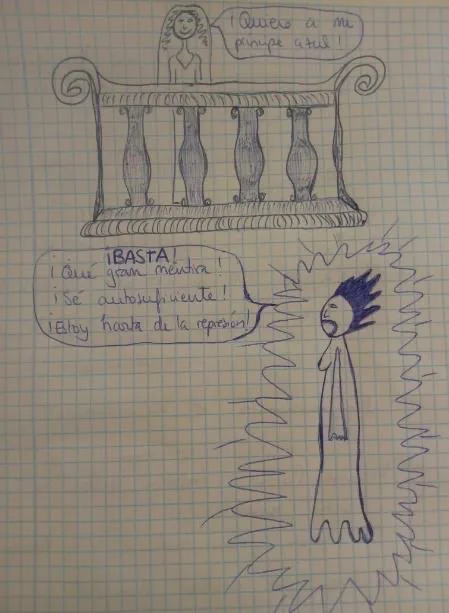
I dream that I’m in the top part of a house, on a balcony. The setting is from the time of Romeo and Juliet. It’s night time. There’s a woman downstairs, dressed in black. She screams very loudly.
I explore what most disturbs me from the dream, that is the scream of the woman, the crying. For me her cry represents the cries of many women who want to free themselves from repression. She is a woman who in my imagination represents my grandmother and her quality is that of feeling repressed and wanting to free herself. It’s a cry of pain: That’s enough! She cries for the patriarchal system and the times she has had to limit herself because of it, she doesn’t feel free, she feels enclosed and wants to stop feeling that way, she wants to change the situation.
The disturbing figure of the woman screaming is secondary because it represents something distant from what I am, or some energy that I have not yet fully integrated. The energy is the part of me that is not carried away by the idea of romantic love, that follows her intuition, the part of me that’s connected with herself, that is not carried away by romantic ideals that dream of perfect relationships. In the dream I’m on a balcony Romeo and Juliet style. It’s a familiar part of me, the part that imagines idyllic, perfect couple relationships, hoping for a love that will last forever and will be wonderful. These two figures don’t relate to each other, but they want to. The most unknown thing about both parties is how they relate to each other. How can I listen to both of them? What’s useful about each one for me right now?
In my personal life an internal polarity has emerged that I’m already aware of:
The polarity that I discover is between “the one who waits for her Prince Charming” and “the one who realizes the repression and is fed up, wants to change it”.
The tension is between the part represented on the balcony that awaits the encounter of a romance, a Juliet who wants or waits for her Romeo because she doesn’t feel capable of leading her life without a partner. The part of me that wants and accepts the idea (fostered by patriarchal culture) that I need a man who loves me, Romeo and Juliet style, to be complete and happy.
And then there is the other part, represented by the woman in black who screams/ cries, with the pain of all women who suffer, but who adapt to the pattern of needing a man to complete them in order to be happy. Their crying is the “That’s enough!” The energy of one’s own determination, which enables one to put limits on the patriarchal system, to know and look for what one needs.
I feel identified with both sides, but sometimes I don’t know what to do with them. I explore one side and the other, and the internal dialogue between them.
How can I make these two parts in me become more integrated into my everyday life? They’re like two separate parts: the part on the balcony and the part downstairs screaming.
To explore them, I connect more fully with what each archetype means, the symbols of my dream, I connect with my processmind with the help of my therapist:
Therapist: “Become the sea. Take your time. Be there and enjoy it. Let it happen.”
I usually get into the water. Sometimes I am a coral, or salt that cleanses the body as a healing process. I resort to all the sensory elements that help me to become organically a part of the sea.
From there, feeling the essence of the sea in me, I look at the Bàrbara who feels she needs a man to be complete and happy and I look at the part that screams.
My therapist says to me, “Look at Barbara with this problem of whether or not she has a partner. What would you say to her? I feel the energy of the one who screams and says “That’s enough”: “I am a beautiful woman, I am complete and perfect alone; and although I would like a partner, that doesn’t make me any less of a person. I’m a wonderful person in my own right.”
How do I work with the fear of being myself? It is important to integrate both and that they help each other.
The advice is that both parts learn to love each other, that they try to be friends and that they don’t criticize each other because what happens is that when one is present the other gets angry with her for taking up space. How can they be more compassionate with each other, become close, support each other?
With my processmind I can see the two parts and embrace them.
“If you fight your demon, you find moments of pleasure, freedom and exceptional energy-whether you win or lose the battle with yourself“
Arnold Mindell (“The Shaman’s body”, Ch. 14)
Another important experience that I discovered while exploring my dreams is very much related to a part of me that wants to express itself and that is very connected with my processmind. This part I link with my shamanic side because
I have a very sharp intuition, I have a lot of consciousness and I do not doubt it. I can be who I am in the moment and it’s perfect.
In his book “The Shaman’s body”, Mindell encourages us to connect with our shamanic side. The word shaman has been related to “someone who works temporarily as a healer or spiritual guide”. He suggests that we can do modern shamanism and describes it as an archetypal form of behavior that appears when you are faced with unsolvable problems; and affirms that certain dreams, impulses or strange sensations can awaken the magical, healing and wise person in us. He is not intending to make a study of shamanism, but to provide ways to support one’s own inner journey. He thinks that what partly defines the duration of our personal life, that “deathwalk,” is the struggle to be oneself against internal forces and external rules.
“Elements of shamanic experiences, such as prolonged trances, spiritual awakenings, sudden healings, (…) are often preceded by various types of inner experiences, or <calls>, such as serious illness, near-death experiences, or <large> dreams of wise spiritual figures. Shamanic abilities appear when you stop doubting the reality of the spirit, something is transformed and you develop a deep attention, a constant focus on irrational events.”21
In this dream, the “rituals” and the “water” were the most symbolic secondary elements that contributed to my experience as I explored them.
I discovered that water is an element that takes me to phase 4, to the processmind. When I was exploring it, I realized I was yawning. The effect of yawning makes me relax, makes me enter an altered state of consciousness that allows me to enter the processmind. In that space where there are no critics. I connect with the center of the earth, I feel that I am part of nature, I feel the water that brings me to a state of fullness and well-being, everything makes sense. That’s all we need. Water is like life, the connection with myself. I feel something coming from my chest and I open my arms to feel it more. It’s a feeling of having an orgasm, something wonderful, which says yes to life, which trusts… everything makes sense… nothing is so important than feeling good with myself. From there I can do anything.
My processmind helps me to discover that it is not about where to go but about how to go and enjoy each moment.
4.2. My childhood dream
“One of the things I discovered in childhood dreams was that they could not only discover the professions of the people who have those childhood dreams, but also the type of relationships we will have, the nature of our chronic symptoms and even the experiences that occur near death. Earth Based Psychology Book.”
A. Mindell
Why is it important to explore childhood dreams or early memories?
hey’re a gateway to personal myth. Jung linked childhood dreams with personal myth22. Jung’s concept for describing a pattern for personal development throughout life – he found that childhood dreams revealed an archetype or mythical pattern for the person’s life, the portrait of certain tendencies, symbolically represented.
When we explore the personal myth we shed light on our transformation process or it helps us by giving us information about unknown aspects. This can help us when making decisions. To do this you must connect with the first childhood dream or experience you remember.
Mindell broadened the concept by proposing that we can also see those patterns in recurrent and chronic experiences, such as chronic symptoms, addictions, and relationship patterns. He sees the myth of life as a form of “psychological inheritance,” which includes trends related to parents, ancestors, cultural context, and historical background.
We remember the 3 realities, the personal myth is connected to the great I or universal I that is located in the level of the essence:
Image taken from Lety Mendoza with permission of the author.
Description of my childhood dream:
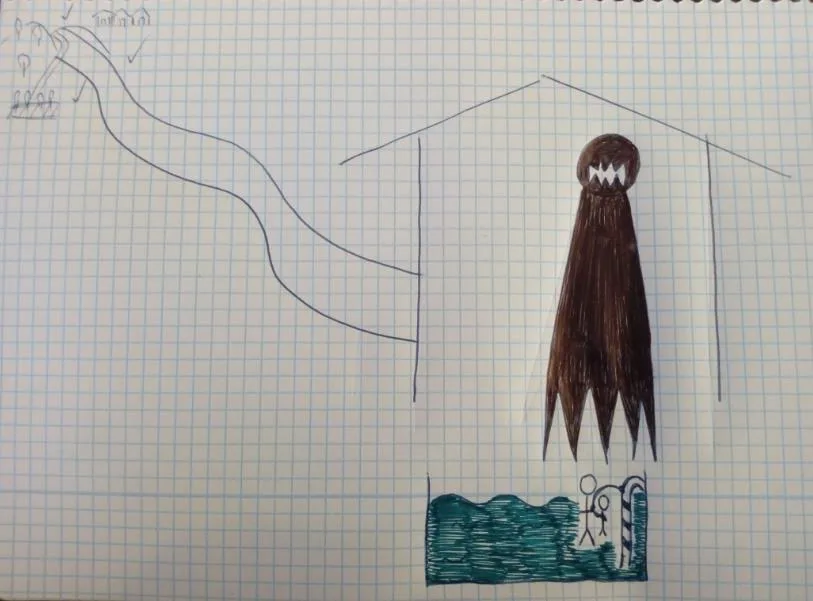
In my childhood dream I am in a house and I hold my little brother in my arms. An adult man dressed in black and with a black face, wants to lock us in a basement full of green water. He wants to leave us shut in there. I take care of my brother and hold him tight so he doesn’t drown. We are attached together with handcuffs and to a metal staircase inside the basement. We can’t escape. There is a small intuition in the dream that makes me think that there is a way out, that we can escape.
Drawing of my childhood dream
Early childhood dreams or memories can be explored many times throughout life and new messages can be found or understanding of critical or decisive moments deepened, etc.
I explore my dream from the processmind in a therapy session:
In the dream I occupy a part that is familiar to me: the one who is afraid and the one who cares. I focus on the black figure that is the X energy of the dream, the most disturbing or secondary (distant from my consciousness, what “I am not”). I want to find something useful in the black man (his power). My therapist helps me explore the figure of the black man by helping me get into that figure, occupy it as if I were him, and explore the energy by hitting a cushion. I take the energy of the black man and so I take a cushion and squeeze it tightly, this way I become him, to experience his energy. I become a figure who says, “I’m the boss here,” while I hit the cushion. I can feel my fingers forcefully sinking into the cushion. I notice the sound of the blow on the cushion and I like it. I copy the repeated sound of the blows out loud:”pam pam pam”. It has rhythm, weight; and then the figure of an enormous animal with giant feet comes to me.
The black man becomes an elephant. Here we notice how the energy of something that frightened me, when amplified becomes an elephant that moves slowly. The elephant is already a less fearful figure. Suddenly I see a figure of a huge animal and its giant feet walking. I like the rhythm. It’s like a black elephant that moves slowly and safely. When I think of the elephant I feel a sense of composure. How would it help me to move with greater composure and security? How does this energy help me to continue with composure and security?
I think of the final project I’m working on. It’s like going into battle with my critics without hiding anywhere, going with who I really am. To be able to show my inner diversity with composure and security.
But the critics appear: I reconnect with the energy of the elephant. What would the elephant say to the critics? From this poise, I feel that this is a challenge: I want to get to know you! We’re going to get to know each other well. I want us to be friends. Sometimes critics hide. To the critics I would say: be brave, and come here. Let’s meet together. I’m ready! Instead of feeling the pressure of the critic and being afraid of it. From the composure I can relate in another way with the critic. Not only do I want to confront the critic, but I also want to give myself the opportunity to work with the internal evaluation, not the external one.
My personal myth is to connect with my processmind in order to be more detached and deal with my critics and my own fears because critics feed on my fears. Fears are sustained by critics. There’s a tension between fear and security in my life. I came to this world to deal with the black inner figure and that this figure would give me security. To deal with the inner voice that tells me that I’m not worthy of things and that I do everything wrong.
I want to discover the useful essence. The black figure is precise and simple, that’s where all the power is. The one who holds me and the one who protects, nurtures and is compassionate (as I am in the dream with my brother). The black figure wants to live more in me.
All this comes from the fact that I haven’t felt cared for in my family and by my mother. In the dream I take care of my brother. The energy of caring is in the dream. In my life, feeling cared for is more secondary. I’m good at taking care of others. I’m not that good at taking care of myself, or at least it’s not that easy. I want to make the decision that this final project will be the most important thing I have ever done in my life so far. But somehow this demand is another way of distracting myself and avoiding hugging myself. Now I’m helping to make this final project difficult to write and capture what’s happening to me. There are times when I connect with despair and I think I’ll never get it right. Here I realize that I’m feeding fear again. The strength of the elephant (energy of composure and security) helps me to face fear, I want to quieten my critics voices.
Something I’ve become aware of as the project progresses has to do with the idea that this work is a long-term challenge. I know that there will still be more battles to fight with these critics, this energy that frightens me and immobilizes me. It is important to know the adversary in order to make his strength mine. But the next step after making his strength mine is to go beyond it and transform this confrontation and achieve a moment of oneness with it.
Why is water in my personal myth?
Because it makes me feel safe and there’s no contradiction there anymore. I don’t have to take care of anything or anyone anymore. But when I return to the consensual reality and have to take care of myself, the critic comes to me again. Curiously in the dream I’m in a basement full of green water and I’m afraid my little brother will drown. Therefore, there is a part of me that is projected in my brother, the part that needs to be cared for, the part that believes that I can’t do it alone, the part that feels small. In a therapy session I become the green water. I notice how my whole body enters an altered state and I become lighter, as if I could wrap up all the elements of the dream in myself. I feel internal security emerging from my chest. I can move my arms and I feel a state of well-being, compassion. I become the spirit of a forest, its branches and its luxuriant foliage. Something that sustains, a wise and strong part that relies on my internal resources. I yawn and enter more into the experience, connecting with the processmind. From there, I look at my brother’s figure (my vulnerable part) and say: don’t worry, I’ll protect you. I’ll always be there holding you and taking care of you.
What is the relationship between the elements such as green water, the black figure, being chained to the ladder, my brother and the way to escape from my dream?
Since it’s a relationship dream, it’s interesting to see how I relate to my own vulnerability. I discover that there is a pattern in my life to learning how certain parts of me can relate to each other. How can my vulnerability come out knowing that another part of me will know how to take care of it?
How did exploring my childhood dream from the processmind help me to understand the elements in the dream better, and how they relate to each other?
As I explore it, I discover that from my processmind I am not afraid. I understand all the parts, I welcome them, I embrace them. I realize they’re all necessary and they’re there for some reason. There are parts of me that need to relate to each other better. In the dream I am chained and this part is more familiar to me, but I have the intuition that there is a way out, that I can escape, which is the processmind, the part that cares for me, the wise one that knows that whatever happens I have the tools to deal with difficult situations. Water has always been there, as something that protects and heals. It’s the part that helps me be more detached. I know I can escape and not just identify with my fears. I have an insight: these different parts have always been there. I like the idea of learning to love them, to understand them. How has my processmind helped me to better discover the patterns or messages of my life myth?
I’ve discovered a pattern in me that has doubts. I am constantly facing my part that doubts, that is afraid to let itself be. And I come and go between the one who gets angry at life because she feels chained and the one who feels very vulnerable. Little by little I’m finding better ways to deal with my fears. To realize that they are not stronger than me and to be able to move with greater composure and security with the challenges I face.
I connect with the confidence that “there is a way out”. I detach myself from the tension of working with difficult situations and working with my own edges. To have a committed detachment, that is, to be detached and at the same time committed to the situation by giving myself compassion, fluidity; to feel myself without the swing that goes up and down.
May my fears not prevent me from connecting with lightness, enjoyment of life, joy. What gives true peace and tranquility is knowing that I have internal resources, feeling supported all the time by something greater than myself. So I’ll never be alone on this path.
Exercise of exploration for the life myth:
hink of a childhood dream or memory, the oldest you can remember.
Describe it briefly and find out what most unsettles, disturbs or strikes you. Find the essence of that which is different from you, disturbing or strange. Perceive its energy (as in my case the figure of the frightening black man)
Now breathe and connect with your body Imagine that your body is a part of nature and let that place breathe in you, feel its essence and become that place.
From there look at the disturbing figure or symbol and feel how its energy is also part of you.
Think about whether this energy is something you’ve been struggling with for a long time, or if it is connected to patterns that affect your relationships or decisions.
Discover how you could come closer to knowing this energy, how you could let it be more present in your life, how it would help you deal with your critical voices, or in your decisions, or in the way you relate to yourself and others.
Chapter 6.
6.1. Processmind, critics and biodanza.
In this chapter I explore parts of my connection with my processmind through my body and using movement as a channel of information. Arnold Mindell defines the movement in a concrete way. He says, for example: move your spine and your pelvis and find a pattern in that movement, this is a blank access23 in the movement channel. This is what is done in biodanza24 or in the other methodologies that use movement in a therapeutic way. What Processwork emphasizes is to focus on the second attention, that is, not to occupy everyday attention but to be able to enter a different attention in this dream world. Find a pattern, use your second attention to notice what images are around the experience (dream level). The model in Processwork is to learn to flow between these levels of consciousness, to develop second attention and find out what happens there.
In conversations with Kate Jobe25, I discover that the different methodologies related to dance (biodanza, 5 rhythms, open river, etc.) aim to support exploring the movements of the body that arise unintentionally.
In this space there are no words. What usually happens is that an experience linked to the movement emerges and then you frame it by giving it a name.
Therefore, the movement goes from the essential level to the level of dreams, but it is an energy, it is no longer contained. Somehow the whole processworks to create a universal state of mind. It is important to say that music is influential in creating this state.
The movement consists of going between the 3 realities: consensus reality, level of dreams and level of essence; especially between the last two.
My question is how does biodanza support me in dealing with my critical voices and dream figures that appear in my limits? (Edge figures)26
What happens to me is that as I enter the proprioceptive and movement space (I stop being in the auditory) it seems that my critics disappear. I go very quickly to the essence level and I forget my critics, as if they weren’t there. Do the critics disappear? What disappears is not the critical voices but their influence. Normally when the biodanza session ends I feel stronger, happier, connected with myself and I feel better prepared to deal with the influence that my critical voices have on me.
The interesting part is the change of state. Going from the state of criticizing yourself to getting rid of your critics is a change of state. The movement is a way to do it, but it leaves the edge-figure in the universe without being processed and it finds its way back. The powerful thing about Processwork is that it not only focuses on making a change of state, but also sets out to transform the relationship with the critic.
The critic seems to be external to us, something outside of me, but in reality it is a role that is within us. The content of the critic itself is made up of external voices: it is a role that can have patterns of authority, whether social, cultural, or within the family. But at the same time they are marginalized forces that are within us and it is important that we process them because sometimes we can escape and not take advantage of the valuable information that would help us integrate them.
From the perspective of Processwork, the internal critic can be treated as an opponent to fight, or he can be treated as a useful source of information and then be extinguished.
Sometimes it is good to confront the critic when it is an oppressive and abusive figure connected with personal history, precisely because it can help the person get in touch with a force or with a previously marginalized identity; or become aware of dynamics of abuse, discrimination or oppression.27
On the other hand, confrontation is not always the way. Sometimes it is counterproductive. The critic is an edge figure, which we can also avoid, because it may be getting in the way of exploring a secondary experience, or marginalized aspect or role more deeply. Our energy can get caught in battle and we fail to connect with the experience behind the role because we only reveal ourselves when we’re in it. Sometimes you gain more power by experiencing unknown aspects of the role than in brief confrontations with the critic.
So you have to be careful not to overvalue the confrontation with the critic. We can lose the signals that the critic’s role is indicating to us to unfold the process, and remain only at the level of ideas and judgments. The critic can be a valuable source of information and analytical, if we aim to explore it with an open mind, as a beginner. For me, the movement has been a great way of doing that.
In my own exploration I discover that I am in the universal state of mind when I feel more detached, there is a change within me.
According to researchs by Kate Jobe, the state of the processmind is a state of the essence level and therefore there is no language. There is something organic in letting yourself move. You use the movement to discover the processmind in the moment. Then in ProcessWork we pay attention to what slightly catches your attention. In my experiment, for example, when I move I notice that my claw-shaped hand catches my eye. Then I focus my attention on this signal and seek to amplify it in the visual channel so that I can connect with the energy behind it, experience it, discover its meaning, and then later put the message into words.
I summarize here my own experience that I filmed:
I have been attending biodanza classes for 2 years. First, with my teacher I choose music that helps me connect with the different states. Then I enter the states dancing them. The main idea is to dance the energy “X” and then dance the energy “u”. Then leave everything aside and access the universal state of mind. From there I find the two energies and dance them. Find the useful advice.
Steps I followed in my experiment:
I identify what disturbs me (energy X)
Energy X is the critic who says: you will never be able to deal with critics! I dance feeling the energy of that critic. It is an energy with many sudden movements, with force. I make a gesture with my hand to express it, it looks like a claw. When I feel the claw, the image of a panther comes to me. I amplify the experience feeling the claws.
Drawing of X energy:
What do I discover when I dance energy X?
What this allows me to do is use another channel, the image. It allows me to have a more real interaction with the critic. What I am trying to do is transform the critic’s energy by capturing it. By moving like a panther and feeling that energy in me, I no longer transfer it solely to the critic. I feel that I am able to embrace the critic more and I don’t feel so aggressive towards it. It loses importance. In short, what I feel is that the critic is a part of me, I no longer feel so distant and aggressive.
I identify the part of me that is affected by this critical voice (energy u)
Then I dance the u energy: fear, doubt, insecurity. I feel my arms. I find that my arms and my hands begin to move in a way that makes me connect with an energy of obscurity, insecurity, doubt. There is no direction, I feel I’m drifting and I see an image of a leaf in the wind
Drawing of energy u:
I begin to dance my processmind, until she dances me.
As in previous exercises I accompany my experience with all my senses, I place myself in the space of the sea until I can feel, smell and hear what is there. I feel the sea around me, I embody the sea. I am the queen of the sea.
Drawing of my processmind:
Now I am preparing to dance the two energies as queen of the sea:
In the dance, I find the X energy: It is in the triton of the queen of the sea. When I dance that energy I feel there is a direction and I know what I want.
I dance the u energy: I find it in the movement of water. I see that energy in the small movements of water. The processmind embraces the part that is not clear, that is afraid.
During the exploration I am aware that the edge is to “let go.” I work it through amplifying the images.
Who is it that makes the dance happen? There is a performative role. The processmind is what dances me. The processmind is powerful, loving and emotional because it dances me, it transforms me.
What is the role of the music? The music helps me to get more into the experience, it helps me connect with the energy I want to amplify and be able to enter it more completely.
What is the role of the observer? The role of the observer is that of my teacher and the camera. These two roles help me get more into the experience and be focused, to not be distracted with other things. Why do you need music to connect with the energies? Now I realize that music allows you to occupy the auditive channel to be able to use another channel (like the visual one) to occupy.
I recorded a video of my experiment. In it there are many things happening. It seems that I am exploring something and suddenly something changes. That is where I really get into it. Specifically, what happens is that at the beginning I am being the critic’s energy and suddenly I become the panther. I manage to transform the energy of the panther and incorporate it into me. I empower myself through the critic’s energy. My experience in that moment is that I can fight with whatever I want; I feel powerful, capable. I don’t want to be powerful just to give my critics a beating, but I’m powerful and I feel capable. I don’t have to trust my critics’ judgment. That part of the critic’s strength also helps me rethink my own belief systems because as long as they don’t change the critics are still valid.
There is a point at which the level of dreams becomes very clear, very beautiful. All this comes from the movement, that is, the movement comes first. I am acting as a critic and suddenly I am in something completely new and that is the transformative moment. It is no longer Bàrbara dancing the critic but it’s the panther coming through Bàrbara. It’s no longer the critic. It makes me feel that this energy is more mine than the critic’s and so I can use it more consciously. I no longer project my critics externally but take the energy with awareness.
Sometimes in relationships I become a panther but without awareness. This energy is in the example above with the grrrr’s energy. The energy comes out but unconsciously and comes out with hostility because I cannot express myself to the other person. This energy has come out in different ways and the question is how I can inhabit it more.
When I begin with the idea of dancing the energy of the critic and that little transformation happens in a magical way in movement, that is the moment of connection with the state of the processmind. Before I can name it something very spontaneous happens, the moment in which this magical experience happens is incredible!
To summarize: the processmind is a state that comes and goes all the time. In those moments you see that something happens and expresses itself through the body and becomes something else. Including or amplifying the energy in the visual channel with images helps to display and clarify it so that it is more real, more complete in our language, more satisfactory.
I realize that I am trying to do something difficult because the states change. It’s not possible for me to be connected with my processmind all the time. Maybe I’ll have to be in and out of this all the time. My struggle with the critic is on a daily basis. My critic is in consensual reality, is annoying and it has power. But when I can transform the energy and make it mine, I’m able to flow better and not get stuck in phase 2 with the critic.
I’ve changed the way I see it and it and it’s very different to what I thought at the beginning of my research. I no longer dance the critic, but instead the critic’s energy turned into a panther. How can I anchor it with my body? This is the investigation. When I have problems it is important that I am able to move like the queen of the sea holding the triton, which embraces everything that I am. Through the movement I can anchor this experience.
The two main lobbies of my critics are: you do everything wrong, you don’t deserve anything!
When my critics are focused on ‘you don’t deserve anything’ how can I hear the part of me that knows that I do deserve, but deserve what? What blocks my voice? And what do I want?
To enjoy, to find the life I want, to be successful and happy, despite the fears I have. This helps me feel more secure, more complete.
Tip: embrace and enjoy all the parts. The queen of the sea loves my inner diversity. Sometimes it is good to know what I want and sometimes having a certain fear is also good. Not being afraid of being afraid, of not feeling capable. I can dance between one and the other. When I dance both I realize this, that I can embrace the two parts of me, the one that feels capable and the one that doesn’t. This flexibility will be present throughout my whole life, and will continue to be a work in progress.
Chapter 7.
7. Conclusions
Note my Edge with the essence level.
With all this work that I have done through my personal myth, exploring my conflicts in my relationships and my edges, I’m beginning to understand this force, this work of transforming the critic, of dealing with it and taking its strength, and not letting it just be an energy that overwhelms me and stops me. I like to see how everything is interconnected: my personal myth, childhooddreams, conflicts in the relationships. At the energy level I notice how the tension has been present all the time between knowing how to take care of myself and not knowing how to take care of myself.
I have realized that strategically it is good to occupy secondary channels. For example when I am working with my body (the movement channel) and the visual channel enters, in this case I occupy the secondary visual channel.
Connecting more with a light, detached, loving and compassionate part of me has allowed me to connect with a wider external part that helps me to trust life.
All this experimentation of working with my belief systems, critics, childhood dreams, edges, relationship problems, etc. And where my critics appear:
Who am I now?
I am the same with more awareness. Also I have realized that I don’t have to allow my critics to treat me in a violent way and that I deserve to be happy and create a sense of home inside of me.
How have they been transformed?
I challenge my critics. When I notice I am criticizing myself ruthlessly I stop my critics and tell them that it is not fair what they are doing and/or saying to me. I show them the impact of what they are doing has on me and show them how that doesn’t help me to walk towards the path that I want to go which is a more caring and loving atmosphere. I go inside of my body and connect with an atmosphere of self care and love. I remember a moment where I felt like that when I am in biodance. I become the loving, compassionate and tender mother I want to be for myself.
My processmind helps me to remember that I am not trying to be perfect but to embrace my different parts. When I have a disturbance my aim is to welcome it with curiosity instead of wanting to finish or take it out of me.
What resources do I have now?
I don’t let my critics only to be against me and give support to the other side. I understand that my job is to be on my side and value why I do what I do. Then I am able to see with compassion the other side and also value it. After doing this I am able to let go the entire situation and not get obsessed with it.
What deep understanding have they given me?
That sometimes they are there because of a good reason and unfolding them has given me great messages that I wasn’t aware of. Looking at them from a deep level they support me even sometimes the way they say it is not the best.
Has the idea that I am not enough as I am transformed? Does it have less weight?
When I am aware that they are there I stop and embrace myself. I remind myself the things I like from myself, things I have done that are amazing and tell me: Bàrbara you are a great spirit, giving the best you can of yourself!
How has it been transformed?
Now that I become aware of them quicker sometimes I can stop the voices, let them see something else that is also happening. I have developed something loving, detached, able to shine a light somewhere else.
The process: there were moments where I despaired, but I was able to continue thanks to working with my edges and trusting that what I was doing was the right and necessary way for the critical voices to be less hard on me. I found throughout this experience ways to deal with them better, to stop them or transform them.
My initial questions were these and the exploration and all the research regarding the internal exercise I have done make me realize:
1) How can my processmind help me in my relationship with my critics?
Critics become less aggressive and I can use them as allies, taking their strength. It is as though I could integrate them into me, become aware that they are a part of me. I can get out of duality and understand that it is something that comes and goes.
2) How can I trust myself more?
I want to be happier and be the boss of my life.
I have a new way of being. I do preparatory innerwork. I look for strategies. When I detach I can see the truth on both sides -if a critic tells me that I have only advanced 2% I can see the truth in it. I agree with the critic and I say that maybe the 2% rating is not very reliable but it is true that I have my whole life ahead of me and I will always discover new things. I tell the critic that I have uncovered the most important thing, what was most deeply embedded. I tell the critic that I love it as my ally. If the internal force is not my ally, the voices will no longer make sense to me, the voices will continue to make sense while I still need to explore an energy that is useful to me. When those voices cease to make sense by themselves they will fall. They will cease to have strength or the strength they had before.
There is still a lot to do for me to be the boss of my life and be happy. With respect to what is behind me feeling unworthy, much remains to be done, I have explored many things and I am on the path. On the one hand the critic feels recognized and feels less fear. The critic represents my fears. It also represents the part that says: don’t trust yourself so much, you’ve still got a way to go! The critic doesn’t know how, sometimes we calm the critic voice when we ask it: tell me how! Sometimes the critic has no answer. You confront it and say thank you for participating but give me something that will help me.
3) How do I trust the signals more?
Now that I notice the signs, I try not to project my critics externally. I assume that critical voice is inside me and I say: stop! so as not to project them on the outside.
I am aware of the uncomfortable signals that I receive and I draw the strength to stop them.
The idea of this project is that my awareness has grown in it, in realizing it, in alertness. How I notice things and what I do with the things I notice. This project does not demand perfection, it requires coherence. Congruence makes your life easier, you don’t fight so much, to have to be someone, you start to feel more the tranquility of being yourself, of being happier, not being perfect. But deep down there are things that have to be explored more like feeling worthy because I’ve already explored the feeling of being capable.
When the voices appear, I still feel that I am not worthy of concluding the final project or helping others. I am not worthy of connecting with the more spiritual level, the essential. I give myself permission to be deserving of this title of facilitator. How do I feel inside myself? Again, my aim is to help myself connect with a place inside of me that has a sense of home. It relaxes me thinking that this is a long term career. I remind myself that I have given the best of me, gone through many challenges, difficulties, learning’s and discovered good spots inside of myself. This is not the end but I am proud of the steps I am doing and the inner and outer world I am creating. Finishing this project helps me realize that I am the same I have always been and at the same time I am a new person, depending from which reality you look at it like shamans travel into different realities. Finishing this project helps me realize that I have earned many different tools and that I have to apply them when needed. My inner evaluator is happy with the job I have done and now it’s time to rest and enjoy the resources from a creative way.
This final project is a dream come true. I am going to allow my critics enjoy the happiness and not live in fear. I have the feeling that something sustains me, like the earth. I allow myself be sustained by the earth and also my critics. I also allow myself to be the earth and sustain my inner diversity.
I let the world sustain me.I am the world sustaining my inner diversity.
The connection with the processmind is a challenge, a gift and an opportunity.
Chapter 8
8. Glossary
Projection: The projection it is a mechanism from which the person sees on another person his or her own qualities. The person can see on the other person feelings, desires, thoughts that the person doesn’t accept in him or herself because of some kind of difficulty or edge directing then to somebody or something and thinking that they are part of the other person and not recognizing those qualities inside of the person.
Altered states: An altered state of consciousness can be defined as a mental state than can be or not recognized subjectively by a person or by an observer as accessing to a different mental state. It is a period of time where you access to a state without awareness and you don’t have a part of you that can express what is going on inside of you.
Polarizing: It is a process where some characteristics are established and determine the apparition of two zones, the poles, that are considered opposites respect to a certain propriety, so the whole remains in a state called polarized state. For example if there is a pole of going faster there might be the opposite pole of going slowly.
Field or system: the atmosphere or climate of any community, including its physical, environmental and emotional environment. The field that is drawn is cultural; it includes the entire region in which we are. In each place there is a field in action. It is part of a larger field, through this circle, there is an atmosphere that we create in this circle, this place, the people who we are. One way to see it is that these fields interact, are not separate and create possibilities. this field as it is now will never come back exactly the same.
Bibliography
Kenny G (2012) An introduction to Moustakas’s heuristic method. Nurse Researcher. 19, 3, 6-11.
Mindell, Arnold. Dreambody: the body’s role in healing the self (2011).
Mindell, Arnold. Quantum Mind: the edge between Psychics and Psychology (2000).
Mindell, Amy. Metaskills: The Spiritual Art of Therapy (2003).
Mindell, Arnold. ProcessMind. A User’s Guide to Connecting with the Mind of God.(2010)
Mindell, Arnold. Dance of the Ancient One: how the univers solves personal and world problems (2013).
Mindell, Arnold. The Shaman’s body. (1993)
Joseph Goodbread. Radical Intercourse: how dreams unite us in love, conflict, and other inevitable relationships. (1997).
J. Diamond & Lee Spark J., A Path Made by Walking, Processwork in practice, pag. 102-105.
Voices or internal dialogues that contain judgments or assessments about thoughts, conduct or behavior. ↩︎
Kenny G (2012) An introduction to Moustakas’s heuristic method. Nurse Researcher. 19, 3, 6-11. ↩︎
Mindell, Arnold. Dreambody: the body’s role in healing the self (2011). ↩︎
Mindell, Arnold. Quantum Mind: the edge between Psychics and Psychology (2000). ↩︎
Mindell, Amy. Metaskills: The Spiritual Art of Therapy (2003). ↩︎
Mindell, Arnold. ProcessMind. A User’s Guide to Connecting with the Mind of God.(2010) Page XI. ↩︎
Leader: this word is taken from the term eldership, translated as wise leadership. ↩︎
Personal notes from a Workshop in Barcelona. (2016) ↩︎
Mindell, Arnold. ProcessMind. A User’s Guide to Connecting with the Mind of God. (2010). ↩︎
Mindell, Arnold. ProcessMind. A User’s Guide to Connecting with the Mind of God. (2010). ↩︎
Mindell, Arnold. Dance of the Ancient One: how the univers solves personal and world problems (2013). ↩︎
Mindell, Arnold. ProcessMind. A User’s Guide to Connecting with the Mind of God. (2010). Page 28. ↩︎
Mode or sensory path through which verbal information travels ↩︎
Joseph Goodbread. Radical Intercourse: how dreams unite us in love, conflict, and other inevitable relationships. (1997). ↩︎
In the exercises that Mindell creates, he uses the letter “u” in lowercase, since when he pronounces the letter in English he alludes to the “you” of the person who is restricted by the known party. Here we will use the letter “y” in the same sense, alluding to the “I” close to the known identity. ↩︎
Sentence taken from a therapy session. Rhea Shapiro. ↩︎
Mindell, Arnold. ProcessMind. A User’s Guide to Connecting with the Mind of God.(2010) ↩︎
Personal notes from a Workshop in Barcelona “The Shaman’s present”. (2014) ↩︎
It is used to designate an open channel with the objective that the person complements with their own content. Above all it serves to keep the person free from bias, and to not judge, for example. ↩︎
It is a self-development system that uses music, movement and group meeting situations to deepen self-knowledge. It aims to promote the ability to link the person with their emotions and their expression in a holistic way. It also supports deepening ties with others and nature. ↩︎
Diplomate in Processwork and expert in channel movement ↩︎
Roles or personifications that arise in relation to boundary situations. ↩︎
J. Diamond & Lee Spark J., A Path Made by Walking, Processwork in practice, pag. 102-105. ↩︎