
Storytelling – process oriented
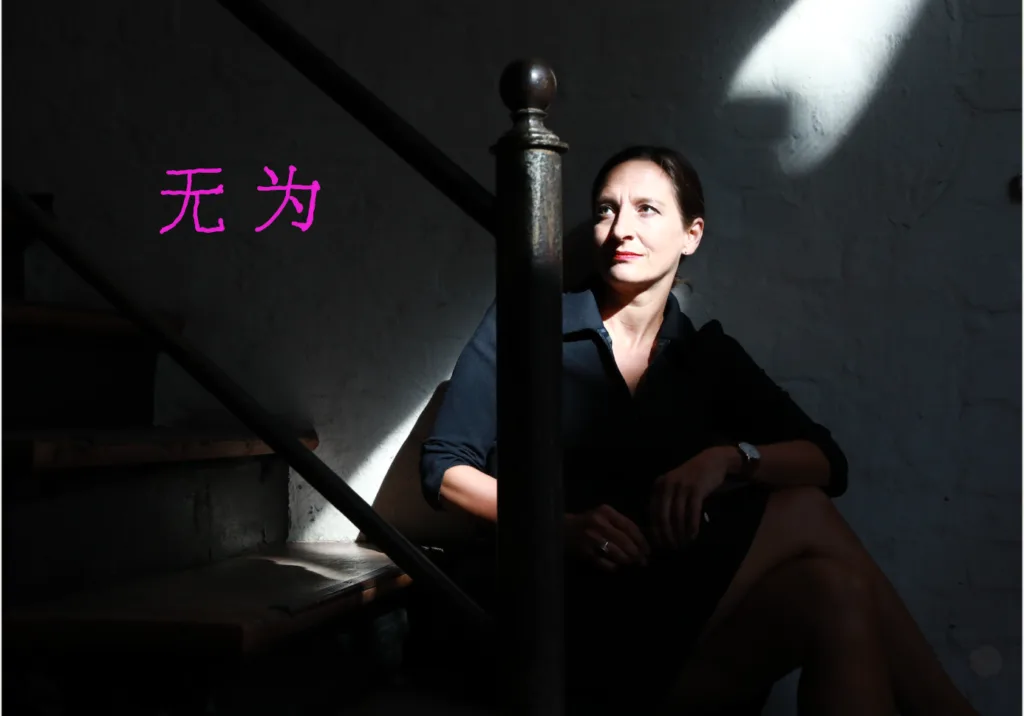
Backstage I still have a few minutes left before the performance starts.
People around wish me luck. They are patting me on the back saying: “We know you’re going to do great. They mean well.”
Desperation is growing within me. I am going to play the lead role here tonight – and it seems only I am aware – that I don’t know anything. I am not prepared. I have no lyrics, no text.
Blank.
I wake up.
My repetitive Childhood Dream
Dear Reader,
Thank you for getting in touch for a moment, a few moments or even some hours with me and the lines I wrote. These lines mean ‘the world’ to me – today.
Step in and observe my experiences through your own eyes and through your own unique perspectives, so that they may transform into new experiences, and may still contain a common essence we share or maybe not.
You will travel through times, reality levels, diverse narrative material into some of my ‘parallel worlds’ to reflect back -over and over again- upon my life myth1. This is the basic pattern which organizes in depth the stories I tell and listen to.
My first Decade of Process Work
My dear teacher and coach, Gilla Haeckel2, had directed my attention towards Process Work and the Deep Democracy Institute. That is why in April 2012, I attended my first seminar with Dres. Max and Ellen Schupbach3 in Amsterdam. Probably it was my sensitive dreamer part that felt welcomed from the
very first moment. I didn’t have any idea, where exactly I had arrived, what for, and for how long… but I had arrived. It felt like home.
Referring to DDI as my ‘Process Work Homebase’, I feel also privileged by having traveled to training events of other Process Work schools and teachers4. Lately in lockdown times, I could even travel ‘further’, joining some virtual trainings of the ANZPOP5 and ‘Process Work online’ offerings.
Around three years ago, I started playing with the idea of combining Storytelling and Process Work6 in my diploma thesis of the Deep Democracy Institute (DDI). In my professional field of Organizational Leadership and Communication, Storytelling is often interpreted as ‘one way communication’, whereas to me, it is not. And it is also not only the content that matters, but the awareness of the teller, and the dialogue with the audience. It is awareness and relationship work and the story itself is ideally the unfolding of a secondary process7. A journey from who we are today into who we may become tomorrow. As such, story becomes a vehicle for transformation.
While I first juggled a little with abstract ideas and then wanted to shed light on my professional practice, I started to write Signature Stories8 about 18 months ago. I recollected childhood memories, where I conflicted with my environment. This writing filled me with such deep joy, that I could not help but follow this creative process.
Shyly, I allowed myself to become the object of my research and came to understand that through this narrative process I began to listen to myself more than ever before. Although it was not an easy walk to live through some ‘dark experiences’ again I knew all along that this process was deeply healing for me, and it also increased my awareness of my own healing capacities. The medicine of the ,Wounded Healer ‘9. It gave me a clearer picture of what my contribution in this world and life could consist of.
The outline of this paper has emerged from this collection of Signature Stories. Telling led me into writing. I had been journaling for many years, but I hardly ever shared any of those. And I loved this ‘non-sharing’ because it freed me from any expectations, and allowed to just give space to what wanted to emerge.
During these creative writing months, I had gone underground, until late at night and into the early morning hours following impulses and inspirations. Ok, that is not completely true, lets speak ‘CR10‘- objective truth – being a single mom with three boys working as a self-employed facilitator, it was the timeslots the boys were with their dad that I enjoyed my freedom and dedicated a lot of it to my research adventure.
But in this space, yes, I allowed myself to write from the heart, I let it flow and everything that wanted to come up, could come: Deeply democratic writing. I dived into a kind of creative ocean and yes, that alone was a gift. Liberating, healing. Here, only a part of it -maybe 50 percent- will find space, the rest I am going to keep for myself or maybe use them as ingredients for future ‘soups’ that I will still cook. At this point, I would like to mention again how hungry I was to be creative … I followed my joy and my curiosity to find some treasures all along the journey.
In contrast to the linearly logical (more mainstream11) research approaches, the structure of this thesis emerged out of the flow – from out of the narrative material.
Dreaming into Research
The Blank is part of my life myth and to deal with it in the context of this research was another precious gift to me.
During these weeks the picture of a typewriter kept flirting with me again and again. I see myself sitting there as a journalist (maybe a gonzo journalist12) writing about world topics combining it with my heart-centered subjective views. As if I could contribute to an overall awareness building with it.
I still need to discuss this with a parental voice inside of me who labelled me as the one who was able to be calculating but not writing. I guess I just had a different approach to words -a telling one- than German schools had had in the eighties and still do have up to now. What I understood is, I am an ‘everyday poet’, my writing voice is rather coming from the heart than from the mind.
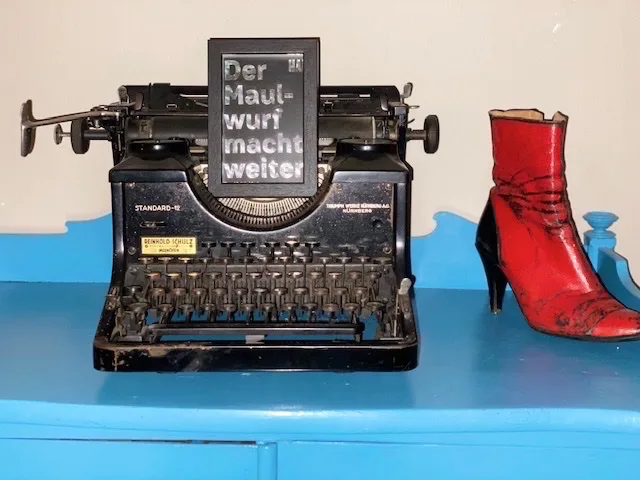
This was just another of these moments, where my nature conflicted with cultural context and directly leads me into my basic research questions:
- What have been moments my ‘true’ nature conflicted with socialization?
- What does my life myth tell me about who I am and my fundamental direction and patterning? How does it help me understand my deepest edge to stepping fully into who I am and want to be?
- What is my contribution here in this world? And how can I joyfully live into it?
- Storytelling – process oriented, what does this mean?
Thanks to Rebecca Lang and her final IAPOP13 project, I found out about Clark Moustakas’ Heuristic Research. This gave me a name and further instructions around an approach I had -rather intuitively- chosen.
Methodology
Moustakas (1990) describes heuristic research as “a process of internal search through which one discovers the nature and meaning of experience” (p.9).
Moustakas further specifies (p.13):
In the heuristic process, I am creating a story that portrays the qualities, meanings and essences of universally unique experiences. Through an unwavering and steady inward gaze and inner freedom to explore and accept what is, I am reaching into deeper and deeper regions of a human problem or experience and coming to know and understand its underlying dynamics and constituents more fully.
Thus, as a result of the inquiry process, the researchers find self-knowledge, awareness and an expanded sense of self, enabling their transformation (p.9).
Research Phases
1) A creative Self Experiment
Similar to Carl Gustav Jung’s Red Book*contemplation, I immersed myself (my Self?) into a self-experiment by inviting the flow of writing over a period of several months, while I got to listening to many different voices, and was telling many different stories. Out of the plenitude of narrative material, I started to build artefacts … like an alchemist I carefully selected specific ingredients to compose an alchemistical concoction.
In the distillation process and interweaving of components something additional like a narrative, a storyline appeared, which then led me onto a more sentient and transcendent level. A creative surprise appearing out of the unknown.
What for? I followed a stream of deep joy of creating, also some tough hours of chewing and digesting the food I had generated driven by a deep curiosity in self-discovery. At a certain point I was not sure, who was working with whom: Me with the writing, or the Written with me. I needed to take time-outs in order to detach before being able to continue work. Some of the stones I bore with me I had transformed into gold, others are still waiting for this process to happen, others maybe will never be completely transformed.
2) Providing a Reader’s Guide
In the first phase I needed the creative freedom to detach from any audience. Only after I had almost finished the story gallery, I was ready to follow my mentor’s, Josef Helbling14, recommendation to work on a Reader’s Guide. I am deeply grateful for his persistence in reminding me of it. Explaining the plot behind each Gallery Room has deepened my whole experience. I started to create a bridge between teller and audience (observer and observed). But to really become fluid between the roles, I also needed to switch into the audience’s role.
3) From Interview into Dialogue
At a certain point I felt I needed to ‘step out of my own soup’, listen to other stories beyond my own and to understand how they resonated and interacted with mine. I also wanted to get feedback from outside regarding my way to combine Process Work with story. Therefore, I invited seven experienced Process Worker and DDI colleagues for an interview. My objective was to create a ‘similar’ experience in terms of structure to the one I had had during my writing journey.
I started to ask my interview partners about a childhood memory concerning a conflicting experience with some authority figures (or their cultural context), then about their own life myth, and what in terms of Worldwork11 the till now ‘unheard voice’ wanted to bring on stage. At the end the term interview seemed not to fit anymore, because it was not a ‘stiff’ role structure. Starting as an interview, it became more of session, flowing into a dialogue towards the end of the conversation.
The deep conversations also gave me an idea about our relationship myth or shared Signature Fields, and how I as an observer put light upon certain aspects on their stories which were somehow connected to mine. Introducing my resonating story parts could help unfold new aspects through similarities or differences. In Process Work terms, the narrative material makes appear an Intentional Field15* and it needs relationship work, and the sensitivity of a facilitator for the upcoming signals16 to respect the teller’s and the listener’s and their common process.
The objective of the dialogues in this work was to help me to step out of the double role of being observer and observed at the same time, and to generate more insights about role structure, reflect my practice to work with Story as a Process Worker, and to find a first approach to relate to potential readers of this work.
4) Feedback loop with the Interviewees
The sharing of the very personal content felt at a certain point very delicate. Not surprisingly though, as it happens to be the major edge in my Childhood Dream ‘to step on stage’. That is when I decided to invest more energy in the relationship with the audience; I had had the idea of a feedback loop with the interview partners in the final phase of my research.
I had offered them all a transcription of their respective interview along with the First Gallery Room. If they liked this ‘appetizer’ of my work, they could order more from the menu of the overall contents of this thesis. Surely, my curiosity and wish for feedback was and is high, but still more important was to keep it a somehow light and joyful co-creative adventure to the reader.
5) Finishing
Each of these phases grew out of a little (or bigger) crisis, a step over the edge was needed, something new wanted to happen in the process. A very special phase is (in this very moment) the finishing. There is still so much to do, in terms of format, language, some ideas that still want to be included, and other ones are still coming up. When is it enough?
And even if I consider it enough now, some of the stories could already be re-told. I wonder, how can you ever finish a work in Process Work? And what happens after … are the stories dying when they are not connected to my process anymore or do I need to let them go like children, giving them the space to live further in their very own way?
How to read through this Work?
1) The first part is designed like a Story ‘Gallery.’
This is the artistic part which creates an atmosphere that is rather multidimensional than linearly logical. You may even get irritated and may wonder how the fragments connect. At that point you are invited to simply experience and to find your own meaning to it or to go directly to the respective Reader’s Guide. An interactive link is introduced after each Story-Artefact.
The ‘Story-Artefacts’ originate from different sources, such as
- Journal – more recent experiences
- Signature Stories – Childhood Memories
- Dreams (Night and Day)
- Portrait(s) of a role in this Gallery Room
- Dialogues
- Tales / Poems / Songs
Maybe you also spend a moment listening to the music or looking at the picture, to settle into the atmosphere of each room.
2) The second part is a Reader’s Guide
Here you will receive an analysis providing you a deeper understanding of each Story-Artefact. The analysis is conducted through a Process Worker’s lens.
3) Life Myth Reflection
The Childhood Dream as reference for my life myth is occurring as a third part in each of the rooms. The highlighting shows which aspect of the Childhood Dream I deepened through working on this Gallery Room. A Process Work practice or explanation further illustrates the connection
4) Theoretical Impulse
On top of that, each Gallery Room helped featuring a specific facet of the broad Process Work paradigm, like Lucid Dreaming, Signature Field, Feynman’s Diagrams, metaskills etc. Although this paper’s audience will predominantly be the Process Work community, I wanted to make it accessible to a wider audience by introducing the relevant vocabulary through footnote and glossary.
5) My Wake up Moment
What was my insight working on the respective room? Which edge did I step over (or not yet)? This part helps me to further boil down the fragments and the analysis to gain their essence. From each room a sentient title results, a kind of mantra, which became the title of the room. All titles together compose a ‘narrative manifest’, which resulted in a kind of a code that maybe useful in future as a personal guideline.
6) Appendix
At the end, you find an overview of the different artefacts, life myth aspects, the glossary and literature references.
Acknowledgement
First and special thanks to my main coach, Ellen Schupbach, who has been supporting me over the last decade with her love and wisdom to grow more and more into my ‘true’ nature, to walking ‘my path’ and becoming more fluid between strength and tenderness. Patiently and repetitively, she has taught me how to embrace myself including all my struggles, which led to a continuous deepening of self-love, and therefore my overall capacity to love people and life in general.
I also want to thank Max Schupbach, an amazing teacher, who was one of the co-creators of Deep Democracy facilitation putting a special focus on leadership and organizational work. He has been a continuous source of deep learning and inspiration through his ‘magical17‘ process-related interventions, as well as his profound and light stories supporting the process, and his loving support as a leader of the DDI team.
My thanks also go to my thesis supervisor, Josef Helbling, who gave me orientation and stability through this joyful but also intense research process. With kindness he helped me to trust in my creative approach, motivated me to dig deeper ‘for the diamonds’, and at the same time find the right scope to make this project ‘feasible’.
Also, gratitude to my thesis co-supervisor, Gabryiesca Basiuk, in her multiple roles, as an interview partner, close friend, work colleague, and part of my guiding team. I thank her for the encouraging support all along and especially in the last period walking me through the challenges of finishing the work.
Further thanks to the DDI faculty, especially Nader Shabahangi and Julia Wolfson, and other certified Process Worker like Kate Jobe, Michal Wertheimer and Andrew Smith who helped me deepen various aspects of this work. Not to forget my dear companions Beatrice Leone and Anna Pujol, as my Peer Group who were loving, challenging and reliable reference points on this journey.
Special thanks also to my interview partners Gabryiesca Basiuk, Anna Pujol, Beatrice Leone, Gill Emsley, Julia Wolfson, Serge Ribachuk, Devkos Bradley (Smith) to support me by joining in -at this point- into my explorative adventure.
I also want to bow to Arnold Mindell as the founder of the Process Work paradigm and the manyfold teachings through real shared experiences as well as on the theoretical side by studying many of his books. Also, gratitude to Amy Mindell, who deeply inspired me with her work on dream-inspired creativity and metaskills.
My deep gratitude also goes to Anaa18, who has been supporting me over the past couple of years through with her Interdimensional Healing modality by holistically working on my chronic thyroid issue. She deepened my understanding of energetic work and self-healing capacities. Special thanks to her for editing and checking up on language to ensure the comprehensibility of my writing.
Finally, gratefulness to the DDI tribe, where I found brothers and sisters, spread all over the world and closer to my soul than many of my neighbours or CR family members. The short video I made after the DDI Cairo Intensive 2018 ‘The World in my Backyard’ expresses best my deep love, gratitude and appreciation for the shared learning path, my teachers and co-students.
https://www.wevideo.com/view/1231407572
My Invitation
You probably already feel my passion for awareness-building and transformation through creative processes. I would like to invite you to join me in a dance of Process and Story. Maybe you can catch a spark of the grace I find in it, and ever so often feel delighted by.
This Songtext “The Fools Who Dream”
of an audition in the film Lala Land gives you a first taste of my life-myth and what kind of performance,
I want to bring on stage as a storyteller …
"A bit of madness is key
To give us new colors to see
Who knows where it will lead us?
And that's why they need us"
So, bring on the rebels
The ripples from pebbles
The painters, and poets, and plays

And here's to the fools who dream
Crazy as they may seem
Here's to the hearts that break
Here's to the mess we make"
After a long path of unsuccessful rehearsals, one of the two main characters, the actress Mia is asked to ‘simply tell a story’. In response, Mia sings a story about, how her aunt, a former theater actress who eventually died of alcoholism inspired her to chase her dreams. This is her breakthrough …
Enjoy the ride! Steph Kata
Room I: Dream first
Summary: Blank. Stardust. Lucidity.
This first room is about experiencing uncertainty or, as I will be referring to it throughout the research paper the Blank Moment. You will be introduced to the concepts of consensus reality (CR)19 and dreamland (NCR)20 which will eventually also be deepened. A tender girl appearing as a dream figure21 assisted me in the process of surrendering to the unknown and in receiving ‘stardust’ as a gift from moving between the two layers of reality. By following an inner dialog between the ‘ Dreamer’ and the ‘Engineer’ you will get an idea about the tension between these two roles in the Northern German/ Western European context. Room I is finishing, upon what we can learn about lucidity22 from Indigenous cultures.
1) Story Gallery
a) The Oceans’ Whispering
St. Peter-Ording, 12th of March 2020, 10pm – Journal
It’s full moon. The lonesome existential fear I had carried with me or fought against over the past seven years was now appearing once more – at its ultimate high. For one day, it seemed to overwhelm me. I fell into a fluttering delirium. Difficult to admit, because first of all, you should know, I am a strong, brave woman who always finds solutions.
This may be a good moment to introduce my everyday identity23: March 2020, I am a 47 years old woman, born in Munich, now living in Hamburg, single mother, with three sons (11, 13 and 16 years). I work on my own, as a process facilitator, communication expert, and leadership coach in the corporate field.
At this moment in time, I had no solution, but I had a clear impulse what to do next … before life would get ‘locked down’, whatever that could mean, I wanted to go to the beach in St. Peter-Ording24.
Due to the covid-19 pandemic, the government announced an overall lock-down, two days before. As most of my income was generated by working with groups, in presence, within three days ninety percent of my professional assignments for the next three months got canceled.
On top of that, it has been announced that schools will be closed from Monday on. Beside the financial worries on my shoulders, home schooling and needed everyday care would significantly increase.
Whereas, I had found my way to smoothly move through the complexity of responsibilities over the last years, as a single mom and entrepreneur, now all ‘structure’ suddenly collapsed.
At this moment, I wanted to breathe the rough energy of the North Sea and cleanse my crystals in the ocean waters. I needed these crystals right now to be at their full power.
Yes, I do have some crystals, and sometimes I speak to them. Although crystal cleansing is not part of my everyday routine and identity, this kind of – let’s call it ‘new age’ playfulness- provides a private source of wisdom and insight for me.
By the time I arrived, it is dark night and the long beach bridge was still illuminated. It was low tide; the water was far out. I took a walk under the beautiful starry sky. With great determination I walked towards the water. There is no one else around – what a relief. I would just walk to the edge of the water, rinse my crystals under the sky and turn around.
At this particular area the water can be very far out during low tide. It took another half hour walk from the beach bridge …. then I heard the deep sound of the water coming out of the dark. An eerie moment. I realized that now I was at the mercy of the water. And yet I continued my stride. Couldn’t remember a time that I had ever felt more alone, and at the same time so much part of the whole, of something greater. For a moment I contemplate the idea of losing myself in the ocean, the idea of merging into its vastness appeared seductive.
Somewhere deep inside of me, I heard the ocean whisper:
“You can try, but I will spit you out. You have something to do here.” Blank. I stand still, look upon the amazing sky and feel the impulse to open my arms wide. The Anderson’s fairytale ‘Star child’ came to mind. I open my arms and … receive …. stardust.
I headed back, leaving fear and despair behind, somehow proud of my courage to have walked alone through the night, gifted by the connectedness I had experienced, still a bit dreamy and also curious to step back into the unfolding collective ‘Blank Moment’25.
The Oceans’ Whispering (Journal) see reader’s guide
b) Star Child
Anderson Fairytale
A goodhearted unnamed orphan girl only had her clothing and a crumb of bread that a kind soul had given her.
She gave her bread to a hungry man, and her cap, her jacket, and her dress to three freezing children. After wandering into a forest, she saw a naked child begging for some clothes and since it is dark and she cannot not be seen, she gave also the last piece of her own clothing away.
As she stood there with nothing left at all, suddenly stars began to fall to earth right in front of her, transforming themselves into talers (gold coins), and she found herself wearing new clothes of the finest linen.
The story ends with the girl being rich.
Star Child (Tale) see reader’s guide
c) Dreamer meets Engineer
Lüneburger Heide, 5th of August 2029, Inner Dialogue
Engineer (E): Who are you?
Dreamer (D): smiling … ah, it’s true, you may have difficulties to see and to know me. Who am I? I am a highly sensitive person with a rich inner world. I am fascinated how processes are reflected in the sky, in the community, in relationships, in our body and our dreams. I love to watch the sky, to follow the moon and to perceive how all of this affects the atmosphere. I find guidance therein.
E: I see you quite seldomly in public. Is there anything you have to hide or to hide from?
D: Hmm, let’s say, I like to be invited, and I do not like to be humiliated. I have a lot to share, but for worthier purposes than mere entertainment or to even making fun of it. Taken seriously, I am at ease ‘on stage’. As I am part of the whole, connected to everything. I am and perceive myself rather a vessel than a person.
E: Sounds a bit spooky or somehow esoteric?
D: What does esoteric mean for you? Someone who lights incense sticks, works with crystals, reads oracle cards, celebrates moon rituals? Yes, I admit, all that is also me. And what conclusions do you draw from this?
E: To me, you seem to be lost in spheres, to be living in a dream world, not capable to even calculate. To be very honest, I think you are a ‘spinner’, a fool – not able to survive in this world.
D: Thank you for being so honest. That gives me the possibility to answer. You know, there are so many good rational smart minds around this country. Why not open up to more than one talent? Mine is to sense the atmospheric and energetic surroundings. I can read patterns and stories out of many different settings.
E: Are you saying you are a truth or fortune teller?
D: Not really, the ‘stories’ help me to translate my sensing into pictures and words. The translation makes it my momentary truth, yet I do not consider it to be a general truth. It is you, my listener who decides if this has any relevance for you.
And in a way, yes. I am a fortune teller. The sensing of the atmosphere allows me to become more aware of some tendencies at a very early stage, it helps me to adjust to circumstances and to support transformative processes. It does not make me less able to survive, maybe even more, at least differently.
E: Honestly, you somehow scare me. You may manipulate me with your sensitive powers? Or seduce me spiritually?
D: I like that you take me seriously. Yes. I am powerful.
Dreamer meets Engineer (Inner dialog) see reader’s guide
2) Reader’s Guide
The Oceans’ Whispering (Journal)
Journal – these are story fragments that come from my diary. I am sure, there are many ways to write a diary. Mine is a very intuitive and flirtatious one. I am not very precise, and not very ambitious with it. To me, it does not need to be beautiful. It can be of course, but that is not the primary goal. What I like is, to catch sparks and to unfold experiences.
During emotionally balanced and happy times I cultivate the practice of two morning pages directly after waking up. In these early moments, I still get a bit of dream material in my writing. It is a kind of contemplation. In really good periods I observe and find material for stories all around and write it immediately down in the very moment. In ‘bad times’ I tend to forget it and I am in focused survival mode, no flirts, no stories. I call these ‘bad times’ because writing is something very nourishing to me. This ‘muse time’ is my doorway to travel through different reality levels26 from an everyday reality (referred to consensus reality/CR) into more dreamy states (or non-consensus reality/NCR) in Process Work27. These journeys make me feel connected, aligned, more complete.
When I lived through the St. Peter-0 rd ing experience narrated above, I was clear that night that I will use this experience as an opening of my thesis. With all fears, difficulties, and restrictions the covid-19 time brought, and still is bringing today28, I was clear in this night that I will use the space the collective Blank opens for me personally to dive deep in this research. The collective setting was the frame for the story that wanted to emerge. The time spirit would be co-creating.
The deep work on this peak experience29 helped me surrender to the unknown in a quite early stage of the ‘pandemic crisis’, and to make the virus (not all along) my ally rather than my opponent.
This does not mean that this period was an easy one, and that all worries and challenges completely disappeared, but that I could frame it differently, as a chance of deep self-exploration, creativity and transformation.
As Rebecca Solnit pointed out, to be lost is to be fully present, and to be fully present is to be capable of being in uncertainty and mystery.
In a moment of crisis, we can leave our everyday identity behind: During my walk, I got altered by the overwhelming emotion of panic, found myself in an altered state30. It was, what I call, a Blank Moment. I walked through dreamland31 and even connected to the essence32 of the experience – the sentient level.
My learning was and still is to surrender, to leave (some parts of) my everyday identity behind and let emerge new aspects that allow me to find a smoother everyday dance with the Process Mind33.
In my writing I have introduced you to my everyday identity, as being the one who knows and always finds solutions. My edge34 was towards being lost, and not to know. The action of cleansing my crystals became so important, because I associated this with getting my channel clear in order to find spiritual guidance. Latest when the Ocean whispered, I went through a dream door35.
My auditory channel36 is an unoccupied one, which means, it gives me easier access to secondary information – to the unconsciousness. During my writing, I was shortly wondering, if I ‘heard’ the ocean whisper or if I imagined this experience through the writing at a later state. But now, reflecting upon it, I remember that I had a much longer inner talk with the ocean, elaborating and deepening the ‘there is still something to do for you here.’
Covid -19, as a pandemic has interrupted our collective structures and routines massively, that is why I call it a collective Blank Moment and suppose that the ‘elixir’, I took from it, could be useful for some others or even the collective (at least the mainstream) too.
Star Child (Tale)
Tale – here I introduce tales, fairytales, myths, that hold wisdom that in some way answers my specific needs in this experience. Star Child is showing me a way, how to further process tendencies in the Gallery Room. Whereas the journal extract is still closer to consensus reality (CR), but connected to me as a person, the tale is metaphoric, unpersonal, and gets closer to the essence level.
The fairytale was no artificial after-construct, but really came to my mind on the beach and yes, I was opening my arms on the beach and I received – stardust.
Star Child is like an amplification37, a deepening of the invitation to receive: impulses and support from dreamland. Abundance. I understood that each grain of stardust was worth more than any piece of money in this world.
In dreamland, I could find abundance. There is another currency to deal with. This was a wonderful answer to the existential fears of lack, scarcity, and even poverty, which had initially been overwhelming within me and had caused the altered state.
The Star Child tale …has helped me to step over the edge, has supported me in moving away from fear, away from a vegetative hyperactive state of a fight-flight response, and the need to have everything under control, into a trusting and receiving mode, arms wide open.
Dreamer meets Engineer (Inner dialog)
The inner dialog is the documentation of an inner work. The conversation between these two parts has allowed me to elaborate the Dreamer as a role and the Engineer as its major critic. The dreamer is not really secondary for me, I clearly identify with it. Yet, it is more like a secret ‘love affair’ – I tend to hide it in public.
Such a dreamer, this girl, that is what my family used to say in childhood. I did not really like this label at that time. Still today, I often try to keep this talent private. For sure, this is one of the reasons I feel so much at home with Process Work, and with the idea of different reality levels. It helped me to revitalize my externally rather marginalized dreaming qualities. Why marginalized? After having read the dialogue, you might understand better.
Regarding the Dreamer’s quality, my stepfather II (STH) played a major counterpart. Just like everyone, he is a multifaceted being and I prefer to release him as a person. Inspired by him, I created the role of ‘the Engineer’.
The Engineer is a very rational, analytic, smart, hardworking, duty driven figure, a role which also describes a strong tendency in German culture especially present also in the organizational corporate field.
Sure, I am also familiar with this role. My academic curriculum started with a bachelor’s degree in mathematics. I also find beauty in abstraction and logics, and relief in ‘not being emotional’. Over the past ten years, I have rather marginalized this part and hope to onboard it again along this work.
3) Life myth Reflection: The Blank Moment
Backstage …. I still have a few minutes left before the performance starts. People around wish me luck. They are patting me on the shoulder with the words: we know you’re going to do great. They mean well. Desperation is growing within me. I am going to play the lead role here tonight – and it seems only I am aware – that I don’t know anything. I am not prepared. I have no lyrics, no text. Blank. Panic. I wake up.
In each chapter, I will reflect my life myth and look upon this Childhood Dream from a different angle. To start with, I am going to focus on the Blank Moment. The not-knowing (of the lyrics) is like a collective nightmare in our western culture. We all know Blank Moments, in a light version, when we suddenly miss words, lack technical support, or a question knocks us out etc. Most of us adults are also afraid of the white paper or the blank canvas in our creative endeavors.
As a part of me wants to function flawlessly according to mainstream38 culture, each Blank Moment causes initially slight panic, until I surrender myself to absolute presence. Then I remember, my bulletproof Blank oment recipe.
Practice – My Blank Moment Recipe
During the online Supervision Days of the Institute of Process Work in Barcelona in July 2020, I heard Kate Jobe39 speak about dream doors and stories, that made me curious and I asked her soon after for an online session to explore this further. When I tried myself to get sorted to find ‘my’ topic to work on, I had forgotten my original impulse, felt confused, did not know anymore what I was really here for, blank, seems that I got my topic directly presented as an experience, my good old friend: The Blank Moment.
Kate asked me to express my current experience through a movement. First there was a small tender movement that made me smile, gave me the feeling …: “yes, I know, but differently, not in words, it emerges from the heart.” Then I stood up, opened the arms wide like the Star Child ….and I received. It was like energy running down from the sky through my body. Kate later said my facial expression had completely changed. It felt like I had been filled up with light or energy.
Quickly, I tried to find reasonable explanations again. But as soon as I started to know, I became aware that I was not unconditionally receptive anymore. When I surrendered to ‘the Blank’ instead, I got whatever I needed in this moment to feel energetically complete. At peace. I arrived in this very moment. Absolute presence.
To get there I needed to free myself from the idea of performance, that means to shut myself off from my surroundings, either being alone or protect my space in an imaginative way, so that no inner or outer pressure/expectation could disturb my inner stillness.
A critic challenged me by saying: “And that’s all, nothing more?”
That seems to also be part of this process, my brain was too slow to grasp the deep meaning of the moment, it needed a bit more time to unfold, and to arrive there. Now, seen from a greater distance, I understand that I received a wonderful gift – a concrete recipe how to deal with the ‘Blank Moment’.
I went further, asking a really big question, what it was that I would want to contribute in this world. This time I opened my arms on a lower level and felt the energy enter my hands and forearms. In this state I had difficulties to find words, I tried… and understood that I needed to let creativity flow, let it rise to my throat, to then express whatever wanted to express itself.
I gave clear orders to all inner critics in this moment to step aside, telling them that at a later stage they would be welcome to contribute to streamlining a result.
The one thing I want to contribute to the world – coming up here and now – is to give space and to hold Blank Moments.
4) Theoretical Impulse: Lucidity
PW Impulses – here I offer short theoretical impulses which inform the room and top aspects which – in my opinion – occur to be specifically relevant within this setting.
Some indigenous people believe that the bright part of the moon corresponds to Everyday Reality as the dark aspect to Dream Reality.
Arnold Mindell, 2004, p. 17
Arnold Mindell calls the worldwide non-perception of dreaming an undiagnosed epidemic. The fact that most people of this world have learned to focus solely on everyday reality and therefore have forgotten about the dreaming background, makes people suffer from chronic unhappiness. In my work, I want to focus on working with active imagination40, stories and narrative material as a special access to more sentient experiences.
My objective is to show ways in which stories can help us better understand our dreaming, bring our ‘told’ lives more and more into alignment with it, and maybe also support the manifestation of our dreams.
Similar to non-measurable quantum physics, which speaks of a field of potentialities, the dream world (in the view of some indigenous people) relates to the real world. You can’t measure dreaming, but you can feel it.
Arnold Mindell, 2004, p. 21
To trace the dark side of the moon requires the ability to trace subtle tendencies, one need a certain quality of attention and concentration that Arnold Mindell calls lucidity.
Whereas the original definition of lucid dreaming was to become aware of dreaming during the night, Arnold Mindell broadens the definition into sensing the dreaming that creates the dream, be it either by day or by night.
5) Wake up Moment
Not-knowing is not a state of scarcity, it is an invitation to receive
Installing the first Gallery Room, I notice that I had built a stage for ‘the Dreamer’. I own a quality that is able to deal well with the Blank Moment. Writing and so deeply working with it, makes me trust more in the Blank state as a doorway into the dreaming, a connection to the creative source – the Process Mind. Out of this state emerges what wants to be told or created. Inspiration and abundance.
This Gallery Room helped me understand how much I had followed the mainstream marginalizing41 my ‘dreamer quality’. Although, it is probably one of my biggest talents, I did not completely own it. The healing I wish for the whole collective, obviously starts with me, bridging dreaming, spirituality and creativity with rational, analytical grounded-ness.
This doesn’t only mean to meet the dreamer in an altered state in times of crisis or as a hidden leisure activity. This inner dialogue enhanced my awareness of the strength and power that lies in this part, and helped me to find words for the outer world. I am curious to observe, how this will lead into making more of my dreamer qualities visible, where appropriate, in my private as well as in my professional life.
It starts with my three boys, although they experience me often as a facilitator, I notice that I only rarely explicitly shared my sensitive dreamer qualities with them, as if I feared their judgement and kept them rather like a tender plant in my very own well protected space. I guess this is one thing, the ocean meant by ‘you still have something to do here’, to make more of it visible.
On the other side, I will take the Ocean whispering ‘you still have something to do here’ as a research question through all Gallery Rooms, because it assures that after all kinds of dreamland travelling and sentient experiences, I remember to connect my insights back to consensus realty.
6) My Questions to You
What does the Ocean whisper to you? What is it, you have to do here? Do you have similar roles discussing like my ‘Dreamer and Engineer dialogue’ inside of you?
Room II: Own your Truth
Summary: Chosen for. Patriarch. Signature Field.
The second room is about the experience to feel unwelcome or not consciously having been chosen for within your birth family. As a ‘survival strategy’ in these circumstances you either start to please, adapt and compromise to find or keep your position in this family or you can believe in something greater, something beyond CR which holds you in a similar way as your birth family is assumed to do. You will meet my grandfather an old-style patriarch ‘fighting for the good’ and discover how I along with the well-adapted, empathic Stephanie, I also nourished Durga – my rebellious nature fighting for truth. The tale of the Chicken Farm helps this part to unfold. This rebel part innately carries courage and fearlessness within to make the ‘shyness to step on stage and become visible’ disappear. As a theoretical impulse, I frame how the different’ Gallery Rooms’ reflect different facets of my Signature Field42.
1) Story Gallery
a) From a Department Store
Munich, 1977, Signature Story
At 4 years old, I asked my grandfather: “Opa43, where do the babies come from?”
He answered: “Oh, you mean how YOU came to us? I went to the nearby department store and chose you out of a big offering of babies.”
I asked back: “Why did you choose me?”
He answered: “That was easy, you were the most beautiful one.”
CR Info: Being the fruit of an unexpected pregnancy of a 17-year-old girl-mum, all solutions from keeping the baby, abortion to adoption, were being discussed. Whoever decided in the end, I came and stayed for a while, although the family constellation (esp. stepfathers) changed a few times over the years.
From a department store (Signature Storv) see reader’s guide
b) The good Girl’s Twin
Munich, 1977, Inner Dialogue
…from a baby shelf. Ha, what a nonsense! Department stores do not have babies on the shelf.
That’s what I had thought already as a child. But I did not speak up on my thoughts. I let my grandfather with the belief that he was the one who had ‘bought’ me into the family and latest with his charming ‘you were the most beautiful one’, I had even been tempted to accept this story. It was a kind of arrangement.
In my dreamland, I was a twin. Whereas the polite well behaving girl was Stephanie, the other one was a naughty girl, her name was Micky. She didn’t care about any rules, was very brave, fearlessly speaking out and doing what seemed right to her in this very moment. In a way she was how I always imagined my grandfather as a boy, naughty: ‘Ein Lausbub’44.
The two girls were in continuous dialogue, Micky was wild natured which helped me somehow to get along with the corset of everyday world.
The good Girl’s Twin (Inner Dialogue) see reader’s guide
c) Bride’s Father’s Speech
Varese, 7th of September 2002, Journal
The seventh of September 2002, my wedding day. My beloved grandfather had died 6 years before, and I was missing him a lot. He would have proudly led me to the altar. Not sure how widespread this tradition is, but here in Germany when you get married in church, it is still very common practice that the bride’s father walks the daughter through the church to ‘officially’ hand her over to the spouse. It did not feel very congruent for me to follow this symbolic and let this privilege to my father I had never lived with.
Although my ‘real’ father had joined with his wife and the five children. I felt that he was struggling with his role. So, did I. Over the years, we had built up some contact, met perhaps twice a year on his ‘territory’, but he never came to see me in my home.
Still, I had hoped he would take a step into ‘fatherhood’ by holding a speech as it was common for the bride’s father to do. My expectations had caught him by surprise as he wasn’t prepared for this challenge. But he took my wish seriously and disappeared during dinner to get ready to speak.
He made a beautiful and very touching speech. Although, when he described one specific situation, he got me annoyed. He mentioned a ‘men’s drinking night’ with my grandfather (mother’s side), that had happened in my early childhood. In this night, they both had come to a common understanding that it was my soul who had chosen this path and them to be the families that I wanted to be born into.
The Bride’s Father’s Speech (Journal) see reader’s guide
d) Old style Patriarch speaking Truth
Portrait
My grandfather saw a lot of beauty in me – that is true. I was his princess. Or Durga, how he liked to call me. Although he has left his physical body more than 20 years ago, we are still well connected. In the sense that in dreamland I can have my conversations with him. From time to time, I ask him for advice or support, whenever I feel I need some of his ‘Cowboy Energy’.
He was a strong and influential man, an old-school patriarch, and of course much more than this. For example, he even set the rule for all the women in the family to wear their hair open and soft. Otherwise, he would drop into a very bad mood and withdraw his affection. And, surely enough, nobody wanted this to happen.
Yet, an even bigger challenge was that he liked to tell that as a boy he believed women were angels and got so disappointed when he found out that this was not true.
Just like all the other family members, I made sure to put all the effort into meeting his expectations or at least to succeed in ‘being a good girl’. And I did well. I had a special place and even a special rank. In a way I became his trusted strategic and psychological advisor. I could tell him a lot, also unpleasant things. Very often, I was a mediator especially for my mother and my stepfather. He would listen to me. He respected me deeply.
After his death, I broke some of his rules like wearing my hair tied up, although deep inside of me I still found a deep-seated fear of disapproval. Yet, thinking about it now, I am not sure if this was really my own or my mother and grandmother’s worry that I might have taken on. Fact is, it did not have any influence on our dreamland relationship. After a while I concluded that spirits do not judge on hairstyle, they just love unconditionally.
Giving my grandfather a voice here today after all we had lived through, he would tenderly say having tears in his eyes:
Whoever had decided for you to come in this family, I am deeply grateful for it. And yes, I have to admit, in the beginning, I was not happy at all about my daughter’s early pregnancy, I would not have had chosen this. But it didn’t take very long for me to understand, and you know this, that with you I had received one of the biggest gifts in my life. I love you!
Patriarch old Style speaking the Truth (Portrait) see reader’s guide
e) The Chicken Farm
Tale
A man found an eagle owl and put it into the nest of an ordinary hen. The little eagle grew up with the chickens. The little eagle behaved like the chickens because he thought that was what and who he was and was supposed to be. He scratched the earth for worms and insects. He gurgled and cackled. And from time to time, he would flap his wings and try to fly a bit Just like the chickens. He lived a happy life.
But one day he saw a magnificent bird cycling high above him in the cloudless sky. Gracefully and majestically, it floated through the violent fierce currents of the winds, almost without moving its strong golden wings. The young eagle looked up in awe.
“Who is that? “… he asked his companions. “That’s the eagle, the king of the birds” said one of his companions. “But don’t get upset, you and I, we’re of a different kind.” The young eagle looked up again. A strange excitement befell him.
At first quite timidly, then more and more excited and stronger he began to flap his wings, and then it happened with a bloodcurdling cry he rose into the air and floated away. He was never seen again on the chicken farm.
Chicken Farm (Tale) see reader’s guide
2) Reader’s Guide
From a department store (Signature Story)
Why did this conversation with my grandfather come up here? It contains the deep question we probably all keep within us. Who decided me to come to this world?
Somehow our life starts with a Blank Moment. Nobody told me, what this (performance) life was about. I was not prepared. At least I could not remember – once alive. Why did I land in this rather unfriendly, unwelcoming environment? Who chose this?
How much I would like to hear all your answers now!!!
Instead of a great variety in the answers that you all would give, it is ‘only’ my truth unfolding and being presented in this Gallery Room.
In this moment I decide to put a question at the ‘exit’ of each room. Maybe you take it up for yourself, maybe we will find some space to have a conversation, maybe it is the start of a conversation that takes place somewhere and somewhen else.
The good Girl’s Twin (Inner Dialogue)
Dreaming was my way to escape, my secret way to be free, to be whoever I wanted to be. My way not to be ruled by the outside. In dreamland, I got to be the creatrix, I had all the support I needed. In a way, that is what I am still doing today …. I am a dreamer, a storyteller. This gives me a lot of freedom and independence, a certain spiritual rank.45
Immersing deeper into the roles, there’s Stephanie on one side, the ‘good girl’. She is constantly figuring out everybody’s expectations to deliver performance, as this had become her survival strategy. This kind of behavior is needed to be the chosen one from the ‘department store’s shelves’. Speaking about primary process*, for a very long time I identified with this ‘good girl’ and became a ‘super’ performer.
In this room, also the ‘bad girl’ gets on stage – she has no fear and no hesitation to share ‘her truth’. She does not mind the audience; she expresses anything she feels that needed to be said, no matter, whether the audience liked it or not. This part is radically honest, speaks from the heart, good and bad. She is alone on stage committed to ‘her truth’ – a social activist. I call this my cowboy energy full of assertiveness, impact, ready to kill anything that stands in my way and also ready to be killed. She carries a bit of a ‘bully’ energy, not always easy to be friends with.
The Bride’s Father’s Speech (Journal)
We agreed that it was her soul that had chosen this path and us as families, that was the conclusion of the two men.
How did these two ‘strong’ men dare to put all the responsibility on my shoulders?
Today, I also can see the great privilege I had. These two ‘ strong men’ did not victimize me, they did not attempt to own me nor oppress me. Both in different ways, gave me space and power to evolve and become the creatrix of my life.
This leads me to the following personal conclusion, if we believe to owe our life to another human being, we remain in a certain type of dependency and may be at risk to strive to live Today, I like the idea that it was me (or my soul) that had chosen my destiny. Just to add a little detail: I prefer to consider it a mutual agreement – a soul contract.
Today, I like the idea that it was me (or my soul) that had chosen my destiny. Just to add a little detail: I prefer to consider it a mutual agreement – a soul contract.
Patriarch old Style speaking the Truth (Portrait)
As the hypno-therapist Milton Erickson said: “It is never too late for a happy childhood.” This sentence is the base of narrative therapy, de-constructing and re-telling our past stories that influence our life.
That is what I am doing here, I re-tell my past, not all, but the parts that want to be retold right now. That does not mean to escape in an illusion or marginalize the experience, it means to dive deep into the story and to grasp the wisdom in it. This deep dive enables me to tell it differently, to redefine it.
Empathic Stephanie was my primary identity, it took a while to really own my pain, a while to empathize with myself. It was by stepping with complete solidarity on my side that my telling became transformative and healing.
When my grandfather speaks here, it is important for me that he acknowledges the ‘not welcoming’ first. That sounds like I planned what he should say. Did I? In this case, I would say, I did not.
Other times, it happens to me, I storify, I make stories up. One of my major learnings in Process Work is not to trust my stories, but to consider the outer feedback to understand if I walk along the path, to check if I am really connected to the process, and thought about considering different sides. But how to deal with my dead grandfather?
When I listen to inner dialogues, or write them down, it is often a flow, the words come, sometimes I do not get the message right at first, then I try further, and I know when I got it right. It is a feeling of congruency46 which I learned to recognize. It is a positive inner feedback.
Chicken Farm (Tale)
In my late 20ies, it was Gilla Haeckel15, who shared the ‘Chicken Farm’ tale with me. She supported me many years to unfold my ‘eagle nature’.
Inspired by my friend and guiding team member Gabryiesca Basiuk47, I became aware of my focus on the eagle nature, and got reminded to also re-connect to the chicken in me. By allowing this, I felt a sudden relief: Is this part of a sound recovery just to allow myself to ‘be normal’, average and mainstream in certain aspects.
I also notice that being mainstream is not always a choice; having the choice is a big privilege and awareness is appropriate.
3) Life myth reflection: The Lead Role
Backstage …. I still have a few minutes left before the performance starts. People around wish me luck. They are patting me on the shoulder with the words: we know you’re going to do great. They mean well. Desperation is growing within me. I am going to play the lead role here tonight – and it seems only I am aware – that I don’t know anything. I am not prepared. I have no lyrics, no text. Blank. Panic. I wake up.
British author and education expert Ken Robinson starts one of his books ‘How finding your passion changes everything’ off with the story of a six-years-old girl:
Usually seated in the back row, daydreaming while looking out through the window, the girl is now fully involved in her artwork. She draws for 20 minutes and does not notice anything around her. The teacher notices this and turns towards her asking what she was drawing. Without looking up, the girl answers: “I draw the picture of God”. Surprised, the teacher replies: “But nobody knows what God looks like.” And the girl says… You’ll know in a minute!”
This describes my feelings when I step with truth on stage. There are no doubts. I do not need to have lyrics, words come because I know from deep within. I know my truth. Sure, this is not everybody’s truth and it will also not last forever. It is enough that it is true for me in this very moment.
4) Theoretical Impulse: Signature Field
Signature Field is a consistent power that is a special characteristic of your nature. We all share the same ‘mother earth’, but each of us represents a particular part of her. The way you do anything is an expression of your ‘Signature Field’, the power moving you, the ‘Earthspot’* you come from
A. Mindell, 2010, p. 68
Thinking of my life myth* as being a diamond, each of these Gallery Rooms shows a facet of my ‘true nature’ and helps me to deepen the understanding of my Signature Field and the special scent I bring into this world.
Just like the Childhood Dream as a basic pattern which could express itself differently each day, it can also show up in certain stories we tell about ourselves. And it is important to keep in mind that there are many other stories to be told. One diamond, many facets.
When an intentional field arises in dreamland it can take many forms. In ‘Quantum Mind’, Arnold Mindell speaks about the relationship between observer and observed: as soon as you look at something, its appearance breaks up into an infinite number of other possibilities, all of them come into being in the same time. All these other possibilities exist in parallel worlds (A. Mindell, 2000, p.238)
The Signature Stories are like dots, their connection is the storyline, the whole text a plot. For me all of it is a Heroine’s journey48, in the sense of reviewing and processing essential themes of my life. I could have chosen different dots and told a different journey. In addition to the intentional field, there is also…. a narrative field and the Tao49 that helped emerge the stories that wanted to be told.
Besides opening a space for personal storytelling, there is another edge* announcing itself. Do I really want to share this deeply personal writing? There is still some facilitation work to be done to find a smooth and caring way, so that both Stephanie and Micky can accept it unanimously.
5) Wake up Moment
A healthy woman is much like a wolf, strong life force, life-giving, territorially aware, intuitive and loyal. Yet separation from her wildish nature causes a woman to become meagre, anxious, and fearful. The wild nature carries the medicine for all things. She carries stories, dreams, words and songs. She carries everything a woman needs to be and know. She is the essence of the female soul… With the wild nature as ally and teacher, we see not through two eyes only, but through the many eyes of intuition. With intuition we are like the starry night, we gaze at the world through a thousand eyes.
Clarissa Pinkola Estes, Women Who Run with The Wolves
It is only through this writing that I become aware of how this secondary process the ‘bad girl’ or the wild, untamed character has always been there. It survived outer and inner oppression and I am touched how I found different ways to keep it creatively alive.
I also noticed that my grandfather called me Durga, the name of a Hindu goddess who holds a representation of the wild feminine with a fierce warrior spirit. He must have been aware and also a promoter of this part in me.
When he died. I made a speech on his grave with the title ‘you taught me fighting for Good’. He was a patriarch and not an easy person. And he was a warrior who also fought for the good in a humanitarian sense. Writing this, I feel deep love and appreciation in my heart.
Regarding the era he lived in, my grandfather was quite aware of his privileges and engaged himself from his position in the world.
Apart from the stable and paid job assignment, he was strongly involved in an international NGO and his house was always open for many people from around the world. It also happened that he sat himself on a bench to have a talk with a ‘homeless’ old man, to listen to his story and then spontaneously invited him for dinner at home.
It was his curiosity and generosity I loved and which was so contrary to my second home shaped by my stepfather’s attitude towards life. The latter one’s attitude I would describe with negativity and scarcity. He would always go for maximizing his own profit and still never get enough.
6) My Questions for You
Who had chosen you to come here? How is your inner dialogue between eagle and chicken going? What do you know about your ‘wild nature’ ?
Room III: Be flirtatious
Summary: Mothering. Kind. Performance Trance.
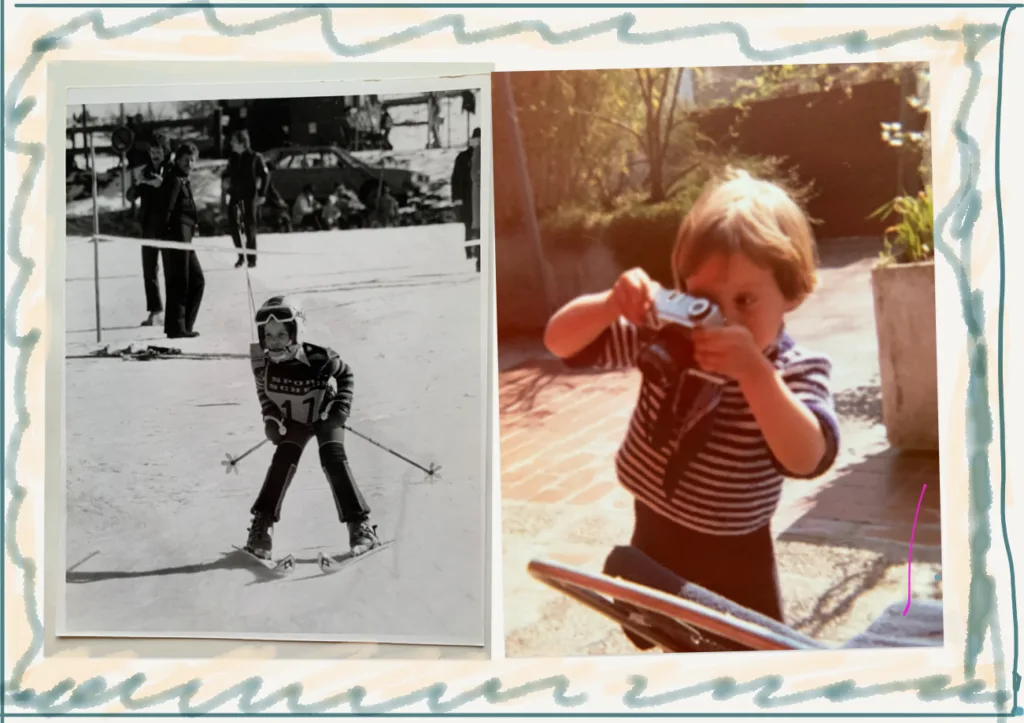
The third room starts with a dream work and the lesson of mothering a ‘neglected’ part of myself. Through the Signature Story ‘Racing differently’ two roles appear: the goal-oriented, and the relational one. The reflection shows how family and cultural conditioning made me marginalize the relational the ‘kind’ part in me. This part also invites me to a more joyful and playful life approach, just as it embraces Me and the flow of life with a beginner’s mind.
This also gives space to imagination and creativity. Qualities that our ‘tired warrior’ part needs in order to cut through the collective performance trance – even more so during these current lockdown situations.
1) Story Gallery
a) Mothering needed
Amsterdam, 1st of March 2020, Night Dream
Coming home from traveling, I take my baby in the arms. It is wobbly, it has no strength in the body, it feels almost dead…taking the clothes off, there are traces of blood. I find an open deep cut. I feel anger arise towards the man in the house – the father. He had not called me, not informed me, had allowed or made a (probably unnecessary) surgery and did not ‘after care’ or close the wound. When I take the baby in my arms, I notice, how the baby is first searching for someone else, probably its dad, until it finally surrenders and melts in my arms. Healing is happening. Lucid shine around our two bodies.
Mothering needed (Night dream) see reader’s guide
b) Racing differently
Kitzbühel/Austria, February 1979, Signature Story
6 years old. Growing up close to the mountains, I was already a very good skier. At least, that is what I thought. I did not fear any mountains and could easily keep up with the adults. My mother had registered me for a ski race in Kitzbuhel within Austrian Alps.
I still remember wearing start number 49 and off I went to joyfully make my way through the gates. At the track, there were a few camera men from the press. Every time I spotted one of them, I slowed down and smiled brightly into their camera.
At the award ceremony, my cousin of the same age, an experienced racer, proudly accepts her prize for the second place on a stage. Whereas I … came 87th (out of 89 participants) in the ranking.
The next day, a big article appeared in the local newspaper ‘Abendzeitung’. A picture showing the winners …
and one featuring me … subtitled ‘This was the friendliest participant of the race’.
Racing differently (Signature Story) see reader’s guide
c) Mom. Sweet-sour.
Portrait
It is difficult to portray my mother. After having created all rooms, I return back here, noticing that I had missed out doing it. As if I still have difficulties to allow myself to speak out here. Yet, it is such an important piece of the puzzle.
My mother is a very charming, attractive woman, easy to relate to. As a child my friends envied me to have such a young, dynamic, and very actively engaged mother. But her charming persona covered up an underlying narcissistic personality. The stage was hers. She played her roles well. Yet, in the background I held space for her emotional neediness by taking care of her, while – in terms of age and role structure – it should have been still me to be cared of.
Worst about this was the emotional pressure I frequently experienced. I received her love and attention if I served her needs. It is a very hard thing to step out of a mother-child relationship, and probably not completely possible, but for a period it was necessary for me to get out of an emotional abusive dynamic.
Mother. Sweet-sour. (Portrait) see reader’s guide
d) A Watch’s Suicide
Kyiv, October 2015, Journal
A watch on the left arm … I always felt an urge to rebel against this rule set by ‘the mainstream’. It reminded me of rigidity – one negative aspect of time. It somehow constrained my free spirit in its creative flow. Over the years I lived well without wearing any watch at all. Although I must admit, not such a big thing, as time is being displayed everywhere.
September 2015, I had entered a ‘flirt’ with a cheap golden Casio watch, a model similar to my very first silver one I wore in the late 70ies. This time I decided to invest into the golden model and travelled with my ‘new’ watch decorating my left wrist to attend a Deep Democracy facilitation training50 in Kyiv.
Intensively working on unfolding personal and group processes, we usually get into a slightly altered state of perception after some days, wandering between dream and reality. One afternoon, being in a giggly mood, we chat as we take a walk with some colleagues along the river Dnjepr until we reach an impressive bridge.
As I rarely cross a bridge without pausing on it, I ask my companions, if they minded to rest for a moment in the middle of the bridge. We slow down, pause, look and dive into the intricate patterns of light reflected by the waters.
In a flash, with a decent bang … my golden watch hits the railing of the bridge before falling freely into the depths … swallowed by the river. After mentally checking in about the weight of my loss, I feel a big relief and start laughing out loud.
A Watch’s Suicide (Journal) see reader’s guide
e) Ice Flowers
Tale
Once upon a time, there was a small village that had forgotten all its stories. Imagine long nights in which none of the parents told,goodnight stories’ to their children. There was no celebration, no music, young couples made no plans for their future. People were extremely bored. All nourishing fruits and vegetables around the village were picked and they had no idea how to get or find any new produce.
One day, an old woman who lived alone in the mountains, for once came to the village. The villagers asked the old woman for advice. She said:, If you pick one of the ice flowers from the very top of the highest mountain, then your village will flourish again’.
The Elders of the village sent out their strongest and bravest warrior. He climbed the highest mountain peak around, found the ice flower, put it carefully into his basket and climbed back down towards the village.
The whole village welcomed him full of expectation at the village’s gates. When he opened the basket in front of all his curious neighbours, the basket was empty. A dark splash of water was the only remainder of the ice flower.
Into the silence of disappointment, a little girl said: ‘Let me have a try on it’. ‘You?’ answered the villagers. ‘You are Just a small girl. How could you possibly succeed in something that our bravest warrior was not able to accomplish successfully? But they let her go and followed each of her steps with their eyes until she disappeared in the fog. It was quite late when they saw her coming back. She smiled. Again, everybody was gathering at the entrance to the village.’ ‘Where is the flower?’, they asked. The girl smiled and said: “Come with me to the fireplace and I will show you”.
As soon as everyone was sitting around the fire, she started to tell: ‘lt was extremely cold and foggy. I could not see anything. Suddenly the fog lifted and I could see the ocean in the distance.
And then I noticed the flowers, the most beautiful flowers I had ever seen sitting directly down at my feet. They shimmered like ice crystals and seemed to be very tender. I kneeled down, sensed their smell, but they started to melt as soon as my nose came close to them.’
The girl told the villagers about the colours, the smells and the sounds she had experienced… and when she ended her story, the whole audience could see the ice flowers and the land towards the ocean. The audience felt like they had climbed up themselves and were now standing on the top of the highest mountain.
‘Imagine…’ a small boy started. ‘Yes, imagine …’ said some others. And in this night, all of them stayed awake and told each other their dreams, wishes and visions for their future. ‘Imagine …I’
Ice Flowers (Tale) see reader’s guide
2) Reader’s Guide
Mothering needed (Night dream)
This dream occurred during a DDI51 training in Amsterdam. In the morning sharing the dream with the group, Max Schupbach asked me, how old the baby was. I said around 6 months, and what it was, that was born around this time. And Max added, whatever it was, do not get too quick into analysis – which he considered like being the surgery – but ‘mother’ the quality. That is what was needed here. Only later it crossed my mind that what started around this time was my self-experiment – the writing of this thesis – in such a joyful experimental way.
Zooming out and reviewing my life story, I was mainly rewarded for performance and missed the mothering of this ‘sweet’, playful relational quality. And it is through this writing and my main coach Ellen Schupbach’s wisely loving support that I embrace it more than ever as being another essential part of my ‘true nature’.
Racing differently (Signature Story)
My mother loved telling the ski race story laughing out loudly with tears in her eyes. It made me feel awfully ashamed, how stupidly I had not understood the rules. The conclusion I drew by this time was, oh, okay, it’s all about becoming a fast performer, otherwise people would make fun about me.
Today, I love to tell the Racing differently Story and tenderly embrace the slow friendly relating part in me. I tell to this sweet part: “Good that you are still with me, I have lived too fast for too long… and sometimes I even have forgotten my friendliness.” In a way, I learned to mother myself and I came to understand that this creates a ‘lucid radiance’ around us.
Mother. Sweet-sour. (Portrait)
There is still so much to discover in the Racing differently Story. Story in process. Right now, I would like to point out, that I am embracing the sweetness as being part of my nature. As a child I probably also felt confident in copying my mother. She has this sweetness and flirtatious talent or even approach to life.
Why did she make fun of me as I was ‘racing’ her or my or perhaps our way? Why did she not want me to follow in her footsteps?
Jealousy became a major problem, when I was growing up. I had spent a lot of time at my grandparent’s place, and my mother profited from her parent’s support being a very young mother. On one side, she promoted our relationship (as long it was useful for her), on the other side she had difficulties to watch the love my grandparents felt towards me.
Some years ago, my grandmother moved in elder care and my mother installed the new home for her. Whereas before my grandmother had all the flat full of pictures of all of us, in the new room now, I had disappeared. All pictures on the wall were showing my mother, her new partner, my half-sister and my grandmother, none of me and the boys anymore. Not sure what was the most painful about this discovery, the fact that I was disappearing in my grandmother’s world or the fact that my mother was doing this to me.
My grandmother’s increasing dementia and me being 800 km afar, made this a somehow hopeless battle. Not sure if this was an escape but it helped me to deepen my trust in another dimension of (NCR) relationship with my grandmother, a dimension where my mother would not be able to interfere.
I had no contact with my mother the past years. In one of our last ‘what’s app conversations’ before that, she wrote: “If grandpa had known about you (not sure but I think she was referring to my ‘egocentric’ life decisions), he would have turned in his grave.” I answered: “No, he would have been very proud of me.”
I still remember Josef Helbling’s, comment on this in one of our sessions at that time, he said: Yes, your mother’s father would have turned in the grave and your grandfather would have been proud.
How could we experience him so differently? This is what I also got aware of, conducting the interviews related to this work: we all have our individual frame of reference (Moustakas, 1990, p.26), like a filter that makes us look at the same person, at a similar experience in a completely different way.
A Watch’s Suicide (Journal)
Life has convinced me about some advantages of being structured in our time- and action-based society, and still more in my professional responsibility as an organizational consultant. It became part of my everyday identity.
Through this story, I understand that I have not conflicted with structure, time or watches – but with timelessness. I still underestimated these delicate spaces, where flow rules over time. My path is to appreciate more and more the slowing down and the magic that happens when structure emerges – with ease – out of the flow.
Ice Flowers (Tale)
When I introduce Storytelling in organizations, I often start with telling this story. It explains on a deep mythic level, why imagination, creativity, and stories matter to cope with current times, exhaustion, and unhappiness – it also helps me to introduce the sweetness of the beginner’s mind52.
Often, the listeners can connect to the tiredness of the warriors, the lack of a bigger vision and community spirit in their professional life. That is how the door opens to step over an edge, to get in touch with the unknown.
The organizational world is full of experts, who often reject to connect with beginner’s mind. It is a secondary process53. This is a good example, how a tale can help to introduce and deepen the understanding of roles in a metaphorical way and invite healing or transformation to happen.
3) Life myth Reflection: Beginner’s Mind
Backstage …. I still have a few minutes left before the performance starts. People around wish me luck. They are patting me on the shoulder with the words: we know you’re going to do great. They mean well. Desperation is growing within me. I am going to play the lead role here tonight – and it seems only I am aware – that I don’t know anything. I am not prepared. I have no lyrics, no text. Blank. Panic. I wake up.
Some years ago, working on my life myth with Caspar Fröhlich54 during his DD-Days in Zurich 2015, I dreamed my Childhood Dream further. Me- as the one that does not know the lyrics, took all my courage and stepped on stage ‘not-knowing’.
The void did not last for very long because there was a lot… there were the sensing of the atmosphere, images travelling through my mind, impulses from the audience … and I just had to choose, to pick up a flirt and a ‘story’ would unfold.
Over the past years, I got to appreciate the state of the ‘beginner’s mind’ more and more and became aware of how much it is needed in my context and probably also in a larger one.
Also, in the organizational field the leadership paradigm VUCA (the acronym for volatility, uncertainty, complexity, ambiguity) has strongly been emerging and evolving over the past 15 years. The Covid-19 situation pushed us even more into a collective uncertainty of not-knowing, in the sense that we cannot trust in long-term plans and strategies anymore. Instead of this, organizational leaders need to develop the skill of being able to lead themselves and others through uncertainty.
4) Theoretical Reflection: Metaskills and Flirts
In her book the Dreaming Source of Creativity, Amy Mindell speaks about the intentional field. She compares it to putting a magnet under metal fillings.
The intentional field guides and organizes our experiences invisibly and immeasurably, even if we are usually unaware of its presence.
Amy Mindell, 2005, p.19
To make the intentional field visible you need a medium. It can arise through body movement, paint, writing, relationship. Each of us has personal preferences. Playfulness is important in the process of finding out what ignites our passion. For me creative writing (or talking), painting and reading oracle cards are a playful way to get in touch with the intentional field on a regular base.
Amy Mindell also quotes Shunryu Suzuki:
“If your mind is empty, it is always ready for anything; it is open to everything. In the beginner’s mind there are many possibilities, in the experts’ mind there are few”
Amy Mindell, 2005, p.56
As long as I had wanted to start my research as an expert, I did not really get in a joyful flow. Only when I gave up on all existing concepts and started to playfully follow my creative writing, I reached a flow state and got to connect to my way of doing ‘ ski races’ or ‘researches’.
At this stage within my journey, I started writing about moments of my childhood that flirted with me. They were quantum flirts55, became doorways to a wider range of sentient information and deeper understandings. Amplifying these moments into stories and further into Gallery Rooms, helped me to unfold, to process the narrative material.
5) Wake up Moment
… as if I had forgotten the beauty of being sweet and in love with people and life in general
Practice – Letting the Performer go
Time for another identity shift – time to finally strip it off, the performer skin. One of our sessions, I work with my coach Ellen Schupbach on the ski race story and notice that I have a resistance to connect to the ‘sweet’ part within me. In our conversation we deepen the sweetness, and I get deeply touched. I realize how beautiful it is not to be in competition, to not race as fast as possible, but to smile, enjoy and relate to the people who cross my way. What a nice discovery – this is my ‘narcistic’ or let’s better call it ‘flirtatious me’.
How will I remember that from now on? I do not want to fall back into this efficient performance trance that is going on all around. Ellen and I take a picture of the two of us.
At the end I leave with the words: “You know, I will go for a walk now and smile to the people that cross my way.”
6) My Questions for you
What is your relationship with time and watches? Do you also have a way of creatively express, to help the intentional field emerge in any way? Who did already get a bit of sweetness or a smile from you today?
Deep in the night, when there is no place to hide
Amy Mindell56
I’ll find a river, deep inside
And all my dreams
Will start to flow
And down the river
I will go
Room IV: Dive deep to get sharp
Summary: Losses. Truth. Feynman
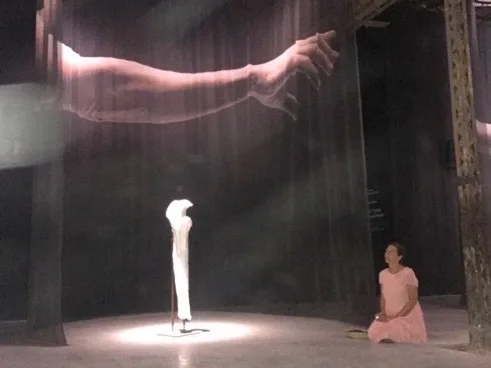
In this room, you will get in touch with the experience of loss and abandonment, and how my imagination and spiritual ‘relationships’ helped me cope. The Naked Truth illustrates the importance for ‘Truth’ to move into ‘Story’s clothes. In terms of storytelling, this room points out the listener’s responsibility to choose between health ‘food’ and junk ‘food’ referring to a story’s contents and conveyed messages. This room also shows how a perceived strong opponent eventually turns into an important teacher. Saying no to toxic messages and unhealthy relationships was a major step on my personal path and enabled me to open the arms (the heart) to receive support and love from my environment. Feynman’s two diagrams picture annihilation and stability on an electron’s path and share the deep insight I got, how this answer to the question, how to deal with the audience in a Process Worker or modern Shaman’s way.
1) Story Gallery
a) Loving myself
Kairo, 2018, Contemplation
Gaia appears. She rubs mud and earth all over my body. It is the kind of ‘dirt’ that enhances beauty. It’s earth. At the same time another lightful being appears, Serapis Bey, an ascended master, he floods me with clearing, purifying light. Together they put me in front of a mirror. Gaia says: do you see how beautiful you are, an incarnated light being, an earth angel. If you insult yourself, you insult us!
Loving myself (Contemplation) see reader’s guide
b) Willi. Our Family Ghost
Togo/Africa, +1980, Portrait
Already writing his name touches me, Willi, my uncle, my mother’s older brother, once said to me: “I am not sure if I am made for this world.” In this, I felt very much connected to him as I had not entirely felt sure whether I was made for this world myself.
At one specific point in his life, he decided that he wasn’t. The brother of my mother had been a tender and sensitive man. Already in school he was forced to retrain his natural left-handedness into being a ‘proper’ right-handed student. He never had a girlfriend. I guess a more open attitude towards homosexuality could also have helped him to stay alive. After he committed suicide during a short professional stay in Togo/ Africa in 1980, he became the family’s ‘ghost’, meaning, he disappeared into the taboo zone of the family.
Surely there was some explanation needed, but already as a child I felt the stories being told in the family were incongruent, the ‘suicide’ was not spoken out. Although I was craving the truth so much, I tamed my curiosity as nobody wanted to talk or being asked about Willi. He got ghosted.
Willi. Our family ghost (Portrait) see reader’s guide
c) The Spanish Queen ruling the ocean
1979, Tarragona, Spain, Signature Story
I remember a magic moment when I was 6 years old, playing on the Catalonian beach. Diving deeply into my imaginative world, I started to create stories out of the waves. I became a Spanish Queen. The waves were my guests. All of them were colourful characters and came with different intentions. All I had to do was to decide to whom, when and how long I would give audience to. There was no effort at all, I ruled and took decisions with ease and grace.
The Spanish Queen ruling the Ocean (Signature Story) see reader’s guide
d) Toxic Telling
1988, Munich, Journal
The unspoken gave space to …
Many years later, stepfather II (ST II) decided to tell me the ‘ ultimate’ truth. Listen to what I remember him saying: “You should know, your grandfather had completely failed in the upbringing of both of his children. He had not only driven your uncle into committing suicide but had also contributed to driving your mother into manic-depressive episodes. Important for you to know is, that depression is a genetically predisposed condition which usually leads to suicide or any kind of addiction – and sooner or later – it might also touch you and future generations.”
(Telling this piece of information, I immediately get the urge to shake this negative energy off which had built within and around me whilst receiving this view of events)
He continued: “Now you may understand why your grandparents loved and supported you so much, because it was their chance to do better, they wanted receive some form of absolution for what they did wrong before. But what they forgot is that they owe first to your mother. As you have a big influence on them, take care of this and promote justice in this family.”
Toxic Telling (Journal) see reader’s guide
e) The Naked Truth
Tale
TRUTH walked into a village. The local inhabitants started cursing at him. They chased him out of the village, walked along the road until he reached another town. Children ran away, hiding from him. The adults spat at him and cursed him out of town. He walked, lonely and sad, down the empty road, until he reached the next town, still hoping to find someone who was happy to see him, who would embrace TRUTH with open arms. He walked into the third town, this time in the middle of the night, hoping that at dawn he would find people happy to see TRUTH with dawn’s light. But as soon as the townsfolk’s eyes spotted him in the emerging daylight they ran back into the shelter of their homes, Just to come back throwing garbage at him this time, ran off, out of town, into the woods, and after crying, and cleaning himself off from the garbage, he went back to the edge of the woods, when he heard laughter and gaiety, singing and applause. He saw the townsfolk applauding as STORY entered their town. They brought out fresh meats and soups and pies and pastries and offered all of these delicacies to STORY. Who smiled and lavished in their love and appreciation?
Twilight set in and TRUTH was still sobbing and feeling sulky dwelling at forest’s edge. The townsfolk disdainfully ignored him, but STORY came out to see what story was going on. TRUTH told STORY how all the townsfolk mistreated him, how sad and lonely he was, and how much he wanted to be accepted and appreciated. STORY replied in a very matter-of-fact way, “Of course they’ll all reject you,” STORY looked at TRUTH, his eyes slightly lowered sideways, “no one wants to see the naked truth.”
So, STORY gave TRUTH brilliant, beautiful clothes to wear. Then they returned into town walking side by side, TRUTH and STORY. And the townspeople greeted them with warmth, love and appreciation, for TRUTH enveloped in STORY’s clothing was a beautiful thing and easy to be met with. And ever since this moment, truth travels with story, and they are always an accepted and much welcomed pair. And that’s the way it was in every age, it is at present, and the way it will always be.
The Naked Truth (Tale) see reader’s guide
2) Reader’s Guide
Loving myself (Contemplation)
As you may have noticed my imagination is very active. In terms of channel theory, the visual channel is occupied, as I easily receive inner pictures and in deeper contemplative states of consciousness I even see ‘full-fledged movies’. Often some deepening happens through the auditory channel, when I open to this kind of subliminal conversations – inner dialogues.
Usually, I rather do not share this kind of active imagination scenes. I relate to C.G. Jung who did not want to have published his Red Book, because he was concerned about people possibly diagnosing him to be ‘ill’.
Now, 100 years later the German ‘mainstream’ still is not quite open towards this creative quality.
There is a big fear of being judged. And I notice, after having introduced the dreamer in Gallery Room 1, I do not feel that shy anymore. I rather remember it being my normal reaction. It feels good to go beyond this now.
You may think ‘she’s crazy’ – and you might as well be right. And maybe you sometimes are that kind of crazy too. Maybe you too sometimes walk the streets talking to yourself? It became one of my hobbies over the last few years, to put my headphones on and to go for long walks through town. People think – in case someone notices -1 am talking to someone over the phone, but no, I talk to myself meanwhile recording it, as I usually get a lot of great insights from this practice.
Here I chose the Gaia scene, because I would like to offer you deeper insights into the power this ‘imaginative story’ had on my wellbeing. I received it exactly in a moment of emotional break down. It made me understand the importance of self- love and the need to shield myself against toxic energies. It helped me to stand up and set my boundaries – to say STOP to what was not healthy to my self-worth.
Willi. Our family ghost (Portrait)
Blank. It is not easy for me to talk about and to reflect upon Willi as a person. Through writing, I am getting more access to him again.
Not having had enough adult support and a smooth closure of our CR relationship, I found, as a child, my own way how to deal with it. Especially before sleeping and when my parents left me alone at night, I got in touch with him. He became my ally. The one, who knew about my fears, the one who I could rely on, the one who was always there when I needed someone to ‘talk’ to.
These, most likely, were the moments when I trained myself in ‘talking’ with spirits. I kept it secret, as I did not want to take chances that any of the rationally minded adults would steal one of my most reliable supporter away from me. Similar to some children not wanting to hear that Santa Claus or Nikolaus are not real.
Of course, growing up I got trained in my rational CR awareness just like everyone else, which made me give up my conversations with Willi too. It took many years until I started opening to these kinds of ‘relationships’ again.
The Spanish Queen ruling the Ocean (Signature Story)
This childhood memory was timewise very close to my uncle Willi’s death. It was emerging out of one of my darkest periods in my life.
My mother had separated from my first stepfather shortly before. Although I had considered him to be my father the first six years, he completely disappeared out of my life, and I only saw him again once, 12 years later. The fact that no one had ever explained anything to me is what made me search for all kinds of reasons why he had ‘given up on me’. Then, the ocean of pain caused by Willi’s suicide broke the whole family system and amidst all this there was I as this little six-year-old girl.
Luckily there was dreamworld, where I was a beautiful, graceful queen, who decided, when and who and for how long to give space to all these people fighting to get my attention. I love to work with this childhood memory, because it connects me to my ability to read stories out of the intentional field*. Somehow, I had to remember this in times of later crisis, that when I get stuck in CR, I should look for answers in dreamland.
At the time, I got lost within the family system, in their own pain the adults forgot about me, and I experienced a lot of deep and dark loneliness. Again, it was the dreaming that complemented what I so much needed: attention. And yes, maybe I had the lowest (social) rank in the family system, but in my dreaming, as the Spanish queen, I enjoyed the privilege of a different status, the highest of all, compensating for what I didn’t receive in everyday life.
Toxic Telling (Journal)
My stepfather II (ST II) was for sure one of my biggest opponents in the first part of my life. At the age of 16 I left his house. His subtle aggression was making me also physically ill. I had started suffering regular asthma attacks at night.
Although I moved out early, I ‘carried’ him with me, ST II. He became my strongest inner critic – my inner oppressor. Still many years later, no matter what I had been doing during the day, in the evening, he (or I) would scan me inquisitively, asking until he (or I) finally got what was not good yet and what could have done better.
His voice could spoil every success, for me, every achievement, not to mention the pain of failures. Especially difficult because also Willi’s destiny had continued to swing with me … either I fulfilled expectations, or I also would have to die. These experiences and my interpretations of those brought me into a persistent state of fight and flight.
Practice – Digging for diamonds
With Julia Wolfson57, I worked on my ST Il’s scan energy and end up in a movement where I bring my hands together at an acute angle. It is an energy that is focused, that leads out of confusion into clarity, that finds key issues – crystal clear. The movement leads me into the center of my body – ‘the Hara’ as Traditional Japanese Medicine calls it. Turning inward, I can sense a diamond being there. My inner compass.
I understand that in a state of confusion, of creative distraction, any state of ‘not-knowing’ during an interaction … I can connect with this energy of my crystalline compass within. As I ask myself what this perception was all about, an impulse arises, it is a sharp, precise one.
The impulse is crystal clear and does not care if it pleases or displeases. Its purpose is to sharply indicate something – using extremely high precision.
To embrace this, as I perceived it, manipulative and weakening quality, was challenging. It needed deep trust in the process to understand the neutrality of the energy behind: it was neither good nor bad. And that beside the little me*, there is a big me* that embraces him as part of my field and as a teacher for some life lesson.
ST II used the sharp and precise diamond quality to find the exact painful point within someone to weaken them and to destroy relationships, whereas this quality used with a loving intention, can be a growth catalyst – a wonderful skill.
Whereas my grandfather taught me what to fight for, ST II helped me to understand what to fight against.
In real life the two of them were in a continuous power battle. My grandfather had a much higher social rank, being an academic, president of the Munich court of justice, he was a publicly respected, generous and charismatic figure.
ST II instead, rather closed off, introverted, a smart analytical mind. My grandfather used to call him a ‘sergeant’ and said he knew this type of character from his war experiences. He said: This was the type of low rank military that did not dare to confront any higher ranks openly, but instead abused their power by victimizing lower rank people.
For sure, my grandfather would not draw a favourable picture of him. Nor would I. I agree, ST II abused his power. Not physically, but emotionally. He was like a snake, a manipulator, whispering all kinds of intrigues into our ears. He was great at separating people from each other.
Thinking of the sweetness I wrote about in the previous chapter, he made me understand my limits of kindness. He made me become judgmental and separative. In a way, he was one of my first teachers in setting healthy boundaries. As an adolescent girl, I said NO to his authority, I did not want to be led by him, I said no to his fear and hate stories, no to his toxic messages destroying my self-worth.
I understood that there are different ways of dealing with power and different ways to abuse it.
The Naked Truth (Tale)
“There are stories that come to you and then they travel with you”, Mary Alice Arthur, one of my storyteller teachers said to me many years ago. That is exactly what the Naked Truth did. This tale expresses my desperate search and longing for truth, the realization that the audience often does reject truth and also that truth can be dressed well or badly. Working on or walking through this Gallery Room, the tale ‘The Naked Truth’ suddenly appears to me to be one-sided. And I wonder to maybe tell this story differently in the future.
Truth is saved by Story. Do you think Story can live without Truth? Maybe it can for a while, gaslight and manipulate people, or just entertain them superficially, but is it sustainable? I would say, no. My intention is, to allow them to dance together.
In a way, Willi’s suicide showed a truth nobody wanted to look at or listen to. ST II offered a story for the truth. According to my view, a very ugly story with an extremely bitter taste. I would have preferred to hear the story from my grandparents. Their truth. Yet in a way, by not telling their stories, they left the authorship to him.
As a listener, we also have a responsibility which stories we engage in. I did not engage completely in my stepfather’s, but some traces I needed to work on for quite a while in order to be able to let them go and then retell the story to myself in a more congruent way. Similar to food, there are’ junk’ stories and ‘healthy’ ones.
At a later point in time, I talked to my mother about Willi’s suicide as in the meantime I had made my own various versions out of it. She told me the way he had committed suicide. Interestingly enough, I still carry the various versions in mind that I had told myself over the years so that now, writing this thesis, I cannot remember which of them was the real one. As if how he did it, did not really matter. One sentence though, had gotten stuck in my mind: It was, that he did suffer from not meeting people’s expectations.
The WHY – mattered.
3) Life myth reflection: The Audience as Opponent
Backstage …. I still have a few minutes left before the performance starts. People around wish me luck. They are patting me on the shoulder with the words: we know you’re going to do great. They mean well. Desperation is growing within me. I am going to play the lead role here tonight – and it seems only I am aware – that I don’t know anything. I am not prepared. I have no lyrics, no text. Blank. Panic. I wake up.
After having worked through this room, I much better understand the overwhelming quality of fear because with Willi’s suicide in my memories, meeting expectations got a life and death issue.
And how should I ever meet all their various expectations?
Let me just shortly draft the complexity of my audience (as a child) in terms of authority figures – to deepen the understanding of the diffuse fears around ‘stepping on stage’ – expressing myself:
- my grandfather who celebrated me, although I was always a bit scared to disappoint him and his high expectations one day
- my father who I visited twice a year to ‘be’ in contact
- Stepfather I (ST I) who had given up on me when I was 6 years old
- ST II devaluating me and setting unreachable expectations
- my mother, who firstly claimed the stage to be her’s, and secondly for a daughter to show off
- my grandmother, a loving reference point in my life
Up until this point, I worked with the energy closest to my CR identity, which was the girl stepping on stage. Now I attempt to step into the audience’s shoes, the shoes of the ones who judge, who criticize and/or applaud.
Practice – Shifting into the Audience’s Perspective
I get up at 3.45h to get ready for the last virtual event of an ANZPOP sequence working with dreams. I struggle between my Blank Moment-Childhood Dream and a second more recent one. The second dream brings a little more energy with it, the ‘Blank Moment’ starts tiring me a bit. Have I not worked enough with it lately? It is the first time that I feel that. Is this another edge? The resistance surprises me and therefore I decide to go along with my Childhood Dream no matter what.
I choose to focus upon the aspect of desperation, considering the expectations coming from the audience. All of these aspects create an intense physical pressure in my head. I pressed my hands firmly against each other until I felt a sudden relief when my hands ended up in a prayer position.
I remember a session I had with my coach Ellen Schupbach not long ago. Like in that session, it suddenly feels warm, safe and loving. This (inner) space dissolves all my tension. I then become aware again of my hands being in prayer position and whereas I had felt powerful as a dream figure making pressure, I feel humbled now in my everyday perception.
As if I had understood the concept of spiritual rank in a new way.
Maybe you will not believe me, but it took me arriving in this fourth room that I discovered the following sentence written in my Childhood Dream: They mean well.
Another highlight in this process were Max and Ellen Schup- bach introducing the concept of the supa supu vision58 during the virtual DDI festival 2020. This has helped me to further open up to my teachers, recognizing the love in their support and more than ever before, I could start to open my arms.
4) Theory Impulse: Feynman’s Diagrams
When I read about Richard Feynman’s diagrams in the ‘Process Mind’, I deeply connected to Arnold Mindells love for bringing the two disciplines physics and psychology together. I saw the beauty in reunifying analytical sharpness and the feeling wisdom.
Richard Feynman, a quantum physicist, used virtual particles to explain electric fields. In the diagrams below he shows two interpretations of what happens to an electron entering an electric field.
In ‘Dreaming While Awake: Techniques for 24-Hour Lucid Dreaming’, Arnold Mindell describes the difference of the two Feynman scenarios (see graphic below) using the analogy of a public speaker.
In the first scenario, the speaker is annihilated or tranced out by a critic in the audience. After picking himself up after the shock, he had experienced, he continues lecturing as planned. The lecturer is sticking to his identity and probably staying ‘in conflict’ with the audience for the remainder of his talk.
Featuring the second possibility is a Process Worker (or a modern Shaman), who uses the Blank to step out of time (and plan) and to connect to the Process Mind by utilizing the energy of the disturbance and by then bringing it into the room. That is how the tension gets transformed and the lecture can continue smoothly.
Graphic: The Path of Annihilation versus the Path of Stability59
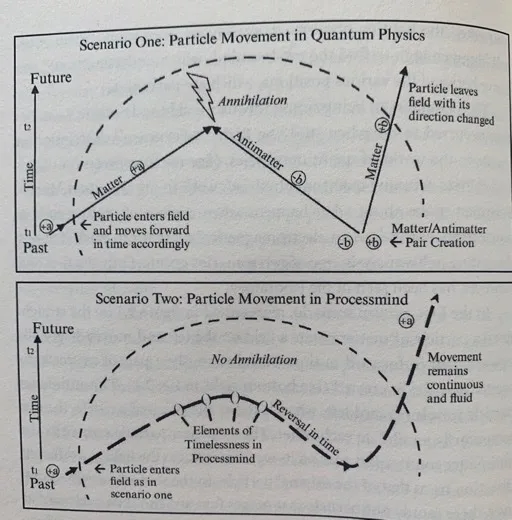
1) In the path of Annihilation, the electron moves forward in time (primary process) and a pair of positrons is created. One of them is an antimatter particle which annihilates the original electron (secondary process). The electron of the pair reemerges into a new direction.
Translating this into psychology, it means in the first case the electron holds on to its primary identity. The annihilation means, it gets erased, the path gets changed but unconsciously.
2) In the Path of Stability interpretation, the electron first moves forward and then backward in time; no electronpositron pair creation or annihilation occurs.
In the second case, the electron has a fluid self and manages to go, back and forth in time, it reverses its own direction instead of being annihilated by the positron.
What really happens in this moment is a Blank Moment, non- consensual. Although both interpretations are justified, the second ‘the backward movement’ in time cannot be measured by today’s physics.
To me it became very obvious of how Arnold Mindell’s interpretation connected to my Childhood Dream. They offered a deep answer of how to deal with my ‘life and death’ issue. Stepping on stage, instead of staying stuck in panic, I can allow myself to die in this very moment, to let go of all that I am identifying with (all I know) – and open up to be reborn. It sounds simple and of course it is not. But this understanding allows me to let go of the intensity and reminds me of dying as a start of something new.
Like the Shaman Don Juan would call it, I would not resist any longer but get ‘ready to step into the nagual’.60
5) Wake up Moment
No “junk” but “health” food
After having created Gallery Room 4, I feel a strong assertiveness in choosing- with awareness – the stories I want to engage in. I like the metaphor of the food, and the idea of healthy and junk stories.
In choosing for this I take on a judgmental and ‘strongly dualistic’ mind. Depending on the intention, stories based on fear-making are junk stories; whereas stories made of love are health stories.
It had been an important step for me to allow myself to say NO to certain types of feedback and relationships, and allow myself to choose my own audience, as well as to choose the kind of feedback I would take in and which one I would drop.
An unforgettable moment on this path was a relationship work with one of my dearest fellows at the DDI intensive in Bangkok 2019.
Practice – Choosing not to relate
We had had a difficult time during the months before the upcoming event due to a lot of double signaling – repetitive inviting and rejection. After deepening and clarifying our mutual understanding, we came to the surprising result that not relating in this given moment was a good choice for both parties. I will never forget the beauty of this work. I could feel the underlying love and acceptance and how we could deeply respect each one of our individual processes. Even when we were surprised and there was a slight sadness connected to it, it did not feel hurt anymore but congruent and harmonious. Now, we are slowly starting to connect again but out of a clean space without the pressure of expectations.
I also came to understand, why my ‘flirts’ brought me to Signature Stories that all had to do with authority conflicts.
The audience’s energy in my Childhood Dream is about leadership, about setting rules and deciding on what was right and what was wrong. The Signature Stories helped me to review my authority conflicts to better understand my own leadership qualities and characteristics. What I judge to be right and wrong.
The essence of each chapter resulted in a mantra, and all these mantras taken together form my ‘narrative manifest’, a kind of ethical code that guides me in being a leader and a follower nowadays.
6) My Questions for You
What does ‘stepping on stage’ mean for you? How is your relationship with the audience? Any one similar to my authority figures, you recognize? Are they still sitting in your audience?
Musik: Deifedanz/ Dreivierteltanz
https://www.youtube.com/watch?v=3D-j9PcOPAk
Room V: Honor the Wild
Summary: Mermaid. Identity clash. Money.
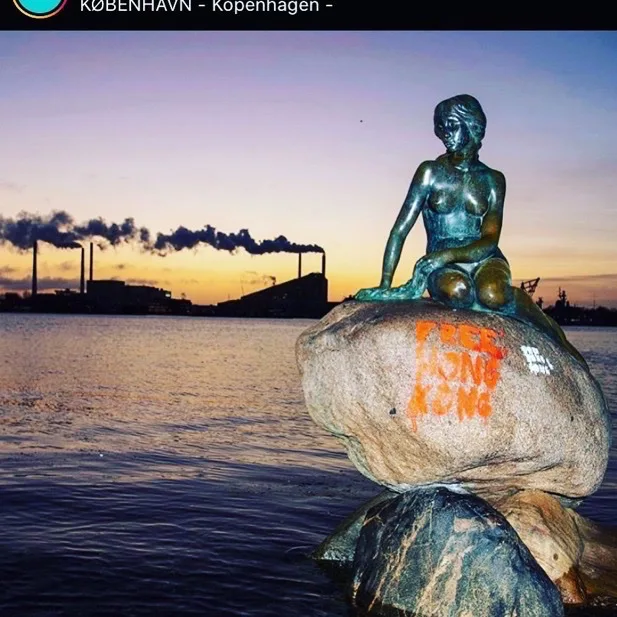
In this room I share the experience of my ‘fluid’ identity and how creative expression through Pantouns helps me to find myself, and stability in this fluidity61. The tale of Melusina, the mermaid, deepens the delicacy which lies in this energy as well as the difficulty to protect her space well within me. The occurrence of the same repetitive nightmare shows a clash of identities at certain evolutionary moments in my life – a clash between my truth and an everyday identity built on expectations. Here the cobra as a spirit animal became an important supporter in defending and standing up for my truth. The Signature Story ‘Money does not rule my decisions’ also features a suspense between CR and non-consensus reality (NCR) as I perceive it, and how embracing both helps me to be present and to connect.
1) Story Gallery
a) Every Morning a ‘New Me’
Everywhere, 2012 till today, fluid Portrait
Since 2011, I write Pantouns. It is a Tibetan Writing Contemplation – in Process Work terminology one could call it an ‘Inner Work practice’. After nine years 3-5 times per week, I have a collection of more than a thousand Pantouns – as flying notes – in my cupboards. The day I started writing about Pantouns for this thesis, a mermaid occurred:
The Mermaid
- I am a mermaid
- I have a glittering dress
- I am carried by the water
- I don’t speak.
- I am a Mermaid (repetition line 1)
- I am graceful
- I am carried by the water (repetition line 3)
- I am connected in love
- I have a glittering dress (repetition line 2)
- I reflect the water world
- I’m not talking (repetition line 4)
- I don’t need words.
- I am graceful (repetition line 5)
- I am a part of creation.
- I am connected in love (repetition line 6)
- I live without time
- I reflect the water world (repetition line 7)
- I shine rainbow-coloured
- I don’t need words (repetition line 8)
- I work with the light
I wondered why and how the mermaid would find its place in the overall flow until I read the Melusina story in Arnold Min- dells book the Quantum Mind (A. Mindell, 2000).
Every morning a ‘New Me’ (Journaling a Fluid Portrait) see reader’s guide
b) Melusina and the Man who doubted her
Tale
“Once upon the time there was a man called Raymond, who was searching for his bride-to-be. He was sitting by a river when out of the river suddenly emerged a beautiful maiden! Bedazzled, the man ardently proclaimed his love for the maiden and asked to marry him.
She said: “I’ll marry you but whatever you do, don’t look for me on Saturdays.” Raymond said to himself: “Well there must be something very interesting happening on Saturdays. She’s a great woman from Sunday to Friday. She is predictable, she has a nice character, but what is she doing on Saturdays?”
One Saturday, he broke the rule and looked for Melusina. What did he see? A mermaid! She screamed and disappeared and he never saw her again. He probably said to himself: “That was some woman. She was beautiful but she had a fishtail!”
(Arnold Mindell, 2000, p. 207)
Melusina and the Man who doubted her (Tale) see reader’s guide
c) The Cobra Throat
Ahrensburg, Easter 2015, Journal
The moment of separation was a moment of great financial instability. Surely, not the best point in time to decide for it. My ex-husband had lost his job some months before, and I was quite freshly independently working as a freelancer. Our children 3-, 5- and 8-years old.
Around separation I started suffering from Hypothyroidism. While working with this body symptom, I repeatedly crossed paths with a Cobra, a spirit animal, who asked to speak through my throat. It was one year after separation, during a conversation with my ex-husband (Ex), I remember this energy once very pure and sharp rising up in me.
Ex: Have you ever thought about how to cope with this whole situation being divorced? Caring for the boys and earning money?
Me: Much too long probably. Have you?
Ex: Let me tell you one thing: You will never make it!
Me: I felt a very strong and sharp energy rising in my body as I answered: Would you really have preferred me to stay because I had no other choice?
The Cobra Throat (Journal) see reader’s guide
d) Money does not rule my
Decisions Villach/Austria, 1984, Signature Story
1984, I was on holidays in Villach/Austria with my grandparents. One night we went out for dinner being a group of eight people, all adults and me being the only child. The waiter started to take orders and he also asked me in a very respectful way: ‘Young Lady, what do you wish to eat?’
The adult crowd did not pay any attention, I felt proud, felt like a real lady, and screened the menu to make my choice. Still today I am surprised that I had decided for a FISH dish. 62Kaiserschmarrn would have been much more my style at that time. Probably, I thought Fish to be somehow ‘elegant’.
Apart from this the dinner was unspectacular, yet there was a crucial moment immediately afterwards in the car. My grandfather -out of the blue – shouted on me: “How the hell, could you order this fish? Who do you think you are to choose one of the most expensive dishes on the menu?”
OMG, yes, who was I to choose such an expensive dish on the menu? I felt awfully ashamed. Being a child, I had not thought about money, hadn’t looked at the prices. How ignorant. I should have known better (cynical undertone).
Money does not rule my Decisions (Signature Story) see reader’s guide
e) The Betrayal Letter
Hamburg, 2011/2020, Repetitive Nightmare
In this dream, I become aware of the fact that they have found out… they (representing different actors e.g., mother-in-law, husband) found a piece of writing, a letter, a proof of my betrayal. In the dream, I know what the betrayal is about. My fear is immense. It feels like being in a different timeline. Like in former times or even today in other places or cultures, as a woman betraying her husband -the moment this dark secret gets revealed – I will be expelled from my community and society in general.
I wake up sweating …. I still feel the guilt and shame, but I always wonder and ask myself why I am feeling that way. Whenever this dream occurs, I get up and kind of dream-walk through my apartment, still trying to get the ‘issue’ resolved.
The Betrayal Letter (Night Dream) see reader’s guide
2) Reader’s guide
Every morning a ‘New Me’ (Journaling a Fluid Portrait)
The Pantoun work offers a moment of contemplation to me, of not wanting or expecting anything and it also creates a bridge for walking ‘with a bit more of awareness’ into the day. In this moment of silence, I allow a picture to arise and then, for example, a mermaid appears on the blank canvas of my mind. Then I work associatively on the given Pantoun rhythm and amplify the experience just as I have shown in the Pantoun quoted above. Whenever I have more time, I use the Pantoun like dream material and check, which line strikes or disturbs me most.
During his Red Book self-experiment, C.G. Jung was looking for stability in connecting to consensus reality. Every morning he wrote his name, date and location into his diary. Whereas for me it sometimes feels like connecting to dreamland, the atmosphere or the intentional field, gives me stability before I ‘loose’ myself in consensus reality again.
Melusina and the Man who doubted her (Tale)
The day I started to reflect on my Pantoun writing for this work, my morning-me was ‘a mermaid’. This was the first time she appeared as a character. I carried her with me through working on this thesis, not exactly knowing why and where she wanted to be in this all. Reading ‘Quantum Mind’ by Arnold Mindell, I came across Melusina – and received some answers to my question.
This fairytale speaks about the part that lives partially in the water- an imaginary part, a soul part, something eternal, wavelike, and fluid, symbolized by Melusina. This part suffers and disappears when we look at it doubtfully or with disrespect.63
Uncertainty arises from a lack of relationship with the wavelike, fluid essence of life and just as well when we lose ourselves. Our mainstream experience to be focused on time, space and social norms is rather shocked once it gets faced with NCR experiences through dreams or altered states of consciousness.
Thank you, Arnold Mindell, for helping me understand the central and crucial role the mermaid plays in and for my writing.
The Cobra Throat (Journal)
In a way my childhood made me an expert in observing negative couple dynamics. I had seen my mother staying married for 20 years with STII suffering from depression, falling into alcohol addiction. That was surely not the path I wanted to follow. I personally had grown out of the narrative (or mainstream belief) that staying together as a couple is (always) the best for the kids.
Just this scaring voice kept pressuring me from time to time: You will never make it! Make what? Survive without husband at my side? That was not what I wished for. Out of my experience I had a very traditional family high dream.
I had so much wished to live family differently than I had experienced in my childhood. And I gave it up, the price was too high. It was anything that a cakewalk though.
Although we had profound fights as a couple – man and woman- around guilt and responsibilities, on the level of parenthood, we quickly found peace after separation. We always appreciated each other in the mother-/father-role and that made the separation for the kids somehow smooth. They could continue to live their lives enjoying two loving and caring parents, ‘just’ that their parents did not live together anymore.
Surprisingly, the toughest area of conflict became the spiritual one. Stay tuned for this in the following Gallery Room.
Practice – Black Swan and Black Rabbit
Max and Ellen Schupbach offered an extremely empowering series of multiple online events64, at the beginning of the covidl9-period. One of the first exercises was about shapeshifting into a predator. And here she rose again my friend ‘the cobra’:
My prey is close. With a darting movement I rise from the ground, from being almost invisible into a very powerful presence. The prey is shocked and freezes … no sibilant needed; it is the sudden appearance of the Cobra which scares.
Me/CR: I notice a satisfying smile on my face, thinking, hunting becomes so easy with the prey in freeze state.
After having swallowed the rabbit (in this case), I climb back to my favorite place in the height of a big tree and spread my body allover. From there I have a broad overview.
I live a comfortable life. From time to time, I quickly generate energy. The important thing in this is to choose the right moment at the right place and then I can relax again …
Me/ CR: I enjoy the effortlessness. It makes me laugh out loud.
Money does not rule my Decisions (Signature Story)
Looking at my younger self, the girl choosing fish over Kaiserschmarrn in the restaurant, makes me want to hug her tightly and relief her: ‘How could you possibly have known? Nobody had taught you what to consider when ordering a meal at a restaurant. It was not upon you to guess upon any assumptions people had.
Now, reviewing this scene from a much more evolved perspective, how would I assess this situation today? What at that given moment could have been right about my decision to choose for the fish?
Reflecting on this, I felt a big relief and even enthusiasm rising within me as I gave it a voice: ‘It is, that money should not be the main reason for making choices in life.’
Please note that this does not mean to squander any financial or other resources, but the profound insight that money is often playing a too dominant role over pleasure and even health in decision making and in my overall cultural context.
Life gave me a quick switching up of roles on last year’s family holidays. As if to balance out my perspective, I got stressed with the boys, when all three of them ordered most expensive dishes from the menu. I love to be generous with my kids but being the adult and therefore responsible for our joint budget, I had to create some awareness around limitations of resources. … I made this transparent to them and we agreed on a fixed daily budget and a generous closing dinner at the end of our holidays.
The Betrayal Letter (Night Dream)
I know this dream well, as I had dreamt it quite often before separating in 2012. From this, I usually woke up, strongly sweating and still carrying a feeling of deep guilt within me.
When this Betrayal Letter dream began, I was ready to shed my old skin, preparing to leave a part of me behind. As Ellen Schupbach helped me to understand the characteristic of nightmares is that you experience an identity clash. This was not what my ex-husband wanted or expected. At this point I had to decide between his expectation and my inner truth.
It was time for an identity shift. I chose to follow my own truth. …. it became a long and -sometimes- arduous process lasting over several years.
Even nowadays, after many years of being divorced, my ex- husband accuses me of having destroyed his life. And for quite a long time, I have been shouldering the weight of this ‘responsibility’.
At this point, I choose to reconnect to my feelings when I wake up from this ‘reoccurring nightmare’ … I still feel the guilt without having an actual reason for feeling this way. Now that I start questioning it, I choose to work with it and resolve it for good.
I want to take it seriously that I do not know ‘what to feel guilty for’.
3) Life myth reflection: Shapeshifting65
Backstage …. I have a few minutes before the performance starts. People around wish me luck. They are patting me on the shoulder with the words: we know you’re going to do great. They mean well. Desperation is growing inside of me. I play the main role here tonight – and it seems only I am aware – that I don’t know anything. I am not prepared. I have no lyrics. Blank. Panic. I wake up.
In a way, the Pantoun is the perfect answer to my Childhood Dream. I wake up and step into a Blank Moment. I connect to the not-knowing and ask myself as a creator on stage: “who am I today … what is happening on stage today?” It is the connection to the ‘fluid me’, the mermaid in me, that helps me to step on stage in a ‘prepared’ way, to wake up.
If I would analyze my Pantouns of the past years, then some regulars, ‘heroes’ in their own sense, would appear, like for example the Black Cat or a Dancer. Then there are others who only appear occasionally like the Gardener or just once like the ‘Coffee Stain’. Certain times feature a special pattern or tendency, for example over a longer period more animals showed up. Lately there is also room for more mythical creatures, dragons, fairies or the Mermaid, and even an “Alien worm’. The cobra has been one of my more regular visitors.
Sometimes they feature qualities I clearly identify with, and others that I might identify with as well, yet they are under-represented in my life because I shyly hide them from people. Also, there are those I dislike, for example the physical symptom of the Herpes virus.
Utilizing the ‘I am’ format, I do (at least in this writing moment) identify with these qualities in one way or the other. As I choose to amplify the experience, I gain a deeper understanding of the specific quality implied.
4) Theory Impulse: Real and Phantom People
PW Impulse
To add some tasty theory to this chapter, I want to bring in the shamanic definitions of real and phantom people. As in many books, Arnold Mindell also refers to Don Juan, Castaneda’s shamanic teacher, in the ‘Quantum Mind’.
Don Juan calls a person living in ordinary Consensus Reality, who occasionally gets knocked out by ‘annihilation’, a phantom. Whereas a real person steps out of time by shapeshifting into other identities.
Don Juan suggests that we transform our normal identity as a particular person, in a particular society, and that we become free spirits moving independent from time and space. This real person has a fluid identity and is whatever imagination, movement, mood fantasy, or feeling disturbs her.
Arnold Mindell, 2000, p. 534
What is it that determines whether we pass the threshold to become a ‘fluid warrior’?
Other factors like the nature and strength of the field are important, the rigidity of your own identity, and your own ability to use your second attention
p. 535
The ‘second attention’ is the subtle ability to receive NCR signals and unfold them. Our surrounding is another influential factor to step into this space of fluidity. If your environment is very rational, like for me the German Corporate World and their organizational structures, it might be a little difficult to open the door to dreamland and present myself in my Mermaid identity.
You may not be able to become a bear at any time, but you can eventually if you have enough support from your surroundings
p. 535
Does this mean the Mermaid will need to stay in her secret space then? For a moment I feel said. Then grateful, for noticing the relationship I have with her and I also feel responsible to protect her space well.
I care the mermaid well protected in me and in the middle of German rational context, I have to remember to create my little blank, to privately connect to her, doing some inner work.
5) Wake up Moment
Every day, every moment, I can choose anew who I am and what energies I relate to, I can choose my allies. When I express it like this, the vastness of potential identities feels overwhelming. Maybe this is the same kind of shock that Raymond in the “Tale of the Mermaid’ experienced when he saw the fishtail.
Looking at this Gallery Room V and it’s colourful abundance, I more and more begin to understand that one name, one identification, can only host one fragment of the whole. This appeases my longstanding struggle with my three given first names – at least a little.
At the end of a Process Work Online event66 with Joe Goodbread67, I very much reached a dreamy state of consciousness and questioned into the virtual plenary: “I do not really understand, why we have to have A name at all.”
Joe answered, or at least that is what I heard: “Oh you are lucky, most people do not feel at home in dreamland like you do.” He asked me to get into a little movement. My hand started to move, until it is stretched out, as if it wanted to reach out.
Yes, I wanted to relate to others from my dreamy state and I suddenly came to understand that there are advantages when people can call me by a name.
Names or Consensus Reality in general help me to connect with others. I also understand that it is important to me to consciously relate my dreamland journeys back into consensus reality.
From now on I will end my morning practice, inspired by C.G. Jung, and add to my Pantoun, my name, place and date, to ground my NCR experience on a CR stage.
6) My Questions for you
Maybe, you just want to try out writing a Pantoun? What animal, metaphor, creature is spontaneously coming in your mind? If you feel like, just associate further and follow the repetition as assigned in the Mermaid example above.
Room VI: Trust beyond
Summary: Church. Beyond. Embodiment
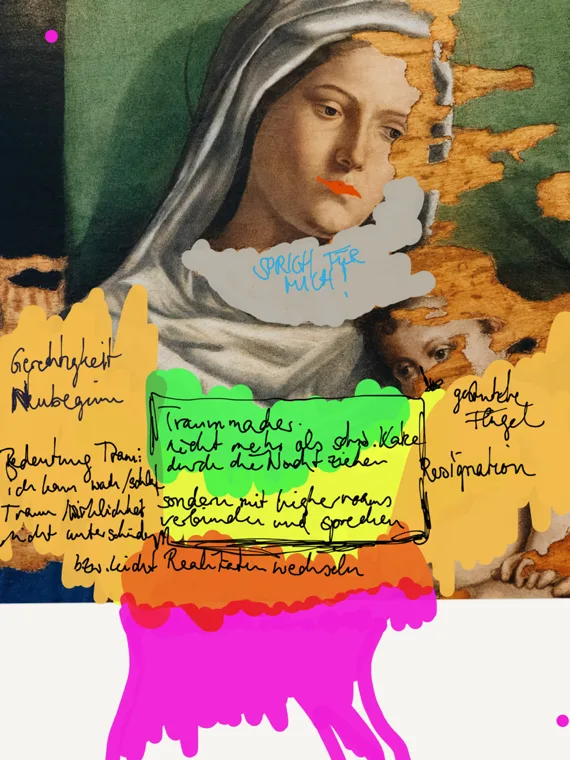
In this room, I share my personal experiences with Church (as institution), taking on different perspectives on concepts and stories, and reflect on how each of them might be useful or could also hinder us from relating to the ‘beyond’. It leads me also to question gender and its ‘definition’. What does it take to be a woman or a man? Does it take the physical body, the skirt or pants, your name, or personal identification? Which consequences would it have to identify with…? Theoretically, you will walk through some different edge dimensions also arriving at the edge to the universe – to allow oneself being part of it all, and the embodiment – the possibility to find the Devine in ourselves.
1) Story Gallery
a) Name Change
Hamburg, 18th October 2017, Inner dialogue
… the official document from Munich arrived today, my name is changed. After our divorce I chose to change my name back into my birth name. BACHMAIR.
In German legal tradition there is a longstanding tradition of having one common surname for the family. With the first child you have to legally decide on the family’s surname. Listen to my inner dialogue one year after divorce:
In a way, it feels harsh to take my birth name back.
Yet, I could even be harsher by legally asking my three boys to join but no … that is not what I want… I am fine with them keeping their father’s name which was our family name: BOLDT. They are a beautiful result of our Boldt family time. It is their birthname. And there is no need to change anything about their relationship with their father and his last name.
And how about my kids being an important part of my life as well? … oh, my G … panic … they are three of my biggest treasures in life. Would this name change possibly affect this?
So why, if the name is of no real significance on a relational and emotional level -as it is commonly assumed, did I then choose to get my birth name back?! And yet why should I keep a man’s surname whom I had separated from?
It feels more congruent to link back to my roots. Somehow, it makes me feel grounding back into myself again.
Will this affect my relationship with the boys?
No, these boys will have a well-grounded mother with a heart full of love. I decide this to matter more than having the same surname.
Name Change (Inner Dialogue) see reader’s guide
b) Our Temple
Hamburg, July 2018, Journal
In our present home in Hamburg there is a Tibetan Buddha sitting next to a small Durga figure and a bible next to my son Oscar’s bed. Already from a very young age on I considered myself being a seeker, I was very curious about the different’ stories’ around divinity and at the same time I had my difficulties with Church and the rigidity of its rituals as I had experienced it in my Catholic upbringing. To my great surprise, my ex-husband joined a Christian free church after our separation. That way, my children happened to receive some Christian religious education – at least every second weekend.
One evening playing cards with the three boys, a discussion about a quote from the bible arose amongst us. It was about the Christian God being ‘the true one’. Hot discussion. At a certain point I was overwhelmed by a deep sadness and tears filled my eyes. I said: How come that all of you believe The same and what you believe in, is so different from my beliefs? I feel lonely in my believing. You are my sons too. How comes that I had no influence or the other influence was so much stronger than mine?
Oscar, middle son and strongest church believer of the three, rushes to me, hugs me and says: “But mom, are you serious? You are not alone, we love you, no matter what you believe in, didn’t you teach us that in our house many different religions have their place.”
In that moment, I knew, my planted seeds had also germinated.
Yes. Amen. Om
Our Temple (Journal) see reader’s guide
c) Mary Magdalene
Hamburg, 16th of August 2020, Night Dream
She appears to me in a dream. Adolescent, lucid. I sit upright in front of the picture hanging next to my bed. But instead of the black cat, I see Maria … and get an explanation, it is not Mother Mary, it is Mary Magdalene who seems to be depicted here.
In this dream, while looking at Mary Magdalene’s picture, I remember that actually an image of a black cat is hanging there. And I somehow perceive myself sitting upright in front of the picture dreaming and fantasizing into it.
Mary Magdalene (Night Dream) see reader’s guide
d) Asking for the Skirt
Munich, 1976, Signature Story
Who knows why? But my mother tended to dress me like a boy, she cut my hair short, so that I often got asked: hey little boy, what is your name? As soon as I arrived at my grandmother’s place, I asked her: ‘”Oma, may I please put a skirt on today.”
Asking for the Skirt (Signature Story) see reader’s guide
e) Desert at Dawn
Hamburg, July 2020, Daydream
I connect to a specific Earthspot – picture of a white desert landscape in Egypt at dusk. The time of the day is important, as before dusking it is very hot, and after sunset it gets quite cool. At dusk, the temperature is perfect and the desert shines in the most beautiful red and pink tones. I can find two energies in the landscape, one is the graceful play of colors and the second is the bleak vastness of the desert, which I identify with clarity and width.
Desert at Dawn (Daydream) see reader’s guide
f) Oma. Love beyond Story
Munich, 9th of September 2020, Portrait
With a heavy heart, this morning I set off to Munich to visit my beloved grandmother. Heavy because she keeps forgetting more and more and I am afraid of the moment, I will have disappeared completely out of her memory. Today she addresses me with the name of her own mother.
It is the first time, she doesn’t seem to remember our mutual stories anymore or only as very short spotlights and yet somehow, somewhere she still recognizes me, the deep love connection, somehow differently, she feels me, she radiates … it seems as if she is in the very moment, in absolute presence, and every now and then some memory fragments appear.
Somehow, I succeed in letting it just be without trying to make her remember. I am less interested in the memories, and follow her into the forgetting, it is like a silent pause in music.
I realize how she is becoming my teacher again, she knows much more than I do, than most of us do, about what we are trying so hard to understand. Whilst we are still seeking, she becomes more and more one with the ‘not-knowing’. And I am happy to meet her in this as well, and to experience this deep love – a love beyond story and words.
Oma, Love beyond Story (Portrait) see reader’s guide
2) Reader’s Guide
Name Change (Inner Dialogue)
Maybe you think, oh, she made a drama out of this not so important decision and yes, you are right. When I told the boys that I will have to decide about my surname, one of them asked in a very lighthearted way: ‘And what is it, you want to do?’ In this moment I understood that for them (or at least one of them), it will probably not change anything. It was my own personal decision; it was about me and my identity.
After having formalized the change back, I called my mother and grandmother, I thought they would happily welcome me back under the ‘Bachmair’ roof. It caught me by surprise, but apparently both could not understand, how I could make ‘such a decision against my children’. As if I had abandoned them by this choice – or broken some golden motherhood rules. Now I understood where my inner drama about this decision had come from. On a deeper level, I knew this reaction coming.
Our Temple (Journal)
Growing up in Catholic Bavaria, I had learnt from priests and teachers, that children from unmarried parents were bastards. This sounded rude to my ears. I decided that a ‘true God’ would love me like everyone else around me and not be so judgmental about something I did not feel responsible for. This Church didn’t seem to be very welcoming. Luckily, I had a certain freedom of choice because my grandfather was a curious traveler, hosted many religions at his home, explored them, told me about them … and none of them seemed to marginalize bastards the same as the Catholic Church appeared to be doing.
More and more I became comfortable with being a free spirit and to host spiritual diversity in and around me. Strangely enough, exactly the opposite formed directly in front of my eyes: My children were becoming more and more committed to a rather conservative stream of Christian church. What they liked about it?
I try to put it in words, this part of church (differently to my Catholic experience in the 80ies) offers children friendly ‘rituals, it is a community with a strong idea of solidarity, also clear guidelines how to pray and connect to God. That touches me, we share the wish to live a more ‘spiritual life’ and probably the ‘heart for solidarity’, and both is not so obvious in our surrounding today.
One of my key disturbances was the missionary attitude of this specific Church community. In one of our discussions, Emilio my eldest son says: “But why should I not share (and teach) other people when I feel I have found something beautiful for me?”
At that point he caught me. I took up is his side and said: “Thank you, you just taught me an important lesson. I had always thought that spirituality was something very intimate. My way to be spiritual is not mainstream. It seems much easier to refer to one of the big universal books or mainstream religions. But maybe I did not appreciate enough the beauty of having my very own way to be spiritual. How could I blame my boys to follow the Church, if I did not find appropriate ways to share (and teach) it?
Here I come to notice that, compared to the Christian church, I don’t have a bible and so much third parties to refer at. Oh, I mean I have a lot of third parties to refer at, but they change every day and somehow, I feel them as energies within myself I connect to, rather than external entities. At the same time, I struggle with any fixation on words, and, although I value the wisdom of the bible, I cannot agree on ONE book telling the truth.
So, how could I possibly find words for what cannot be expressed? How can I reach from beyond words back to words? It is about creating and sharing experiences, collecting and telling stories.
I almost don’t dare to mention it here, but how is it possible that my boys do not know about my Childhood Dream?
Mary Magdalene (Night Dream)
What is most interesting to me about this dream is the experience of the half-awake state that occurred several times lately. In this state of consciousness my awareness shifts quite smoothly between dreaming and being awake.
Another aspect of it which fascinates me, is the person of Mary Magdalene herself I do not know a lot of her. My first reaction was great anger coming up and I can observe the black cat transmuting itself into a black panther, ready to kill.
What infuriates me so much in this is that this woman – one of the most important figures around Jesus – was not at all seen and appreciated in the Bible, by the Church. Why?
Where did she get lost in translation? Why it is only 12 male apostles on the picture of the Last Supper. It seems that she was one of the closest people around Jesus. Has she not been there that evening? For sure there are many possible explanations, maybe at this time, it was normal that men and women had dinner separately. Or was it the ‘storyteller’ who designed the picture this way?
No matter what, the key question is what did it do to our culture and could this story not be retold in a more appropriate way?
Asking for the Skirt (Signature Story)
Somehow, nowadays I can understand my mother’s attitude about preferring boys over girls. Me too, until my third pregnancy I strongly wished to be a boys’ mother and being a mum of three boys made me extremely proud.
And I feel proud today, but rather to be the mother of these beautiful beings, and sure it makes me practicing leadership, motherhood, men and women relationship in a sometimes quite intensive everyday setting.
Interestingly I always felt very ‘at home’ in the mother role, I enjoy our squirrels, our tender and sometime harsh togetherness. I love supporting these young men on their path. And, I also notice my limits at certain points, feeling grateful that they have their father (and other mentors) as reference points too.
In a way, it is counter-cultural to say, but for me it is also a big privilege of my life situation (being separated) to completely step out of this role and responsibility every second week for a long weekend. I love this me-time, I normally use for either Process Work study, writing, creative expression, extra work time or just recovery.
In a way, my mother freed me, probably unconsciously, from experiencing any disadvantages from being a woman. From very early on, I was identified as a smart mind and that also meant rather no kitchen work and no one questioned my academic path. I had a lot of privileges that generations ago were exclusively reserved for men. I followed this path and even created an international career, in a way very much in line with ‘masculine’ qualities. It was only during my late 20ies especially through my pregnancies that I got deeply back in touch with my ‘feminine’ side.
It was as if I was putting on a skirt again.
Desert at Dawn (Daydream)
As part of a ‘Trauma Work webinar’ at the German Institut fur Prozessarbeit68, I volunteered to work with Michal Wertheimer69 in the virtual center. To start with, Michal asks me, what picture or film scene spontaneously comes to your mind? Quickly again a picture of Maria Magdalena, this time with Jesus, a film announcement came into my mind. The two of them like being on a photograph together. They look like a happy, loving, and balanced ‘power couple’. There’s an abundance of love emerging and spreading out from their togetherness and harmony.
What did the Church make out of them? A hero and a maid, a saint and even a prostitute. Again, I feel deep anger arising from within myself towards one of the most powerful storytellers of the last 2000 years: The Church, and the imbalance this created in terms of feminine and masculine energies.
The Earthspot teaches me how to find the ‘right temperature’ in order to be neither coming from a place of ‘hot’ rage and anger nor to stay ‘frozen’ in the imbalance, but to speak gracefully and with clarity.
Oma. Love beyond Story (Portrait)
It was the 60th birthday of my mother, she had organized a big celebration, and I felt a lot of resistance to join. Our relationship hadn’t been at its best for quite a while at that time, and I knew how much she expected me to actively contribute to celebrating her, by giving a speech or something similar. I felt torn between her expectations and what felt true to me in that moment.
On my way to the locality, as I was traversing a park, I suddenly discovered my grandmother sitting on a bench. Almost feeling like sleepwalking, I went over to her and yes, it was really her sitting there. I asked her: “Oma, what a surprise, what are you doing here?” She said: “Waiting for you. I thought, you would come along here.” In this moment, I recognized love in its purest form, unconditional.
I have memorized this picture within me, knowing that this love will further exist within me, and that makes it timeless. It is comforting and helps me in this current phase to release my grandmother to her own path.
Surprisingly, it also helps me to liberate my mother from the expectations I put on her – that probably also were hard to fulfill. After a long period of silence, I met my mother again in summer 2020, inviting her for lunch. I did not intend deep conflict resolution, but, in a way, a relief to loosen the strong tension of ‘not being in contact’.
The encounter was light, superficial, neither sweet nor harsh. And something about it even made me proud. In a way, I felt my friendliness embracing our conflict – without giving up my position. I did not need to convince her about me being right or wanting her to be different. It was just about letting be what was there, not about performing one for the other. Being kind in a very profound way.
3) Life myth reflection: Oneness
Backstage …. I still have a few minutes left before the performance starts. People around wish me luck. They are patting me on the shoulder with the words: we know you’re going to do great. They mean well. Desperation is growing within me. I am going to play the lead role here tonight – and it seems only I am aware – that I don’t know anything. I am not prepared. I have no lyrics, no text. Blank. Panic. I wake up.
I just saw a video about Braco, a spiritual healer, he goes on stage and doesn’t say anything. It is his mere presence, his gaze that touches the audience. What a beautiful and relieving realization: it is not all about words. This opens another Childhood Dream perspective. Through metaskills70, like being non- judgmental, we can open a space where people get the chance of feeling themselves and perceiving the divine in themselves. In this space there is no more separation.
This realization makes my fear of the audience dissolve and the separation from it disappears. In Arnold Mindell’s 4 Phases Model this is the 4th phase. He defines this phase as not being a permanent state, but a short access to oneness, divine love, the Tao. There are many ways and teachings about how to relate to this deeply centered state.
This reminds me of an experience I had facilitating a Large Group at a DDI Intensive in Cairo around ‘men and woman’. Although I was ‘standing in the fire’, I felt a fluidity in swinging with the music, there was no right or wrong, a deep connection with the collective and the overall process.
4) Theory Impulse: Co-creating the Universe
Arnold Mindell describes the ‘edges’ also as the borders and barriers that exist to the eternal and continual flow of inner processes (A.Mindell, 2000, p.46). In other words, an edge is the barrier between what you know and identify with, and the unknown or unconscious.
In the 5th chapter, Co-creating the universe, Arnold Mindell introduces different forms of edges. The first one, is the edge of getting into the process. It is about self-perception. To give some examples, I notice quite regularly a feeling of pressure in my throat (Thyroid). It is often connected to something I am disturbed of, I could or should speak about, something that conflicts with my truth. It often connects to ‘anger’ and I am easily ignoring or oppressing it.
A second variant is the edge to significance. Here, an example could be my half dream about Maria Magdalena and the deep anger inside of me. It is a feeling of injustice or inequality, caused by not seeing feminine qualities honored how ‘I wished for them’ to be. What does it mean? Is this my trauma? Or a collective trauma? What does it mean in terms of relationship to men/my sons or my masculine energies? I feel irritated, am I turning into a feminist?
Then there is the edge of living the process. I have a strong natural authority in our family setting. But I wonder if this is not built on my ‘masculine qualities’ like ‘I am the one earning the money’, I can be very assertive, and true I am also very sensitive and caring, but do I acknowledge the feminine qualities (like care, spirituality, solidarity) likewise? Could I do more to live the balance or make the balance more visible I may already live?
I noticed the edge to speak out (this relates to the throat again), when I openly stated at our dinner table that another reason of my struggle with the Church is the patriarchal belief system behind. And that the whole narration of Christian Church values male qualities higher than females.
I question why God is somehow pictured as an ‘old white man’ and Jesus a ‘young white man’. My sons felt a bit caught by surprise, did not really know what to answer… fruit for thoughts.
And finally, there is the edge to the universe.
In most religions this edge appears in the form that the gods and goddesses are ‘not I’. Most people in the West have problems considering the possibility that the Gods and Goddesses of ancient myths and traditional wisdom symbolize their own transcendental experiences or states of being.
Arnold Mindell, 2000, p.46
5) Wake up Moment
Reading Arnold Mindell’s words on the edge to the universe, helped me to grasp my spiritual self-understanding: my deep belief that all gods and goddesses, all angels and spirit animals, ancestors, and family members are us- this is my profound experience about interconnectedness and oneness.
Practice – Dreamwork, Dreamplay
In a ANZPOP webinar71, I worked with Anuradha Prasad72, on my Maria Magdalene dream. Showing her the wall with the image of the black cat, she asks me about a picture next to it. It is a picture of Durga I had created some time ago.
It touches me that Anuradha, living in India, on the other side of the world, reminds me of Durga on my wall in front of me. I had not noticed that Durga was playing along well with Maria Magdalena as well as the black cat on this wall.
Durga, my ally, who my Grandfather had already invited to be at my side, is the feminine energy that has no place in Christian church. There is no feminine warrior, as far as I know. I slowly start to understand the anger that is growling in my depths. The same anger that occurs when I see the Church undermining female self-determination in Poland, or my ex-husband telling me over and over again, that I will never get through it all by myself.
I understand that the anger is not only a reaction, but it is also the energy that got and is oppressed. It is exactly this fire power that helps me to get through it all. Although I had become aware of the strength in it, I still struggled with owning it for quite a while. I had already experienced that people got rather scared once it showed itself.
It feels like taming a wild animal, an altered state, for a while I felt not yet able to master it. Slowly I am learning to become aware of it earlier. I find ways to express it more directly, and one day, maybe I will be able to move into a certain ‘speak out’ elegance. It is the elegance I see in the black Panthera.
Everything inside of me screams, (or maybe just my throat), I want to write, write, write write….
True stories. Told by me.
6) Questions for You
Do you have a spiritual practice? Which role play stories or words? Do you relate to a male/female warrior energy too?
Room VII: Step(h) by Step(h)
Summary: Fire. Dancing. Joy.
In this final room, you experience the scaring drama quality of a fire moment, the Buddha spirit and the beauty of being part of a community, a supportive neighbourhood. Theoretically, Max Schupbach speaks about three major roles in conflict or power battles and inspires me to shed some light onto the ‘ conservative role’ within myself. ‘Wild Nature’ talks to empathic ‘Stephanie’, who appears to have been the listening host to all of it. The Signature Story ‘Royal Gypsy-blood’ stands for my wish to help to re-tell some overcome conventional rules and the deep wish – or even calling – to facilitate diversity and inclusion. The Wake up here is the cutting through a long trance, releasing old pain and anger, dancing, step by step … finally learning from the next generation how my Childhood Dream could be dreamt with a joyful tonality.
1) Story Gallery
a) Terrace on Fire
Hamburg, Monday 2.7.2019, 2:56h am, Journal
Last summer, around 1.30 am, I was woken up by my eldest son Emilio’s cry: ‘FIRE, MOM, FIRE!!!!’ I jumped out of bed and saw a bunch of firemen running through our flat to get on the roof. Following them, I saw a two-meter flame on our roof terrace.
An anonymous neighbour had seen the flames from far and – thankfully- had called the firemen. They were quick in stopping the fire and in that very moment I highly appreciated their caring and actively helping attitude instead of accusing me of something.
I felt awfully guilty, because actually my lack of presence -at least partly- had caused this fire. I had thought to have put out my cigarette in a pot holding extremely dry soil (dry soil doesn’t often happen in Hamburg’s climate), but the cigarette butt had probably re-lit itself and subsequently caused the fire.
The fire had burnt a chair, a table, and some pieces of the wooden terrace structure. Two hours after the fire was extinguished, I had answered all kinds of questions to the police, I went back to bed, I went back sleeping, hoping that this was just a bad dream from which I would soon wake up.
The next day, I went looking for a small Buddha statue that had been sitting on (the now burnt) table. I checked the whole ‘ broken’ terrace structure and finally found the little sculpture ‘grounded’, sitting on a deeper level about one meter underneath the terrace directly on the roof – with indestructible grace.
Waiting for me to be picked up.
Terrace on fire (Journal) see reader’s guide
b) Wake up!
Hamburg, 10th of September 2020, Night dream
I am sleeping. In my dream, Max Schupbach is shaking me, screaming: “Wake up, wake up!” As I open my eyes – still in dream state – I perceive a TV screen showing ‘Black Lives Matter’ issues in the US.
Wake up! (Night dream) see reader’s guide
c) Me, the Coffee Stain
Lingenau, 27th of June 2019, Pantoun
I'm a lot more than that
I am a rule-breaker
a non-perfectionist
a conqueror
disturbing order
and
in my liquid origin
I Joyfully surrender
To the flow of things.
Me. the Coffee Stain (Pantoun) see reader’s guide
d) The Royal Gypsy-Blood
Bavaria, told over generations, Signature Story
18th century, exploring my maternal ancestral line, I discover a blank spot seven generations ago. According to my grandmother, nobody mentioned anything openly, but rumours said that the ‘blank spot’ referred to a gypsy woman.
My great-aunt – grandmother’s sister – told a different version and praised our royal ancestry – all her life. In her story, our ancestor originated from a love affair with a member of the Bavarian royal family, and this was the ‘blank spot’ ….as he was born from an inappropriate relationship. A bastard. A secret to be kept, or only to be whispered about.
Which version represents the actual truth? Nobody knows.
What to do with such a story? You could leave it untold. Push it aside for lack of evidence. One could also try to search for facts. But do the facts really matter? What effect does that have on my family history?
Let’s imagine, there was love between the two, gypsy woman and nobleman. So what? Just a little further on history’s timeline, there will come a moment in time, where these two individuals do not only love each other, but will be able to celebrate their relationship publicly.
Being the storyteller, I promise, I will work on this outcome.
Moreover, I want to speak to the bastard, telling him that there will come a time in future where many couples do not get married anymore, and finally the expression ‘bastard’ will have disappeared as there will be so many of ‘us’, that it’ll almost become the norm.
The Royal Gypsy Blood (Signature Story) see reader’s guide
e) Stephanie. The Empath.
Hamburg, 25th of Feb 2021, Inner Dialogue
Wild nature: What happened to Stephanie? This well-behaving empathic part? What was her role in this story?
Stephanie: Oh, I held quite a significant part in it, as it was me listening to everything within the story.
Wild nature: Listening ok. Yet, I am not quite sure if I like that. You are mainly focused on outer expectations, rules and conventions.
Stephanie: Oh, yes, as an empath, I can’t do differently than to sense it all – mainly to secure myself in my surroundings by adaptation. I have been pleaser, performer, chicken, … I know, you don’t like that about me. But I have learnt to use my senses to listen to you too.
Wild nature: Oh yes, touché!, it is true, you really did.
Stephanie: And I love who you are. I look forward to moving forward and growing together.
Stephanie. The Empath. (Portrait) see reader’s guide
2) Reader’s Guide
Terrace on fire (Journal)
Sometimes speaking about my mother, I call her a ‘drama queen’, and I am well aware that I have this talent too. I walk very intensely through life. This pertains to both internally perceived as well as externally experienced drama.
These moments of unawareness and the drama in- or outside of me will occur over and over again. Even if processing the experiences had resulted in a moment of awakening and clarity, I’m highly likely to fall back asleep again. Just that the moving between sleeping and being awake might becoming smoother over time. And with my increasing ability to connect to the background process, I can hold space for the drama to be completed.
Expressing my feelings in a creative way is a relief. Drama also helps me to amplify certain situations, to process them, and move through them. The inner work can take different outer expressions, like talking to myself while walking, Pantoun writing, painting, and dancing – all of that helps me to dive deeper into the experience and search for the underlying wisdom.
Practice – Conflict Work
During the DDI Festival running from October to December 2020, I worked in the virtual center as coach during a supervision class. Yuliya Fillippovska73 started to give me feedback in the supa supu vision sense, by referring to my metaskills.
Yuliya spoke about my calm centeredness and the sparkly eyes. She associated the sparkly eyes with me contributing magical impulses to the process.
She asked if I could connect to it. I could … the work that had just happened was a relationship work, ‘quite hot’ as one of the two women involved, was already predicting in the beginning. Her prognosis was that it might get tough along the process. I remember my reaction in this moment. Centered- ness. Calmness. I know that one of my traits is to stay really centered and focused amidst conflictual tension and transitional chaos.
The process74, happening between these two strong women, unfolded in an enormous speed: There was no time reflecting upon structure or any form of pre-planned interaction. As an appropriate coping strategy, I delved into catching flirts, amplified them, framed them and added impulses from my side.
Even though most of them were not accepted, my impulses supported the women in finding their track and we very quickly got to a cool spot. An impressive, unforgettable interaction.
I know that I have the metaskill to ‘stand (quite centered) in the fire’, the ability to detach – the Buddha in this story – to hold the space and distill some wisdom from the respective drama.
The biggest gift to me, and perhaps also a new discovery out of this peak experience was the care and support of the firemen that I had experienced as well as the attentiveness of my neighbours. I can still connect to the feeling of deep gratitude and privilege of being part of a reliably and quick working emergency system and an attentive neighbourhood.
Wake up! (Night dream)
It was during a DDI supervision in Amsterdam, I was working with a client in the center of the group, and apparently in a slightly altered state, when Max Schupbach took me to the side and said in a rather tough voice: “Wake Up, Stephie! You are dealing with a matter of life and death here.”
In that moment I felt terribly ashamed. How come, that I was tranced and not taking my client seriously enough.
This happened around 3 years ago, but I feel it is worth reflecting upon it further: something in my client’s story triggered one of my own, one of my still unprocessed and unresolved stories.
One of my biggest discoveries on this current writing journey was the inner child’s pain. The oppression kept me in a bubble or at least tranced me in certain moments, I got stuck in my story and could not see the whole picture from a facilitator’s point of view.
Me, the Coffee Stain (Pantoun)
The coffee stain is a Pantoun which made its way into a poem. On the morning of an upcoming ‘story camp’ that I had co-organized two years ago, I had spilt two cups of coffee that particular morning, just one after the other. Clumsiness had always been an issue with me.
Although I had somehow learnt to ‘own’ it and to cope with the reactions in quite a charming way, I still get caught by surprise quite often.
I had so much fun in creating this poem, it made me enjoy the coffee stains, the clumsiness, and how this clumsiness as being disruptive and joyfully being present with it all. At the closure of this camp day, I felt the impulse to share it with the whole audience.
To my surprise there was no edge, no critic holding me back, it just felt so right and natural to step on stage with my clumsy and joyful self at that particular moment.
Please feel free to decide for yourself on this, but I personally would not consider it being any form of poetic masterpiece – ‘The Coffee Stain’. It was just a description of who and how I was on that specific day. People were probably more caught by the enthusiasm I brought on stage than by the actual words I said. In a way, this opened doors for all other participants to just express current experiences and give value to whatever this meant to each one of them individually. Maybe not all of it is sophisticated art. Maybe I can call it: ‘Everyday Art’.
The Royal Gypsy Blood (Signature Story)
Here, I feel the need to mention that I am not sure, if ‘gypsy’ is the politically correct expression to use for the person I’m about to describe. I decided to stay congruent with my experience and therefore consciously chose for the term ‘gypsy’, as I had grown up with it.
This expression fits best for me to access the expressive outlaw nature of this colourful woman. It is not my intention to hurt anyone’s feelings, so please take my apologies in advance, and I would even like to have your feedback on how to introduce my great-grandmother in a more appropriate way.
Since childhood, I always strongly sympathized with this mysterious gypsy woman, her vividly expressive outlawed existence. On other moments, yet, I had wished I could praise her lover’s royal blood and by that gain the necessary respect.
Today I understand that it is part of my myth to find something royal in my own personal ‘outlaw’ expression, as well as to disregard conventions like an outlaw and from this position define my own rules as a queen.
Isn’t it amazing that Stephanie and Micky are appearing here again in their grown-up version? To becoming fluid between good and bad girl, queen and wild woman, Maria and Durga, seems the main plot of this story … and this Signature Story proves to not just be mine alone. It is also an untold story of my ancestors (over the past 7 generation) and probably of many women on this planet.
I am curious to hear more stories of this kind. And I am looking forward to inviting these stories into my life.
Stephanie. The Empath. (Portrait)
This brings a great interview75 to my mind that Dr. Xenia Kuleshova76 had had with Dr. Max Schupbach, where she had asked him: “The world is in a difficult and painful spot, many wars, and lots of power abuse, what can we do as facilitators?”
Max Schupbach answered that he generally perceived three main roles within world conflict settings:
- a conservative role that takes pride in traditions and is about long-term rules and regulations.
- a social activist’s role that dreams of a better future.
- a spiritual role, the one of detachment, of universal rules, the one that connects to an overall wisdom.
He further states that being a facilitator we should beside CR information also consider this role structure and facilitate their relationship.
That is what happened in the dialogue between ‘Wild Me’ and ‘Empathic Me’, a piece of worldwork inside of me.
3) Life myth reflection: Waking up!
Backstage …. I have a few minutes before the performance starts. People around wish me luck. They tap me on the shoulder with the words: we know you’re going to do great. They mean well. Desperation is growing in me. I play the main role here tonight – and it seems only I am aware – that I don’t know anything. I am not prepared. I have no lyrics. Blank. Panic. I wake up.
In a way, working so intensely through the upcoming story material over the past two years, helped me to become more mindful about the emotions of pain and anger, that I had still been carrying even after 15 years of going through various forms of systemic therapy like the family constellation modality, and a journey of nine years of ongoing Process Work. And by now, I am sure that there is more to work on, more stories to tell and to be listened to.
The writing and reflecting increased my awareness and the understanding of my ‘internal frame of references’. This process also helped me cut through some of my trance, allowing myself to being more present.
I woke up. And I will sleep again.
Practice – the Sensual Dancer
During a virtual seminar with the Spanish School for Process Work, I offered myself to demonstrate an exercise led by Andy Smith77. I was asked about a ‘world issue’ that mattered quite a lot to me and wanted to work on the marginalization of the dream- and essence level especially in the Northern European & American spheres. I felt a deep urge to share the deep sadness this causes within me, seeing so much burn out and depression around and people not accessing the potential healing powers being contained in the connection to their dream body.
Andy asks me where I exactly felt this in my body. I have the urge to get up and immediately I feel great strength within my body. Just my feet irritate me. They feel numb like sleeping. In that moment, I was not sure about how much I could rely on them. Amplifying the uncomfortable trembling, I start walking step by step. Slowly the movement rises and gets more and more a dance that comes out of my hips. And, wow, it becomes joyful. I feel I have everything I need. The dream figure occurring is a sensual dancer. Suddenly, I feel deeply touched by the awareness of being guided – of being guided by the sounds of the universe.
As Andy asks me, what kind of advice I had to the ‘burn-out cultures’ of the mentioned regions, I shortly loose track, get overwhelmed by the big question or a big task. Here I perceive a voice saying: “Don’t think it to be too big for you. Just, step by step, share your experiences and stories and don’t be afraid as you are not alone, and you also are guided by the music.”
Lily Vassiliou78 says: “I just saw you in the role of a facilitator, how you dance with the groups, how you were picking up critical voices.’ Andy adds: “…and the non-critical as well, all of your allies, that you needed.”
4) Epilogue: Blank Moment 2.0
Hamburg, 15th of February 2020, Journal
Yesterday morning, my youngest son Peter came to me, telling me about a dream he had: “Me and a friend were asked to perform on stage. We did not know what to do. Funnily enough, the audience started singing and the stage transformed in an air cushion… the audience cheered!”
Peter ends up smiling and says: ‘Can you imagine, Mom. People were cheering, we all had so much fun, even though we didn’t really do anything.’
Here I thought, mission (momentarily) completed. There is nothing more to be added.
5) Question for You
Any experience coming in your mind thinking of synchronicity79?
Conclusion

Zeitgeist: The Victory of the Spoken Word
Lately, the German weekly magazine ‘Die Zeit’ published an article titled ‘The Victory of the Spoken Word’. The article claims the spoken word to be a new trend showing itself for example in podcasts, voicemails, and the new social media platform Clubhouse. Behind this development is a new form of communication, individual, accessible, form free, spontaneous. The focus on the voice invites a new form of authenticity. The article also explains, how it generates resonance in the current socio-political (speaking for Germany) context which currently often claims: Let’s give a voice to it or Let’s talk!
My heart jumps high! Since I started to integrate story into my work, I often got labeled as a ‘storyteller’. Oftentimes I doubted it, as I identified myself as being a great listener, a story crafter, a dream catcher, but a storyteller – I was not sure about that. I don’t identify as a ‘stage performer’, nor as a master of the written word.
Imagine, there is a new type of storytellers coming on stage … leaders and facilitators that are present, dream into the future, share their truth, and are ‘flirtatiously’ in dialogue with the audience. Communication will be less about finding the perfect words, but about authentic presence, process awareness, and relationship skills. Story will not be a noun anymore, but a verb – a process!
This might be the time for a different kind of storytelling – a process oriented one!
Authenticity eats Perfection (for Breakfast)
Lately, I gave a training ‘Lead with Story’ to an ambitious group of young consultants. The feedback was not really great, rather disappointing. In hindsight, I came to understand that they had expected a classic storytelling, communication training, whereas I was working with them ‘my way’ on ‘Storytelling as a Leadership Skill’ focused on authenticity, empathy and cocreation. As I was not directly in contact with the client before, I had missed out on properly checking the framing of the assignment.
It was a ‘Themaverfehlung’ (degression of subject), as we call it in German. The client had actually expected ‘a pitchtraining’. It was one thing to deal with their harsh criticism itself, but another was – and this part of the interaction has struck me even more: my self-confidence. I was not doubting the training at any time: From my perspective it had fulfilled everything that was of importance according to my priorities. I was clearly in the ‘coffee stain’ or ‘cowboy’ energy.
Reflecting on this situation during a supervision session shortly after, I had to laugh about myself: How good it was to see that I had fully arrived in this energy ‘standing for my truth’. It had been a long journey to get there. And now it may be time to watch them dance together: the wild and the empathic side within me.
Narrative, Story and Myth
In contrast to story, a narrative is much bigger. It is a way of looking at the world. An over-arching concept that influences sense-making and decision-making. It doesn’t necessarily have a clear beginning, middle or end like a story does. A narrative most often unfolds over time.
A narrative can be the string that holds the stories as pearls e.g. the ‘American Dream’. Whereas a story points at something in the past, narratives show what is possible, give direction in pointing towards the future.
Margolis, 2020, p.34
Story is simple and complex at the same time. There is a wide range of different ‘genres’, but, let’s keep it simple, usually there is at least one character involved who undergoes certain experiences. Aristotle further defined that in a story there had to be a beginning, a middle part, and an ending.
Joseph Campbell80, having researched thousands of big stories and myths, concluded that each story is carried by a similar structure, the monomyth or the ‘Hero’s Journey’. He built on C.G Jung’s idea of archetypes and defined the single steps of the journey (all in all 24) according to psychological phenomena. Campbell divides the journey
into the Known and the Unknown World, related to the primary and the secondary in Process Work. He emphasizes that story is change in words, it is a ‘process’.
Feministic movements had struggled with the Hero’s Journey ever since, as its focus is solely put towards a male
character. Jean Houston81 complemented the idea by developing a Heroine’s Journey. Whereas the male variant is action based, the female one is collecting inner parts, an inner journey towards becoming ‘whole’ – as C.G Jung would call it. In my opinion, these concepts should not be man or woman related, as – of course – both can journey inner and outer adventures. Yet, it is useful that the concept of a Heroine’s Journey is adding certain leadership qualities to the mail version that might be seen as yin (or feminine)
qualities like introversion, a sense for the collective, empathy, spirituality, and emotional vulnerability.
In this thesis, I play with different forms of story, dreams and narrative material. In Appendix II you can find the story of Shalimar, a fairytale, I had written seven years ago, still at the beginning of my Process Work venture. It had been at a time where I left many of the stable and solid structures of my previous life behind. After having walked through all the Gallery Rooms, you will notice that Shalimar’s story is the backbone, the narrative structure behind all Gallery Rooms. And surely enough, it is a Heroine’s Journey.
The seed of the seven Gallery Rooms were the ‘peak experience’ and six signature stories. These are anecdotes of my childhood where I conflicted with an authority figure, the family system or the cultural context. These anecdotes are rich material to search for pieces of one’s own ‘true’ nature.
Pieces that were left behind due to adaptation. Each of the Gallery Rooms made appear a ‘personal truth’. Honoring it as the essence of the Gallery Room, I used this elixir the title of the respective room.
Altogether, I call this my ‘narrative manifest‘, or maybe it is my ‘power signature’, the personal code for my leadership or facilitation style. It somehow is a structure that helps me navigate into the future.
The fact that it has emerged out of Life Myth, Signature Stories and a whole creative process gives it for sure more solidity and credibility than everything I could have worked on purely conceptually.
What this ‘telling’ of my stories meant to me …
First of all, writing a story can be a profound mode of self-reflection. It allowed me to step into the meta-position of a teller. I got to analyzing my experience like a dream, looking what felt energized and energizing, primary and secondary process, the edge. It was a playful way of inner or dream work for me.
Also, I got to asking: “What is the difference between a dream and story?”
One could answer that the dream-maker was creating from the unconsciousness, whereas a story-maker was closer to creating consciously. But if we take the concept of lucid dreaming seriously, for a Process Worker, the line between the two might become very thin. It becomes dream-inspired storytelling.
As Arnold Mindell said at a certain point, there are stories we tell again and again, because we did not manage yet to step over an edge. The ‘Racing differently’ is a story of this kind, I re-told many times until it felt congruent.
And there are other stories like the Oceans’ Whispering
I had told repeatedly during the past year, because I saw others going through a similar struggle. Many self-employed people and entrepreneurs in my surroundings were confronted with similar existential fears during the pandemic. Whenever I came across someone like that, I shared…
Stories like the ‘Racing differently’ and ‘Money does not make my Decision’, I also told in some of my trainings to demonstrate, how anecdotes can show some of our ‘signature’. The social activist in me also liked to challenge some mainstream narratives on performance and money with these two stories.
Storytelling is also an Art: The more sensual we tell a story, the more areas in our listener’s mind are activated and it will be much better memorized than information purely in the form of dates, facts, and figures. It also activates mirror neurons that means that the teller and the listener show the same brain reactions. Their brains entrain themselves to each other as if they were both living through the same experience. Though even it is a personal experience, story makes it a shared one. This is important for relationship work and community building.
Even more so when we create more abstract roles out of the personal telling like the Dreamer and the Engineer. I suppose many Process Workers especially in the north western hemisphere can relate to these two roles, although the content of the dialogue might sound slightly different.
I am personally fascinated with deep diving in the depths of stories and pick up their contained wisdom. Room four – Dive deep to get sharp – had been the most challenging and demanding to me personally out of all the Gallery Rooms of this work. Having some compassion for this little girl was just not enough, I needed to stay there, come back more than once, feel the desperation and pain again and to experience, how this made me step out of my identity and travel into other worlds. Whenever I had found the deeper wisdom, the meaning of it, I was able to arrive at a state of inner peace.
The whole work was a profound and tender mothering of myself and a (momentary) completion of my first Process Work decade. It provided me with self-love, the warm embrace that allows me to speak, to hold the pain, to cut through the trance making use of my anger, to wake up, and become more present in todays and tomorrow’s world.
Referring to Max Schupbach’s metaphor of a jazz band, I studied the instrument and I played it in many ways during my Process Work Journey over the past decade, and in depth in this research. I look forward to further discoveries and to – contributing to an amazing band staging graceful and impactful music.
Thank you DDI, thank you Process Work community, what an amazing experience to be part of this diverse multidimensional orchestra. It is the shared spirit, continuous teaching and learning, the mutual support in this deep work that is encouraging to bravely re-tell old stories, and to give voice to new stories that want to be told.
Owning our story and loving ourselves through that process is the bravest thing that we will ever do.
Brene Brown
Those who could make a meaningful story out of their suffering, could find the strength to survive.
Victor Frankl
Belonging starts with self-acceptance, because believing that you are enough gives you the courage to be authentic, imperfect.
Brene Brown
We all are storytellers and have a story worth telling.
Michael Margolis
We are not human beings having a spiritual experience. We are spiritual beings having a human experience.
Pierre Teilhard de Chardin
Appendix I: Playing with Structure
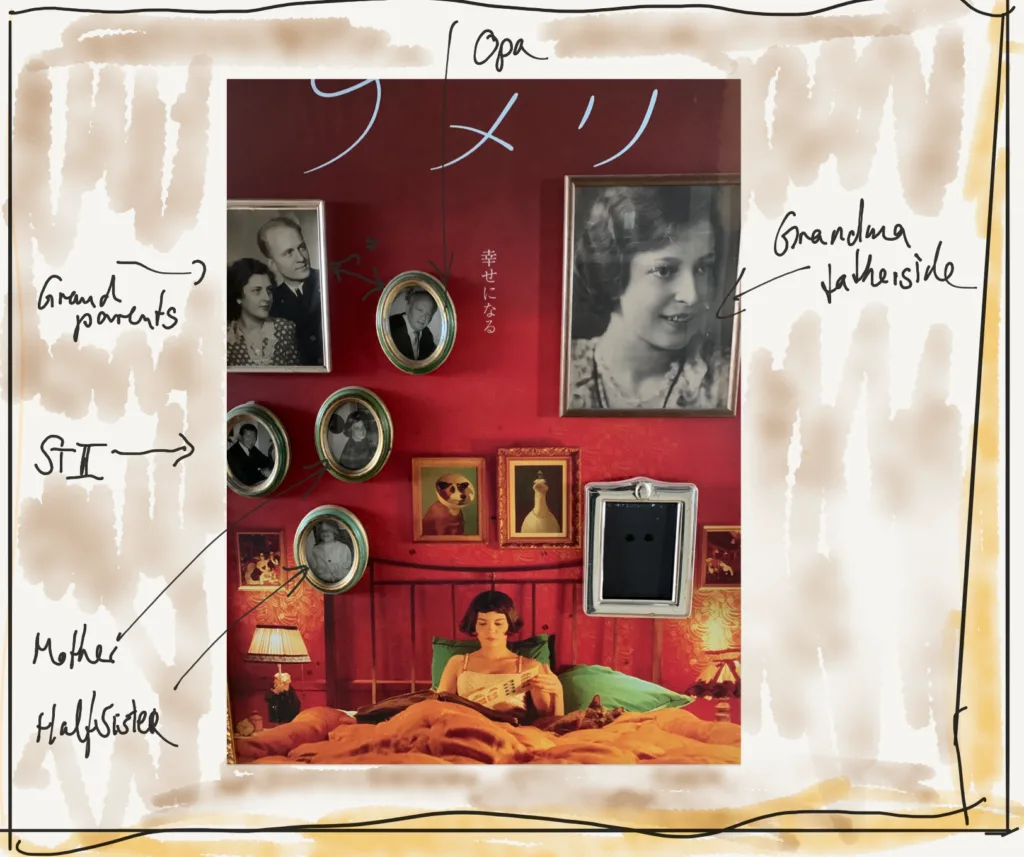
1) My narrative Manifest – overview of room titles
- Dream first
- Own your Truth
- Be flirtatious
- Dive deep to get sharp
- Honor the Wild
- Trust beyond
- Step(h) by Step(h)
2) Summaries of the Rooms
Room I: Dream first
Summary: Blank. Stardust. Lucidity.
This first room is about experiencing uncertainty or, as I will be referring to it throughout the research paper Blank Moment*. You will be introduced to the concepts of consensus reality (CR)* and dreamland* (NCR) which will eventually also be deepened. A tender girl appearing as a dream figure* assisted me in the process of surrendering to the unknown and in receiving ‘stardust’ as a gift from moving between the two layers of reality. By following an inner dialog between the ‘Dreamer’ and the ‘Engineer’ you will get an idea about the tension between these two roles* in the Northern German/Western European context. Room I is finishing, upon what we can learn about lucidity* from indigenous cultures.
Room II: Own your Truth
Summary: Chosen for. Patriarch. Signature Field.
The second room is about the experience to feel unwelcome or not consciously having been chosen for within your birth family. As a ‘survival strategy’ in these circumstances you either start to please, adapt and compromise to find or keep your position in this family or you can believe in something greater, something beyond CR which holds you in a similar way as your birth family is assumed to do. You will meet my grandfather an old-style patriarch ‘fighting for the good’ and discover how I along with the well-adapted, empathic Stephanie, I also nourished Durga – my rebellious nature fighting for truth. The tale of the Chicken Farm helps this part to unfold. This rebel part innately carries courage and fearlessness within to make the ‘shyness to step on stage and become visible’ disappear. As a theoretical impulse, I frame how the different’ Gallery Rooms’ reflect different facets of my Signature Field*.
Room III: Be flirtatious
Summary: Mothering. Kind. Performance Trance.
The third room starts with a dream work and the lesson of mothering a ‘neglected’ part of myself. Through the Signature Story ‘Racing differently’ two roles appear: the goal-oriented, and the relational one. The reflection shows how family and cultural conditioning made me marginalize the relational the ‘kind’ part in me. This part also invites me to a more joyful and playful life approach, just as it embraces Me and the flow of life with a beginner’s mind.
This also gives space to imagination and creativity. Qualities that our ‘tired warrior’ part needs in order to cut through the collective performance trance – even more so during these current lockdown situations.
Room IV: Dive deep to get sharp
Summary: Losses. Truth. Feynman
In this room, you will get in touch with the experience of loss and abandonment, and how my imagination and spiritual ‘relationships’ helped me cope. The Naked Truth illustrates the importance for ‘Truth’ to move into ‘Story’s clothes. In terms of Storytelling, this room points out the listener’s responsibility to choose between health ‘food’ and junk ‘food’ referring to a story’s contents and conveyed messages. This room also shows how a perceived strong opponent eventually turns into an important teacher. Saying no to toxic messages and unhealthy relationships was a major step on my personal path and enabled me to open the arms (the heart) to receive support and love from my environment. Feynman’s two diagrams picture annihilation and stability on an electron’s path and share the deep insight I got, how these answers to the question, how to deal with the audience in a Process Worker or modern shaman’s way.
Room V: Honor the Wild
Summary: Mermaid. Identity clash. Money.
In this room I share the experience of my ‘fluid’ identity and how creative expression through Pantouns helps me to find myself, and stability in this fluid state. The tale of Melusina, the mermaid, deepens the delicacy which lies in this energy as well as the difficulty to protect her space well within me. The occurrence of the same repetitive nightmare shows a clash of identities at certain evolutionary moments in my life – a clash between my truth and an everyday identity built on expectations. Here the cobra as a spirit animal became an important supporter in defending and standing up for my truth. The Signature Story ‘Money does not rule my decisions’ also features a suspense between CR and non-consensus reality (NCR) as I perceive it, and how embracing both helps me to be present and to connect.
Room VI: Trust beyond
Summary: Church. Beyond. Embodiment
In this room, I share my personal experiences with Church (as institution), taking on different perspectives on concepts and stories, and reflect on how each of them might be useful or could also hinder us from relating to the ‘beyond’. It leads me also to question gender and its ‘definition’. What does it take to be a woman or a man? Does it take the physical body, the skirt or pants, your name, or personal identification? Which consequences would it have to identify with…? Theoretically, you will walk through some different edge dimensions also arriving at the edge to the universe – to allow oneself being part of it all, and the embodiment – the possibility to find the Devine in ourselves.
Room VII: Step(h) by Step(h)
Summary: Fire. Dancing. Joy.
In this final room, you experience the scaring drama quality of a fire moment, the Buddha spirit and the beauty of being part of a community, a supportive neighbourhood. Theoretically, Max Schupbach speaks about three major roles in conflict or power battles and inspires me to put some light on the ‘conservative role’ within myself. ‘Wild Nature’ talks to empathic ‘ Stephanie’, who appears to have been the listening host of it all. The Signature Story ‘Royal Gypsy-blood’ stands for my wish to help to re-tell some overcome conventional rules and the deep wish or even call to facilitate diversity and inclusion. The Wake up here is the cutting through a long trance, letting old pain and anger go, dancing, step by step … finally learning from next generation how my Childhood Dream can be dreamt with a joyful tonality.
3) Artefacts by ‘Genre’
Journal
- The Oceans’ Whispering (Room1)
- Bride’s Father’s speech (R2)
- A watch’s suicide(R3)
- Toxic Telling (R4)
- Every Morning a New Me (R5)
- Our Temple (R6)
- Fire on the Terrace (R7)
Signature Stories
- From a Department Store (R2)
- Racing differently (R3)
- The Spanish Queen ruling the Ocean (R4)
- The royal Gypsy Blood (R5)
- Asking for a skirt (R6)
- Money does not rule my Decisions (R7)
Day and Night Dreams
- Mothering needed (R3)
- Loving myself (R4)
- The Betrayal Letter (R5)
- Desert at Dawn (R6)
- Mary Magdalene (R6)
- Wake up (R7)
Portrait/Dialogues
- Dreamer meets Engineer (R1)
- The Good Girl’s Twin (R2)
- Patriarch old Style (R2)
- Mother. Sweet-sour. (R3)
- Willi. Our Family Ghost. (R4)
- The Cobra Throat (R5)
- Name Change (R6)
- Oma. Love beyond Story (R6)
Tales
- Star Child (R1)
- Chicken Farm (R2)
- Ice flowers (R3)
- Naked Truth (R4)
- Melusina – the Mermaid (R5)
- Shalimar (R7)
- Digging for Diamonds (R4)
- Shifting into the Audience’s Perspective (R4)
- Choosing not to relate (R4)
- Choosing a Predator (r5)
- Earth Spot (R6)
- Dreamwork, Dreamplay (R6)
- Sensual Dancer(R7)
- Conflict Work (R3)
Life Myth Reflection
- Blank Moment
- The Lead Role
- Beginner’s Mind
- The Audience as Opponent
- Shapeshifting
- Oneness
- Joy on stage
PW Theory Impulse
- Lucid Dreaming
- Signature Field
- Metaskills and Flirts
- Feynman’s Theorem
- Real and Phantom people
- Edges and Co-creating the Universe
- Roles in Conflict Facilitation
4) Life Myth Aspect in each Room
1) The Blank Moment
Backstage …. I still have a few minutes left before the performance starts. People around wish me luck. They are patting me on the shoulder with the words: we know you’re going to do great. They mean well. Desperation is growing within me. I am going to play the lead role here tonight – and it seems only I am aware – that I don’t know anything. I am not prepared. I have no lyrics, no text. Blank. Panic. I wake up.
2) The Lead Role
Backstage …. I still have a few minutes left before the performance starts. People around wish me luck. They are patting me on the shoulder with the words: we know you’re going to do great. They mean well. Desperation is growing within me. I am going to play the lead role here tonight – and it seems only I am aware – that I don’t know anything. I am not prepared. I have no lyrics, no text. Blank. Panic. I wake up.
3) Beginner’s Mind
Backstage …. I still have a few minutes left before the performance starts. People around wish me luck. They are patting me on the shoulder with the words: we know you’re going to do great. They mean well. Desperation is growing within me. I am going to play the lead role here tonight – and it seems only I am aware – that I don’t know anything. I am not prepared. I have no lyrics, no text. Blank. Panic. I wake up.
4) The Audience as Opponent
Backstage …. I still have a few minutes left before the performance starts. People around wish me luck. They are patting me on the shoulder with the words: we know you’re going to do great. They mean well. Desperation is growing within me. I am going to play the lead role here tonight – and it seems only I am aware – that I don’t know anything. I am not prepared. I have no lyrics, no text. Blank. Panic. I wake up.
5) Shapeshifting
Backstage …. I still have a few minutes left before the performance starts. People around wish me luck. They are patting me on the shoulder with the words: we know you’re going to do great. They mean well. Desperation is growing within me. I am going to play the lead role here tonight – and it seems only I am aware – that I don’t know anything. I am not prepared. I have no lyrics, no text. Blank. Panic. I wake up.
6) Oneness
Backstage …. I still have a few minutes left before the performance starts. People around wish me luck. They are patting me on the shoulder with the words: we know you’re going to do great. They mean well. Desperation is growing within me. I am going to play the lead role here tonight – and it seems only I am aware – that I don’t know anything. I am not prepared. I have no lyrics, no text. Blank. Panic. I wake up.
7) Joy on Stage
Backstage …. I still have a few minutes left before the performance starts. People around wish me luck. They are patting me on the shoulder with the words: we know you’re going to do great. They mean well. Desperation is growing within me. I am going to play the lead role here tonight – and it seems only I am aware – that I don’t know anything. I am not prepared. I have no lyrics, no text. Blank. Panic. I wake up.
Appendix II: The narrative Backbone
Shalimar – The Dance of Joy
Once upon the time a young woman Shalimar was living in a rich village surrounded by beautiful gardens. The gardens were full of big trees bearing fruits in all kinds of colours, scents, and sizes. People used to walk in these gardens. Strange enough, there was an old rule in the village not allowing the inhabitants to eat any of the fruits. Nobody remembered the why, but everybody was strictly respecting the rule.
One day, Shalimar was sleeping under one of the oldest date trees, when a green-orange lizard whispered in her ear: Shalimar, taste one of these beautiful dates -a different world will open up for you. The young woman still half asleep took one of the dates and tasted it … and yes, what a wonderful experience – what a joy. Unfortunately, other villagers saw her breaking the ,holy’ rule and, yes, still the same evening, the community decided that she had to leave the village.
Deeply desperate she left her family and home, walking away, full of sadness, until she reached the next village. Shyly she sat down at some distance to the village and a wave of sadness and agony of being excluded by the loved ones turned into an ocean of tears. The villagers watched her from their homes, but nobody really wanted or knew how to deal with this desperate sadness.
Feeling even more rejected, Shalimar’s sadness turned into anger. What was the meaning of a rule forbidding JOY? Why did all people follow such a rule without questioning it, and even worse, giving more importance to a rule than to her as a part of the community? The anger made sparks falling down from her heart and when they got in contact with wood little fires started to burn. The villagers became curious, they came closer, but then the anger and the sparks scared them. And Shalimar – caught in her angry shyness – did not know what to say or how to relate to them. So, everybody went back home.
Tired of all emotions and inner struggles, Shalimar decided to lie down underneath a big tree and fell asleep. She started to dream about the beautiful gardens of her home village … she saw all the people eating the tasty fruits of the trees and started dancing, dancing together – a dance of joy. Still dreaming, the small lizard came back and said: “Shalimar, create a fireplace and talk about your dream.”
Shalimar woke up, looked out for a sheltered spot, collected good wood and started a fire. The villagers felt attracted by the warmth of the place and joined her sitting down around the fireplace. After a short while, Shalimar started to tell her dream. When she finished full of passion for the Dance of Joy, an inspiring spark jumped over to the man sitting next to her. Now this man told his dream, then a child took over, next an old lady … and magically, these dreams began to create a beautiful music in the air. After a while, people started to dance together – a beautiful dance, the dance of JOY.
Steph Kata 15.04.14
Appendix III: Glossary
Active Imagination
As developed by C.G. Jung between 1913 and 1916, active imagination is a meditation technique wherein the contents of one’s unconscious are translated into images, narrative or personified as separate entities. It can serve as a bridge between the conscious “ego” and the unconscious. This often includes working with dreams and the creative self via imagination or fantasy. Jung linked active imagination with the processes of alchemy. Both strive for oneness and inter-relatedness from a set of fragmented and dissociated parts. This process found expression for Jung in his Red Book. (Wikipedia on Active Imagination and C.G. Jung, accessed 01/03/21)
Addiction
Conflict between a primary and a secondary process in which one uses increasing quantities of a drug to support a secondary process in order to overcome the primary one. Typical drugs are morphium, heroin, alcohol, cigarettes, coffee and tea (Arnold Mindell, 1988, G- p.173)
Altered State
If ordinary waking consciousness is our primary state, altered state includes nocturnal dreaming, hypnotic conditions, drunken and drugged states, states around strong emotions like rage, panic, elation, or states induced by meditation (Arnold Mindell, 1988, G- p.173)
Amplification
A method for strengthening our experiences so they can develop and unfold (Amy Mindell, 1995, p.28).
Awareness
Noticing what you are experiencing (Arnold Mindell, 1988, p.97). The ever-increasing ability to notice and follow what is arising in a given moment (Amy Mindell, 1995, p. 132).
Beginner’s Mind
A mind – or perhaps heart – that is open and unbiased. It is not shaded by knowledge but is free and spontaneous enough to follow what we normally forget or overlook (Amy Mindell, 1995, p.83). A mind or heart that is focused on the flow of events rather than on attaining a particular goal, even when that goal is healing (Amy Mindell, 1995, p.183).
Blank Moment
A moment of (usually) uncomfortable surprise that occurs when we are confronted with sudden changes or uncertainty or sudden forgetting. It often occurs when we got on an edge* between primary* and secondary process*. As covid -19, as a pandemic has interrupted our collective structures and routines massively, it may be considered a collective Blank Moment.
Consensus Reality (CR) vs. Non-consensus Reality (NCR)
The generally agreed-upon idea of what is real. In the twenty-first century, this means that which can be observed objectively in time, space, matter, and energy (Arnold Mindell, 2010, G-p. 272) CR is everyday reality. It is the known primary world, in the Shaman Don Juan’s words ‘The Tonal’, whereas NCR is the secondary, mysterious unknown world ‘the Nagual’. More to find at Reality Levels.
Channels (occupied, unoccupied)
The specific mode in which information is received, for example the visual, auditory, proprioceptive, kinesthetic, relationship and world channels. The latter two refer to information by seeing, hearing, feeling, moving, through another person or an outer event (Arnold Mindell, 1988, G-p. 174)
Childhood Dream (see Life Myth)
Deep Democracy
A concept, as well as an elder’s* multidimensional feeling of representing attitude towards life, that recognizes the basically equal importance of representing consensus reality concerns (facts, issues, problems, people), dreamland figures (roles, ghosts, directions), and the essence that connects everyone. (Arnold Mindell, 2010, p. 272)
Dreamland (see Reality Levels)
The world where Dreaming first expresses Itself, in a particular form such as the dualistic world of dreams, movement, dance, images, body aches and pains, and so on. (Arnold Mindell, 2002, p.31). Dreamland appears in narratives in terms of past, future, or not here, not-me. (Arnold Mindell, 2002, p. 160). A general level of awareness including dreams, dreaming while awake, and noncon- sensual experiences (relative to a given community) (Arnold Mindell, 2010, p. 272).
Dreamdoor
A potential opening to another world, another realm. It is a door, an opening, an invitation that can be taken, or not (Arnold Mindell, 2002, p. 159).
Dual awareness
The therapist is in one role while talking about the other role – meta- communicating- at the same time (Arnold Mindell,1988, G-p.174).
Double Signal
Language or body gestures which the communicator does not identify with. Signals or communication which are related to a secondary process* (Arnold Mindell, 1988, G-p.174).
Everyday identity (see primary identity)
Earth spot
A special place on earth (or imaginative) that we love, Shamans call it a ‘power spot’, in inner or client work often used to connect to a more sentient level (Arnold Mindell, 2010, p.6)
Edge
The experience of not being able to do something, being limited or hindered from accomplishing, thinking or communicating. Structurally speaking, an edge separates the primary* from the secondary process* (Arnold Mindell, 1988, G-p.175)
Elder
An elder is someone who is comfortable with her style and can go beyond it; she or he is an awareness facilitator. The elder says, from time to time, “Now this is happening, now that.” She asks, “What are you aware of ? What is trying to happen ? Where is nature going ?” This elder stands compassionately for all of the parts and simultaneously, for the ineffable dreaming process that flows between them (Amy Mindell, 2006, p. 322).
Essence or sentient level (see reality levels)
Everyday Identity (see primary process/identity)
Facilitator (process-oriented)
The facilitator is the ‘dreaming eye’ of the field itself. From the perspective of this dreaming eye everything we notice, including ourselves, is part of the dream we are unfolding. If this facilitator role is not filled, group work feels like a pot of stew without a cook. No one is there to add the right spice to the various parts or to turn off the flame when the cooking is done. The facilitator knows that people are not roles, and that nearly everyone can fill the roles. Anyone is too whole to be only one role. Everyone is responsible for every role, including the one of the facilitator’s (Arnold Mindell, 2000, p. 578).
Field
A feeling of causal or acausal interconnectedness between various places and people, and evidence for the existence of such interconnectedness as in the case of synchronicity*(Arnold Mindell, 1988, G-p.97).
Figure
Any aspect of the dream – be it a person, object, creature, landscape – that catches your attention (Arnold Mindell, 2002, G-p.176).
Flirt
Flirts are the first way in which the Essence world arises in our awareness, the first way we experience the intentional field. Flirts are quick, evanescent, non-verbal sensations, experiences, visual flickers, hunches, moods that suddenly catch our attention (Amy Mindell, 1995, p. 24)
Fluidity
Our ability to move between the different reality levels (Consensus Reality, Dreamland, Essence) or roles (Amy Mindell, 1995).
Hero’s Journey
Joseph Campbell, literature scientist and mythological researcher, analysed thousands of myths of diverse cultural backgrounds, developed the archetypical structure of the Hero’s Journey, or the Monomyth. He promoted the idea of one story-pattern beyond all stories that involve a hero who goes on an adventure, is victorious in a decisive crisis and comes home changed or transformed (Wikipedia, accessed 01/03/2021)
Individuation Process
This term was originally defined by C.G. Jung and refers to the lifelong development of an individual capable of integrating all of the various parts of her/his personality into ordinary life. In process thinking, individuation also refers to the ability to access any altered state*, such as dream figure, body problem or relationship projection and to live and process these states in the moment they are present without losing contact with one’s ordinary identity. (Arnold Mindell, 1988, p.176-177).
Intentional Field
Guides and organizes our experiences invisibly and immeasurably, even when we are usually unaware of its presence. Like putting a magnet under metal fillings (Amy Mindell, 1995).
Life Myth (based on Childhood Dream)
C.G. Jung found that Childhood Dreams, which often stayed in a person’s memory into adulthood, revealed an archetypal or mythic pattern for a person’s life. Like an astrological chart, the Childhood Dream was not a predetermined path, but a picture of tendencies, represented symbolically. (Diamond and Jones (2004), p. 148). Years later, Arnold Mindell, extended Jung’s work on life myth and Childhood Dreams to encompass chronic body symptoms, addictions, and relationship challenges, proposing that mythic underlying patterns exist within each of these areas. (Rebecca Lang, 2019)
Lucid Dreaming
Whereas the original definition of lucid dreaming was to get aware of dreaming during the night, Arnold Mindell broadens the definition to sense the dreaming that creates the dream and that can be by day and by night (Amy Mindell, 1995).
Lucidity
The ability to trace subtle tendencies requires a certain quality of attention and concentration. The ability to be foggy and open at the same time, to notice the slightest events that catch our attention, those tiny sparks that we often marginalize with our ordinary consciousness (Amy Mindell, 1995).
Mainstreaming
The pressure to conform to a particular type of mainstream group – which might be very different from the way you really are, look, or feel. Remember, mainstreaming in relationships makes us forget our own feelings, movements and phases in order to act like others (Arnold Mindell, 2019, p.220).
Marginalization
Something that used to be in the center of your awareness – like frustration or tiredness –and is placed in the “margins” of your focus where you can barely see it. Marginalization is a deep process, which usually occurs without you even noticing that you have done it. Of course, you can suppress experiences, but to do that, you need to know they exist. Marginalization is more subtle; you need mindfulness, focus, and training to notice how Dreaming gets put into the margins of awareness. (Arnold Mindell, 2004, p.33-34).
Metacommunication
The capacity to communicate about the content and the process of communication (Arnold Mindell, 1988, G-p.177).
Metaskills
Deep spiritual attitudes and beliefs that manifest in therapy and in everyday life. By focusing on this subtle feeling level, you become involved in an artistic and spiritual discipline (Amy Mindell, 1995).
Narrative
In contrast to story, a narrative is much bigger. It is a way to looking at the world. An over-arching concept that influences sense-making and decision-making. It doesn’t necessarily have a clear beginning, middle or end like a story does. A narrative most often unfolds over time. A narrative can be the string that holds the stories like pearls, e.g. the ‘American Dream’. Whereas a story points at something in the past, narratives show what is possible, give direction in pointing into the future. (Margolis, 2020, p.34).
Non-Consensus Reality (NCR) (see Consensus Reality)
A different reality, one that seems to be more “individual” from the viewpoint of Consensus Reality (CR), subjective and less solidified; it has less consent and less mainstream cultural authorization (Arnold Mindell, 2000, p.26).
Path of Crumbs
Hänsel und Gretel finding their way back home. In Process Work, this means discovering the spontaneous process and intently focusing on its winding path (Amy Mindell, 1995).
Peak Experience
A moment that touches us most deeply and holds a state of being, an essential energy with the capacity to connect us with our emerging potential and to enhance our overall state of being.
(Elsa Henderson, 2016)
Primary Process / Primary Identity (see Process)
The body gestures, behavior, and thoughts with which one identifies oneself or which it can be assumed one would identify with if asked (Arnold Mindell, 1988, G-p.178).
Process
The continuous flow of signals through various perceptive channels. Process is differentiated into primary and secondary information which is closer to or further from the sender’s awareness (Arnold Mindell, 1988, G-p.178).
Process Mind
The palpable, intelligent, organizing “force field” behind our personal and large group processes and like other deep quantum patterns, behind processes of the universe. It is a nonlocal, invisible, dreaming intelligence behind all our experiences, present as the deepest part of ourselves, a wisdom that simply knows “now this” and “now that.”
According to Mindell (2010), the Process Mind influences our overall direction in life. While, at different times in our lives, we may follow many paths and be pulled in different and unpredictable directions, the Process Mind tends to pull us in a specific and predictable overarching direction in life which corresponds to our deepest self (Rebecca Lang, 2019).
Process Work (PW) (or Process-oriented Psychology)
Process Work (or Process-oriented Psychology) is a psychological paradigm that was developed by Dr. Arnold Mindell, an MIT physicist and Jungian psychologist. Process Work originally grew from Jungian psychology in the 1970s and 80s, when Arnold Mindell practiced at the Jung Institute in Zurich.
Process Work, also called process-oriented psychology, is an awareness-based practice that follows the nature of individuals, communities, and eco-systems. As an evolving, transdisciplinary approach, Process Work supports individuals, relationships, and organizations to discover deeper layers themselves.
It focusses on following the natural flow of signals whether it appears in body, movement, relationship or groups. PW has an ethical belief in connecting individual work to political, environmental and group work. PW investigates our known world and opens up to the unknown, the numinous and inexplicable elements of life that are the potential seeds of new life and creativity. It seeks to uncover the spiritual in our most mundane reality (Amy Mindell, 1995).
Rank
A conscious or unconscious social or personal ability or power arising from culture, community support, personal psychology and /or spiritual power. Whether you earned or inherited your rank, it had organized much of your communication behavior, especially at edges and in hotspots (Arnold Mindell, 2014, p.42). The sum of a person’s privileges. (Arnold Mindell, 2014, p.28) Psychological Rank refers to a kind of centeredness that allows the person to remain balanced in the midst of difficult psychological states. Spiritual rank refers to a person’s perceived connection with god or the spirit (Amy Mindell, 2006, p. 283-284).
Roles and Ghost Roles
A role is a tendency in the field, a flow of information that is considered to be known amongst a community (or to a person) and is represented by someone. Roles are currents in the ‘river’ that everybody agrees to exist (Schupbach, 2012). If roles can be compared to river currents that everybody agrees on. A ghost could be defined as a role that is not owned by anyone in the moment it appears. Referring to Max Schupbach’s metaphor, ghost roles are currents under the surface.
Reality Levels
The most familiar level is what we call Consensus Reality (CR). This is the realm of our everyday lives and experience. It is where the ideas, attitudes, or activities which are more or less accepted or agreed upon by most people as normal or conventional. It is represented by mainstream views and societal norms and what is generally agreed upon as “real” (Diamond & Jones, 2004). Consensus reality includes data, facts, structures, goals, practices, finances, stakeholders and issues or problems that are openly discussed and needing attention.
The second level of awareness is referred to as Dreamland. This is the realm of less tangible, less visible, and subjective or dreamlike experiences that are not generally agreed upon as “real”, such as emotions, fantasies, projections, gossip, and other experiences which comprise our inner world. At this level of experience, dreams, dualities, double signals, disturbances and conflict occur.
Dreamland experiences can be found in stories, myths and history; in creative tensions and impulses, such as excitement, jealousy, and power struggles; in the roles that people rarely identify with, but project outside themselves onto other people or groups; and in the problems or events that happen to an individual or group. As it is not a reality agreed upon by the majority, in Process Work it is referred to as a non-consensus reality.
The third level of awareness is a sentient level Process Work calls the Essence. This is the realm in which everything is interconnected and where there is a sense of universal and undifferentiated oneness. It is dreamlike, non-temporal, nonlocal, and all-pervasive everything.
In the realm of Essence, disturbing polarities no longer exist, and things are only partially measurable and hard to articulate. This level of awareness can be found in moments of unity in a group and when roles, polarities, and conflict disappear. Once again, as the Essence level is not a reality agreed upon by the majority, in Process Work (PW) it is referred to as a non-consensus reality (R. Lang, 2019).
Shaman
Is a tribal leader who is able to enter altered states, and to journey into the underworld, or in the world of spirits, and then bringing it back into consensus reality so that is useful to the client or community (Eliade, 1982).
Shapeshifting
Changing identities and states of consciousness. Some form of shapeshifting is always involved in the resolution of psychological problems in therapeutic practice. One’s personal development depends on being able to move from one framework or state of consciousness to another, seeing the same thing from different viewpoints, living in various worlds, one at a time. For example, in one world you may be in consensus reality where time goes forward, yet in another world, you may enjoy another kind of life in which time goes slower, backward, or even stops. (Arnold Mindell, 2000, p. 277). Dropping and extending your self-definition is a kind of shapeshifting (Arnold Mindell, 2004, p.189).
Second Attention
Arnold Mindell uses Don Juan’s language to describe the moment of catching and harnessing the energy of spontaneous events, for focusing intently upon numinous and unknown material. The first attention notices the primary doing, whereas the Second Attention grasps fleeting secondary material, holds it and allows these experiences to express themselves fully (Amy Mindell, 1995).
Secondary Process
All verbal and non-verbal signals in an individual’s or community’s expression with which the individual or community does not identify. The information originating from secondary processes is usually projected, denied, and found in the body or outside the sender (Arnold Mindell, 1988, G-p.178).
Sentient Level (see Reality Levels)
Signals
Signals may originate as almost imperceptible experiences that only the observer notices. Otherwise, signals are perceived pieces of information, communicated through words, sounds, actions, gestures, or body feelings. Signals have a local appearance, but may be nonlocally entangled with communication partners at a distance (Arnold Mindell, 2010, p. 273).
Signature Field
A Signature Field is a consistent power that is a special characteristic of your nature. We all share the same ‘Mother Earth’, but each of us represents a particular part of her. The way you do anything is an expression of your ‘Signature Field’, the power moving you, the ‘Earthspot*’ you come from (A. Mindell, 2010, p.68).
Signature Story
A Signature Story is a told (often childhood) experience that you remember as a turning point in life. It often means a conflict with authority, family or cultural context. It is close to the Process Work concept of a childhood memory, already ‘storified’ meaning first interpretations were made of what kind of values played a role at the time and how it does fit into the current context.
Spiritual Rank (see Rank)
Story
In its simplest form, it is about a character and what happens to him/her. It has a beginning, a middle, and an end. Think of a story as an anecdote that recounts specific moments occurring within a time and space. It provides us with entertainment, insight, or even a life lesson. It creates a shared emotional experience, that can bond us together (Margolis, 2020, p.34).
Synchronicity
A term defined by C.G. Jung, used here to describe a secondary process occurring in the world channel (Arnold Mindell, 1988).
Tao
A power, the source or energy behind the universe and the wisdom or order behind individual lives within that universe. The Tao cannot be described in words and is therefore variously translated as ‘way, path, right way, or meaning’. The Tao is a noetic path of awareness, transient and always changing and passive in the sense that one must be open to understand it (Arnold Mindell, 2007, p. 23). The field-like power you cannot see (Arnold Mindell, 2013, p. 94). The Tao is a field, and our experience of the Tao is our Process Mind. (Arnold Mindell, 2013, p. 87).
The ‘Path of Heart’ means following the ancient Tao, you know when you are on track. No one can follow this path without awareness of what is happening. One needs to use the second attention, feeling the dreaming body, and find the TAO. When you are on track it feels like you are not losing any energy. Though, one may be in the midst of a whirlwind, still it is the path of least action, the path of sometimes referred to in Taoism as ‘not doing’, or ‘wu wei’ (Arnold Mindell, 1993, p.141).
Walkabout
Walkabout is a rite of passage in the Australian Aborigines society, during which males undergo a journey during adolescence, typically ages 10 to 16, and live in the wilderness for a period as long as six months to make the spiritual and traditional transition into manhood. Indigenous temporary mobility practices remain poorly understood within mainstream Australian society. They are often explained away as simply the product of a nomadic predisposition to wander about aimlessly. This lack of understanding led to the term “walkabout” being used in a derogatory way to explain unplanned and unexplained trips. (Wikipedia, accessed 01/03/2021)
Worldwork
A small- and large group method that uses deep democracy to address the issues of the groups and organizations all kinds. Worldwork employs the power of an organization’s or city’s dreamlike background (e.g., projections, gossip, roles and creative fantasy). Worldwork facilitators listen to the land, do inner work, and practice outer communication skills involving role consciousness and signal and rank awareness to enrich organizational life (Arnold Mindell, 2010, p. 273).
Wounded Healer
One who helps others because he/she has survived his/her own painful experiences. Like the Shamans going through their training in aboriginal societies, the best Open Forum facilitators-elders have also been hurt. In a way, they have even died, in the sense of having detached from their earlier identities. Multicultural elders may have been victims of oppression, but they learned to free themselves enough from the oppressed role to feel their way into other “spirits” in any given conflict. They seem to know all the sides regardless of the issue (Arnold Mindell, 2003, p.162-163).
Appendix IV: Literature
Arthur, M. (2020) 365 ALIVE! Find your voice. Claim your story. Live your brilliant life. OH: Firelight.
Baldwin, C. The Storycatcher. Making sense of our lives through the power and practice of story
Brown, B. (2017). Braving the Wilderness: The quest for true belonging and the courage to stand alone. London: Vermilion.
Campbell, J. (1993). The Hero with a Thousand Faces. Hammersmith, London: Fontana Press.
Castaneda, C., (1998) Die Kunst des Träumens. E-book. Fischer Taschenbuch Verlag.
Castaneda, C., (2000) Das Wirken der Unendlichkeit. E-book. Fischer Taschenbuch Verlag.
Diamond, J., & Jones, L.S. (2004). A Path Made by Walking: Process Work in Practice. Portland, OR: Lao Tse Press.
Hillman, J. (1996). The Soul’s Code: In Search of Character and Calling. Milsons Point, NSW, Australia: Random House.
Henderson, E. (2016), Peak Experience as an access to inner direction, IAPOP Final Project, Portland.
Houston, J.
Kuleshova, X. (2018), Interview with Dr. Max Schupbach
https://youtu.be/5_WQj-ReHWI (accessed 01/03/21)
Lang, R. (2020), Befriending a life myth through fairy story and unfolding, IAPOP Final Project, Portland.
Margolis, M. (2020) Story 10x: Turn the Impossible Into the Inevitable. CA: Friesens.
Mindell, Amy. (1995). Metaskills: The spiritual art of therapy. Tempe, AZ: New Falcon.
OH: Gatekeeper Press.
Mindell, Amy (2006), Alternative to Therapy, A creative lecture on Process Work. Portland, OR: Lao Tse Press.
Mindell, Amy (2019). Your Unique Facilitator Style: Explore Your Special Gifts and Powers as a Facilitator, Therapist, Teacher Coach, and Helper.
Mindell, Arnold (1993) The Shaman’s Body: A new Shamanism for transforming Health, Relationships, and the Community. NY: Harper Collins.
Mindell, Arnold (1988), City Shadows Psychological Interventions in Psychiatry, London: Routledge.
Mindell, Arnold (2000) Quantum Mind, The Edge between Physics and Psychology Portland, OR: Deep Democracy Exchange.
Mindell, Arnold (2002), The Dreammaker’s Apprentice: Using Heightened States of Consciousness to Interpret Dreams, US: Hampton Roads Publishing Company
Mindell, Arnold (2003), Deep Democracy of Open Forums: How to Transform Organisations into Communities: Practical Steps to Conflict Prevention and Resolution for the Family, Workplace, and World.
Mindell, Arnold (2004) Dreaming while awake /24 Stunden Luzid Träumen, 3. Auflage, Petersberg: Verlag Via Nova.
Mindell, Arnold (2007). Earth-Based Psychology: Path Awareness from the Teachings of Don Juan, Richard Feynman, and Lao Tse. Portland, OR: Lao Tse Press.
Mindell, Arnold (2010) Process Mind: A User’s Guide to Connecting with the Mind of God. Wheaton, IL: Quest Books.
Mindell, Arnold (2013) Dance of the Ancient One, Portland, OR: Deep Democracy Exchange.
Mindell, Arnold (2014) Sitting in the Fire: Large Group Transformation Using Conflict and Diversity, Portland, OR: Deep Democracy Exchange.
Mindell, Arnold (2017) Conflict: Phases, Forums, and Solutions. North Charleston, SC: CreateSpace IPP/World Tao Press.
Mindell, Arnold (2019) The Leader’s 2nd Training: For Your Life and Our World. Columbus, OH: Gatekeeper Press.
Moustakas, C. E. (1990). Heuristic research: Design, methodology, and applications. Thousand Oaks, CA, US: Sage Publications, Inc.
Pinkola-Estes, C. (1989) Die Wolfsfrau, D, München: Heyne Verlag.
Schupbach, M., 2004. Lights On! USB Agenda, [WWW Document]. Deep Democr. Inst.URL
https://www.deepdemocracyinstitute.org/fileadmin/user_upload/PDF_DOCS/Articles/lightson.pdf (accessed 15.12.19)
- C.G. Jung (26 July 1875 – 6 June 1961), was a Swiss psychiatrist and psychoanalyst who founded analytical psychology. He found that repetitive Childhood Dreams, which stayed in a person’s memory into adulthood, revealed an archetypal or mythic pattern for a person’s life (more in glossary) ↩︎
- Gilla Haeckel, Dipl. Psychologist, hypno-systemic coach and expert in constellation work, + 18th of January 2019 ↩︎
- Dres. Max and Ellen Schupbach, they co-founded the Deep Democracy Institute (DDI), A Global Leadership Institute and Thinktank, and work in diverse settings in Africa, North America, Europe, Middle East, and Asia. ↩︎
- visiting other schools and Process Work teachers in Switzerland, Catalunya/Spain, Worldwork in Poland, Mindells in Berlin and Ireland ↩︎
- Australian New Zealand Process Oriented Psychology ↩︎
- Process Work (or Process-oriented Psychology) is a psychological paradigm that was developed by Dr. Arnold Mindell an MIT physicist and Jungian psychologist, (more in glossary) ↩︎
- Secondary are all verbal and non-verbal signals in an individual’s or community’s expression with which the individual or community does not identify, (more in glossary) ↩︎
- A Signature Story is a told (often childhood) experience that you remember as a turning point in life. It often means a conflict with authority, family or cultural context, a moment you get socialized or a rebel (more in glossary) ↩︎
- A Wounded Healer helps others because she has survived her own painful experiences. Like the Shamans going through their training in aboriginal societies, the best Open Forum facilitators-elders have also been hurt. In a way, they have even died, in the sense of having detached a bit from their earlier identities. ↩︎
- Consensus Reality – The generally agreed-upon idea of what is real. In the twenty-first century, this means that which can be observed objectively in time, space, matter, and energy ↩︎
- Aspects, a group generally agrees on and identifies with (glossary) ↩︎
- Gonzo Journalism does not aim to be objective in observation, but to share subjective experience around a topic, Max Schupbach shared the idea of as social media communication format based on it ↩︎
- International Association of Practitioners of Process Oriented Psychology. The Association supports collaboration and sharing research, experience and ideas in the evolving field of Process Oriented Psychology. ↩︎
- Josef Helbling is a psycho-therapist, facilitator and supervisor from Switzerland. Josef is the Dean of students in the DDI training programs. ↩︎
- The Intentional Field guides and organizes our experiences invisibly and immeasurably, even we are usually unaware of its presence. ↩︎
- Signals are perceived pieces of information, communicated by words, sounds, actions, gestures, or body feelings ↩︎
- with ‘magical’ I mean impulses, that are so sharp and quick that I can often just feel their transformative power (and not or not directly understand it cognitively) ↩︎
- Anaa, is a trained Neuro-Kinesiologist, Healer, Psychic Medium and Counsellor ↩︎
- Consensus Reality (CR) is the generally agreed-upon idea of what is real ↩︎
- Non-Consensus Reality (NCR) is another reality, the one that seems from the Consensus Reality viewpoint to be more “individual,” subjective and less fundamental; it has less consent and less mainstream cultural authorization ↩︎
- A figure is an aspect of the dream – be it a person, object, creature, landscape – that catches your attention. ↩︎
- Lucidity is the ability to trace subtle tendencies, it requires a certain quality of attention and concentration ↩︎
- Characteristics, gestures, behavior, and thoughts with which one identifies oneself or which it can be assumed one would identify with if asked. ↩︎
- Northem sea village, 90min from Hamburg in Germany ↩︎
- A Blank Moment is a moment of (normally) uncomfortable surprise that occurs when we are confronted with sudden changes or uncertainty or sudden forgetting. As covid-19, as a pandemic has interrupted our collective structures and routines massively, I call it a collective Blank Moment. ↩︎
- A. Mindell introduced a model of three awareness levels: Consensus Reality (CR), Dreamland (NCR), Dreaming (NCR) – see more details in the glossary ↩︎
- Process Work (or Process-Oriented Psychology) is a psychological paradigm that was developed by Dr. Arnold Mindell, an MIT physicist and Jungian psychologist (see more in the glossary) ↩︎
- March 2021 – one year later, we are driving in the third wave (moment of finalizing this project) ↩︎
- A moment that touches us most deeply and holds a state of being, an essential energy with the capacity to connect us with our emerging potential and enhance our overall state of being. ↩︎
- If ordinary waking consciousness is our primary state, altered state includes nocturnal dreaming, hypnotic conditions, drunken and drugged states, states around strong emotions like rage, panic, elation, or states induced by meditation ↩︎
- Dreamland as a level refers to experiences that are dreamlike; that is, those experiences that lie in the background of your awareness and have been marginalized. Dreamlike experiences include, for example, feelings you have not yet noticed, dreams and dream figures, and double signals. ↩︎
- The third level of awareness is a sentient level Process Work calls the Essence. This is the realm in which everything is interconnected and there is a sense of universal and undifferentiated oneness. It is dreamlike, non-temporal, nonlocal, and permeates everything. ↩︎
- Process Mind is the palpable, intelligent, organizing “force field” present behind our personal and large group processes and like other deep quantum patterns, behind processes of the universe ↩︎
- Edge is the experience of not being able to do something, being limited or hindered from accomplishing, thinking or communicating. It occurs before stepping into the ‘unknown’ ↩︎
- (*) in Glossary ↩︎
- The specific mode in which information is received, for example the visual, auditory, proprioceptive, kinesthetic, relationship and world channels. ↩︎
- Amplifying is a method for strengthening our experiences so they can develop and unfold ↩︎
- The pressure to conform to a particular type of mainstream group – which might be very different from the way you really are, look, or feel. ↩︎
- Kate Jobe is a Certified Process Worker since 1990 and a trainer in Process Work at several Process Work Institutes (Zurich, Portland and Barcelona). As a former dancer, she has a special focus on movement. ↩︎
- As developed by C.G. Jung between 1913 and 1916, active imagination is a meditation technique wherein the contents of one’s unconscious are translated into images, narrative or personified as separate entities. ↩︎
- Something is marginalized when it was first in the center of your awareness – like frustration or tiredness – is placed in the “margins” of your focus where you can barely see it. ↩︎
- The Signature Field is a consistent power that is a special characteristic of your nature. ↩︎
- Opa is a German abbreviation for grandfather ↩︎
- Bavarian expression for a naughty boy, interestingly there is no feminine version of it ↩︎
- In some indigenous cultures the storyteller, similar to the West African Griot was not only entertainer, or news-bringing nomad, but also had high social rank as advisors to the royal family. Their spiritual wisdom also led into social status. ↩︎
- Congruency in the sense of inner harmony ↩︎
- Gabryiesca Basiuk certified Process Worker, from Poland, is working with business, organizations and NGO’s, facilitating change in multicultural communities. ↩︎
- Wean Houston complemented of the Hero’s Journey developing a Heroine’s Journey. Whereas the ‘male variant’ is action based, the female one is collecting inner parts, an inner journey towards ‘wholing’ like C.G Jung would call it. ↩︎
- TAO is a power, the source or energy behind the universe and the wisdom or order behind individual lives within that universe. The Tao cannot be described in words and is therefore variously translated as way, path, right way, or meaning. The Tao is a noetic path of awareness, transient and always changing and passive in the sense that one must be open to understand it – see glossary ↩︎
- Special thanks here to the DDI Institute, its founders, Max and Ellen Schupbach and the faculty, my teachers, who practice and teach Process Work with a special focus on leadership, community building and coaching. ↩︎
- Deep Democracy Institute. International. A global leadership Institute and Thinktank. Founder: Ellen and Max Schupbach ↩︎
- A mind – or perhaps heart – that is open and unbiased. It is not shaded by knowledge but is free and spontaneous enough to follow what we normally forget or overlook. A mind or heart that is focused on the flow of events rather than on attaining a particular goal, even when that goal is healing. ↩︎
- Secondary process are the verbal and nonverbal signals in an individual’s or community’s expression with which the individual or community does not identify. The information from secondary processes is usually projected, denied, and found in the body or outside the sender ↩︎
- Caspar Fröhlich, certified Process Worker, based in Zurich, applies ProcessWork in the field of Organizational Development and Coaching ↩︎
- Flirts are the first way in which the Essence world arises in our awareness, the first way we experience the intentional field. Flirts are quick, evanescent, non-verbal sensations, experiences, visual flickers, hunches, moods that suddenly catch our attention ↩︎
- Amy Mindell, 2005, p. 19 (from her song Deep in the Night) ↩︎
- Julia Wolfson, DDI faculty member, based in Australia, facilitates and coaches worldwide change, many of them in connection with human services. ↩︎
- Max Schupbach introduced this term re-framing supervision, in the sense of ‘looking down’, what was not enough, could be done better, but focusing instead on reflecting the learner’s individual skillset that showed up (in soawilii dialect: supa means cool and supu juicy) ↩︎
- Arnold Mindell. Process Mind, p.112 ↩︎
- A. Mindell often refers to Carlos Castaneda and the teachings of his shamanic teacher Don Juan Matus, and the Nagual is ‘the unknown’ world, you reach once you let go all you know (die) ↩︎
- Fluidity as an ability to move between the different reality levels (Consensus Reality, Dreamland, essence) or roles ↩︎
- A typical Bavarian/Austrian sweet egg and flour dish ↩︎
- Arnold Mindell. Quantum Mind, p.209 ↩︎
- DDI online event. 29th of March 2020 ↩︎
- Shapeshifting means changing identities and states of consciousness. ↩︎
- The ‘Process in Process Work’, the 9th of Nov. 2020 ↩︎
- Joe Goodbread is a Research engineer and Certified Process Worker (since 1981) ↩︎
- Founded by Kirsten Wassermann and Peter Ammann ↩︎
- Israelian Dipl. Processworker ↩︎
- Amy Mindell introduced metaskills as deep spiritual attitudes and beliefs that manifest in therapy and in every day’s life. ↩︎
- Australian New Zealand Process Oriented Psychology. Dream Work. Dream Play webinar by Penny Watson and Martin Hemsley ↩︎
- Indian Dipl. Processworker ↩︎
- Yulia Filippovska, lives in Kyiv and is director of Deep Democracy Institute, Ukraine. She has brought the Hub Kyiv social entrepreneurship network and TEDxKyiv conference to Ukraine. ↩︎
- The continuous flow of signals through various perceptive channels. Process is differentiated into primary and secondary information which is closer to or further from the sender’s awareness. ↩︎
- Interview with Dr. Max Schupbach – https://youtu.be/5_WQj-ReHWI ↩︎
- Dr. Xenia Kuleshova, PHD, DipPW, is a Russian born physician and psychologist, living in Switzerland. She is the director of DDI Russia. Xenia has participated in numerous public diplomacy projects. She is now producing films about intercultural relationships. ↩︎
- Andy Smith, Dipl. Process Worker, teacher in the Spanish and UK School, Andy’s work centres on transformational change in communities, organisations and participative democracy, inclusion and diversity. ↩︎
- Lily Vassiliou, Ph.D., is a Certified Process Worker with a background in social work, systems theory, and group dynamics. She completed her doctoral studies in the area of Psychology, researching Process Work’s approach to panic attacks. ↩︎
- A term defined by C.G. Jung, used here to describe a secondary process occurring in the world channel (Arnold Mindell, 1988). ↩︎
- Joseph John Campbell (March 26, 1904 – October 30,1987) was an American professor of literature at Sarah Lawrence College who worked in comparative mythology and comparative religion. He gained recognition in Hollywood when George Lucas credited Campbell’s work as influencing his Star Wars saga. ↩︎
- Dr. Jean Houston (born 10 May 1937) Philosopher, scholar and longtime observer of culture and behavior the world over ↩︎