
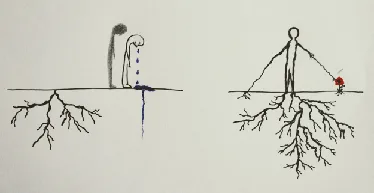
1. Thanks
First of all and for the first time in my life, I want to appreciate myself for giving myself permission to embark on this journey. For accompanying me unconditionally without losing my compassion and love for myself through the conclusion of this process. I want to honor the fears, difficulties and traumatic stories that have taught me to become who I am. And I want to honor the part of me that has been able to give rise to the pain, and has even been able to embrace the abusive figures that have had a role in all of this.
Today I am most grateful to the part of me that doesn’t surrender, to the part that doesn’t believe in the impossible, to the part that strives as a force for growth, to release the trauma impregnated in my cells and to pass from victim to survivor. I am very grateful to this part because if I hadn’t persevered, I wouldn’t be here today.
But I also want to thank to myself for offering me a new opportunity, a new look and experience at life and living in it. And much of this look comes from having discovered and fully surrendered myself to the Process Work methodology. I am grateful to the people who developed this methodology, and to the people who have approached and transmitted it to me from the two schools in which I have grown up throughout the whole process: the Instituto de Trabajo de Procesos and the Deep Democracy Institute. Thanks to each one of the teachers for having transmitted me your passion, knowledge and for having sat next to me in the fire with love, so that today I can discover myself day by day in a new way of living and looking at life.
And I have to name my body, because the experience has not been exactly light, indeed, it has been a container of intense and painful experiences. Give it courage for its strength and its desire to be inhabited, for its sensitivity and capabilities, and for the persistence in finding ways to be able to express what is happening to it and bring its wisdom, although sometimes it is hardly seen or heard. And because in spite of the history that is recorded in it, it continues to regenerate and transform itself to be well. And today I can tell it that I thank you, that I see your pain, but also your strength, your courage and your light.
All this would not have been possible or would have been more agonizing, without the people who have held, supported and walked with me on this path with much love.
I thank Andy Smith, main ally in this process, for his support, magic, interest in this project and help to go deeper, and for his help to give shape to my gut feelings into words. To Lily Vassiliu and Kate Jobe for the constant accompaniment and care along the way, believing in me at all times and helping me model self-respect. To Gill Emslie for always being there with her love and support, and Max Schupbach for the opportunities on the road and teaching me that nothing was impossible.
And I want to name my family, who somehow or other have been very present throughout this journey, and who have somehow managed to teach me what unconditional love is. To my parents for giving me life, and in spite of the difficulties, to have done it in the best way we could and knew. To have learned to love each other in pain and to learn, more and more every day, to relate to each other.
And it has been important to feel able to share my process with loved ones, to share my work and my guts with them, and with it to break with that silence that isolates and hurts so much. To all those people who in one way or another have taken care of me along this path, reinforcing the figure of caring that has been so important.
And I want to dedicate this work in some way to all those of us who have suffered sexual abuse in our stories, to share a little of the solitude that this hides and make the world shine a little more.
1. Beginnings
a) This journey and the reasons for going on it: “the Personal is the Political1”
“The best way of doing politics and transforming the world is to tell our innermost secrets”2 Arnold Mindell
This is an exploration of myself and my past, which is, in parts, very intimate, that talks about me and my experiences. It stems from my own life, and talks about part of my past in relation to my experiences of pleasure, understood in a broad sense of the word. It is a heuristic project in which I will explore personal and collective edges3 in relation to pleasure through the exploration of my own history, my body experiences, feelings and sensations, and by using the tools of Processwork. In this way I hope to unfold my personal process in order to frame4 a social issue. It is a heuristic process because I am studying the topic through reflections about my own personal history and on how pleasure is activated or not at the very moment as I write about it and study it. In addition, by using Processwork and innerwork methods and feedback from the different levels of awareness, I am also getting feedback from and with my supervisor. All of this helps to ensures a heuristic method that allows for immersion and explaining and summarising the themes involved.
The aim of my journey is two-fold. One goal is to find ways of freeing myself and dealing with everything that has tied my identity to suffering and pain. The wish is to create a new narrative for the rest of my path through life, for a new and more democratic view of my experience, both with my inner voices and also with my awareness of my experiences, so as not to live dominated by internal critical voices. And my second goal – no less important is that through laying bare my experience and exploring it, I might be able to reach other people with similar experiences or difficulties concerning what I initially define as “being able to open up to pleasure”.
This exploration is aimed at people who are interested in the subject matter or are involved in the world of Processwork, which is the viewpoint and perspective used.
One important thing this methodology has offered me is to welcome the different parts of me. And so I will begin, welcoming the different parts that are present in me as I begin this journey. I would like to welcome my strength and desire to transform things and my belief in the possibility of change through consciousness. I would like to welcome the part of me that is afraid of opening up old wounds that could bleed again; the part of me that is afraid to expose itself, as opposed to the part that believes that it is important to put a name to our own struggles in order to transform the collective. I would like to welcome the parts of me that want to write and go through the process and the part that wants to get this over with as soon as possible and not go through it at all. I would like to support that infinite number of voices that are inside me, because all of them deserve their place and to be listened to, even the ones that are the most marginalized and silenced on the social and personal levels.
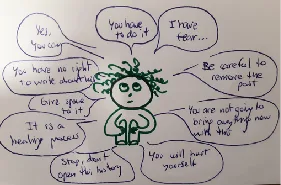
In my life, in my work and concretely in this paper, I have often remembered Arnold Mindell’s sentence with which I begin the chapter. It is something that he said in a class in Portland four years ago and that became imprinted within me. It has served as inspiration in order to bring out my truth, to bring out who I am, and to go out into the world in my fullness, accepting my nature as part of the whole. This sentence helped me understand that it was time to give voice to our pain, to the stories that we have lived through, to each person’s most hidden secrets. Only in this way could encounters between different people construct a world that was less hostile, one that was more sincere, more honest, and more human. It is important to share our internal struggles; in doing so, we see that they are common around you and they relieve the field5. This is part of my activism in the world. As Mindell says “the inner self, the relationships and the world are all aspects of the same community process” (1995). This approach allows me to work on personal problems and also address the political, social and cultural issues that I want to give voice to.
Throughout this writing I have had to reconnect with the meaning of all of this, so as not to be carried away by the fears, edges and questionings that suppose me to expose myself and to expose part of my history.
For me the word pleasure has been a state that has remained largely unexplored, and at times in my past, a word that lacked real meaning. Therefore, I claim the space to pleasure, to jump over the edge of being able to talk freely about it, especially having been socialized as a woman, and connect with the power and force that the word hides.
Julie Diamond begins her book “A Path Made by Walking” with this paragraph that for me gives meaning to my writing:
When life brings painful experiences, or problems overwhelm you, being able to find meaning to the difficulty is liberating. Such transformative experiences often seem magical
Diamond, 2004: pg xi
And with this hope of transformation and with a teleological6 gaze, I embark on this journey of deepening the pilgrimage towards pleasure, with the aim of
going beyond ordinary consciousness7 to discover patterns, tendencies,
shapes and colors hidden behind what is on the surface. The journey transforms what was painful and difficult into the fertilizer that will help bear new fruit; with a fresh vision, it sees and experiences the same things in a new way. Trusting that obstacles, challenges and complex situations offer a true potential for learning, growth and transformation.
With all this begins the journey into the unknown, towards a little inhabited identity, the “flipside” to living in suffering, which for now I define as the face of living in the pleasure”. A journey that perhaps starts as the return to something called home …
Traveling the path of the unfolding process allows you to venture beyond the boundaries of preconceived notions, the family experiences and the ordinary identity and yet feel yourself on the path to your own home. Following the flow of process also involves going with what is happening in a given moment, rather than resisting it. […] It means that when an obstacle or difficulty arises, we face it in order to find out what changes are meant for us in challenge. This is a spiritual attitude that is interested in discovering how our innermost being attunes itself to whatever arises in everyday life and how this prevents us from being victimized by our experiences.
Diamond & Spark Jones, 2004: 18
Mechanical systems have a predictable behavior pattern based on cause- effect, but in complex systems, the theory tells us that we cannot predict everything that is going to happen since there are many parties involved interacting with each other. Open to this challenge, I begin this piece by not knowing what will happen along this process, without being able to predict the results, and taking the idea of following the natural flow of the process, following its signals8 and seeing how the chapters, learnings and feelings evolve while traveling down the river, and letting myself be carried away by its currents and other elements. I get onto a train called “pilgrimage towards pleasure”, ready to travel to new worlds, and with a destination that I do not know clearly today but that I can feel in my heart: that something important brings me this journey and the decisions that go along with it. I know that the trip won’t be easy and it will present edges where I will want to get off the train. But I assume the arrival of difficulties and the confrontation of belief systems9 and internal struggles, because I have the certainty that nothing can be worse than the struggle against life and pleasure, which I lived in one way or another, in the way already traveled. And undertaking this journey to awareness, I try to leave behind the victim of experiences in order to take on a new role10, at least more creative, with more agency, more wholeness and with a broader and less biased view of reality.
It is therefore an important personal decision, a commitment to life, a change of point of view “towards something that I associate with light”, permission to pleasure and freedom, choosing the path of least resistance and swimming in the direction of the current, towards beauty… I venture into pilgrimage towards pleasure… to discover the other side of the coin and integrate it as part of myself, with the aim of moving towards a more complete being and living my life in my wholeness.
Inspired by the need to find meaning in my existence, I take the pleasure as my inspiration for a new direction in life and here begins the adventure…
And I would like to invite you to travel with me, but I already anticipate that for my part, we are going to be throwing all judgments and demands out of the window in order to clear the path…
b) Point of departure: Processwork overview
This project is part of my final stage of Processwork or Process Oriented Psychology studies. This is a paradigm and methodology born from Jungian psychology in the 70s-80s by Arnold Mindell, a Jungian analyst and physicist analyst. Mindell, together with his group of students, investigated the development of the theory and practice of Processwork.
This is a multilevel and multicultural “awareness practice” that supports individuals, relationships and groups in discovering themselves. It has applications in psychotherapy, leadership, coaching, medicine, politics, art and organizational work.
For me, discovering Processwork has been a gift that has breathed life into me. I discovered it at a point in my life where my level of suffering and anguish was making my life a dark, grayish color. And this methodology was like a ray of light from the beyond that could give other tones of color to my life, and provide other perspective on it. These past years have seen a long process of becoming aware, believing in and following my experience, in order to go on discovering myself and opening up to a new, more democratic view of myself, my past and towards the world, expanding my identity with the aim of generating a more friendly and compassionate being than the one I inhabited in my past. Learning at the same time to have a less one-sided and severe view of experiences, and giving my beliefs and experience a better way to address the difficulties encountered.
This paradigm teaches us to believe in the hidden wisdom of the often ignored, disturbing parts of our beings, relationships and environments, the parts that we tend to push aside. And we use different ways of unfolding these experiences to reveal their wisdom, internalizing the different parts and listening to their messages, to promote the integrity of the system.
For many years I felt that there was no place for me, that I did not belong to this planet. Eventually I understood that, within the apparent world, other subworlds or parallel worlds exist where at times I can feel more at home. This helped me to find my place.
Processwork, among other things, has offered me the ability to accept my deepest nature – one that is adventurous and intense – with greater ease, compassion and love. And part of this journey, this project, has to do with the connection with my deepest self and my way back home.
c) My luggage and metaskills
Something crucial for this journey will be the luggage that I take with me. Mainly I take myself, along with my story and all of its colors and shadows, my dreams and fantasies. But there is also something very important to take along, to guarantee the quality of my experience during the journey, in the process of writing, reflection, study and creation. These are the tools, skills and, above all, metaskills11, that I have learned and developed along the way. They help me to travel lighter, more gently and with more love towards myself. Because first and foremost, the most precious object in the suitcase and for this journey is going to be me myself, and this is the opportunity to give me the care I need, and from then on, to generate a transformation.
To this is added the challenge of trying to make this path from and not towards pleasure; or trying to discover to be in it, or open to it. Without pushing me, but giving him space to be, beyond the edges, belief systems and fears.
And before embarking on the journey I want to acknowledge that I start out on it very frightened. I feel that I am putting myself at risk and still I do not know, to this day, how I am going to translate into words what I feel in my guts. But I do feel that I am making a deal with the reader, where I would like both of us to put ourselves at risk. I am willing to take the risk and I am speaking about my story, my past, my vulnerability as a human being, one that feels, and above all as a woman. A woman who is opening up her insides to speak of her pain, her frustration, her struggles, pools of sadness and depression, traumas and abuse, and all that has left its mark. But not only this, but also insides that speak of hope, light and many, so many dreams wanting to be lived out. And because of the intimacy of all of this, in this writing I try to make a commitment, a relationship between my writing and whoever reads it; just thinking that this is the case offers me a vision that is less filled with judgment, and more full of understanding and compassion towards myself, a voice for a better world.
As Brigitte Vassallo said in a lecture: “I write so that my scars stop being only my own” (Barcelona 2018)
Since the writing arises from my intimacy, an important premise is going to be respect and faithful to who I am. This leads to the fact that I do not intend to write in an especially formal, rational or intellectual way, but to explore and have fun in the creative process. It’s going to be a process of learning how to do it, of getting to know my difficulties and abilities, while trying not to get stuck, pigeonhole or over-identify myself in a rigid scheme of who I am, which may come to oppress me.
Considering the importance of method, with the focus on the process and not on the end result, an important skill that I need to cultivate will be compassion. The compassion to myself as a writer. Amy Mindell talks about this meta-skill “as a quality in many spiritual traditions. It is a capacity of special feeling that makes it possible to understand and feel the client’s world” (Amy Mindell, 1995: 66); and in this case, this quality will be especially applicable to how I observe and treat myself. She defines this quality as “nurturing, caring for, and attending to those parts of ourselves that we like and identify with while attending equally and appreciating those parts that we do not like […] Further, compassion involves helping all these parts to unfold and reveal their essential nature and meaning” (Amy Mindell, 1995: 69)
Developing this quality has been crucial for me to be able to work with complex issues of my past, to welcoming difficulties with love and less judgment, and above all not to be overwhelmed by inner critics12 and to be able to set boundaries to them.
Respecting all our inner voices is a deeply democratic attitude towards ourselves, also known in the work with groups as Deep Democracy13. This was a very necessary step in going beyond my primary identity and avoiding letting myself be carried away by the tyrannical forces, which often tend to dominate me and oppress me. In my personal work, deep democracy has meant trying to accept, value and give a balanced power to all my inner voices, diverse emotions, conflicting thoughts and feelings, subtle movements, etc. Trying to discover the important message or contribution that each one has to offer. Applying the philosophy of deep democracy is a difficult job because there are always aspects of the self or of others which I would prefer to simply change or simply get rid of. However, it is important and necessary to integrate and explore the different parts that will emerge as parts of the whole; trying to develop an inner elder14 or facilitator that can simultaneously hold and honor the diversity of perspectives in order to welcome what is emerging, without judgment.
This facilitator figure will often have to mediate and dialogue between the parts. It will be very useful to give her own space to appreciate the different voices and be able to accompany the process in its entirety, from a more detached and less involved perspective, one that is less immersed in the drama of life.
An important contribution of Processwork is this openness to accepting rejected and rather secondary experiences15, “the numinous and inexplicable elements of life that are the potential seeds of new life and creativity” (Amy Mindell, 1995: 57), which can offer us a more complete experience of reality.
The “beginner’s mind” is another important meta-skill to welcome what might emerge along the path. It is a Zen attitude, “a mind – or perhaps heart – that is open and unbiased […] allows us to appreciate and notice seemingly inconsequential events” (Amy Mindell: 82). It offers me to have a freer and more impartial look, one that is less attached and more spontaneous, so that I
can explore the secondary process16 without attaching myself to already
established labels. This skill is useful to me, together with curiosity, in order to discover new aspects or new ways of looking at facts and feelings, and allowing myself to explore each experience as unique.
Before starting to write, a clear premise was that I needed to include art and creativity in order to develop this process, because it is from there that I have often felt my life healing, making it more beautiful and full. And I feel that this has a lot to do with my experience of pleasure and with giving myself permission to dedicate my time to create and enjoy art, something which is a great challenge for my critics.
The creative mind “allows you to join to what you are experiencing, become it and actually create with it. You are no longer a passive observer, but a living, creative force in nature itself” (Amy Mindell: 135). It is in these moments of creativity where I feel free with the energy of the play and detachment, as if I were an innocent child with no prejudices. These are moments where freedom and excitement about life blossoms, and where something new appears beyond my ordinary identity and my awareness, as a bridge to other worlds. Sometimes these are instants that connect me with the very essence, with something beyond the explainable.
And with all these elements important for the care of the process, taking the magic of alchemy, I put them in a pot to be cooked with the hope that it will come out something like gold or something similar in its essence.
And before closing the suitcase, I do not forget to invite my critic on my journey. But this time, I invite him as great ally, to help me pinpoint details and issues that without him could go unnoticed. But, above all, I do so by negotiating the space he occupies and by carefully redefining the nature of my relationship with these more critical voices.
d) Where everything begins
“Death drives my journey”
More than a year ago, after decades of deep suffering, years of constantly battling my tendency towards depression and after an intensive search to try and understand my existence, I repeated to myself for the umpteenth time: I need to change my life. But this time it is not about “changing my life”, but about a change of looking at and feeling about my life.
At several points in my life, death was knocking at the door, or rather, I was the one who knocked at her door, to try and find a way out of the anguish I was experiencing. I needed to be on the edge of life in order to love it, value it and wish to inhabit it. I needed a final hard knock in order to make the decision to choose to be on the side of life, of light, of saying yes, of abundance…, what I could now call the side of pleasure.
Everything began towards the end of my studies when I had to choose the subject for my dissertation. Women’s sexuality, pleasure and freedom were topics that had fascinated me for years. They were topics that were often present in my conversations, concerns and they even marked part of my great personal struggles. At that moment, a strong emotional rupture took place and, on that same day, my body breaks. That brought with it a series of difficult circumstances that led, yet again, to deep depression, but this time also to a will to clear the path ahead of me.
Because of a serious accident, I had to have an operation. To be operated under anesthesia marks a before and an after in my history. It can be difficult to understand what is the fear of going into surgery for a simple operation like this. But for people who carry a history of abuse in their bodies, giving up the body to be operated on under anesthesia and without control of the body itself can be frightening. It was an important moment of surrender, where I could only trust that my body would be treated with respect. It was an important turning point: I could only hope and trust that my body would be treated with respect. This time, someone else other than me would have to be being highly vigilant, and I would happen to occupy another, less familiar role, which was the one of trust and surrender… After the operation, I had to spend weeks in a wheelchair, and for the first time in my life I experienced stillness and physical immobility, which brought a clear vision to me about my innate moving nature. I had many days to think and reflect, and I realized that one thing was certain: the day I would walk again, I would have to walk a new path, navigate new routes. I was not going to wander along the familiar paths of depression and dark places again and again. It was time to leave behind my role of victim, time to take on the stance of the survivor, in order to redefine myself and believe that I could get rid of my old identity, one that was no longer useful to me. Seen as a process, this put conflicting elements together: a part that realized it could not control things and another part that moved forward and empowered itself in order to travel along a different path. I realized that this has a lot to do with embodying the experience of being immobile!
Those were difficult months but my decision was taken: it was time to take a new path.
During this time I begin to become aware of how I had spent many years in a place where my life was shrouded in darkness, and how pleasure had been absent in my life. So I took the word pleasure as an element to research and I ventured out to discover what it was like to inhabit pleasure, to name it, feel it and even allow myself to enjoy it. And so began my new role.
Shortly after starting this adventure, I had the opportunity to go to Indonesia and take a journey that I call my “journey of pleasure”. I made this journey a challenge to myself, because my belief system was trying to boycott the adventure and to belittle the idea of traveling with the sole objective of finding pleasure. Even with the internal struggles posed by this challenge, and not quite knowing if I was going to be able to sustain that kind of trip, I took my backpack and set out to learn how to just enjoy the moment. And I did so for days, confronting my critics and not finding full satisfaction, but being able to not wallow in suffering. It was a complex search and it provoked many uncomfortable feelings, but I tackled them with no suffering. Nothing seemed too amazing and I was kind of frozen up inside, but I just let myself be and did not ask too much of myself.
And suddenly, a day arrived when things in my life took a sharp turn…
It was a beautiful sunny day. A new friend and I were touring a small island and the inhabitants were giving us bright friendly smiles when they exchanged our glances. It was fascinating what the locals woke up in me, I felt full of gratitude. And between smile and smile, the night began to fall on that tiny magical island; from that experience I wrote this letter:
Written on the return trip:
How facts change when they are expressed in the first person or the third person … yesterday, I was living what would be the most panicky day of my life until now. And I have experienced some terrible fear in my life. But yesterday, impotence and surrender took place in their maximum expression.
The night was falling. Elena and I were going out to have something to eat after a long, lovely day. Our expectations were simple: to be surrounded by and to soak up the energy of the place and its inhabitants. There are simple things that make life undoubtedly more beautiful, and this time it was those people.
We were talking with the women whose home we were staying in. I started to get impatient because I wanted to go and have dinner. But Elena was prolonging the conversation. Looking back, I can now understand how nothing is a coincidence and what the meaning of the sequence of events was.
Suddenly, the women began to look very odd, moving uncontrollably through space while holding onto each other. They were screaming and their faces were panicked. I soon understood what was happening. An earthquake was beginning to shake the earth we were treading. Never before had I imagined going through what we went through that night. It seemed that the earth was being shaken up in order to wake her up from a nightmare. An extremely anguishing nightmare that lasted hours.
We did not understand the language of the locals but we did understand the language of the Earth. Shortly after all the shaking, all was still and everything apparently went back to normal. A normality that bothered me deeply, as if nothing had happened. But the nightmare had just begun.
We tried to follow this apparent return to normality and continue with the plan of going out for dinner, but after a while, the restlessness in our bodies made us return home with empty stomachs. And the moment we stepped into the house, the most absolute panic began. An aftershock, followed by agonizing screams, sirens, people running everywhere, blue emergency lights… The only word we understood was Tsunami.
Terrified, I climbed onto the back of the motorcycle of a woman who was shouting out to me that we had to run for it. On the road, people ran desperately looking for higher ground, on an island that barely had any. The word humanity was taking shape. That woman could have left us there but she did not. I remember her words praying to “Allah” and telling me that she was so sorry that we were living through that. I squeezed her very hard around the waist and in tears, kept repeating: “thank you, thank you for helping me”.
My terrified body was trembling, and it trembled through the long hours of waiting. We were on the road for hours, sharing looks with the locals, who were shedding tears of farewell, fearing that the worst was to come. In my head I replayed all those shocking images from distant places that we had watched years ago on the news, about a tsunami that killed thousands of people. But now that distant thing was no longer distant, but something I was living in my own skin.
It was the longest wait of my life. Each and every one of the important people in my life passed through my heart to mentally say goodbye to them. As I was carrying my phone with me, I wrote a message to my brother: one of those conversations you have before someone leaves forever. And later I did the same with my parents. It was a really hard moment, one where a connexion takes place in some other place, a place where the deepest pain is no longer there. On both sides we knew that this could be the last time that we would hear each others’ voices. Surprisingly, there was an extreme calm that I would never have imagined experiencing in such a situation. In a place such as this, there is no space for struggle, it is a kind of resolution. There are instants where you touch what is called essence17, where only a place for love remains, and the whole system is put back into order.
During the long waiting hours that dark night, the earthquake inhabited my body, trembling just as when an epileptic fit comes to take me. But my awareness was clearer than ever. There was an instant, sitting on the edge of the road where we waited for the thing that had to happen, that my body suddenly became still, surrendering. I vaguely remember the feeling. Suddenly I was talking to someone or something beyond, maybe Earth, maybe God… I never knew what it was. I asked it for a second chance. I declared that I had lived for a long time in darkness, lacking pleasure, depressed, and now I was trying to connect with beauty, to learn to appreciate it and learning to see the light in life. I promised that if I survived, I would live in pleasure and go towards my dreams without any further excuses. These were moments of absolute peace where, after my promise, I gave myself to whatever happened, leaving nature to decide for me.
I had gone on a pleasure trip, with the sole goal of learning to live in a way that was more tied to pleasure. Being able to inhabit pleasure is a task that for many may seem easy but for me it meant a whole new discovery and challenge. And strangely, from that pleasure came the worst nightmare I could have lived through, to feel that this time it would not be me who decided to live or to die, but that nature would decide for me.
And before I continue, I have to say that whereas I am here narrating my own experience, many others did not survive the earthquake.
From that experience and from the promise I made, I came up with a lot of strength to choose life over death, to make a firmer commitment to break with certain trends. Today, some time later, despite living the terror and agony of those long hours of waiting, I am fully grateful for what nature taught me. That night, death came to me to connect me with life, and it was not the first time I received his visit, but this time when he appeared, the option of choosing him was out of the question, a decision not to be taken even in the greatest agony. Now, over time, I can see how during that night of extreme anguish, although it seems paradoxical, there was a small feeling of relief, a feeling that all I could do was wait, that it was all out of my hands, that there was no longer a fight. At that moment, my identity as a warrior and fighter was canceled. Yes, it was a sense of relief, longed for many times in my story where death was imagined as the path to surrender, to giving up the struggle, as a rest from so much suffering… But that night, at the moment when I most wanted to live, there was a feeling of freedom, of detachment, of putting myself in the hands of life. Maybe that had something to do with pleasure?
Taking this experience where death comes as a life counselor in synchronicities18:
Ancient and shamanic teachings speak of acquiring wisdom from synchronicities, that is, listening to the environment. Taking the unusual external events seriously and believing even in your own lies, you approach your personal myths. If you do not, death itself has to upset your idea of who you are and force you at gunpoint, so to speak, to surrender and follow natural events.
Mindell, 2017: 14
This experience led me to give this paper the name “the pilgrimage towards pleasure”, with its main focus being pleasure in life.
3. On the path to the pleasure
a) Brief historical tour
Pleasure can be an abstract and diffuse theoretical concept since it has to do with the subjectivity of each person, since it is based on an individual’s senses and experience. But when we talk about pleasure, we do have a social image, a certain idea or experience of what is pleasure. In this chapter I’ll try to talk about what we could agree pleasure is. And I’ll start by taking the Wikipedia definition, which talks about pleasure being related to satisfying a need.
Pleasure can be defined as a positive, nice or euphoric sensation or feeling, which in its natural form manifests itself when a conscious individual fully satisfies some need: drink, in the case of thirst; food, in the case of hunger; rest (sleep), for fatigue; sex for the libido; fun (entertainment), for boredom; and knowledges (scientific or non-scientific) or culture (different types of art) for ignorance, curiosity and the need to develop capacities. Nature usually associates the sensation of pleasure with some benefit for the species and Philosophy classifies it among the possible types of happiness
https:// es.wikipedia.org/wiki/Placer , 07.05.2019
If we look at the etymology of the word, according to the Dictionary of the Royal Academy of the Spanish Language, the word “pleasure” comes from the Latin placere (to please or to give pleasure). 2. m. Physical or spiritual joy or enjoyment produced by the doing or perception of something that likes or is considered good.
In order to talk about pleasure, I need to travel through time, since the concept has been understood in different ways according to different sociocultural contexts and in different ages. Keeping in mind that this is not an objective quantitative research project, but rather a heuristic project, I will let myself make leaps in history. I will outline how different authors who have dealt with this concept might have defined it.
In order to begin this panoramic vision I am interested in starting from Greek culture, since it is a culture that has had great influence on Western thought, and is a culture that was developed around pleasure.
Greek mythology is full of gods and goddesses, demigods, heroes and heroines, all motivated by many sexual encounters and infidelities. These models and references were imitated by society. These mythological characters’ behavior was inspired by pleasure, creating a social acceptance of it. But it is important not to forget that this experience or conception of pleasure took place in the upper classes, and so was a privilege that belonged only to a few.
In the work of Plato and the Sophists we see pleasure as key. They present pleasure as something that is ethically good, they defend cultivating pleasure, protecting it and even normalizing it.
In Greek culture, after the sophists came Epicure and the hedonists. The Epicureans aimed to achieve the absence of pain, with the individual renouncing everything that causes pain and suffering. For the Epicureans, the key to fulfillment had to do with the intelligent administration of pleasure and pain, cultivating ataraxia (the absence of disturbances of the soul), while knowing that the excess of pleasure could lead to pain.
The word “Hedonism” is formed from the root hedoné meaning “pleasure” and the suffix -ism that expresses “doctrine”. Therefore, “hedonism is a philosophical doctrine that places the pleasure as the supreme good of human life.” (Wikipedia) But at the same time, the pleasure principle must be controlled in order to develop a non-neurotic mind.
Until the middle of the 20th century, philosophers discussed the nature of pleasure by focusing their interest on hedonism. (Oxford Encyclopedia of Philosophy 1995: 834).
We can not ignore how these philosophical currents became conditioned by the rise of Christianity. This evokes an omnipresent God, who observes everything, creates guilt, and introduces the concept of sin, of the forbidden, and of punishment. Initially, Christianity was based on Greek philosophy, and valued the spirit above the body. And it was not until later that the Christian vision of sex was radically reformed: with the temptation of Adam in paradise, “accepting Eve’s proposal”, sexual desire is associated for the first time with the origins of sin. That is the moment when human sexuality is conceived for the sole purpose of procreation and within marriage. This association between sex and sin has governed the Christian sexual doctrine for more than a thousand years, and even now we live under these mandates that frame the collective and social unconscious. Paraphrased from (https:// www.nuevatribuna.es/articulo/historia/sexualidad-mundo-cristiano/ 20170918123834143458.html)
Please allow me to now take a historical leap. With Humanism and the arrival of Modernity, science became very important, and the concept of pleasure was conditioned, as Schopenhauer, Marx, Freud and all the so-called Philosophers of “the school of suspicion” say, by the appearance of capitalism and liberal societies. These philosophers are described as such because of their questioning of the foundations of Western philosophy, and especially the role of reason. For Freud, reason is only a part of the mind, and is very small compared to the unconscious. He formulated the idea of the “pleasure principle” as opposed to the “pain principle”, suggesting that from when we are born, human beings tend to instinctively seek pleasure.
The Pleasure’s Principle is one of the two principles that, according to Freud, govern mental functioning: the whole of psychic activity is intended to avoid displeasure and to seek pleasure. Since displeasure is linked to the increase of the amounts of excitement, and pleasure to the decrease of them, the pleasure principle constitutes an economic principle.
Wikipedia, 12.09.2019
From Jung’s perspective, this psychic energy would also be the starting point that allows people to seek pleasure and reduce conflict in various circumstances.
And it seems that all these philosophical and psychological visions of pleasure are not just suppositions, but that there is also a scientific explanation for it, which demonstrates that the brain is designed to seek pleasure. Normally, doing something pleasant causes neurons to release the chemical dopamine. This release causes a sensation of feeling good and evokes the desire to repeat an action over and over again.
With the emergence of liberal and post-modern societies, pleasure became something more ephemeral, linked to the desire for consumption and to capitalism, this being not only economic but also cultural capitalism, in which each is person a small business in which to invest so that one can constantly be up to date, informed, in shape… Being happy seems a kind of obligation, and the prevailing values become success, social recognition and constant well-being…On the other hand, sadness, anguish, vulnerability, pain and displeasure are rejected and set aside, invisible and even considered as part of an illness. Being happy appears to warrant going to all kinds of lengths and conversely creates a burden of fear and guilt if one feels sad. It seems that some states are more socially acceptable than others, determining certain attitudes and behaviors. As we can see happening now on social networks, this lifestyle makes us slaves to this so-called happiness.
Based on all this information from history and science we could say that pleasure is something to achieve in order to attain success. However, at the same time it has to be controlled because it seems potentially dangerous.
I find it interesting how the idea of pleasure has been changing throughout history and how it has been constantly transforming to this day. We could say that pleasure has to be contextualized, insofar as it is always situated in a socioeconomic and historical context. Therefore I will talk about and reflect on pleasure based on my own cultural context, environment, experiences, and life and past.
It is hard for me to come up with a clear or concrete definition of pleasure, one with which I could feel comfortable. But doing research into the subject and having a brief historical notion of the evolution of the concept has opened me up to new ways of thinking and different points of view. I do realize that talking about pleasure is like talking about how we work at a social level in relation to our freedoms, managing our needs, connecting with our own essence and with our bodies… And the historical context also reminds me of the myriad issues encompassed in the term “pleasure”.
b) Health and pleasure: roles and forces within the capitalist framework
Our dominant social system tries to hide pain and conflict […] The democratic world is addicted to peace and harmony; most people use their rank19 and privileges to avoid conflict. The media focuses on individuals with conflicts of interest, but the system prevents large groups of people from coming together to work on their common issues.
Mindell, 1995: 193
As Mindell says, as a society we avoid all disturbances, whether these be conflicts in relationships or anything that can be bothersome to the body and takes us away from well-being.
If we study this invitation to marginalize pain and to avoid everything that does not lead to wellbeing, the aim of some philosophers such as the Epicureans, we can observe clear legacies in the management and avoidance of pain and illness. If the symptoms are alarm signals sent by the body, the majority social pattern is that of masking these symptoms so that the disturbance disappears. There is no interest in the message that it can bring to the body and to those symptoms, the primary objective is to get away from anything that generates discomfort or unrest at a physical or mental level. This promotion of non-suffering leads us to overmedicate ourselves to mask the symptoms, and this is also compounded by the need to pathologize everything that can go beyond the strictly normative, with a fixation on the duality of health and illness.
In the book “Health in sickness – Sickness in health” (2014), Pierre Morin offers an antidote to this hyper-medicalized and pathological society. It offers us a new look into the classic concept of health: a broader, less biased and less oppressive view of our experience. Morrin explains how our vision of health has reduced our general wellbeing by separating experience and illness from the context of each person’s relational life; by marginalizing and disempowering those who are different or cannot be cured; and above all, by separating us from the meaning of the symptoms and the enormous wisdom they bring to the person’s development process.
The body symptoms are not necessarily pathological, that is, they are not simply a disease that must be repressed, cured or from which one must recover. Symptoms are potentially significant and meaningful states
Mindell, 2006: 11
Morin differentiates two ways of looking at health: the one we already know and which he defines as “small health”, focused on the imbalances of mechanical aspects (blood pressure, cholesterol, sugar levels…), understanding the body like a machine that sometimes breaks down; and “big health”, a term introduced by the philosopher Nietzsche, which offers a new look where “small health” is included but where another dimension of meaning and purpose is added. He tells us how the body dreams and how, through listening and following its signals, it reveals deep truths about what it means to be human and what it means to be well. (https:// www.youtube.com/watch?v=2FD5_qFRcpY)
Our mainstream culture view on health excludes many people by thinking they are not healthy. When we marginalize certain aspects of health, we put people in a position of being belittled, create less well-being and more stress, and above all miss out on great potential, strength and power as a community by making ourselves conform to the norm.
Processwork talks about “rainbow medicine”. This is a paradigm that takes notice of labels, since they give us information about what is really happening. But the subjective experience of the person and his symptoms are given just as much importance, since it is understood that there is an energy that wants to be expressed through the body. By validating the experience and letting it be expressed, the symptoms may or may not be relieved, but in any case it becomes a channel20 of information and awareness. From this perspective, the symptoms bring out an energy that does not disappear no matter how much we medicate it. This energy has an important message to give us. If it cannot manifest itself through the body, it will look for other channels. Is a teleological vision, in which we are interested in the “what for”: the message hidden in what happens to us.
Rainbow medicine includes the real time and space of physical reality, as well as dream levels of the body’s psychological reality. It includes components of classical medicine such as anatomy, diagnosis, medication, surgery, biophysics, etc., as well as alternative medical procedures that involve subjective experience, dream patterns and all levels of
Morin and Reiss, 2010: 24
consciousness21
In Processwork we do not need objective tests to validate experiences; instead, we are interested in the subjectivity of the experience. And we understand that the body is not something mechanical but is an instrument that changes its tones by itself and can only be understood within a process.
b.1) Depression and stress: enemies of pleasure
It is important to mention that pleasure has a quantifiable effect on human health, since it is one of the ways to combat stress and depression, two of the ills of capitalist society.
In order to talk about pleasure, I find it important to talk about depression and health in the current society we inhabit. If we go to the etymological root of the concept of depression, we will see that it comes from the Latin term depressio which means oppression, shrinkage or despondency. (https://es.wikipedia.org/wiki/Depresión)
Each era is marked by certain diseases according to its sociopolitical context. The philosopher Byung-Chul Han, in his book on the society of tiredness (2012), writes that while in the past health narratives centered around viral and bacterial issues, in the 21st century, mental health is what has taken center stage with diseases such as depression, Attention Deficit Hyperactivity Disorder, Borderline Personality Disorder or Occupational Burnout Syndrome. If in the past there was a difference between the inside and the outside, where the bacteria represented the enemy, now the enemy lives within us. We are being attacked by ourselves, with our unrealistic demands on ourselves which sometimes even lead to us exploiting ourselves, from a false feeling of feeling free. And he talks about a false feeling because we believe that, since the demands or coercion comes from outside, we are free, but this is not really the case. And according to Byung-Chul Han, these diseases are due to the freedom of action and excess of stimuli. He talks about the violence or excess of Positivity, understood as the excess of communication, overproduction, work, leisure or sexual super-performance… an excess that causes the individual to fall apart in the face of so much excess. In the past, violence came from distant or strange places, and now it comes from the multiple options and activities that the system offers us, creating asphyxia, saturation and exhaustion.
Depression is the disease of a society that suffers under the excess of positivity. It reflects that kind of humanity that directs the war against itself.
Han, 2012
Han talks about depression as a representative disease of today’s society, and how it is caused by performance anxiety (a process which I feel affected by to a certain extent when writing this piece, and sometimes generally in my life). There is now a system of beliefs that declares that anything can be achieved with enough effort, fueling demands on the self. This is a system that generates victims and executioners at the same time: we enslave ourselves in the pursuit of fulfilment or of (resources for) consumption, leaving aside reflection and boredom.
Lament of the depressive individual, <<Nothing is possible>>, can only manifest itself within a society that believes that <<Nothing is impossible>>
Han, 2012: 31
Han says that “The depression is unleashed at the moment that the subject of performance can no longer be able to do more” (2012: 31). This suggests that depression could enter as a secondary process that appears as an escape route away from an unsustainable situation. A situation where we are not able to set limits to our own and the system’s demands, either in the name of self- fulfilment or as a result of the capitalist system and consumer society. Depressive states tend to appear due to some long-term oppression, and we could say that they arise as allies with a message to help us in our process of completeness.
Nowadays, depression is a widespread phenomenon that can happen to anyone. It can rear its head in transitional moments of your life, when you go through structural or emotional changes caused by certain events. And as a society, we tend to oppress, marginalize and avoid working on it because it disturbs us In Europe, psychiatry, and therefore mental health, is currently governed by a diagnostic manual, DSM-5, which classifies disorders and mental illnesses. The vast majority of human beings could be diagnosed at some point in our lives with many of the diagnostic categories of the DSM. We live in a society that labels and pathologizes; it defines how we should be feeling, categorizing us between the poles of good-bad, normal-pathological, and therefore also those of pleasure-displeasure.
This categorical view of allopathic medicine somehow tells us that there is a problem in the mental health field. When we are given a diagnosis or a label, this can generate fear, while in some cases it may also be a relief. The problem is that often the “solution” that arises is chemical and that does not stop being a partial solution to a wider problem. An important thing that Processwork offers is to be able to work in these different dimensions.
Processwork teaches us that depressions are internally marginalized states that are part of the myth of our life. They are parts of us and if we do not welcome them, they become a life or death matter. They are like a recurring dream.
Clinically, there are different levels and types of depression: these are categories that can help us understand each case to some extent; however, the interesting thing is to be able to unfold the symptoms, the subjective depression that each one of us lives through.
Processwork looks at these states in a measured way, accepting that they exist and that we are negotiating with them, and also that they are processes that need to be unfolded individually, but also at the global level.
And this overload of how we should be, this being excessively demanding of oneself, not only results in depression, but also in stress, generating a state of mental fatigue that often leads to various physical and mental disorders.
We live in a paradox and in a constant moral contradiction in relation to pleasure, where the capitalist system acts trying to get people to seek pleasure and happiness through consumption. This consumption generates an excess of both material and figurative needs. At the same time, we hardly have time for pleasure and for the enjoyment of these needs, within a precarious labour and economic system, for a large part of the population. As we saw in Ancient Greece, here influence issues of Social Rank22 in relation to the management of pleasure and especially leisure. Somehow, I feel privileged to be able to devote my time exploring this subject, thanks to having my basic needs covered.
I think we all need to learn more about pleasure. I would dare to say that pleasure in everyday life is currently “absent”, “disappeared” or “poorly managed”, for a large part of society. An example of this is the large number of people who have addictions, where both substances and behaviors are used as the only way to find pleasure, to access parts of ourselves that are unknown or that we have not learned how to access without addiction.
However, pleasure is a term that seems to be on many people’s lips, it is still a great cultural edge to this day.
c) Pleasure and connection with nature, is also our internal dual
nature
When people see some things as beautiful,
other things become ugly.
When people see some things as good,
other things become bad.

Being and non-being create each other.
Difficult and easy support each other.
Long and short define each other.
High and low depend on each other.
Before and after follow each other.

Therefore the Master
acts without doing anything
and teaches without saying anything.

Lao Tsu, Tao Te Ching translation by Stephen Mitchell
Let me now talk about an author who has inspired me in my reflections about pleasure, health and the management we make of our life and our resources. This time the author is from an eastern culture, Satish Kumar. He brings a vision which is focused on the importance of the connection with ourselves, with our beings and with nature. In his book “Elegant simplicity: the art of living well” (2018), he talks about fulfillment, satisfaction, and even pleasure, all in relation to nature. He theorizes how nomadic societies, as they began to have settlements, lost the connection with nature. This was exacerbated when the industrial revolution arrived, and a large part of the population stopped having time for themselves, leaving no space for spiritual development. We began to overexploit nature, the earth, and its resources. Our connection and balance with the natural world was lost, and quantity began to take precedence over quality.
The world has enough for everyone’s need, but not enough for everyone’s greed23
Mahatma Gandhi
It is clear to me that if we destroy nature we are destroying ourselves, because we are nature. Satish reminds us that human comes from the Latin humus, which means beings of the earth. Everything we eat is transformed and reintegrated to the earth. Everything is inspired by nature, and despite that, we have disconnected from nature, and from cycles, from the rhythm of processes. And too many demands on ourselves, too much pressure for attaining success, the accelerated speed of technology and our quest for perfection disconnect us from who we really are, how we feel, what we experience, and consequently also disconnects us from pleasure as well.
The times of the process are not the times of the capitalist world
Brigitte Vasallo24
If we take the two great currents of traditional Chinese thought, Confucianism and Taoism, both are based on trust in the natural world and human nature.
Nature, for the oriental world, is what emerges from within; it is a process that is completely out of our control. Nature is by definition, is what operates spontaneously, like breathing or the heartbeat. And Taoist philosophy insists on the importance of relying on what happens by itself
Watts, 2010: 27
These currents tell us to follow the flow of things, trusting that things will take care of themselves. But we want to control nature, to dominate it, both internal (how we feel and live) and external, exploiting them to get a better performance, but forgetting to listen to it and connect with its essence.
Taoism, an ancient philosophy that originated in China more than 3000 years ago, from which Processwork is nourished. They both develop the idea of perceiving nature and connecting with it, identifying and naming its laws through Yin and Yang, and by exploring life and its polarities represented by this symbol.
From Taoism there are two aspects I find relevant in reference to pleasure: the quality of fluidity and the dual vision.
Taoism has as its basis the concept of Tao: “the way”. This talks about following the flow of things, traveling along the current and not struggling against it, and the quality of “Wu Wei”.
<<Tao is always inactive but there is nothing that is not being done>> The first Taoist principle is to not oppose the laws and rhythms of the universe. By creating an effortless conduct the Wu Wei will be achieved. This term literally means non-action […] or it can also be translated as “without exertion”
Muñoz, 2001:17
This quality reminds me of the ability to listen to signals, to stop and observe in which direction the path of least resistance is. To pay attention to where the natural course of the process is going and following the flow; instead of struggling and pushing things to go in a certain direction or responding to specific expectations. I frequently find myself in this struggle in my quest for pleasure: I have trouble connecting with the present or just being still.
The Yin Yang symbol denotes two polarities and how they flow from one to the other. The white part starts off small and becomes bigger and that is where the black part emerges; this is the flow of Tao. One is more creative (Yang), and in Process Oriented Psychology is related with secondary aspects, and the other one is more receptive (Ying), and is related to the primary process. Yin Yang also shows that when a force is fully expressed, the other one will emerge naturally and spontaneously. Both parts are necessary for the sum.
Tao can also be understood by accepting that in the reality of phenomena there are always complementary poles […] In the world that we live in,an idealism usually prevails that tries to obtain the first element (good, beautiful, …) and be free from the complementary (ugly, bad,..)
Muñoz, 2001: 19
For Taoists this is unthinkable, because one element cannot exist without the other,
The polarity concept is based on the principle that positive and negative, north and south, are different aspects of a single system, and the absence of one of them would mean the disappearance of the entire system.
Muñoz, 2001:19
Without rest there is no movement, there is no day without night, no darkness without light. They are all necessary in their measure. This reminds me that learning to live in pleasure does not mean that pain, discomfort and sadness are avoidable. Instead, one should be conscious that it is all part of wholeness. This is how I have a better understanding of my connection to pleasure. It is not about choosing one side of the story, but living every experience on its own and realizing that they all are part of something bigger. When we define or even think about something, we tend to compare it to other things, and with comparison comes division. That way, we cannot see the whole picture. And this connects me with the holistic concept, the idea that natural systems and their properties should be viewed as wholes, not as loose collections of parts.
When I started exploring the concept of pleasure, I understood it as something related to joy, delight, bliss and expansion. As something completely alien from anything that would perturb these qualities. In the search for pleasure I wanted to free myself from anything that I thought was opposite to it. I put pleasure on an altar as though it were a God, something to attain and keep safe. But now I realize that grabbing onto something such as pleasure or pain is equally absurd: the nature of the world is procedural, nothing is static beyond the states and momentary images, which create the process in itself.
Free from desire, you realize the mystery. Caught in desire, you see only the manifestations
Tao Te Ching, chapter 1, translation by Stephen Mitchell
Perhaps the quest for pleasure cannot be reached if I am trapped in the quest itself. Maybe it is not about looking for anything, but rather being centered on oneself.
4. My look at pleasure from the Processwork lens
If I try to look at pleasure from the perspective of Processwork, I understand it as “a space in which to project and dream”. From this perspective, we hear pleasure but we do not know what it is; we can see it as a dream process. We do not have a concrete meaning for the word since it is a subjective experience for each individual. We do not have a normative approach in terms of what is healthy or unhealthy, right or wrong, good or bad. From this paradigm we “follow experience instead of keeping up with any culturally determined standard” (Mindell, 2006, p.6). Therefore there is no preconceived idea about what our experiences of pleasure should be; all we can do is unfold each of them. We are interested in unfolding a subjective sensory experience instead of pathologizing, offering a framework of experimentation and not judgment, which facilitates the unfolding and flow of the process.
This basic non-pathological vision that emphasizes self-discovery and considers that solutions are inherent in problems, is what inspires this work. Turning shit into manure, where everything that disturbs us and we want to discard can be useful and necessary, instead of depressing and pathological. That is why part of my approach to pleasure starts from working on chronic symptoms, disturbances or significant events in my life, in search for answers or learning in all of it.
From a Processwork perspective, we say that we communicate and understand information and signals through four basic channels: proprioceptive, visual, kinesthetic and auditory. And two complex channels: relationship and world. Some channels are more primary for some people than for others. Pleasure is a subjective experience: it will tend to be experienced through different channels for each individual. In my case, the channels through which I access pleasure more easily are the proprioceptive and kinesthetic channels (through movement).
Talking about pleasure can be a “pleasant” experience, but pleasure can also be difficult to talk about, generating shame and even becoming a taboo subject in many contexts or for many people. It can also be connected to painful experiences, and even experiences of abuse. In my case, because of my belief systems, my investigation into pleasure has not been an easy process to make public. As I continued to share my reflections about pleasure, and found a more democratic vision to do so, it became easier to share my views, despite the cultural edge around this issue.
In order to be deeply democratic with a client, a relationship, a group, a situation, an experience, or with myself, in this case, one needs to develop an awareness of the multiple dimensions of the experience. This has been one of the keys of my evolution in feeling or understanding pleasure, amplifying my awareness through different forms of attention: first attention (a consensus of reality), second attention (the land of dreams) and third attention (essence). This is an idea of shamanism that Castaneda recounts in his books and Mindell also takes on, an understanding that life happens in all three dimensions at once. And if life happens in these three dimensions or parallel worlds at the same time, this is also true for pleasure.
My view of pleasure has evolved as I progressed on this journey, and it has been precisely in relation to the incorporation of this multidimensional viewpoint. Initially, when I started to work on this topic, my view of pleasure was very limited and biased, seeing it very much in relation to the consensual, without really connecting it other dimensions.
If I look at it through the different dimensions, the definition of pleasure that I have previously accepted fits into society’s consensus of reality. It would be those measurable, observable, visible experiences in relation to the satisfaction of needs with food, sex, beauty, relationships…, the enjoyment of all these actions related to the senses.
But from dreamland reality comes a more subjective level of reality. My experience is different, and it is different for each one of us. The challenge here is to accept my experience as valid, true and authentic, even if it is not shared by others. It is in this dimension that the polarities of pleasure appear, these could be displeasure, disgust, suffering… or however each one of us perceives them. Roles or dream figures belonging to culture, education, biography, history, family and religion also appear here, and they have their own idea of what pleasure is, and what is appropriate or acceptable or not. These are figures that influence the field, like invisible forces that make sense of our experience, with some or others being more or less close to our awareness.
Finally we find the essential or pre-emergent reality, and here pleasure stops being polarized, the struggle to go beyond the parts ceases to exist, and there is a movement towards the whole coming together. It is something that goes beyond words. A fleeting sensation or experience of connection with something larger. And it is from here, from this totality, that I can welcome or approach pleasure by detaching myself from belief systems, critical voices and identities, in order to just feel the present moment.
Moving from consensual reality to other dimensions has given me a feeling of relief and of freedom, and has allowed me to take a new look at what pleasure means: a sweeter look, more of my own and partly more connected to my truth. All this has mitigated the critical voices and belief systems that led me to undertake this investigation; those had constantly been repeating to me that << I did not know how to connect to pleasure>>. And it is from the essence, from love and compassion, that I have been able to listen to all the parts and experiences and help them come together.
In this way, I now understand pleasure from different dimensions and from a transrational approach, where obstacles are in the consensual reality or land of dreams, battling with our rationality, with facts, voices, belief systems and even with our bodily sensations, dreams and visions. All these dimensions are necessary; being aware of the different levels means that we can go back and forth between them. The important thing is not to get stuck in one of the dimensions, but to be able to move fluidly between them.
It has been an interesting and exquisite challenge to take this approach that goes beyond the rational and known, within a (western) culture that prioritizes and values the consensual. By doing so, I have somehow become closer to myself, to the feeling of being home, and developing a deeper connection with myself.
5. My relationship with pleasure
I would never have said that today my journey would take the path of pleasure as a process to be lived out, explored or discovered. I would never have imagined that I would be dedicating so many hours of my life to researching it and becoming more aware of what had been unknown to me for so many years. All these things had remained hidden, but somehow it had always been there, even though it was under blankets in a dusty attic.
I remember saying as a young girl that I never thought I could live in fullness, in so-called happiness, because it was such an unknown place that I was afraid of not being able to hold myself there in this state. I remember a recurring phrase in my family system: “you have to be productive in this life in order to be somebody”. And I recall some of my own beliefs: “I have no right to feel pleasure, I did not come to this life to feel pleasure: my natural state is one of suffering. I do not know how to feel pleasure or how to live in pleasure, so I run away from it.”
Each and every one of these belief systems or voices reinforced the thought that pleasure was not something that was part of my reality, of my experience. On top of that, my experiences of sexual abuse put pleasure in a place of danger and pain.
In this part of my life, I am opening myself up to pleasure, searching for new patterns, trying to unfold this process. And I call it a process precisely because understanding it as such has been a great discovery, and has offered me a change of perspective or perception. Mindell defines the term Process as “changes in perception” and the variation of signals experienced by an observer. He explains that the Process is like a special train whose destination cannot always be predicted. The observer follows the signals in their real life or in his fantasies, until life is revealed in front of them. (1995)
If we look at identity in terms of structure, we understand that it is a complex issue. Much of our identity is not something conscious, simply because we have lived with it throughout our lives. From Processwork we consider as identity all the experiences that we have lived through, those that we agree with and even those that we do not, those that fit with our idea of who you are or should be, and those that do not. Some identities are closer to our consciousness and easier to understand; we call them primary processes, or “U energies”. In my case and in relation to the subject, for many long years, my known terrain and home feeling was a depressed state, understanding this in a continuum of a process. Meanwhile, the other side of this identity, the more distant or unknown side that we call secondary or X energy, was feeling fulfilled, enjoying and in connection with pleasure. These were aspects that I tended to marginalize, to leave out of my identity since they belonged to the other side of the edge, a place where the two identities intersect. I often felt that I had not been born to be “happy”, that I was here to suffer, struggle and survive. In my imagination, I polarized depression and pleasure.
Human nature is perceived as polarized, as dual. And in a certain way, that polarization is natural and necessary so that in the encounter between the different parts, they help in the understanding of each other, with the aim of developing and discovering each other. But it is important not to lose sight of the fact that there is a continuum between the polarities, and between the experiences can be located within them. Dividing the process into primary and secondary parts is simplifying it too much. And I say this because when I set off, I held the belief that I did not know how to live in pleasure, I did not know how to be in it; I therefore embarked on this journey as a challenge to learn how to be more connected to pleasure. From a pathological perspective, I felt defective because I did not know how to live or feel pleasure. I was in search of something that in the mainstream was apparently common, normal and natural, where the image that everyone had to transmit was one of happiness, joy and abundance… and where I did not feel identified in any of those terms associated with pleasure. I saw it as a station to arrive at, as a milestone, as something material to achieve. With this I lost the idea of continuum, of process, and of the importance of the impermanence of things or states.
All this feeling of not feeling valid in the context placed me somewhere along the margins. I felt very low rank because I did not know how to connect with that apparently easy and natural thing. The depressed state that I tended to occupy put me in the role of the victim, without the tools I needed to leave that place, trapped, and unable to connect with my own rank and internal power.
The idea of continuum has been an important part of breaking down static identities that immobilized me. To let go of those more known identities and enter into more unknown ones, identities that until then barely matched the idea of who I was or could become.
In order to enter into this process, it has been important to develop a different way of looking at pleasure and at myself. In order to discover a new world, sometimes things have been counterintuitive; there have been moments of going into the unknown, although at times generated fear or distrust.
Following the flow of process involves caring for the absurd and impossible and going against conventional beliefs and ways of seeing things. Mindell says, metaphorically, that following the process is “riding the horse backwards”. It demands a different way of looking. “Following the unwanted, unintentional message goes against the collective beliefs. This tells us that if you follow the unknown, it will take you to the edge of the world… But Processwork shows us the roundness of our universe. It shows us that if we have the courage to follow unintentional signals, we will not fall into the abyss, but we will discover new worlds.
Diamond&Spark, 2004: 20
And in this way I have been trying to follow the signs and whatever was emerging in the process, without a clear map but with the confidence that I was on the right track.
I find it interesting to revise at my relationship with pleasure from the perspective of Mindell’s (2017) four phases of conflict and this way to see how much I have focused on every single one of them.
If we understand phase one as relaxation, doing nothing, it could be assimilated to an early stage when I had no interest in it whatsoever; I even felt that this was something totally alien to me, that it was just not for me. But then over time I realised that anger was emerging in me even though I didn’t intend it. Unintended feelings anger and rage at being unable to access pleasure came and this is the beginning of phase two for me. Here I began to enter phase two: one based on conflict and tension. This phase has been very busy for a large part of my life in general and specifically in relation to pleasure. It was also a trigger for me to start doing this research and pushed me into phase three, where I became interested in the experience of dreaming. I observed belief systems, critics and the limits surrounding my conception of pleasure. My surprise was that I connected very deeply with phase four. In it I connect with profound essential, experiences, I let myself be moved by something bigger and unknown and finally, I discovered and began to live pleasure with a new meaning.
Looking at pleasure through these different phases has helped me transform the static idea I had of it and has also torn down the preconceived ideas I had about myself in relation to it. It is curious how you can be trapped in pain and suffering for years on end, how you can create your identity around it and feel that without it you would not be yourself, how you can perceive this as immutable and eternal or even that this is your destiny. This is how I spent part of my childhood, my youth and a part of my adult years, believing that I could not take pleasure in being alive. I felt as if my history was defined by suffering and that was the only way I could learn.
6. Life Myth
As I said above, I understand pleasure as a blank access, a dynamic process that can be lived anywhere and in any dimension; it can be experienced in different channels and I consider it a life force that expands who we are. In that way, can I say pleasure is a part of our mythical life path? Does it take part in the discovery of ourselves? This is where the question begins…
What does pleasure have to do with my life myth?
In this chapter and some later ones, one of my fears when starting this project makes its appearance: the fear of exposing myself too much, of feeling unprotected and vulnerable in sharing the memories of my early life. That said, I would also like to mention that a part of this process is to develop the ability of self-care. So an element of the process will be to set boundaries in order to protect myself, especially in the writing process. I need to take care of the part that is afraid of baring itself too much, so that the part of me that wants to reveal its truth can do so. We need to set respectful boundaries between one and the other, to find the dance that brings them together.
Self-care and protection are aspects that in many parts of my life have been absent or neglected. I find that this is directly correlated to avoiding and rejecting significant parts of myself and therefore being unable to be present and connect with pleasure. This is why preserving a certain level of intimacy will care for the system.
Castaneda says that wisdom is like the Warrior’s journey; connecting with the reason why you are making it is important, because the path will be rough and you will need to remember your purpose. In this chapter, I explore events which evoke some harsh memories but to know and connect with my purpose helps me walk along the path.
As Castaneda says in “The Teachings of Don Juan”: “ man goes towards knowledge in the same way he goes to war: filled with determination, fear […] and courage” (p. XXX, 2001) I would like to emphasize the importance I give to putting those three terms on the same level, and not give more value to determination and courage; this is contrary to what I used to think when I neglected fear. If I have learned anything along this journey, it is that fears exist to give meaning to things. the goal is not to transcend them but to listen to the messages they give us. The challenge is no longer to transcend fears, but to listen to their messages. It is as if they were symptoms: you have to listen to them and let them develop and take on whatever shape they might while you begin to inhabit them.
In Process Oriented Psychology, like in the shamanic and Taoist traditions, we say that we are being moved by forces that are behind our actions and everyday decisions, polarities that are part of what we call life myths or basic patterns. It is as though there were always a spirit in the background of your life, making you and the way you deal with life unique. We also talk about myth within the Jungian process of individualization, where each individual tries to connect with his or her totality, their deepest nature, and their wholeness.
Processwork with long-term edges is influenced by the Jungian concept of the Life Myth. Originally, Jung coined the term “Life Myth” to describe a pattern for personal development through the course of one’s life. (Diamond & Spark, 2004:148) Jung found that childhood dreams revealed an archetype or mythical pattern for life. Mindell extended the concept by suggesting that these patterns and tendencies could also be seen in recurring and chronic experiences, such as chronic symptoms, addictions and relationship patterns.
This is why I consciously and creatively decided to work on my chronic symptoms, events, synchronicities and Childhood Dream. Instead of being dragged along and swept away by all of them, I observe them and listen carefully to their messages. I use them for a long-term transformation, a healthier and more conscious one, and therefore, one with more agency and responsibility. This for me means shifting from the role of the victim to that of the creator. This change is a key factor in my personal history to heal myself and connect to pleasure.
a) Diving into the Childhood Dream
There are different places on Earth where we can experience and discover parts of our myth. Places where we can find similar polarities of the energies that we usually work with and express along our path. And it is through the Childhood Dream that I will start to explore these energies with curiosity and compassion so that I can be conscious of all the different elements that appear in my dream. Childhood dreams show experiences from the present but also show organized patterns, a potential of different energies within a person. This is what interests me: discovering what patterns and unpredicted powers move my life and revealing the gift these patterns bring to my work and to my world, especially related to pleasure. I hypothesize that my dreams say a lot about pleasure and in particular the secondary figures might indicate how to access this pleasure more.
I am in my house, in my room, and two masked thieves dressed in black climb up the stairs and go into my parents’ room. They both have knives in their hands. Each one stands on one side of the bed, and the one next to my mother, with a knife, opens up her body. He opens it up as though he is looking for something inside her, as if he were looking for a hidden treasure. He cuts through her torso; he seems very professional and he does not hesitate: he knows what he’s doing.
The thief (not murderer) opens up the body with a cold energy, without emotions, detached, direct and precise. He is searching for something and he is focused. Since his face is covered, there are no expressions or emotions to be seen.
My mother does not seem to be in pain. She does not move, but just lies in bed as if she were asleep and with her organs outside her body. Her body is opened up.
While all this is happening I am in my bedroom, lying in bed and full of fear. I’m experiencing many emotions.
My father is sleeping next to my mother when all this is happening.
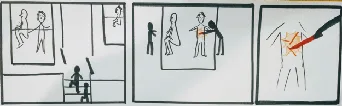
When examining the dream, I see there are three figures or main energies: the girl (me), my mother’s body and the thieves. I will explain what the different energies I find symbolize for me and in order to do that I will have to go in and transform myself into them and process them. They reflect aspects of my life, my behavior patterns and my mythical energies.
❖ The frightened girl: suffering, with fear and a lot of emotion. Closed up on herself, tiny and defenseless. She is in the role of observer and controls everything that happens. Part of the fear is not knowing what will happen and if she will be hurt.
If I consider my identity in the long term, I see her as a primary figure. I see the girl I used to be, with fears, suffering, in need for control, closed up to life’s beauty. It reminds me of the traumatic stories that are still within me, blocked, hidden in the dark.
This is a feeling that I used to identify with in the past, but not so much anymore. It is a feeling that is anchored to suffering and it is one of the reasons I started this project. The girl is the witness of a particular situation and it is a role that was absent in a great part of my life. In my story this translates into hyper-surveillance and constant control, especially at night. This directly connects with a symptom that I will explore later on: insomnia.
In the dream, the little girl wants to be protected, but both the maternal and paternal figures are absent, non-active. They are being attacked, and this means that they can offer no protection. So the little girl will have to develop that protection for herself.
❖ My mother: with her open and passive body
The image is now of an opened up body: my mother’s body is opened up and passive and we see no resistance in it. This contrasts with the last image: the figure of the girl that is closing up on herself. This polarity has played an important part in my life, but I was not fully aware of it. Especially the opening up part: As a result I pushed myself into situations where I felt I had to open up; I forgot to protect myself or even failed to see the danger. This has led me to situations of abuse and violence, partly as I ignored the signs, my fears and intuitions.
As shown in the dream, my mother’s body is opened up, totally vulnerable to attack and invasion, completely helpless. Here is a pattern that is familiar to me and reminds me of the importance of being open and protected at the same time, uniting both qualities. Feeling myself opening up to life and to different sensations is beautiful but I need to do so consciously, respecting boundaries and taking care of myself. Later on in this chapter, the element of crossing my boundaries will be discussed in more depth. Here I just want to emphasize the significance of allowing myself the possibility of opening up and closing up accordingly to what best fits the circumstances. One is not better than the other: what matters is that I stay connected to my body and its signals.
Another aspect that I would like to highlight when going into the figure of my mother’s body is what I call “passive or non-active”, as if the body were abandoned. When I become that passive body, something emerges: a willingness to let go, to surrender, to not do anything. And I feel open to whatever might happen; this takes me into a pleasant state of relaxation, of disconnection. I let go of consensual reality and abandon my old identity in order to go into a more sentient reality or essence. I find that this might be a pattern that I need to incorporate more into my life so that I can connect with these other dimensions.
This figure in the dream shows the role the mother represents for me: it reminds me what I can integrate into being a caregiver for myself: someone who offers protection, who nurtures…
One thing that initially surprised me as I explored the dream was the absence of pain and feeling. It seemed that my mother wasn’t suffering from being stabbed, she wasn’t even protecting herself. Something similar happened with the father figure that remained asleep while everything happened, without protecting or feeling. Both figures represent insensitivity to me.
Also surprise me the passivity of the image, but at the same time it reminds me that one survival strategy when you are abused is to not fight back, to abandon your body to the abuse as a survival strategy.
❖ The thieves: with an energy of going for what they want, active,
direct, cold and detached
Processwork paradigme talks about how picking up and unfolding the most disturbing element in a dream can often bring us the quality we need to deal with the challenge we are facing.
I identify these figures as a more secondary part, although they would be even more so if I saw them as murderers, but I do not. The figure of the thief is a dream figure but it is also the X energy25, the more disturbing energy.
This is the role of the aggressor that takes whatever he wants without asking for permission.
I relate the energy of the thieves to different parts of my life where I have felt victim to that energy, for example in relationships where the other part has taken or occupied the colder and more detached role. But this role has definitely played itself out more clearly in sexual abuse experiences and aggressions, where someone chose what to take from my body and how to take it without my consent or respecting my boundaries.
Taking a look at the course of my life and at some of the events that have marked it, I have seen the importance of integrating more this direct and detached energy. I would like to use these qualities consciously to take care of myself and protect myself, but most of all I would like them to stop appearing in external circumstances or figures. Coldness and detachment qualities are important in order to set a limit on suffering, to protect myself from the abuse of my critics, from painful situations or even when I get attached to emotions that drag me down. There have been moments in my life where the part that sets clear boundaries and connecting with detachment has been difficult to occupy. But I feel that as time goes by I do it with more agency and empowerment.
When analyzing the thieves figures more deeply, the knife appears to be a key element. When I manage to be and feel the knife, I connect with the quality of cutting through layers of the skin to go deep in, with control and precision, and fully present and focused. I really enjoy the sensations of the different textures that I am cutting through; it allows me to be present in the moment and conscious of everything I touch and everything that touches me.
This figure also makes me reflect on the correlation between the knife and being penetrated in a situation of abuse. As I write it, I feel horror. When there is abuse, there is no connection or feeling with what is being penetrated. The knife has an important pattern to not generate abuse: be connected and aware of the signals and feedback of what is going on; listen carefully and be mindful of what you are doing.
These are useful qualities for my personal life and also in my job as a facilitator, which is intensely related to going more deeply into the experience at the edge. Going deep and feeling how the different layers of the skin are being cut through is to enter the different levels with full awareness and presence.
One last detail worth analyzing regarding the thieves is the fact that they are searching for something inside my mother. They are looking for a treasure, a little shiny pearl hidden inside her body.
❖ The pearl inside the body
Another recurring dream I have had since I was little is one where I was a curious bird interested in knowing and understanding. A bird that went inside people’s houses to see how they got on, how they related to each other, and things that happened inside. As though the bird was witness to what was going on behind closed doors. I find that the feeling is similar to my desire of getting into people’s minds so that I can understand what and how they are feeling, so that I can witness how they are experiencing things. I assume that this is where I get my will to accompany individuals, families and groups in therapy.
Going back to the first dream I see that the search for something deep inside the body is something very present in myself and this also characterizes my practice with individual clients and groups. I try to accompany them while they find a small pearl, their own light that is hidden inside of them and that quite often they do not even know exists. I truly believe that it is vastly important to be connected to the light, pearl or essence that defines us and makes us unique. And for me, the connection with that inner light has everything to do with pleasure and being close to who I really am, close to my essence and my deepest inner self.
If I give space to the experience of the pearl I find that it is a white pearl that irradiates a lot of light, but that is situated in a deep and hidden place where its light can barely shine. When it emerges or is found, it has the ability to light things up, and by doing so it gives life color and blackness starts taking all sorts of different shades. The pearl shines and it makes the entire body shine, and even beyond it. Connecting to that is part of my life myth and it is related to moments where I feel alive, vibrant, when life has a meaning and purpose, where I know that I am exactly where I am supposed to be and I feeling fulfilled and connected to something deeper.
In some way, for me connecting to pleasure is to connect with the essence of this pearl, and in that way break up the consensual reality. This is a part of my job and then I need to find a link to the other dimensions so that I have more space for myself and for a wider experience.
I am trying to bring these sorts of elements in my dreams to my job as a therapist and to my personal life. The energy of the search for the light or inner pearl, the energy of the knife cutting through the layers. This search for depth contrasts with a will to stay on the surface, which is unsatisfactory and far from pleasant. All these figures appearing in my dream are allies in my process and some of them guide me towards very valued abilities or meta-abilities that will contribute along the path to relating to pleasure in a freer and more conscious way.
b) What message is my body expressing?
Processwork investigates our known world and opens us up to the unknown, to shady and inexplicable elements that are the hidden seeds that are the potential for new life and creativity
Amy Mindell, 1995:57
I begin this section with this quote, which inspires me to enter into unknown aspects in order to discover the seeds for transformation. And with this inspiration, I take this body I inhabit and its signs as a great source of knowledge, wisdom and experience. I see it as a container of my own history, but also a container of ancestral history. I listen to my body carefully, because it reveals the most absolute and pure truth. It has no filters, it shows a mythic pattern and brings conscience so that it mitigates the feelings of failure or impasse that usually accompany chronic or long-term conflict.
Jung said that dreams were doors to the unconscious. Mindell went even further than the Jungian ideas, exploring how dream experiences did not only appear in dreams themselves, and stated that the experience of dream happened not only on dreams but that the Dreaming26 Process happened all the time, day and night. He discovered that what we dream at night and the symptoms that we perceive during the day have the same energy and that this in turn manifests in different areas of our lives.
In order to understand this better, I have chosen some chronic symptoms or experiences that I have had over the years. My intention is to unveil the messages about pleasure that the signals of my body are bringing to my process.
❖ Insomnia
This symptom has accompanied me ever since I can remember. Fortunately, nowadays is less present and intense in my life. This is why I will describe it in past tense.
I have named insomnia “vampirus insominius vigilantis” (2). It is a dream figure characterized for being a state of constant “hypervigilance” (1) especially active at night. In consensual reality, it manifested itself by keeping me up and vigilant, too alert when I needed to be asleep or waking me up in the middle of the night at the slightest noise. Every little sound or movement woke me up. The feeling was of not being able to rest or disconnect, because a part of me was always watchful just in case something happened. I couldn’t put my guard down even in places that seemed safe. Luckily, while I have been writing this and as the years have passed, this ceased to be a constant symptom, but one that appears only on certain occasions.
At one stage in my life, this state of alert was also present outside the dream experience. It sometimes appeared during the day, but was a lot more common at night, especially while I was walking alone at night in the streets.
I was afraid of being followed or that someone would come up to hurt me. At these moments, the “vampirus insominius vigilantis” dream figure would activate and my body responded by being highly sensitive to the surroundings.
To get to know the symptoms better, I enfold the signals and worked on the different levels (4). I allowed the perturbing energy of hypervigilance (1) to express and when amplified the dream figure (2) of “vampirus insominius vigilantis” appeared. It has eyes all around to control everything. Finally, I went into the essence and l let the universe move me while I tried to see what quality the symptom brought. A look of care appeared, a respectful one, as if it was a meta-look that protects from distance. This made me think of a doll I made a few years ago that I symbolically placed next to my bed so she could take care of watching out while I slept.

1

2

3
4
Another perturbing aspect of the symptom that I developed was the feeling of wasted time when I wanted to be sleeping and couldn’t. When I unfolded this more my making a sketch (5) of the energy I perceived a quality of going nowhere, of not concluding anything. And digging deeper I found a sensation of having the power of taking objects out of a body or thing (6) as if they were painful spikes that when taken out generated relief. When I embodied that sensation I visualized the ability of taking myself out of painful or toxic situations. It was beautiful to connect with that power and very useful for my life and relationships.

5

6
By connecting with the experience and letting myself be moved by the dark energy of the universe <<a new feeling arrived, that I had never experienced before. A sensation that combined abandoning control and knowing I was being protected. I let myself be moved by the universe and I didn’t have to be in control, I let go, I had nothing to resist against. I simply felt where the energies were taking me; a fluid state of no struggle>>
It was really surprising to unfold this experience from insomnia: It was an extremely pleasurable experience and a key element for my relation with pleasure because I could let go knowing I now have the internal security of care and protection.
❖ Epileptic seizures
Another recurring symptom still occasionally appears and I call it “power turbulences” commonly known as epilepsy.
Epilepsy (from Latin epilepsĭa, this from the Greek ἐπιληψία, ‘interception’) according to Wikipedia, is a disorder caused by an imbalance with the electrical activity of the neurons of a part of the brain. It is characterized by several neurological disorders that produce a predisposition to suffer recurring convulsions. They usually have consequences for the neurobiological, cognitive and psychological levels. Generally the treatment is to administer anticonvulsant medications to make the symptoms disappear.
Epilepsy was written about as long back as in ancient Babylon. It has had different meanings, interpretations and ways of being treated depending on the culture. In some contexts, it was attributed a divine origin and was venerated; for others it meant being possessed by the devil or was related to moon cycles. I find it relevant to highlight the etymology of the word: it comes from the Greek “epilambanein” which means to be attacked or taken by surprise.
This symptom or process took me by surprise at the age of 17, with an extreme state in which I had an outer body experience which took me some time to come back from. After this occurance, and a similar one, I started to have epilepsy seizures. When I first had them I had medical tests done and consultations with neurologists and they stated what was happening to me. Throughout my history with this diagnosis I have hardly visited any more doctors and the reason is not because I was not interested or because there were no more crisis’, but because my relation with allopathic medicine has not flowed.
Whenever I consulted with doctors I realized they were not interested in my dreams, in my personal experience, in what was going on with me but only in the fact that I took whatever treatment the allopathic medicine offered me. This is why, from the beginning and until now, I have refused to take that medication, despite it being the only option offered to me, and therefore assuming that I would be taking on the responsibility to deal with my symptoms by myself. After several conflicts with allopathic medical system and its partial view of reality and my body, where I felt my own subjectivity and experience were neglected, I distanced myself from it. It was painful, but to go through it in solitude led me to search for different roads that were more true to my nature.
Process Oriented Psychology was an ally on my path through the epilepsy seizures that helped gain awareness of the symptoms; their meaning, purpose, the message within and nearly all the way I learned to accompany myself through it. It was important to listen to the signs of my body, to feel it, respect it, learn how to inhabit it and to validate my own experience. If I have learned something from this crisis is to be my own caregiver by developing a “metaposition”; a state of mind in which I can observe my own experience with compassion and without judgment. In fact, developing this role of care in attacks has greatly diminished suffering in the face of seizures.
During the seizures I lose control of my body’s movement as well as the ability to see and talk, but my auditory and proprioception channels still function. In fact they are both even more acute and I can clearly feel what is going on around me. When this is happening I cannot communicate normally to the exterior, but in one special occasion where someone very sensitive accompanied me, I was able to establish communication through micro signs. This experience was of great relief and it helped me to take care of myself.
All of this has formed a part of my understanding of Mindell’s, and other researchers’ work on coma and extreme states of consciousness.
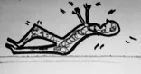
Observing this image, which represents the vision that my “metacommunicator”27 has from the outside when the epileptic seizures are happening. From it I see the convulsions and the inner turbulences I am going through, but what surprises me is the sensation of being trapped in a box. I did not think of it while I was drawing, but rather I noticed it when I observed the picture. It is a disturbing feeling that I have during seizures. There is an energy inside me that hits the walls of my body, trying to get out in a desire for freedom.
I’ve learnt through the exploration of different symptoms that when I feel blocked in the relationship level I enter into an edge and my body immediately somaticizes accordingly. It can range from my throat closing up so I feel as though I’m suffocating and I can’t express myself, to the point of an epileptic seizure if the situation is more severe.
Epilepsy for me has been a process that has evolved as I gained consciousness about it. The more awareness I acquire, the less painful, frequent and intense the seizures are. Epilepsy is a disturbed state that appears on an edge. Like other altered states28 I have experienced, this is a state of being frozen on the edge, and it makes me disconnect from my own power and strength.
When altered states are repetitive they function as an addiction and the experience of the symptom brings you something you cannot express by yourself without it. When I wonder what epilepsy brings to me I realize that deep down the message has a lot to do with the focus of this paper: pleasure.
And on the other hand with its polarity: pain and suffering. When I have learned and observed more about the circumstances in which the attacks appear, I see that there are situations where something completely overcomes me because I did not know how to set limits. My body somatizes the attack which leads to a loss of control and to release, and to a later state, in which for a few moments there is no struggle where there is nothing to do but surrender. It is like a sensation where I unravel and lose my identity, leaving consensual reality.
The post-attack state, in which the pain has been so intense at the physical level that it leaves me no choice but to rest, dissolve and let go, contrasts deeply with the belief system that has marked my life. A belief system on the basis of doing, fighting to survive, to confront the pain, the fears, traumas and other difficulties, and where life was seen as a battlefield where you never let your guard down because you could be attacked.
The feeling of letting go occurs in different moments and aspects of my life and I often yearn for it. It’s a signal that reminds me why I need to go the essence, let go of my identity and connect with my deepest self. For this reason it’s important there is a way I can connect with the experience painlessly and without having to go through the seizures in order to express the blocked energy and whatever is needed to be expressed. (It seems that I keep coming back to the same place).
Again the concept of attack appears, first on my childhood dream personified by the thieves on my mother’s body, then on my insomnia where there is a fear of being attacked from the outside, and finally, with epilepsy where the attack seems to be from the inside.
❖ Depression and death wishes
Many depressions or death wishes have to do with going deep. If you do not have enough access to the essence level you can tend to depression, and this can even lead to diseases.
With my relationship with death, it has been interesting to read Castaneda’s “Journey to Ixtlan”, in which I have felt reflected in his words in several moments, so I will mention some of them throughout this chapter.
Death has been a very present “state” in my life, in the form of desire, fear and the search for death itself. Since I was a very young girl, I have spent long stages of my life in periods of deep depression and stuck in the idea of dying to put an end to the fighting. At times, the suffering was so extreme and agonizing that I felt that continuing in life made no sense. Sometimes I tried to make those desires to die a reality, but I guess that the fear of the unknown, and some glimmer of hope, stopped those attempts.
Depression had taken me. It was like being inside a grey cloud, where life had no colours, and where destructive thoughts exhausted my being. But I even got comfortable in that state. It meant suffering, but it was well-known land, and I thought it was less effort to stay in it than the attempt to go out and venture into the unknown.
Well-being is a condition that must be cultivated, a condition with which one must become familiar in order to seek it. You do not know what wellness is because you have never had it. To feel miserable, you must work intensely. And in the same way you must work to feel complete and strong. It’s stupid! The joke is in what one emphasizes. Either we become unhappy or we become strong, the amount of work is the same.
Castaneda, 2017: XV Not-doing
And yes, while you’re in it, you don’t realize how much effort it takes up to feel bad, and how much you must invest in seeing everything negatively, in abusing yourself, and so on.
There is a feeling of fatigue, tiredness and dejection in the depressed state, but I can see now that part of that fatigue, in my case, came from holding an internal and very strong critic and abuser. A relationship that became so invasive that it took possession of my identity, until I believed that that was what I deserved, a belief system that sentenced me to a life where I couldn’t be better, telling me that “happiness or pleasure” did not belong to me.
As Castaneda says, it is important to lose importance of ourselves, otherwise we lose sight of the world, isolating ourselves. I lost sight partly through being blinded by my critics and belief systems.
Now we care about losing arrogance. While you feel as though you’re the most important thing in the world, you can not truly appreciate the world around you. You are like a horse with blinders: you only see yourself, oblivious to everything else.
Castaneda, 2017: 49
And, as previously happened with the epileptic seizures, once again my relationship with the medical system did not meet my needs with the process. Or maybe it did, it depends on how you look at it. After 2 years of being medicated with antidepressants in the children’s department of the hospital, I reached adulthood, and they transferred me to the adult service. There, a psychologist with a surprising honesty and clarity told me that if for so many years they had not been able to help me, she was not going to be able to do it, and therefore she discharged me. It was a strong blow at the time to find myself alone with all of it. But over time I realized that if I wanted to leave that place, that painful state, I could only do it by myself. It was like being an urbanite who has to learn to survive on a desert island.
I went through an infinity of therapies and processes, I went down many paths, and I saw myself on the verge of death… but deep in myself there was always something, a small light that believed in being able to get out of there and live something different. It was a journey of more than a decade, but it was worth going through and fighting for the exit of that dark tunnel, in order to inhabit life to this day.
One day I discovered that if I wanted to be a hunter worthy of respecting myself, I had to change my way of life. I liked to lament and cry a lot. I had good reasons to feel victimized. But then someone taught me to hunt. (He explains that the Indians are treated like dogs). And I realized that I wanted to change my way of life because it was not worth living.
Castaneda, 2017
Somehow it was the same for me: I had reasons to feel victimized, but I had more reasons to deserve something different to what I was giving myself. And becoming aware of my process, I learned to respect myself and offer myself the opportunity to free myself from so much oppression.
A Buddhist retreat made me think deeply about what I understood about death and what I believed about it. The law of Karma tormented my head for days, since from this specific Buddhist lineage perspective it was meaningless to take death as a way of liberation. But it did help me to consider exploring the calm I was looking for in the moments when anguish wanted to take my life away from me in the past
When exploring the state that I was looking for in those moments of crisis where I fantasized about suicide, I found in death a state of calm and emptiness, in whose essence there is nothing to do. It was a state of buoyancy, where the mind was still and time was dilated, and where at the same time, and this is the most important bit, I lived only in the present moment. It was a quality of detachment of the mind and the body.
Over the years and thanks to the Processwork perspective, I have been able to understand that the underlying pattern in depression or suicide is that of breaking the consensus reality, to be able to access another experience of myself. This pattern is in my dream and it is part of what I bring to the world, the importance of breaking with that consensus reality, letting go of the parties and the struggles, and surrendering so that something new can emerge, something can be born. It has a lot to do with dropping the identity, letting your ordinary self die. It is opening up myself to what will be generated, it’s a shamanic vision, with what Castaneda defines as stopping the world to be able to see beyond.
I fully appreciate being able to work with suicide, being able to listen to the process that it was concealing. Suicide is a process that conceals guilt and shame, it is something that nobody wants to hear or talk about, because it scares us. For me, being able to speak about it and giving it space to process it helped me to be able to connect with life. Suicide masks a great desire for change, for transformation, for the search for meaning and freedom of the trapped identity, for connection with something bigger and with something profound about oneself. And all these discoveries have happened by connecting with the essence and by dropping everything familiar, giving space to what is generated from not doing.
I firmly believe that if we as a society gave more space to death and the processes that come with it, we could connect in a more healthy way with life and ourselves. Death and suicide treated as taboos exclude an important part of life and the processes we go through.
Even Plato stated that death is not a catastrophic final period, but more an inflection point leading to a superior purpose […] Being dead means everything but not being. On the contrary, death elevates, deepens and transforms the being. Being dead means being awake, remaining focused on oneself without the body, that clouds the truth, offers distraction or confusion. Death deepens focus and internalization of the soul.
Han, 2002: 129
c) Synchronicities
It is important to take into account the events that happen to us because they also carry information about the process. At the beginning of the writing, I named two important events that happened last year when I started this project and which I now revisit to relate them to my life myth.
Initially I mentioned that I had broken a bone which left me immobilized for a while. From a shamanic perspective we would say that something came and left me immobile, something stopped me. But this led me to transcend a great edge, that of entering an operating room. For the first time in my life I would give myself over without a state of control, I would be anesthetized and could take that absent role which is absent in insomnia, the one of disconnection, of letting go of control and of hypervigilance. The need to dance again was much greater than the fear of being intervened, without the movement I felt that something in me was dying and I could not allow it.
And not only did I offer myself to the role of disconnection, but also by taking the force that hit my body and threw me to the ground in the accident, I took the agency to change my way in life, to do it in another way. Somehow I took the reins, the agency, instead of staying in the role of victim being taken over by depression. Something curious that happened was that this time I was not running away from what happened to me. I consciously took the pain, the sadness and the lack of autonomy over my body and I listened to its messages, and I lived it accepting it as it came, without rejoicing in it, but without marginalizing what was there. Establishing this new relationship of taking the agency of a new way and of what had happened, was something important and determining in my process.
When you are depressed you are very much in the head and in the thought. But this time I had an added physical experience where for the first time I was immobilized.
For me it is important to mention again a second event (with which this journey began), the earthquake that struck my body and my life to connect me deeply with my being and with the gift of being alive. Death appeared once again as a life counselor. And by connecting with the dark energy of the universe, that great unknown, I took again the agency of living consciously and in search of fulfillment.
That day I paid attention to the bond that links me with death, in order to clarify and remind me of a new way of being in life that could no longer wait.
Think you do not have time and let your actions flow according to that. Let each of your acts be your last battle on earth. There is no time for shyness. Shyness makes you cling to things that only exist in your thinking. Shyness prevents us from examining and taking advantage of our luck as men.
Castaneda, 2017
I had an intention, to travel in order to be in pleasure, but the world decided something bigger for me. And surprisingly, from one of the most agonizing events of my life, nowadays all this trip makes sense. And from that event that seemed the farthest point away from pleasure, I was able to meet one of the deepest pleasures I’ve ever felt.
That happened in two moments. One of them was the moment, in a very deep way, I surrendered to nature, to accept not being able to do anything and to give my life to whatever must happen. It is a very deep sensation, similar to that of when I had the epilepsy attacks, but, surprisingly, this time the attack did not happen in my body. It seemed that it was the earth that had the epilepsy, but my body, for a still unknown reason and despite trembling for hours, did not reach convulsions.
This time the act of letting go happened in another dimension, as a level of connection with spirituality, where a calm and a kind of light took my being and told me that everything was going to be fine and that it was time to leave my life in the hands of nature or the universe. This is an instant that I could recognize as pleasurable, in connection with something bigger, releasing control, offering myself to life.
Another significant moment in relationship with pleasure that day was to say goodbye to the people I loved in my life. Saying goodbye to those people, being able to take the liberty of expressing myself without any kind of filter and from a very absolute love, where there was no polarity anymore, where all the pain of history and all the possible wounds had no place anymore. I said goodbye to my parents, thanking them for my life, and asking for forgiveness for the pain generated at certain times. And I told them without fear that I loved them. I did the same with my brother. And the connection with all of them was from a place of love that we hadn’t known before, from a place of great beauty. We all knew that maybe those were our last shared words, but a kind of inexplicable peace awaited us.
That night I understood that pleasure was something different; that significant took on a new meaning. I understood that pleasure had new aspects, that it could be of different kinds, and that it could come from the least expected places. But if there was something that I repeatedly realized, it was that pleasure itself is something that comes and goes, that we can not try to control it and impose it. That it does not belong to us as beings, but that surprises us whenever nature decides it.
Once again, death brought its wisdom to connect me to life. It seems that sometimes the pattern repeats itself before it can be understood, and it appears in different channels, with the attempt to reach consciousness. As the law of conservation of information says, the information can not be lost or destroyed, the system will continue to send signals over and over again until the system changes. And this time the information arrived on a very deep level so that an important transformation could take place. Since then, life could not be viewed again from the same place, and it took on new tones I’d never seen before, as well as previously unknown sentient opportunities.
7. Next stop: the silenced in the body, the abuse
The silence about the trauma also leads to death: the death of the soul. Silence reinforces the isolation of the trauma29
Bessel Van Der Kolk
As my dissertation advanced, new aspects emerged, aspects that I had initially decided not to include but due to their evident relation with the topic could not be omitted. Sexual abuse is one of these “aspects” and today, at the end of this journey, I realize just how defining and limiting abuse has been for the way I have experienced pleasure.
Before going any further, I feel the need to honor the myriad of past and present silenced voices. I dedicate this chapter to women from around the World, generations and generations who have had repression inked into their cells; daughters, mothers, grandmothers and great grandmothers who have suffered the consequences of a patriarchal system that needs to control the woman’s body as if it were a powerful weapon.
The fire that burns in the social, psychological and spiritual dimensions of humanity can ruin the world. But it can also transform the conflicts into a building a stronger community. It depends on us, we can avoid conflict, or we can sit in the fire intervene, and try not to let the most painful mistakes of the world’s history be repeated
Mindell, 2015: 18
Today “I sit in the fire” to talk about abuse, specifically sexual abuse and all the dynamics that surround it. Being sexually abused has been one of the most painful experiences of my life and the one that has most marked the story of it. Today I break my silence and bring abuse with me to somehow give it back to the community. After a long time of working in it in a personal level, I hand it back to the community within who’s walls it happened and therefore should be the one to take responsibility for it.
We live in a society where one in every four women has suffered sexual abuse at some stage in their lives, this also means that there exists a high number of abusers. But the society that allows this to happen does not only not penalize it but also denies it’s existents, devaluating in this way the damages caused by it. Nearly 70% of revealed abuses have had no consequences neither legally or within the family or social structures. Seemingly the voice that listens to abuse and should take responsibility for it is silenced, a voice we can identify as a “ghost role30” within patriarchal beliefs.
Until recently abuse was not spoken about, only in the last decade has it started to be named and become a public topic. Our culture still makes us want to hide it. There is a lot of suffering, pain, shame and guilt behind abuse stories, but these experiences are lived in silence and even more so the deep impact they have on our lives.
a) My story: recovery and healing from abuse
From a very young age abuse has been part of my life, so much so that for many years I believed that it was my destiny. It felt like something was planning my life, like some sort of powerful being was deciding my life for me, placing me time and time again in those situations. They just kept on repeating themselves and I could not understand why. Desperate and confused I tried to find explanations and responsibilities for what had happened. I asked myself what I was doing to cause what I was going through, it was a constant battle with guilt, confusion and the desire to understand why it just kept on happening
I looked for help in all sorts of different therapies to try and free myself from the mark tattooed on my body that seemed to draw me to abuse situations. At times if felt as if men could read on my body the permission to reproduce abuse towards it. It sounds crazy even as I read my own words but that is how it felt.
I remember an especially significant event related to my search to understand the signs that I may have been giving off.
After a period of therapy, I decided to go on holiday, the days before I departed I was overcome with fear of something happening to me. I remember my therapist giving me one premise for my journey; I was to draw clear boundaries towards any man that came near me. At the time I didn’t listen or believe in the power of the signals my body could emit.
The first night arrived and I was shattered with jetlag, rapidly becoming bedtime my friend and I searched for accommodation. A man who rented rooms offered us a space. I had an intuition that it wasn’t a good idea but, as I tended to do back then I ignored the feeling, I decided to trust my friend who seemed happy with the plan. That night, and for the first time in my life, I wore earplugs to sleep.
Whilst sleeping the man came into the room. When I awoke in a state of confusion and panic it was to late. I could draw any boundaries as incredibly I had not woken up in time. Even now the tears roll down my face as I write this. That day I cried and cried asking myself how this could of happened again, we had hardly spoken two words how could I possible let of any signs or drawn any boundaries? Still, somehow history had succeeded in repeating itself.
When particular problems and experiences happen over and over again, they provide repeated opportunities for examining core issues. Each time they bring new experiences, meaning, and insight. […] Yet each time they come around, they bring the potential for personal change and growth. As in mythic tales, the dragon does not change, but the hero does.
Diamond&Spark 2004: 149
Sadly, this time was not the last. The abuses were repeated some time later, as if I still needed to become aware of something more in the system. But that experience brought something important: I decided to report the incident. For me, to denounce meant to resort to society and seek its support. Unfortunately, I came across a reality I would never have expected. I found a system that blamed me and pointed the finger at me. Instead of bringing protection and listening to the pain, and confronting the abuse and the abuser (being already registered as a repeat offender), it favored revictimization. Although the pain and impotence of what happened was very great, there was something important: I didn’t stay with that silence, instead I returned it to the system. On previous occasions in which I had been abused, I had remained silent, burying the experience in my body without being able to react to it. But this time I stopped pointing inwardly, and started pointing the finger outwards.
A few years later, and curiously on another trip, I remember a situation that did give a new and substantial turn to my story.
I was in an unfamiliar country a long way from home, where I had only been a few days. I had gone to a Processwork seminar. I did not understand the language, nor did I know the culture or the social norms. I went into a store to buy some food. It was a small business, apparently endearing. I was friendly with the clerk, although we could barely understand each other. Suddenly, the man crossed the counter to give me the purchase and pounced on my breasts. There was no one else, it was late evening and I did not understand what was happening. He laughed at me while he groped me. I felt fear and a lot of anger. I remember being blocked, paralyzed and charged up with impotence, without being able to express that anger over what happened, as it had already happened in all the abuses I had previously experienced. It was something small, and I tried to minimize it, but I felt the wound reopen and bleed.
The next day, in one of the seminary exercises, I worked on what happened. I entered the figure of the aggressor to connect with his energy. I learned many lessons from that situation. The most amazing thing was to discover how much I needed that energy, to go towards what I wanted and to throw myself into it without contemplating the impediments. That man was a teacher for me, although unfortunately I again had to live a situation that reminded me of my story. But that discovery, in that remote country, was one of the keys to stop living situations of this type.
This same quality of going towards what one wants, with direction and detachment, was also present in my “childhood dream”. In that case it was the thieves who occupied that energy, while looking for something inside my mother’s body.
I have been processing this topic for many years, working on different aspects. I have been able to narrate the facts giving space to pain, anger, rage and other feelings. I have dialogued with my critics and belief systems. I have worked on the body to decongest it and express the pain. And I have worked on the consequences in the present. But something fundamental has been being able to work little by little in the different roles and explore the energies that they conceal.
Menken (2013) speaks of 4 roles that are present in any social history: victim, oppressor, observer and facilitator. In sexual abuse, the first two roles are present; Sometimes, the role of observer can also be present. I can not imagine the role of facilitator during this type of abuse, beyond the possible follow-up after the events.
In Processwork we don’t have a strict definition of what it is to be a facilitator. In general terms, the facilitator is the person who points out and frames what is happening, accompanies the different parties to help work on differences or conflict, facilitates that the different voices and feelings are heard, etc. It is a figure that was obviously absent in my story, with the exception of accompaniment when working on trauma. But it was thanks to embarking on this journey that my internal facilitator has found its place to be able to attend to and facilitate the polarities, and thus to learn to pick out the useful message of what happened. In order to do this it has been very important to be able to welcome the different parties in a non-judgemental way, with an open beginner’s mind, with curiosity, compassion … and all those elements that were put in the suitcase at the beginning of the journey..
During this healing process I have gone through the different roles that I used to name, some more familiar and lived in than others. For years I identified (and even overidentified myself) unconsciously in the role of victim. I had put on the victim’s dress and, as such, responded to many situations where power relations occurred. And when I undressed I did not know how to put on other clothes. I knew it and I wore it well, it seemed to be made to measure and I was comfortable. The key to changing this situation has been to realize who is reacting in each moment. And to bring awareness to the moments when I was putting on the same dress again. And trust that other clothes and other outfits can also adapt to my body, helping to generate a new identity.
As much as you like to pity yourself, you have to change that. It does not fit with the life of a warrior.
Castaneda, 1972: 161
In terms of Processwork we would say that I had an edge to my primary process as well. I had certain resistances with identifying myself consciously with the role of victim in the situation, with the experience of the victim of the abuse. Therefore crossing the limit and taking on the role with more awareness was an important part of the process of working on past abuse. Listening to the party that is a victim and giving it its place. And being able to recognize abuses as abuses, since previously I had tended to minimize what happened and above all blame myself for it. Even in this writing, guilt has been present at moments, not allowing me the legitimacy to speak of the abuses.
Inhabiting the aggressor or abuser has been complex too. It has needed time, especially to enter from the scenes of abuse and see myself as an aggressor. But it has been easier to enter from the role of my internal critic. The difficulty of seeing oneself as an aggressor seems to be a process similar to that of society or culture, which in some way refuses to accept the cruelty of reality.
We deny the ability we have as human beings to use and assault our children and women to perpetuate the patriarchal form in which we live. When we make this denial, we exclude the facts and live the emotions that produce us
Darder, 2018: 42
However, I have played the role of aggressor in my life. On a smaller scale than I suffered in the abuses that I received, but with the same essence. Neither have I known how to take care of the impact that was generated at times, blinded with power and marginalizing the limits of the other party. It is something human, but not tolerable. We have a lot of work to do as individuals and society to raise awareness of our use of power.
Working on the figure of the attacker, aggressor or external abuser, I have been able to connect with the ability to protect myself, with my strength and my power, with my ability to set boundaries and find my freedom.
It has also been interesting to work in the role of the observer as a figure who, from the outside, witnesses what happens. I have discovered that it is a figure that I have to keep in mind and to which I must give more space and entity. It is like an eye that observes, and when I explore it gives me emotional and physical distance, preserving the intensity and allowing me to gather information from the field. This figure turned out to be like the image that emerged from the insomnia process, which I qualified as a protective meta-look (page 38: Image 3)
Being able to enfold each of the different roles and see what part of myself I inhabit in different situations of my daily life have been important steps to healing and to be more fluid with my history and my present, in relationships and in the world. In turn, the marginalized experiences and feelings have polarized the field less. I have been taking more notice about what happens in my life and so I have been finding, consequently, less external abuse.
In this process of healing the trauma and writing about it, it has been crucial to accept myself in the different phases, both with regard to the aggressor and with regard to the abuses themselves. In order to be able to work on the abuser’s energy, I first needed to be the victim. Become and occupy my side and my pain, to then be able to move to the other side and listen to it. And at the same time to accept that it was not a linear process, where I would often relive sensations and feelings that I thought had already been overcome, and which demanded new attention. It was a flow between the phases and in turn I was able to observe how I was more easily caught in some than in others.
Only when I have allowed myself to show my anger have I been able to move forward through my own wounds and frustrations, present and past, to come to realize that no one is really guilty and that everyone needs to wake up just like everyone else.
Mindell, 1995: 57
It is fundamental to work with trauma on a personal level, but it is also necessary to work on a relational and world level. It is important to be able to work at different levels in order to transform humanity.
I had two healing experiences in my process at the relational and world level. On the one hand, it was talking to someone who identified as an aggressor. This allowed me to complete the interaction that had never happened before, in order to later transcend my role as victim to survivor. I was able to converse, be heard and recognized, by a person who had occupied the role of abuser and who accepted the pain that had been generated. And the second was in relation to the world, in a Processwork event where we did a group process about sexual abuse. It was healing to able to recognize myself publicly in a safe environment as a victim, and later, as a survivor. Bringing that painful secret to the world and to the community was liberating. The wound that was generated in society returned to it, so that as a society we all took a bit of responsibility.
In addition to the roles already mentioned, many others are also constellated in the field of sexual abuse. One that I have deployed and on which I have reflected has been the role of the carer or one who protects. A role that was absent in my experience, both externally and internally. In my process there was no one looking after me or wanting to see the wound. What I wanted was for it to heal and disappear, to be erased from my body. But the abuse is generated again when I forget my body, when I disconnect from it because it contains too much pain. It has been an important job to see the role of the “protector” happening in the moment.
Nobody wants to remember a trauma. In this sense, our society is not different from the victims themselves. We all want to live in a safe, manageable and predictable world, and the victims remind us that this is not always the case
Van der Kolk, 2015: 221
This quote by Van der Kolk reminds me of the holographic theory. According to this theory, what we observe in the community is symmetrical to what we experience in our private life, and vice versa. My belief in this theory led me to want to work in the different roles present in me: they are those who also live in the outside world and with whom I will have to interact and negotiate.
Each relationship, interaction and experience is a new opportunity to learn about limits and respect for myself. They are stations on this mythical journey. And in them, now I see the sensation of failure, of when history repeated itself, as a step more towards freeing myself of a scar that I felt would mark me for life. Maybe I can never erase that mark in my body, but I know that it will turn into a kind of tattoo to remind me of the importance of taking care of my being, my body and my soul.
When you let yourself be carried away by this work and let it tear you apart, something extraordinary can happen. You begin to realize that all impossible situations are also your great teachers
Mindell, 1995: 58
Despite still carrying many wounds or symbolic injuries, nowadays I can talk about it and I feel that having gone through all that I’ve gone through makes me who I am. Of course, I wouldn’t choose to have lived what I lived, that’s unthinkable. But I do take the learning obtained from it, I take the experiences as teachers and I connect with the great need for care and self- automation. There are still some of those situations that, despite taking distance and seeing the process as a whole, I find hard to accept completely without feeling my heart crying.
At times, doing all this work and writing about the trauma has disorganised me internally. I have needed to raise awareness and return to my centre. I have chosen to go through the pain of the experience to be able to integrate what I’ve lived, to connect and welcome my whole being. And I have the same dream for the world: that someday we will be able as a society to accept and assume what we generate, being more consistent with what we are. I dream of awakening from this collective hypnosis in which we live.
Closing this chapter I’ve asked myself, “What is the experience of sexual abuse for me?” And I have connected to a feeling that occupied my body for a long time:p feeling the body empty, as if each and every one of my organs had been removed. When writing it I realise that this is the reaction or feeling I had after being abused. And the action of sexually abusing is to exercise your power over a foreign body and take what you want. To follow through fully, without contemplating beyond your own needs and desires.
If I had to find the magic key within the abuse to heal me from it, this would be my ability to keep going to the fullest, and to take my power to listen to my needs and my desires, with care, love and self esteem.
b) The imprint on the body
Sexual abuse has emotional consequences. In my case, it resulted in pain, anger, the need for control, guilt, distrust, disgust of my own body, rejection of sexuality or the male figure, fears … And many of these emotions persist over the years, although the experiences of abuse belong to a time past. In the same way that emotions are trapped, all the physical experiences and sensations experienced are also recorded in the body memory.
And we try to erase, forget, push aside, … with the attempt to overcome the unbearable physical pain of our emotions.
We do our best to make these terrible sensations disappear, either by desperately clinging to another human being, by becoming insensitive to drugs or alcohol or by taking a knife to the skin to replace overwhelming emotions with definable sensations
Darder, 2019: 235
For years I have criticized my way of living life, marked by intensity. It was an internal criticism but it was also commented on by part of my social circle, which sharpened the guilt. I often had the sensation of feeling dead if emotionally intense things weren’t happening. But that emotional intensity was accompanied by a physical one, where my body was screaming, agonising through attacks of epilepsy, severe headaches, anguish, …
There are studies that talk about both abuse and ill-treatment leaving a chemical imprint on the brain and that are thus reflected in the modification of the genes, a modification that leads to a greater sensitivity to the stress of life itself, leaving the person defenceless from depression and impulsivity, due to a low concentration of serotonin, and therefore making them more vulnerable to suicide. (Darder, 2018: 208 paraphrased)
For me it has been important to know that at the brain level there are real neurological reasons why people who have been exposed to high doses of adversity are more likely to engage in high risk behavior.
Many traumatized people seem to look for experiences that would repel most of us. And patients often complain of a feeling of emptiness and boredom when they are not angry, under duress or doing a dangerous activity
Van der Kolk, 2015: 34
Reading about the consequences of abuse on a physical, emotional and relational level, by other people, and feeling identified by their words, has been a full on process, painful but liberating. I internally sensed that my chronic symptoms were related to it, but reading it in other people’s words was a blow to the body. On the one hand I felt deep sadness to see what a burden abuses bring. But on the other, to understand the history, the symptomatology, and the way of living, calmed me down and took away my judgment. But be that as it may, understanding gives rise to another being in the world, less aggressive and more friendly one. Building a narrative about the experience relaxes it.
Trauma blocks and dissociates the person. The abuses led me to live dissociated from my body, which I only paid attention to when it hurt or entered altered states. I became a slave of my mind, always responding to its expectations. I didn’t listen to the information my body brought to connect with my truth. Therefore it has been a beautiful way to be able to return to the sensations and feel, to reconnect with my nature, validate my intuition and learn to love my body and myself.
The abuse is impregnated in the body and to be able to sustain all this we block it, avoiding feelings, both the negative and the most positive experiences. That is, we block any feeling of pleasure.
If we go back to my Childhood Dream, we can see how the figure of suffering was occupied by the girl, who lived in fear. This contrasts with the figure of the mother, who despite being open and being “attacked”, seemed not to be connected with the pain. In these two figures a polarity with respect to sensitivity is observed. This duality between sensitivity and insensibility has been a very present dynamic in my experiences of abuse: to survive the emotional and physical pain, I learned to numb myself and to leave my body to avoid suffering.
For many years, thinking about facing a sexual relationship was frightening. On the one hand, society sold me that sexuality was pleasant. On the other, for me sexuality represented danger, and occupied a place of suffering and pain, physical and emotional. And the mechanism of survival that I found, both in the abuses and in the relationships I chose, was to leave my body, disconnect myself, avoid myself, to avoid suffering. To separate the body from the feeling. Both for pleasure and for pain. The body had become an inert container.
The lack of respect for my own body and my traumatic experience, together with the social marginalization surrounding the trauma (especially in the sexual sphere), fed my pain for many years. This defined me as a defective being who did not know how to enjoy what is popularly sold as sexual pleasure.
Over the years I learned to respect and breathe into my body and, at the same time, to decide for it and even take the step to choose and inhabit it.
To this end, the work in therapies has been fundamental, but especially the corporal work to reconnect with sensation and revisit the body. At the beginning of the paper I talked about when I was immobilized for weeks in a wheelchair and how there I connected strongly with my nature in movement. Today I am aware that for me dance and movement have been key to not losing the connection with my body.
In order to connect with pleasure it is important to be able to process and heal the abuse history. At least that’s how it was for me. It has been fundamental to talk about it, relate and reconstruct the stories to decongest the body. To search for points of life and light. To leave the survival mode, to stop isolating myself and above all, and very importantly, to be able to resume the ability to feel. And to be able to offer myself, little by little, experiences of security, of pleasure, of care, so that this body learns that it can begin to open to feeling without fear of threat. It is a path of relearning and confidence.
To start to trust in life again, to see the colors of things again, appreciate the small details and not be immersed in a kind of persecution mania, constant hypervigilance and fear of being attacked.
Working with trauma and sexual abuse is a long and slow job. I don’t know if at some point in my life I will feel that the scar has healed, but there is no other option for me than to continue caring for it and giving it love, so that each day it weighs less on my body, and therefore on my life.
8) Internalised oppression, belief systems and abuse
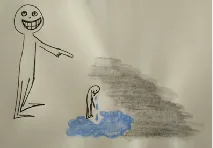
It seems very common in people who have been sexually abused that one of the impacts or consequences is that we develop internal critics that are very abusive, because we reproduce the pattern we have learnt.
When you live for so many years with that type of internal criticism, it establishes so strongly on the belief system that it becomes hard to differentiate what’s abusive from what’s not, creating an oppressive relationship towards oneself.
I have lived a lot under my critic and have been controlled by him. I got to a moment where I hated myself and my body and, to disgust and to despise myself… It’s easy to oppress yourself when you have a lifetime of practice and it’s hard to notice when it’s happening in order to establish boundaries.
In abuse, the ability of saying NO is lost, absent. Negotiation with your own bounderies is complex since there is no healthy pattern to follow and you can easily come back to self-abuse. While writing this chapter the metaskill of not pushing myself has been crucial; because the pusher role is very much present in these kinds of dynamics. I had to remind myself that nothing had to happen and that I needed to constantly renegotiate my boundaries in order to avoid reproducing abuses.
Regarding consent, I had to work on it from within, on my internal dialogue. It has been a balance and a negotiation between a part of me that struggles to escape from the victim role and another that needs protection. If I were working with a client I would have to pay close attention to feedback, but in my case I have to be very conscious about my own signs.
Over the years, as well as during this journey, my belief system has evolved. Now it’s more flexible, fluid, less critical. But still there are some internalized critics that are hard to detect and stop. As I have developed my secondary process, it has evolved and integrated to my identity and it has allowed me to reach the meta-communicator. To be able to become aware, from a detached observation, has been a very important aspect to be able to stop the internalized oppressor. It has been revealing to recognize on my internal psychology the abusive pattern that annulled parts of myself. I appreciate reading my own story and recognizing who was writing it in every moment.
In my life, the critic had become the director who defined what was going on. He had taken the power and the reins, he had possessed me, and all of me obeyed what he said, leaving many parts of me marginalized and invisible.
By working on my internalized oppression I was able to separate the different voices as if they were a group and I have gotten to know some that were let silent. With this I feel more free and with less tendency for depression.
In order to work with this oppression I had to detect that I have a preset theory, a story about me that I created for myself and that I have assumed and quite often it pathologizes my experience.
Paying attention to the relation between internal and external voices has been crucial to be able to detect when things detonate on my and understand why. This comes to show how we are both victims and creators of our own history and at the same time the potential we have to set ourselves free from it. Being aware of what oppresses us is a huge step towards liberation.
By developing the meta-communicator and sorting out the different voices, I’ve observed a tendency to eliminate positive things I say or do, leaving only the negative. It’s like seeing the glass half empty. It has been an exercise to notice at the moment it’s happening and bring consciousness so that in a way the experience becomes more democratic.
As it’s mentioned earlier, pushing and marginalizing experiences is part of the pattern. I have ignored my fears and invalidated my intuition because I considered they started the repression. For instance, when I was afraid of going somewhere I didn’t let the fear stop me. I crossed over the limit under the belief that if I let the fear win I was never going to be able to enjoy. Interpreting fear as repressive and not listening to it made me lose the information it was bringing to me. Furthermore, ignoring the signs led me to abusive situations. This is why I find it important to remind myself to trust my body and the way I perceive the experience through my senses.
The exact same process of marginalization happened when I went to the neurologist and explained my epilepsy episodes. He marginalized my experience by denying it and by placing his knowledge first in order of importance, generating me confusion and pain. The doctor has his theory but I have my truth. The side of me that believes in what I have lived is the one I have to give voice to, the one that needs support. This is the intuitive non- dualistic part of the experience. I have to trust the sensation and carry on, otherwise it becomes a source of suffering and confusion that can lead to perturbed states. Following myself will be profoundly pleasant.
A similar process to the fear referred earlier happens when what we could call the tyranny of the inner child appears. One part takes protagonism demanding what it wants and leaving no room for anything else. Only the needs of this part are present, which takes a fascist attitude and overshadows the others. Whenever this happen I need to remind myself to give me space so that I can listen carefully beyond this imposing part.
When there is a history of abuse, it’s important to pay attention to the use of power because it has been misused causing suffering and pain. This creates an unhealthy pattern. So we need to be aware that we are not reproducing internal or external abuse. It’s important to find new ways of handling and sharing power. For me this was hard work. There were times when with masculine figures I got dreamt up in the struggle in the abuse. Or when I felt fear and I established limits they were harsh and rigid, not being aware of the impact that I was causing
It is also true that having gone through abuse and surviving to it can lead to a great knowledge and development of empathy, assertiveness, connecting to what you want and a profound understanding of life’s nature, … It is a power that in Processwork we call “psychological rank31”. It can be developed by working on yourself to transcend the impact of the abuse experience.
This awareness can lead to pleasure. And for me it is pleasant every time I share it and make the field richer. Also, every time I take a step forward healing these wounds, every time I place a boundary to take care of myself and every time I come closer to healthy relationship patterns. This power is also pleasurable when I accompany people on their own abuse histories and I get the sense that they are feeling understood. It is in these moments when it’s all worth it, when the experience stops bleeding and starts to shed light and heal.
Abuse causes deep wounds that require time to heal. It generates isolation and loneliness because even nowadays these themes are still taboo and are not openly discussed. This is why it is so important to me to give voice to the hidden, the marginalized and name it in public as scary as it is. As well as it is speaking out about the consequences of abuse and how they affect a great amount of aspects of life that are carried in silence. In a way, sharing my experience is reaching out to people that have experienced similar situations and make them feel less lonely and more supported.
9) The unexpected on the road
a) “Life is what happens while you are busy on making other plans” John Lennon
Following the flow of process also involves going with what is happening in a given moment, rather than resisting it. This does not mean just letting things happen, or passively accepting oppression or harm. It means that when an obstacle or difficulty arises, we face it in order to find out what changes are meant for us in that challenge. This is a spiritual attitude that is interested in discovering how our innermost being attunes itself to whatever arises in everyday life and how this prevents us from being victimized by our experiences.
Diamond & Jones, 2004: 19
Inspired by this paragraph, I realize how important it has been to make pauses along the writing process in order to observe what was happening with each letter, with each word, and with each sentence. The fact of having followed the signs has served me as a guide to obtain information, and especially to avoid being a victim of my own experience and not marginalize myself in the course of this journey. Going with the flow implies going with what shows-up, and that is part of the connection with pleasure, with being close to the process and with what it manifests: limits, critics, blocks, different rhythms, discoveries, …
As paradoxical as it may seem, this pilgrimage of pleasure has been a difficult, agonizing, and suffered path. Nevertheless, at no time do I regret having decided to undertake this journey. This journey has become lighter as I discover myself in it, establishing a closer relationship to the process. This has helped me to reconnect and give me a space to live within myself in a different way, with the presence of previously marginalized or silent parts due to internalized oppression.
I’ve been writing and exploring for about a year. I have gone through different stages that required different rhythms and implications, and it has been important to respect them. After months of writing, I remember telling my supervisor, very satisfied, that the words came out very smoothly. His reply was that it was not always going to be that easy, and that the time would come where I would have to write about the limits that would emerge. Hearing that made me angry and sad. For me it was a surprise to be enjoying the writing, and to hear that , all my critics were constellated in this respect. I blocked myself in such a way that I was unable to write or read for 40 days, feeling a very distant relationship with pleasure. Upon returning to work after that time, the letters and feeling of my dissertation began to change. When I read the first sentence, my eyes filled with tears. There was sadness and pain between each line, and I had been marginalizing it under the imposition of my higher dream. I had become a slave of a superficial dream and one of appearances, called “Pleasure”. I learnt that talking about pleasure was also talking about pain, sadness, difficulties … of whatever was in that moment and needed to take some space. Something that was deeper of what I had always understood by “pleasure”.
It is interesting to observe how there we some stages where I would freeze, feeling uncomfortable with the journey for weeks. In other times, the words flowed as if I glided without resistance in a river downstream. The chapter on the historical course of pleasure was tough and there were countless critics around me commenting on my writing. I did not know how to enjoy that section, and I realized that I didn’t really want to write about it because it was not what really interested me. I did it influenced by a belief system that imposed on me the need for a more rational or theoretical chapter.
When I started talking about abuse and trauma, I consciously needed to put a brake on the journey, breathe and go slowly. I had to be aware that, often, when an abuse occurs, everything happens very quickly, unexpectedly and we do not have much time to react. And to be able to talk about it, I had to give myself the space to feel and not ignore the signals that were happening, in order to not reproduce the abuse. It has required a lot of honesty with myself and of having awareness of every moment. I could say that writing about the abuse, despite being painful at times, has been pleasant. This is because it has allowed me to live the quality of being very connected and close to my essence, with the sensation of healing, self-care and liberation.
Other chapters, such as the one about the childhood dream or the internalized oppression, have fascinated me. I have been able to enter and discover new realities, like someone who enters a forest and is surprised by every being or detail that makes up the landscape. In these chapters, creativity emerged, offering a wide range of possibilities and a greater pleasure in exploration.
Nevertheless, it has not been easy to give space and time to this exploration, despite having decided initially that this was going to be one of the pillars in the journey. I was influenced by the belief system that says I am wasting time if, instead of writing, I start to draw, to move the body or to create sculptures in relation to the process. It took me many months to be able to use art and body, and that’s when I really enjoyed the journey. Movement and creativity are basic in my nature. But often reason and productivity, as roles supported by the dominant culture, take over my being and separate me from what fills me with life.
A very precious role for my writing process has been that of Time. The Greeks had two words to refer to this: “Kronos” and “Kairos”. For me it has been important to understand the difference between them. Kronos measures time in a linear way, in terms of quantity and productivity, and blocks me in many moments in which I do not feel I am “getting enough” based on my expectations. On the other hand, connecting with Kairos, the now, the eternal present, allows me to forget the notion of minutes and hours, and enter the experience, like diving among the letters, experiences and concepts. It is in this kind of time that I feel “present in the present”, where I have the sensation of “taking advantage of” time and of learning and advancing in the process.
Any other kind of time, when one is not in the present, means a loss in vital terms, because in it there is no presence. The loss of time occurs when there is no succession, when we are fixed and trapped, existing in a linear time; basically we walk without moving from place, not going anywhere in terms of soul development.
Almaas, 2002: 186
This “walking without moving from place” reminds me of the image of a hamster circling a wheel without advancing. For me, those moments are the furthest from the concept of pleasure. In Processwork we could say that we are cycling around a limit. This happened to me with writing when I really did not surrender to the experience of what I was writing.
Almaas explains that life is constituted by a succession of moments of presence in the now, of being present in the present. It talks about what the “real time of the individual”, is of real life. In my experience, this real time is what I could connect with when I talk about pleasure.
For me, pleasure are those instants of presence, feeling and connection with what I am doing or experiencing, either through the relationship with the other, or through myself when I eat, touch or am touched, etc. It goes beyond the fact something is pleasant or not for the simple fact of being that something. It has to do with how I am doing or experiencing that something, a “feeling attitude” to life, to things, to facts and to relationships, … And this attitude has been an important one and the one that has made sense at the time of writing this dissertation, the attitude being as important as the topics discussed.
Half way through the journey, I discovered details which allowed my fingers to slide across the keyboard in a fluid way: to write in beautiful places in nature, to have the company of music, to give me space to stop and feel, to draw or move what I was feeling. It was beautiful to listen and recognize where pleasure was taking place while I was in front of the computer. There appeared a new way of doing, a new journey of life, a journey from another place.
As I write about this, I smile, I get emotional and my tears fill with tears. This is because for a big part of my life I did not know how to be in this place. I did not know how to see beauty, the value of small things, the good face, etc. I did not know how to give myself the ability to listen to the feedback my body gave to my thoughts, doings and feelings. By finding pleasure as I wrote, I began to change a pattern, to somehow put limits on critics and tyrannical belief systems, that had seized me and distorted my view of reality.
At times I have tried to be linear in the writing process. In others, I have let myself be carried away by the momentary flirtation32 of the experience that called me to be expanded on. As I have let myself be carried along by the unknown, by what caught my attention, I have been getting into the pleasure of writing. I liked the feeling I had, especially at the end of the process, that I was opening little doors in a labyrinth where I was learning and understanding difficulties, where a knot seemed to be unraveling, and where the path took on more and more light and color.
I realize that there have been points that I left to the end, and have been subsequently left out of the dissertation. A chapter that sadly had to be discarded, was “The body of a social, cultural and political woman in relation to pleasure”. A subject that lives very close to my heart and my essence, and the theme that decided the subject of this dissertation. Exploring and writing about women, sexuality, social and cultural limits that restrict our pleasure, were themes that pushed and inspired me during this writing process to dedicate to it so many hours. And it is curious that on the way I decided not to go there, when initially for me it was the aim. But if I learned something along the way, it’s that I can not control everything that happens, and traveling means being open to what is happening.
And in this case the trip needed to come to an end, through extension, fatigue and self-care. As I said at the beginning, I knew what the departure station was, but not the arrival time. And in this case the arrival, for the moment, carries the sign of Self-care, Self-respect and Self-love. An arrival and a beginning in itself.
Our culture is made up of beginnings and ends. Everything starts and everything ends […] However, not all cultures think the same. The diagram that reflects the flow of ying and yang illustrates the perpetual movement of essences; nothing starts or nothing ends, everything flows, and when it reaches a maximum, this maximum already contains in itself its opposite.
Tasso, 2008: 79
More than a year ago, a book by Mireia Darder fell into my hands, “Born for pleasure”. This was an ally to encourage me to give a voice to pleasure as a woman. I even facilitated a series of workshops for women on empowering us through sexuality, from the perspective of Processwork, in order to start investigating the topic. But as I got deeper into exploring the concept, it expanded, encompassing topics that I hadn’t contemplated. Curiously, towards the end of this journey, another book by the same author that has just been published came to me: “The Society of Abuse”. And that’s how the journey went. I couldn’t investigate the pleasure and sexuality of women, because abuse got in the way. For me it has been necessary to transcend and process this history of abuse in order to approach pleasure, since this was one of the main factors that separated me from allowing me to connect with pleasure.
Luckily, throughout the journey I have been able to flow with the path and I have not been distracted by the destination or goal of completion, which would have generated tension, sabotaging my own journey.
Other topics that I would have liked to develop or work on more: my life myth in relation to culture and its ghost roles, altered states and addictions related to pleasure in society. But above all I would have liked to have involved the body and movement more, taking more advantage of my creativity and intuition. And not to have let myself be led so much by the belief that I had to do a “serious and standardized” text.
On the other hand, issues that did not appear in my initial idea, such as abuses, took their strength and place in this process, bringing an important component for healing.
Something interesting along the way has been to understand that life is a mystery to be lived and not a problem to be solved, and the same happens with pleasure. Initially I saw it as something problematic in my experience. In changing my way of looking at it I have enjoyed discovering the mystery behind my relationship with pleasure. Sometimes our thoughts are limited and this is oppressive, and often pathologizing.
b) The critic as an ally
Something that has been very present throughout the journey, and from which I have learned a great deal, has been the constant awareness to avoid making pathological definitions about myself and my experience. It has been surprising to see the great number of times I oppress my experience by pathologizing it, without giving it any option to be explored.
Given the critical presence of the critic from the beginning of the dissertation, it has been important and crucial to give it space and listen to it in depth.
Within the individual belief system, there are the inflamed systems that are occupied by critics, which are larger than individual psychology. They are composed of individual, sociocultural and sociopolitical belief systems. These are internal oppressors and have sociocultural aspects, but we have internalized them. The internal critic is generalist, it is not specific, and that makes it useless.
At first, following process by turning in the direction of oncoming trouble May feel counterintuitive or even dangerous. […] Going with the Tao by turning to face oncoming troubles frees us up, because physical and emotional Energy are no longer spent in resistance.
Diamond&Spark, 2004: 19
I find it interesting to talk about the role or figure of the critic, and look at it this time with affection, attention and compassion. It has accompanied me since I was barely conscious. We have climbed mountains, crossed rivers, traveled plains … It has always been there, and often has things to say. It has taken, or been given, a space where it’s voice was given a lot of attention and even guided the process, taking a lot of power and strength. But its ways have not been those of a good traveling companion, generating much pain, oppression and suffering. On this trip, our relationship has been modified every step of the way. It has not been an easy task, but it’s been very necessary for my health and well-being. In fact, this work would not have been possible without this change in our relationship.
In my story, my critic has had a very strong influence, minimizing my pain, pushing me to surpass edges, oppressing me and making me believe that I’m useless. That is why it has been necessary to train or educate it to be able to listen to it and find the usefulness of it’s messages. I have collected every critical voice that stopped me as a writer, exploring it and listening to it until I found the useful message and the wisdom it brought, deepening and becoming aware of different aspects in order to write in my totality and feel more complete.
Learning how to use the critic, not just combat it and be trapped as a victim, has to do with a new use of power and pleasure. A way to follow my nature and take the critic to a world of beauty. A necessary step to learn to focus more on the beauty of life.
We are talking about something very profound, it is not just pleasure, not just to take us to heaven. It is a change of perspective for the world. The critic was one of the worst things in my life, and what I did was to change it with creativity and with a new look, until it became an ally to enrich my writing and my process.
❖ Some of the critics’ voices:
C: “You won’t be able to spend so much time researching about pleasure if you don’t know how to connect with it. You won’t be able to sustain it and you will get depressed again “
→ Importance of paying attention to what happens to me, knowing that I have great limits with pleasure. It indicates that in depression there is something important to explore. The definition of good and bad, of knowing or not knowing how to be in a certain way, is what creates suffering for me. Thinking that I should be connected with pleasure makes me suffer.
C: “You’ve never been able to connect with pleasure and now you are writing about how to live in it. You don’t even know what pleasure is! You have an “handicap” “
→ Idea to focus on the struggle to be in pleasure, to try to be in the moment.
And look at what limits prevent me.
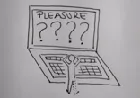
C: “Why do you have to differentiate between male and female sexuality in relation to pleasure?”
→ It highlights an important historical aspect of both the body and the history of women, as opposed to men. It talks to me about sexism, about the patriarchal system…
C: “Watch what you say if you mention feminism and if you talk about women. If you talk about feminism, you have to read many books and make very appropriate reflections “
→ Brings to mind the belief systems that influences us.
It reminds me that I am writing about my experience. The important thing is the respect towards myself and towards my truth, beyond what the majority culture thinks or says.
C: “If you’re not pure or perfect, you’re going to be criticized”
→ Helps to frame a social ghost role that is present in many ideologies. This role is the opposite of pleasure, it silences people and silences me. It’s in feminism, racism, Marxism … Talk about how these role dynamics extract me from pleasure and free expression, and they don’t let me be for fear of humiliation or criticism.
C: “No one will be interested in reading a dissertation about someone’s life. It’s going to look like a personal diary. “
→ Bring the focus to other people with similar experiences, and to what they
can do to not feel so alone. What I live or what I learn is personal, but the patterns can serve others. Remember that working on the personal is political and necessary.
I can speak positively of the other side of pleasure and thus see what mechanisms and processes move and impede access to pleasure.
C: “It has to be useful for something.”
U → Indicates the importance of how to make it useful for me and for others. It helps me look for meaning and to whom it is aimed at.
C: “It is incongruous to be doing this work with anxiety. You don’t find pleasure writing the dissertation. “
→ Remember the importance of not oppressing myself, of paying attention to the critics or belief systems under which I am operating.
Aim to find ways to write where I can enjoy it and find the part I want to be writing, rather than feeling obligated to do so.
Talk about a social belief system about the pressure to feel pleasure.
C: “Do not waste time with drawings, creativity and playing to move your “little” body. Be productive and move forward. “
→ The connection with myself and the ability to look for non-rational ways of learning are crushed by sarcasm, which is abusive. It is a social and cultural edge.
C: “You do not know how to write well, that’s why at school they always suspended you. If you do not feel what you’re writing, you do not understand anything and it’s chaotic. “
→ Emphasizes the importance of connecting with the heart and feeling, to be
able to express from there. It reminds me that my potential lies in my ability to feel.
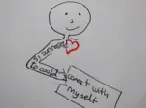
C: “If you do the thesis on pleasure, people will think you’re a” pervert. “
→ Talk about the belief system of society. There is a cultural edge. At first it was hard for me to say that I was doing a thesis on pleasure. I justified myself by explaining that it was about going beyond sexual pleasure.
C: “If you don’t explain your whole story, your reason for doing this won’t be understood”
→ Reminds me of the importance of boundaries: I am not bound to anything. Neither to write the theoretical part of historical evolution, nor to share my most painful moments or situations. I can explain my learning process without having to go into intimate details that I need to safeguard.
C: “You are not writing anything new. You are not contributing anything. “
→ Reminds me of the need to believe in myself, to trust in my experience and, in some way, how important this can be for the world.
There is a lot written about Processwork. I have taken all this generated learning and I have focused on this particular topic. But above all, I have researched through my own experience to widen my learning.
C: “You will not know how to close the dissertation because it will never be enough. You’ll have to have understood everything to be able to finish. “
→ Warns me to pay attention to my self-demand and perfectionism. Also to keep in mind that it is a very broad topic which I will have to limit because I can not pretend to cover everything. Accept that something will always be missing. It reminds me that pleasure has to do with setting boundaries.
10. Conclusions and lessons learned
We define reality based on the experiences, knowledge and social and cultural systems in which we have developed. We create our own view of reality, and in my case it has been necessary to change my viewpoint in order to broaden my perspectives. Pleasure had no place in me. I have had a job to deconstruct all the barriers and beliefs that denied it in me, binding me to an identity of suffering and struggle. I had created my own boundaries within my world, and I had left out the pleasure. Only I could give myself the permission or the opportunity to create something different, and I have done so.
Getting to this point, I connect with a familiar difficulty: to close and set boundaries. I feel the fear, the weight of the demand, the sadness of letting go, the insecurity of venturing into what comes next, the resistance to abandon what I know … Countless sensations, emotions and thoughts run through my body and occupy my mind. And so as not to get carried away by the confusion, I look at the whole journey I’ve made with this paper, and especially with learning to put boundaries, to say no to abuse or critics, to stop the obsessive thoughts or the constant pathologization towards myself. And connecting with this capacity that I do have, I continue with the need to take care of myself and to give space to the new things that arrive. So it’s time to close this journey.
It has been a journey full of learning, mainly on an experiential and emotional level, rather than rational or intellectual. If there is one thing I can say it is that it has been a pilgrimage to find the union between my body, my mind and my soul. And today, seeing the end come, I can be satisfied on an experiential level of the whole journey. It has been a long and hard path where I have felt stripped down to my soul, and I’ve learnt to do it from care and respect, and above all I’ve discovered unconditional love towards myself.
I began this trip thinking of pleasure as something static, determined, as an end or place to reach, as if it were an objective. And my great learning has been to discover the journey back home.
Yes, it’s been a trip back home …
One of the key aspects to be able to return to what I call “home” is to re-inhabit my body, to breathe and feel inside it. That the body ceases to be a hostile, painful or dangerous place to be in, and that it becomes a home to welcome me, to give me refuge, to enjoy myself and above all, to feel safe with myself being my own caregiver. This is opposed to the experience of the body as a place from which to flee, as what happened with abuse or epilepsy. Going home is feeling that I live inside of myself, and that I am in connection with my nature, my essence and with the deepest sense of myself.
A second key aspect has to do with the learning that gives me the detachment I find when I go to the essence, to phase 4. A learning that nature presented me with, when I was close to death living the earthquake, where I was able to connect to a state of very deep pleasure and relaxation, beyond what was happening. It meant accepting death and letting go of struggle, identity, consensual reality and polarities, to go to the essence level.
I began this journey with an intention, but the process emerged through the writing. The abuse penetrated the writing without leaving space to continue in the pursuit of pleasure. In my case, abuse and pleasure were totally connected, and it would not have been possible to return to my own body without embracing the history recorded in it.
I discovered that for me pleasure is to be fully connected with my totality, it is to welcome and embrace all my parts in harmony. Part of being in the whole means saying NO to the critic and breaking the pattern in which I do not give space to myself and to my wholeness, including my imperfections within it. And abuse is part of my history, sexual in the past, and then internal abuse, although now with less presence and intensity, continues to inhabit my daily life.
For this journey I prepared myself before leaving, looking at what skills and meta-skills were going to be useful to make the way as beautiful and pleasant as possible. I embarked on the path to the exploration of pleasure through my own experience, belief and experience of it, as well as observing what it meant or had meant for society throughout history. I also explored it in relation to health and how we manage pain and distress as a society. Nature appeared on the path, and the importance of connection with it, with its cycles and rhythms. The importance of accepting it as it is, without wanting to dominate it, or that things are in a certain way. Nature and the Taoist vision brought me important teachings for the connection with pleasure.
In this process it has been important to know my mental territory. To know my belief systems and my reactions around fears and rejections, and crumble every voice of my critic to unveil the message that was hidden behind it. And not only the mental map, but also the corporal one. I have explored the world of dreams through the chronic symptoms, bodily experiences and important events that have taken place along my path, to reveal the mythical energies or the archetypal patterns of my being; the tendencies that have been present throughout my life. In all of them I have seen how through the secondary figures I can have greater access to pleasure. Even those figures that have had a great impact on my life have been seeds of learning and transformation.
Being able to explore different roles, voices and experiences has been crucial for trauma and abuse work. To work with the different dimensions and to be able to accept the different phases of experience and engagement with abuse. But to get out of the role of victim has been essential for the work on my internal abuser.
Thanks to all this I have stripped of all those layers that in the past I created around myself to cope with this world. It has been like taking layers off an onion to leave myself naked of critics and belief systems, and thus be able to recognize myself again, reconnect with my essence and decide what dress I want to wear and how. To stop surviving, to begin to decide which life I live.
It has been a journey towards completeness, towards the self-discovery of who I am and how I handle myself in the world. I have explored both the most known parts of my identity, as well as those more remote, with the aim of having a more complete vision of myself and, consequently, a more democratic reality.
Working with pleasure and this long term process with my edges to pleasure has helped me to know myself more and connect with my life myth. I have discovered that to connect with pleasure is to connect deeply with my being, it is to be intimately related to my desires, to my needs. It is to be very close to myself and to follow the signs carefully.
By working with my long-term edges, I have begun to integrate new experiences and, in some way, a new identity in my life, integrating more the permission to be creative, to feel and to appreciate beauty. It has been when I have loved myself enough that I have seen myself in my totality.
As a heuristic project, it has been very necessary to have external help. Supervisors who have nourished me with their feedback and have helped me to deepen the process, with an unattached external look. It has also been important to develop in me the metacommunicator’s gaze, to observe the primary and secondary processes of the experience, without judgment and with compassion. This has helped me to open up the experience and explore it from curiosity.
To accept that change is inherent to life and that things have their process and take time to change. It is not easy, but it is essential. At first, I longed to connect fully with pleasure. But it has required a long time and an acceptance of the mystery of life, to get to where I am today and connect with what I now call pleasure. It was different from what I believed a year ago. The perspective of life changes as well as the meaning of it’s importance.
“We did it because we did not know it was impossible”
The simple fact of making this paper has let me look at pleasure, validate it and give it space to integrate more into my life. Paying attention to each moment, attention to what makes me connect or not to myself, and observe under what beliefs and voices I act at each moment.
Pleasure …

What I have discovered about pleasure is that I can not break it into pieces,
but I can only contemplate it as a whole.
It is not necessarily a place of ecstasy,
nor of happiness, nor of absence of suffering or pain.
It is a state that goes beyond being or not being, but how to be.
Pleasure is to be in the moment and welcome what there is without fighting.
It is accepting its nature.
Speaking of pleasure is talking about the present, and even of abuse.
Because everything is part of the same story, of the same reality, of the same patriarchal culture that is part of the whole world and its complexities.
It is to be in the fluidity of the process and to accompany myself through the
difficulties.
It is to listen to myself, to feel myself and to follow the signals of my body.
Yes, it is to listen to my body and to its wisdom.
It is the feeling of freedom in not getting attached and being able to set boundaries.
It is knowing how to say YES when it is YES,
and knowing how to say NO when it is NO.
It is to go into the abuse to extract the power that is hidden in it.
It is to discover the internal map and go into the depths with compassion, curiosity and love.
It is to love myself unconditionally.
It is to respect myself in my fears, edges and insecurities without pushing them.
It's stopping the one who pushes.
It is to curb obsession or judgment, and in turn accept that there is.
It's accepting that I make mistakes and to take them as learning opportunities.
It is to see the teacher in the abuse.
It is accepting me in my diversity and totality and that the different parts coexist in harmony
It's being ... without the weight of beliefs and obligation.
To put a boundary on the writing and help me draw it to a close, I need to accept that these conclusions will not be perfect. Imperfection is part of the mystery of life and non-suffering. Without the imperfection the pearl would not have been created inside the oyster. Imperfection brings beauty and magic. We try to describe magical things, and sometimes it’s difficult.
From here I look at my story with gratitude and respect, and I am happy to bring this dissertation to an end and to make space for new stages of my life. I know there is a lot to learn, but what I have learned so far is enough to keep me moving forward. Accepting and recognising my story is a great base from which to start a new path. I am prepared and excited to develop and explore new patterns, landscapes and experiences. I welcome the mystery of life.
I close with a phrase that shook my heart when I read it: “Recognize that in the place where we are, we have arrived”. Therefore, everything I seek outside or in the future, is already within me. It’s just about trusting it and giving it space. <<Eva…welcome home>>
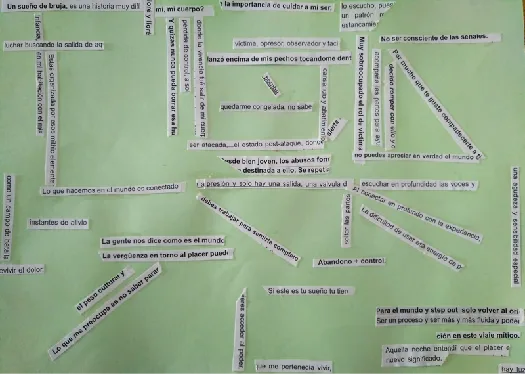
11. Bibliographical references
Ahmed, Sara (2010) The promise of happiness. Duke University Press.
Almas, A.H. (2002) Facets of the unit. The Enneagram of Holy Ideas. La liebre de marzo
Castaneda, Carlos (2017). Viaje a Ixtlan: las lecciones de Don Juan. México: Fondo de cultura económica, 1972. Reimpresion 2017.
Darder, Mireia (2014). Nacidas para el placer: Instinto y sexualidad en la mujer. Barcelona: Ridgen institut gestalt.
Darder, Mireia (2019). La sociedad del abuso. Mostoles: Ridgen institut gestalt
Diamond, Julie and Jones, Lee Spark (2004). A Path Made by Walking: Process Work in Practice. Portland: Lao Tse Press
Han Byung-chul (2002). Filosofia del budismo zen. Herder
Han Byung-chul. La sociedad el cansancio. Herder, 2012
https://archive.org/details/271058357LaSociedadDelCansancioByungChulHan/page/n67
Kumar, Satish (2018). Simplicidad Elegante. Barcelona: Icaria
Mindell, Amy (1995). Metaskills, the spiritual art of therapy. Okland: Lao Tse Press
Mindell, Arnold (1995). Sentado en el fuego. Barcelona: Icaria
Mindell, Arnold (2006). El cuerpo que sueña, terapia centrada en el proceso. Barcelona: Ridgen institut gestalt
Mindell, Arnold (2017). El cuerpo del Chaman. Barcelona: DDeXpresiones de democracia profunda
Mindell, Arnold (1995). River’s Way: The Process Science of the Dreambody. Penguin
Mindell, Arnold (2017). Conflict: Phases, Forums, And Solutions.
Muñoz Goulin, Julián (2001). El Taoísmo. Madrid : Acento, cop.
Tasso, Valérie (2008). Antimanual del sexo. Temas de Hoy: Madrid
Tse, Lao (2016). Tao te ching. Granada: Valparaiso Ediciones S.L.
Van der Kolk, Bessel (2015). El cuerpo lleva la cuenta: cerebro, mente y cuerpo en la superación del trauma. Barcelona: Eleftheria
Pierre Morin i Gary Reiss (2010). Inside coma, a new view of Awareness, Healing and hope. Praeger
Watts, Alan (2010). Qué es el Tao. Barcelona : Kairós
Others:
A lot of information is drawn from different seminars that I have attended during more than 7 years of training mostly in Instituto de Trabajo de Procesos and Deep Democracy Institute.
Much of the Glossary is taken from Merged Glossary
http://psicorockgia.com/la-sociedad-depresiva-del-siglo-xxi
Video Pierre Morin: https://www.youtube.com/watch?v=2FD5_qFRcpY
- Attributed to Carol Hanisch ↩︎
- Attributed to Arnold Mindell ↩︎
- Edge: represents the limit of the known identity as well as a point of contact with unknown experiences o identities. Structurally speaking, an edge separates the primary from the secondary process. Facilitators use a range of tools to help a person go over their edge and complete what she or he is trying to say, do or be. ↩︎
- Frame: metacommunicate about the processes or give the “weather report” of what is happening to help bring awareness. ↩︎
- Field: An emotional atmosphere or a felt sense of a particular shared consciousness that seems to be transmitted by acausal non-Newtonian means. Or, an area in space within which lines of force are in operation. It is simultaneously everywhere with everyone. It is here and now in its entirety, whenever we merely think of it. ↩︎
- Teleology: A belief that natural phenomena are determined not only by mechanical causes but by an over-all design or purpose in nature, or that there is a final or future cause. ↩︎
- Consciousness: Awareness of awareness, i.e., an ability to be aware that one is aware of phenomenological experience. ↩︎
- Signals: Pieces of information. An indicator, generally in movement, language, verbal tone, or other nonverbal signal, that carries meaning. ↩︎
- Belief systems: a set of principles or tenets which they are influenced by a number of different things in a person’s life and change over time. ↩︎
- Role: A view point or function within a field, generally occupied by various people at different times. The concept of roles belongs to the dreamland aspect of process. While each role such as boss, underling, patient, or helper seems to be located with a given individual. And, each of us is bigger than anyone role. In other words, people are not roles ↩︎
- Metaskills: Ability to apply the skills. Feeling quality behind our abilities. It is the felt attitudes, values and beliefs that deeply express our way of working with others. ↩︎
- Inner critics: usually we say “inner critics” to differentiate from an external critic (e.g. another person) but of course many internal critical voices can also be like internalised oppressions etc…i.e. we have internalised something that put us down because of our gender, age, and also through abuse and humiliation and other trauma. ↩︎
- Deep Democracy: A belief that there is wisdom in, under, or behind all views and that there must be freedom for the expression of diverse opinions and experiences so that the deeper wisdom can be understood and so that sustainable solutions to complex problems can be found and healthier communities can evolve. Deep democracy is a basic concept as well as a multidimensional metaskill (feeling attitude) towards life which recognizes the basically equal importance of consensus reality issues and concerns (facts, issues, problems, people) dreamland figures (roles, ghosts, directions), and the essence (common ground) that connects everyone. ↩︎
- Elder: Role or figure that has the ability to understand, empathize with and support conflicted individuals or groups on all sides of an issue simultaneously and compassionately. ↩︎
- Secondary experience: are related with the marginalised process. ↩︎
- Secondary process: Refers to those experiences that are further from a person’s sense of identity. Aspects of ourselves that we, as individuals or groups do not tend or want to identify with. Often we project these aspects onto people we view as “other.” We may marginalize or admire these qualities, creating inferior or superior traits in other groups. ↩︎
- Essence: The common ground that connects all of us. When the essence arises it
expresses itself in terms of parts and processes of Dreamland + Consensus Reality ↩︎ - Synchronicities: An apparently meaningful coincidence in time of two or more similar or identical events that are causally unrelated. These are combinations of psychological and world or physical experiences. ↩︎
- rank: A relative position in society, an organization, community, or relationship that occurs based on perceived differences in various dimensions such as gender, race, age, orientation, appearance, health, education, language, financial status, psychological or spiritual awareness, etc. ↩︎
- Channel: are signal vehicles, which convey intended and unintended communication. In PW we talk about 4 irreductible channels: proprioception, visual, auditory and movement; and two composite channels: relationship and world ↩︎
- levels of consciousness: we understand that …there are three levels, consensus Reality, Dreamland and Essence. All the levels are happening at the same time simultaneous. ↩︎
- Social Rank: it is one of the 4 kinds of rank in Processwork’s paradigme. It is an external kind of rank determined by the culture and society in which we live. ↩︎
- Attributed to Mahatma Gandhi ↩︎
- Attributed to Brigitte Vasallo ↩︎
- X energy: is a disturbing energy, related to the secondary process ↩︎
- Dreaming: capitalized, is used to denote the realm of undifferentiated experience, what Mindell also calls sentient reality. The lower-case “dreaming” refers to noticing and following dreamlike experiences ↩︎
- Metacommunicator: it is a kind of “detached observer” found in Buddhism. It is a self- reflective capacity to notice, organize , and report on one’s experiences. (Diamond&Spark, 2004: 28) ↩︎
- Altered state: It is a state out of ordinary consciousness ↩︎
- Attributed to Bessel Van Der Kolk ↩︎
- Ghost role: In Processwork are those roles that are part of the system, but are not present, in that no one in the group represents them. Voices, perspectives or opinions not accepted or valid by the majority or group culture. ↩︎
- Psychological rank: it is one of the 4 kinds of rank in Processwork’s paradigme. It is internal, related with personal qualities and the way to deal with life. ↩︎
- Related to Flirt. Flirt: We use the word “flirt” in the most general sense of something trying to catch our attention. A flower for example, may “flirt” with us (and vice versa!). The flirt happens so quickly that we usually pass it by or forget it. Yet in communicating, the flirt plays an important role as the predecessor to signals, and potentially difficult communication situations. ↩︎