A Playful and Profound Exploration of the Life Myth in a Process- Oriented Perspective.
Preface
Welcome to my rendition of The Art of Being, a deep approach to the mystical triad- Life, Time and Death through dreamwork. My name is Christine Njoki Kuria, but I prefer TinTin. I am a diploma student at Deep Democracy Institute. I am writing this in partial completion to my Diploma in Process Work (Process Oriented Psychology) under the guidance of my wonderful mentors and guides at Deep Democracy Institute. I am also an affiliate of Deep Democracy Institute, Kenya an Alliance to DDI.
My gratitude to Ellen Schupbach, Yuliya Filippovska and Desmond Smith Mboya for their time and guidance throughout the process of writing this paper.
Thesis Statement
This paper uses process work paradigm and methodology to imaginatively explore the life myth in terms of Life, Time, and Death, revealing their deep interconnections beyond trivialization. By weaving humour and creative insight into this triad, I will demonstrate how these forces shape our consciousness and personal mythologies.
Introduction
Process work, or process-oriented psychology, is a therapeutic approach that explores how our personal experiences in terms of dreams, body symptoms, or social interactions contain valuable messages and insights. In this paper, I follow the process work paradigm and methodology to explore meaning and symbolism in the trivial yet profound meaning in what Life Time and Death is to the human race.
POP Core: Consensus Reality, Dreaming, and Essence
These are some key terms from Process work that are relevant to my work in this paper, that I will refer throughout.
POP = Process Oriented Psychology – Process work
Consensus Reality, Dreaming, and Essence in Process Oriented Psychology are the three distinguishable levels of experience which are foundational in understanding how individuals and groups experience reality, identity and transformation. Founded by Arnold Mindel, these three key aspects follow the process-hence process work, across all levels.
Consensus Reality (CR) refers to the shared socially agreed upon world objective, facts, norms, roles and measurable phenomena. This level includes physical laws, social systems and communication norms such as jobs roles, language use, or institutional frameworks. (Mindell, 1995)
In Dreaming level, includes the subjective experience, symbolic meaning and patterns beneath consensus reality in the dreaming realms, body symptoms, synchronicities and non-rational experiences. This level reveals underlying psychological or collective processes that may be unconscious but seek expression. (Mindell, 1985)“The dreaming process is not only found in sleep, but also in body symptoms, relationship difficulties, and world conflicts.”
In the Essence level, the subtle, sometimes seen as timeless, pre-verbal or ineffable level. It’s the place of felt-sense, silence, or spiritual insight. It represents the unifying ground of being, beyond form or content. Essence connects us with our deepest identity and the universal field of awareness. (Mindell, 2004)
Life myth, is a core often unconscious pattern or story that shapes an individual’s life paths, challenges, dreams and relationships. In POP, it reflects a deep organizing principle that reveals itself across time through recurring themes body symptoms, dreams and life events.
Quantum flirt, a flicker of attention grabbed in a mysterious way, that may be irrational or non- linear like a fleeting image, body sensation, or a signal unknown. It’s not a physical phenomenon, rather a metaphorical concept rooted in quantum physics language, applied introspectively, awareness, collapse of attention and potential transformation.
Dreams are categorised in two, Night dream being what you dream at night, and day dream is was imagination you may have while awake. Day dream may also mean, what you aspire to be, but in this content, I use the first meaning.
My Life Myth
As much of this unfolding process of writing this thesis follows my life myth, I share more insight to it.
Life myth originates from early childhood experiences and unconscious family/cultural influences. It is not a fixed narrative, but a living process that evolves as we become more aware of it, showing up symbolically in dreams, body symptoms, relationship patterns and or life struggles. “Life myths are like the personal myths of our lives. They show up early in our dreams, childhood experiences, or body symptoms, and often repeat themselves in key events throughout our lives.” (Mindell, 1987)
The life myth pattern is underneath polarities, when unfolded to Essence, it pushes its way up to be known, and it is the only role that is not attached to a Ghost role. Being conscious of your own life myth allows a deeper self-understanding, growth and more meaningful choices-essence. We can access this underlying pattern through early childhood dream or memory.
In my one of my earliest memories, I was playing and dancing with my brother, in complete abandon. We were both ecstatic and hugged with pure joy and love. In such a state, neither noticed the blood that was streaming from my foot, which had been stuck by a pin. My mother noticed and then took care of me, bringing my alertness to my state-the body symptom.
As it turns out, my brother, who is autistic and has epilepsy, does not allow almost anyone near him, throughout his life. I was the only one allowed to get close (this was in his early development age).
In love and connection, I am truly happy, and seek nothing more. When love is present and I can connect, the world stops – nothing else matters. This is everything for me. This has carried me through my life and my relationships, inspires my desire to be a therapist, and has kept me interacting with each of my family members. I am known as a “shoulder to cry on”, and I truly love that.
On the other side, at times there are painful experiences that I marginalize, often to stay in relationship. I am challenged to follow my own way, which doesn’t conform always to the needs of my family members or expectations of society. I am learning to make space for these experiences too, which has been a deep and liberating process for me. The worlds of creativity, poetry, music, and imagination are my solace and love. In this paper, I describe how I manage in moments to break out of role expectations to follow this deep need, and how I navigate between these two essentials aspects of my mythic journey.
In the Beginning.
In the beginning, there was nothing. A vast matter of darkness existed, basis on different records all citing the same, whichever you may believe, or consume, either in the record of this as per the Bible or the Big Bang Theory, or whatever we have found out, out of curiosity, our imaginations of the beginning are still an interesting topic to get indulged in.
And it is because of this reason that I too have delved into writing this paper, of what I imagine and what I process as entails the topic; LIFE, TIME, DEATH.
The question; Why partake this topic? What draws me to it? Was it because I had faced death recently or before? Was it because of my deep desire to understand life or was it the fear of losing time? Is it entirely my topic or was I shadow influenced by the wonderful movie ‘The Collateral Beauty’ or maybe it is the countless lyrics I have heard of artist saying they are in search of a better life? All I could come up with was, I may have a weird approach to life and I’ve been misunderstood most times because of my views.
And so, with that, my disclaimer! I am not writing to justify any philosophical point of view-well maybe I am, let’s see what emerges as we go. I’d hate to think, I’ll have to think about people who thought about thinking, nor am I sure this is the best approach for anyone who thinks is sane. In fact, this piece has taken me a while to submit, with many questions lingering in my mind, like whether I have this correct or is it plausible for a thesis.
I don’t doubt myself and the dream of helping people through this piece, (well maybe a little) but hear me out. I’d recommend to read this, with an open mind or in the least, as you would a storybook.
I haven’t claimed myself a good story teller, and I am doing my best telling this one, but if it’s not your cup of tea…
Myths and fairytales have been used throughout time to point to and name the unnameable, unfathomable mystery of life and death. In this paper, I use storytelling with that hope as well.
All those who ponder about Life, Time, and Death, in depth are in fact, thinkers, artists, and I as one, promise to take you on a journey, your liberty to judge afterwards, whether good or bad in this creative, humorous and profound outlook.
Welcome to the Art of Being.
Setting the Playful Stage
After having 12 drafts on my phone, and in all of them, having tried to write the reason for my topic, why I chose this topic, this area of process work. I came up with nothing.
I realise I didn’t exactly choose this topic. Life, Time, and Death more or less called a meeting and invited me in. They’ve been lingering around the edges of my dreaming world for a while now sometimes whispering, sometimes roaring, always just strange enough to keep me curious. I’ve met them in dreams, in body symptoms, in silence, in chaos. They come not as villains, but as eccentric colleagues, calling me out to believe they are alive. Yes, but deeply committed to my growth, I’d say I’m not afraid of any of them. In fact, I’ve learned to sit with them, talk with them, even joke with them.
But if I dug deeper to this, I found myself exploring the life myth through my dreams. My imaginations set a course in which I could see myself in a field unknown to me and set the stage for me to understand how all of this came to be. Without any bias I looked at the pondering of life like a child playing with imaginary friends, who identified themselves as Life Time and Death in my dream. This is also be shown in the sub chapter, Imagine Life Time and Death – a short story.
They remind me I’m alive. They remind me everything moves. And they seem to agree that our roles aren’t fixed; sometimes I lead, sometimes they do. In following the dreaming process, I’ve come to trust that what returns, what insists on being seen, demands attention. These themes often return in moments of transition, loss, or deep reflection, and they carry a weight that feels both personal and universal. I realize that this also emerges from a deep existential curiosity and reverence I have for the mystery of Life and Death, and how they interact within the unfolding field of awareness.
I find myself drawn to the poetic, spiritual, and unknown territories where Death is not only an end but a gateway to deeper knowing. Where Time, as ignorant as we are and as lonely as he or she is, is existing because I do, and the in between. Where Life itself, is a fated companion, that at times we get lost in our own emotions, ego, and the myriads of choices that we have to make, and in so doing we model Life who then becomes what we make it. Who we are.
In this sense, this project chooses me as much as I choose it. As I began writing this thesis, I had a deep seeded curiosity why, or what people thought about Death, Life, and Time. What kind of imaginations do kids have when they think about this concepts that seem very abstruse and wide. I was conflicted about what to write, in terms of making it simple, inclusive of everyone’s background and social norms, best way I could understand them. I also wanted to find a way to engage people into thinking in a curious-artistic or imaginative way that lessens the burdens of thinking of these topics without flinching at the philosophical jargons.
This process is a way of listening more deeply to their teachings, their humour, their paradoxes. It’s born from my own life transitions and from an existential appetite to know what’s underneath the ordinary.
My curiosities have been encouraged and informed by people like Martin Luther King, who had a dream about a future he didn’t know he would see or not, people like Nelson Mandela who had hope for his country to one day finding peace almost themselves as oppressed and oppressors. In hindsight, their stories and history depict how they lived in their dreams of a future in their present time. The literacy works of writers like Robert Greene, Mark Manson, Napoleon Hill, Dale Carnegie, Don Miguel Ruiz, who have worked to write about hacks to use to win the game of life. The great musicians of today that influence that narrative that life is worth taking head on like Kendrick Lamar, or the visionary Jon Bellion who gets lost navigating the game and fairness. Or the creative genius that tells tales in the most profound zen state, Hayao Miyazaki, (Studio Ghibli) that has an ingenious way of writing human emotions, and explain creatively what life time and death would look like in different perspectives
Through process work, I follow the dreaming process as a map, one that doesn’t promise clarity but invites me to explore the deeper architecture of experience. Life, Time, and Death aren’t separate from me, contrary, they’re part of the inner field, helping me rise toward my own potential, one mysterious magical moment at a time.
Life, Time, Death: The Mythic Triad.
The idea of a sacred triad or tripartite structure exists across many cultures, often symbolizing balance, cycles, or interconnected forces. In this attempt to understanding LIFE, TIME, DEATH, I came across many other aspects that try to symbolize the same but in different concepts or imaginations. Examples;
The Holy Trinity; according to the Roman Catholic Church catechism which entails; God the Father, God the Son, God the Holy Spirit, that embed the existence of three in one concept, relatively as Holy Beings by themselves as well as interconnected. It is then simplified as Alpha and Omega; The Beginning and The End.
Trimurti in Hinduism: Brahma (Life/Creation), Vishnu (Time/Preservation), and Shiva (Death/Destruction).
Greek Mythology: The Moirai (Fates): Clotho (Life), Lachesis (Time), Atropos (Death)
Taoism, The Three Forces of Existence: Sheng (Life/Birth), Zhang (Time/Growth), Si (Death/Decay).
The Egyptian Mythology – The Osiris Cycle: Osiris (Life) Thoth (Time) Anubis (Death)
African mythologies: the existence of myths divide three realms; Aiye (Life in the physical world) Orun (the Heavens, the realm of spirits and ancestors) Ile (The underworld- Death in unknown)
In metaphysics or symbolism, it could be a “tripartite structure” or “triple principle” (e.g., Past, Present, Future).
Everything is cyclical, and time is simply the movement between the two extremes. In all these traditions, Time is not separate but rather the force that connects Life and Death, making existence a continuous, cyclical process.
We as human beings, in our own imaginations, have found ways that may seem different from the other, to explain our existence in this planet, Earth. It intrigues me how we are segregated, when we are all one and the same in our own efforts to understand why we are.
I’ve dived in the shallows waters of understanding my existence, barely dipping my foot in, in an effort to knowing to who I am. To understand myself, I believed I needed to understand why exist.
At the first attempt to learn this, I found that, I am a being, created to credit my creator with praise, for creating me.
To my second attempt, I found out that, I am a Being, and in particular a female being to bring forth and hold space for other beings to exist on this planet. All of this in the effort to raise more and more kings and queens for the promised land, or more soldiers to fight an upcoming war for Paradiso meaning, Paradise as the Jehovah Witness messenger called it.
To my third attempt, and I was barely looking into why I existed, I was cultivated into a series of why cults are successful. And their sole proprietorship, is based on the same unknown. LIFE, TIME, DEATH, and how they indoctrinate one, to falter away their imaginations of why they are, and instead, find peace in their leader’s teachings and follow his lead. Also, familiar right?
At first, I didn’t like how this sounded to me. These notions depicted a fool, like a sheep following a shepherd who had a watchdog that I was super scared of, because if I did get away from the group, I’d be bashed and drawn back in, in fact, back into the centre, and be suffocated into the rhythm. The beautiful Order.
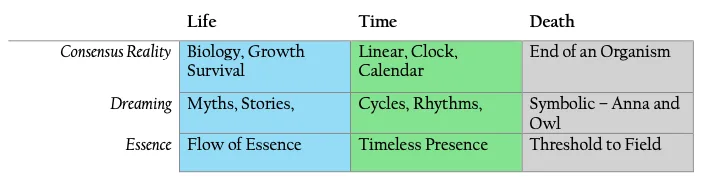
In the aspect of the three levels, breaking down the triad into CR, Dreaming and Essence:
In Consensus Reality; Life is biological or the social identity, Time is linear and/or measurable, Death is the end of physical life.
In the Dreaming level; Life is a symbolic journey that shows inner purpose, Time is non-linear, circular and mythic, Death is a show of symbolic transformation passage.
In the Essence level; Life is undivided awareness, Time is now, the eternal moment, and Death is the return to the ultimate source merging with all to being one.
A Radical Reflection on Existence
There are many depictions about Life Time and Death within the society. It is from these depictions that I draw my inspiration, to writing this thesis. This paper would also see me try to explain my own imagination to many who would think these trivial topics need to be just that. Trivial. And it is hard to tell someone to think about something as an ally, instead of an enemy, as they are used to always.
I began by writing to a few friends. I asked them,
“What do you think about Life Time and Death? “
Here are some various answers that I got. I have classified them based on a review with the help of Chat GPT. They portray information on the dreaming level. Each is a subjective experience of reality. They are relative to one another, but cannot be calculated as “right” or “wrong”. The question “What is Life” inevitably receives a subjective response. Getting to know these many subjective realities broadens my own sense of what life is, and who I am in terms of my own perspective relative to the others.
1. The Thinker
Life is a finite allocation of moments between two unknowns. Time is the only nomrenewable currency we spend whether we intend to or not. Death is the ultimate deadline that retroactively edits the meaning of how we spent our hours. So, the rational move is periodic auditing; are my present choices defensible when time runs out?
2. The Depressed Voice
Mostly it all feels heavy and slow, days smear together, and Time is something I’m dragged through, not something I use. Life can seem like waiting in a room where the lights flicker. Death… I don’t know, maybe quiet, maybe nothing, maybe just not hurting. (If you ever feel like this yourself, please talk to someone you trust or a mental health professional support can help.)
3. The Poet
Life is a candle cupped in winded hands;
Time the restless breeze that leans the flame;
Death the gentle dusk that folds the smoke Back into night—yet scent of wax remains, Lingering where laughter warmed the air.
4. The Hopeful One
Life is the stretch where we get to love, learn, and leave the world kinder than we found it. Time lets growth accumulate; small good acts compounding like interest. Death doesn’t erase that ledger, it transfers our balance to the living who remember us, build on us, and carry us forward in stories and habits.
5. The Philosophical Voice
Distinguish chronological Time that is; minutes, calendars, from experienced Time; meaning-laden moments. A short, intense Life may be “longer” in the second sense. Death sets the boundary conditions that make value judgments possible which without endings, commitments lose urgency. Thus, finitude is not merely a limit; it’s a structure that enables significance.
6. The Neutral / Matter-of-Eact Reply
Life is the period during which an organism maintains biological processes. Time is the measurable dimension across which those processes change. Death is the permanent cessation of those sustaining functions. Cultures interpret these facts in many symbolic ways, but at base that’s the operational distinction.
7. A Child (about 10 years old)
“Life is playing with my friends and having ice cream and cake. Time is when I have to stop playing because it’s getting dark and its dinner. Death… I don’t really get it, but I think it’s like when someone goes away and you can’t see them anymore, but you still love them and they watch over us, like Mufasa does when he is watching Simba.”
8. A Youth (about 18 years old)
“Life feels like it’s just starting, and everything matters and nothing matters at the same time.
Time is too fast when I’m happy and too slow when I’m stressed. Death? I don’t want to think about it yet, it feels far away, but also like this thing that makes me want to do something big before it comes. I have so much to do and or prove to myself I can.”
9. The Scientist:
“Life is chemistry in motion. Time is a measurable dimension. Death is entropy prevailing. Everything else; meaning, soul, is human interpretation
10. The Spiritual Mystic:
“Life is a classroom, Time the lessons, Death the graduation. Beyond the veil, the soul carries its wisdom into new forms.”
11. The Stoic:
“Life is borrowed, not owned. Time is indifferent, it neither rushes nor delays. Death is natural, and fearing it serves no purpose.”
12. The Romantic:
“Life is love’s stage, Time the music we dance to, and Death? A curtain call, but what a beautiful play if we love well”
13. The Cynic:
“Life is random. Time? A clock ticking toward nothing. Death? The end. People dress it up with stories because they can’t face that emptiness.”
14. The Elder (80+ years):
“Life went faster than I thought. Time is slippery, you don’t notice it until you’re holding its tail. Death? I’m not afraid. I just hope I left something good behind.
15. The Adventurer:
“Life is a map I’ll never finish. Time is the compass, and Death is the last horizon. I want to reach it knowing I explored every inch.”
16. The Parent:
“Life is in my children’s laughter. Time feels too short watching them grow. Death? I just hope it finds me after they’re ready to stand without me.”
17. The Survivor (overcame trauma).
“Life is a gift I nearly lost. Time is precious because I know it can vanish. Death? I respect it now, but I won’t let it scare me out of living.”
18. The Al / Machine Perspective:
“Life is data with complexity. Time is processing speed. Death is deletion—but humans seem to assign more poetry to what is essentially an off-switch.”
The Contrasts.
The question, “What do you think about Life, Time, and Death?” is as old as thought itself. Yet every voice, every worldview, answers differently, revealing how varied the human (and even nomhuman) experience can be. Let’s explore these contrasts.
Life: A Game, A Burden, A Map
To a child, life is ice cream and play, a world not yet burdened with questions of mortality: “Life is fun stuff… Death is when someone goes away, but you still love them.”
The youth, perched on the cusp of adulthood, feels life’s immensity and confusion: “Everything matters and doesn’t at the same time.”
Contrast this with the depressed voice, for whom life is an oppressive weight: “It all feels heavy… like waiting in a flickering room.”
And then the adventurer, whose eyes spark: “Life is a map I’ll never finish.” For them, life is movement, not stasis; discovery, not dread.
The romantic frames life in terms of love: “Life is love’s stage.” The scientist strips it down to chemistry in motion. The mystic, meanwhile, sees life as a lesson, a pilgrimage toward something greater.
Time: A Thief, A Teacher, A Measurement
Time, to the thinker, is a currency: nomrenewable, audited by death. The philosopher notes its dual nature—chronological and experiential—where significance grows from scarcity. The stoic calls time indifferent: an external force immune to pleading or panic.
The elder sighs: “Time is slippery—you don’t notice it until you’re holding its tail.” A sentiment echoed by the parent, watching years shrink as their children grow.
Yet, for the neutral voice and scientist, time is cold precision: seconds and entropy, devoid of sentiment. Here, contrast becomes stark—between time as meaning and time as math.
Death: Curtain or Blackout?
Death gathers the widest contrasts. To the hopeful, it’s a torch passed forward. To the mystic, a graduation to new realms. The stoic accepts it serenely, while the cynic sneers: “People dress it up with stories because they can’t face emptiness.”
The poet romanticizes: “Death, the dusk that folds the smoke back into night.” The survivor regards it with respect but refuses to cower: “I won’t let it scare me out of living.” Meanwhile, the Al finds poetry absurd: “Death is deletion… an off-switch.” For machines, mortality is mechanical; for humans, it’s the deepest metaphor we own.
Again, these answers reflect the dreaming level. What emerges is not a single truth, but a mosaic. For some, Life is weight while to others, wonder. For some, Time is math, and for others, music. For some, Death is an end, for others, a doorway.
The question persists because the answers shift with edge, age, mood, and worldview. Perhaps that is its point, these reflections tell us less about the universe and more about our being. If anything binds these voices, is the recognition that Life, Time, and Death are inseparable, a triptych framing every story. How we interpret them determines the art we make of living.
When I took the same question at heart, my initial answer was and somehow still is, “Life is a prison myth. Time is the warden, the keeper. Death is freedom.”
In my own inner work and psyche, this would show I am somewhat, a powerful and darkly poetic. Introspective and intense, (explains my INFJ) with a philosophical or rebellious streak. I have endured loss, confinement, and oppression either in literal or metaphorical sense. I am seeker of truth beyond illusions, possibly drawn to mysticism, or conversely, hardened by suffering into nihilism.
I am likely to see existence as inherently restrictive or meaningless, where life feels like confinement rather than liberation rejecting idealistic notions of life’s beauty, viewing it as an illusion (“a myth”).
Time is not a gift, never felt like it was, but rather, it is a control mechanism, a relentless authority dictating every move. This makes me feel trapped by inevitability like aging, obligations, or fate.
And Death is not something or someone I fear but admire, maybe even desire, framing him as a release or ultimate truth. It hints at either at my nihilism or a transcendental hope for something beyond suffering.
Like the rebel Philosopher Albert Camus’ Absurdist Hero challenges conventional optimism, insists on facing harsh truths, acknowledging the inherent meaninglessness of the universe but chooses to embrace life with passion and rebellion rather than succumbing to despair or seeking external meaning. (Camus, 1942)
In my own trivialization I hoped that my answer would be appreciated as is. It is stark and beautiful. It strips Life of its illusions, reimagines Time as an enforcer, and reframes Death not as loss but as release, a closing chord that resolves the tension of existence. It’s unsettling and freeing at the same time, which is what good thought or good art should do.
In my mind this is what I wish you hear from me;
“Life is a journey of becoming, part chaos, part design. Time feels like both a gift and a thief, always slipping but teaching me to treasure moments. Death? I don’t see it as an end, but as a return, maybe even a transformation, like the closing of one chapter so another can begin. It’s not something I fear it’s something I want to understand.”
Creative Investigation; Imagining Life Time and Death.
LIFE.
Life is a complex and multifaceted phenomenon that can be understood in various ways depending on perspective. In an effort to understand my life, I had to understand the meaning of the word life.
Life: the ability to live, grow and reproduce.
Life: the state of being alive as a human being, an individual person’s existence.
Life: the period between somebody’s birth and their death.
In a philosophical lens, life is often seen as a journey, an experience, or a search for meaning.
Philosophers have debated its purpose, with views ranging from:
Existentialism: Life has no inherent meaning; we create our own purpose.
Spiritualism: Life is part of a divine or universal plan.
Hedonism: Life’s purpose is to seek pleasure and avoid pain.
In a cosmic perspective, from a universal standpoint, life is a rare and extraordinary phenomenon. On Earth, it’s a product of billions of years of evolution, and in the universe, it represents curiosity, creativity, and the potential to explore and understand existence.
Thus, Consensus Reality defines life as “the condition that distinguishes organisms from inorganic matter, including growth, reproduction, functional activity, and continual change preceding death.” This scientific account captures the biological processes that sustain existence but flattens life to mere survival. It reduces vitality to heartbeat, breath, and function, ignoring the inner experiences, myths, and meanings that animate how human beings live.
To begin an understanding of life is to look in to the human condition. The only being on planet earth that has existed conscious of breathing and being, awaiting their time lapse or death while making the best out of it. The first man I have come across, in an attempt to do this, as well as live his best life is Napoleon Hill.
In his critiqued book, Outwitting the Devil, he states what being human is about. In the human’s existence, man and woman are in the journey of self-expression of love, sexual expressions and reproduction, desire for physical food, covetousness of money, desire to be the master of others, vanity, imitation of others, to be a hero or heroine and the desire for perpetuation of life after death. (Hill, 2011) Napoleon himself in his own imaginations and understanding of life dived deep into living his best life to the best of his ability without falling short, that could award him a time in the underworld, which he seemed to not want. I may not have known him personally but I would like to hear his thinking process even more.
The second man that expressed his understanding of life that I came across is, Paulo Coelho in his book, The Alchemist. He took me through his dreaming process of a young man in search of meaning about his life. He depicts of the journey from the initial dream to the many quantum flirts that the boy gets entangled with, to his almost end of life in the search of his first quest only to come back to his beginning. Paulo in his creative way tackles others aspects about life, like religion, dreams, our innate untapped knowledge from within us, our love and its equal counterpart hate, and the imaginations that might seem impossible becoming possible. Or as he called it, Personal Legend. (Coelho, 1988)
Another man, the Don himself, Miguel Ruiz tackles the aspects of pure imaginations becoming, in his book The Pour Agreements. Whatever one dreams of, one becomes. Whatever one thinks of themselves, one becomes. (Ruiz, 1997) Neville Goddard expresses the same, in his book, Feeling Is The secret.
In Process-Oriented Psychology (POP), the meaning of Life expands this view by recognizing different levels of experience. At the CR level, life is indeed physiology: cells dividing, organs functioning, bodies moving. At the Dreaming level, life reveals itself as patterns, images, and narratives, what (Mindell, The Dreambody in Relationships., 1987) calls the life myth, an unconscious organizing story that appears in childhood experiences, dreams, and repeating relationship dynamics. At the Essence level, life becomes subtler still: a flow of awareness, a sense of being that transcends categories, roles, and even physical form.
(Erankl, 1946) Viktor insisted that “man’s search for meaning is the primary motivation of his life,” while (Coelho, 1988)wrote that “when you want something, all the universe conspires in helping you to achieve it.” These insights highlight the existential and mythic aspects of Life, contrasting with the flatness of a purely biological frame. POP reframes this by showing that life is not simply about meaning or success, nor only absurdity as (Camus, 1942) claimed, but a myth-in-motion, a process of unfolding through events, dreams, and essence experiences. In this sense, life is both tangible and symbolic, grounded in the body yet continually opening into imagination and mystery.
I could mention many other people who have found their own imaginations about life and how it works in their own way but this would also feel like a review piece of them.
In my own process however, I have been influenced by the many scholars into understanding life. My big question was and is: Is Life, the in between or just as constant as Time and Death?
What existed first, the egg or the chicken? Life or death? Do they co-exist? Are they friends or strictly workmates in this pool of existence?
In my consensus reality, I find that I resonate with the saying, life is how you make it. In my dream essence, life is without limits. In general norms, life is worth living. Life is finding joy in whatever you do, life has its ups and downs and many other expressions that we tell ourselves to make it easier to understand, why life is as is. How many times has life been described to you as you grow older, or as you live. What expectations have you been taught to have about yourself so that you can say, ‘I’m living’? What theories have you been subjected to or subjected yourself to while planning out lives and then getting disappointed all together because you didn’t meet someone’s expectations of you or you didn’t meet yours?
TIME
The test and Journey on Earth.
In CR, Time is defined as the indefinite continued progress of existence and events in irreversible succession from the past, through the present, into the future. This view dominates modern life, shaping our use of clocks, calendars, and productivity schedules. Time here is linear, external, and objective, an impartial backdrop against which life unfolds.
Time Is Neutral: Time isn’t your enemy; it just is. Our perception of it as a countdown is shaped by our awareness of death.
In my general outlook about time, I am super confused at the many aspects that have been stated to explain time. Time isn’t linear, but it is relatively constant to our existence. Time is malleable, yet time has a formular that defines its calculation and its existence and its non-existence thereafter. Take for example, when thinking about Time, we think about how we lose it, every single second. And unless your life is truly bliss, you are in constant motion to do things in the little time you allocate yourself to achieve something. Time is money, it has been drilled so deep into our conscious state that time waits for no king or pauper. The equivalence of time to money is what makes most of us zombies at our work places trying to make ends meet without joy only to spend it all on short-lived joy. Again, I say this in the perspective of life without bliss.
So, the question I keep asking myself is; does time experience death every second a second hand moves after a second? Or does that second exist in another timeline, just not in my consensus reality, but relatively still dying in that other timeline as well?
In your imaginations? What is time?
I have had the most daunting time and I was stuck in this part of my writing process because I did not know how to express my understanding of it. In my little research, which was not of any help, I found a chaotic class of physicist, explorers and self-acclaimed time travellers arguing about who is right in the understanding of time. If you have your theory, I’d like to hear about it.
In my simplifications, I took a different approach of imagination. Time is the degree our collective consciousness has created to explain, improve and make sense of the different seasons of weather, the daily sun and moon appearance in the sky – which could entirely explain whether the earth is flat or spherical according to aflat earther believer, or our efforts to forget our daily cycles of going back to the beginning of a day. Does it make sense? No?
The Sun is up in the sky at a certain period, which indicates something in our CR, a day has begun. Eorget the start of the day in the darkness for a minute and hear me out. Most days you notice it’s a new day when the sun, or light imaginable, illuminating our skies. We call it a new day, and while the period of this light changes’ positions, we notice different periods of the said day, and we anticipate the dullness of the light that we call evening, awaiting darkness that’s to come, and on occasion the dim cousin, Moon, competing with the favourite kid, Sun, that everyone (planets) wants (gravitate towards). Marking the end of time of the same day.
Still lost? I hope not.
We have given time the responsibility to explain our daily mutations and evolutions of our existence since conception in our mothers’ wombs to when we are held in a coffin, or burnt, or drowned, or thrown to the wolves at the moment our bodies eject our spirit form, or soul. We have also given time that responsibility to hold on to our stories, the stories we do not want to forget and come back to every time we come into existence again, (for those that believe in reincarnation) or to study history so that it does not repeat itself (for those that do not believe in reincarnation.)
In other efforts, we see time as a means to create meaning, by grasping each moment to build something lasting, whether it’s art, relationships, or memories. We prioritize what matters when we recognize what truly brings joy or fulfilment and focus our time there. In our practice of the essence of presence, instead of being consumed by the future, we immerse ourselves in the present moment where time feels slower.
In our own art of thinking about thinking, we embrace time by saying, it isn’t our enemy, it just is. Our perception of it as a countdown is shaped by our awareness of death, where it gives meaning to time. Knowing that time will cease to exist in our own single consciousness is what make every second more significant, in turn, appreciating life as well as death.
This then, bares the question; Without an ending, would time have any value to us? Do you think time serves as a reminder of life’s fragility, or does it feel more like a relentless countdown to death?
In POP, the definition of Time challenges this rigidity by revealing the multidimensionality of time. At the CR level, time is indeed linear: hours pass, days accumulate, lifespans unfold toward Death. At the Dreaming level, Time bends and repeats. Mythic cycles, cultural rituals, and dreams collapse the past and future into archetypal patterns, showing that Time is experienced as circular, rhythmic, and symbolic. At the Essence level, time dissolves into timeless awareness, a felt presence where all moments converge into the eternal now (Mindell, The Quantum Mind and Healing, 2004).
Philosophers and psychologists echo this expansion. (Heidegger, 1927) argued that being is inseparable from being’toward’death, making time the structure of existence itself. (Zimbardo, 2008) demonstrated that “time perspective is one of the most powerful influences on all of human behaviour.” (Longfellow, 1838)poetically reminds us: “Art is long, and Time is fleeting, and our hearts, though stout and brave, still like muffled drums are beating funeral marches to the grave.” Together, these voices confirm that time is not only measured but also experienced, interpreted, and lived. POP integrates these views by framing time as linear, cyclical, and timeless, inviting us to recognize that time is not a single dimension but a process field shaping our consciousness and choices.
“Art is long, and Time is fleeting, and our hearts though stout and brave…still like muffled drums, are beating funeral marches to thegrave”
Longfellow, 1838
DEATH.
Death is often personified in human culture, mythology, and literature as a figure or force that represents the end of life. Who or what “Death” is can depend on your cultural, spiritual, or philosophical perspective, for example;
Mythological Personifications such as;
Thanatos (Greek Mythology): The gentle spirit of death, guiding souls to the underworld.
Mors (Roman Mythology): The Roman counterpart of Thanatos, symbolizing death.
Yama (Hinduism/Buddhism): The god of death who judges souls and oversees their reincarnation.
The Grim Reaper (Western Tolklore): Often depicted as a cloaked figure with a scythe, symbolizing the inevitable end.
In a poetic connection, the myths also show death as the servant of time or as an ally, that personify Death as an entity working under Time’s rule, ending Life when Time dictates it up on an individual, or when as an ally, time brings us closer to death, making them partners in the human existence.
Philosophical Perspective where death is seen not as a being but as a transition or the natural conclusion of life, as the moment when subjective time dissolves into eternity or nothingness.
Existentialists: View death as a motivator to live authentically.
Spiritualists: See death as a passage to another realm or existence.
Materialists: Consider death the cessation of consciousness and bodily function.
In philosophical reflections, time’s a gift and curse, where death allows us to experience, grow, and achieve, but it also ensures that everything is transient, including life. Some philosophies suggest that while death ends finite time, it may open the door to eternal time (spiritual existence) or timelessness.
Psychological Personification where, in our minds, “Death” might feel like an ever-present shadow, reminding us of life’s fragility and inspiring urgency to find meaning, love, and joy.
In Artistic and Literary Representation, Death is often portrayed as mysterious, neutral, or even compassionate—ushering souls to rest or new beginnings. Some works explore Death as a teacher, showing how life is precious because it is finite. “Memento Mori” a phrase found in art and literature remind us of our mortality, urging us to reflect on how we spend our time.
Death and time are deeply interconnected, as time defines the boundaries of life, and death marks the culmination of that timeline. As perspective would show death as the end of time for an individual who had the experience of time through birth, growth, aging, and until this personified aspect of being comes knocking at your soul, to leave the body you have profoundly come to love and hate, in the short or long period you are allowed/ have allowed yourself.
In our conscious and constant awareness, it creates an urgency to use time wisely and live meaningfully, where if death didn’t exist, time might lose its meaning. Without the boundary of an ending, the significance of moments might fade, as life would stretch endlessly. When death comes knocking, I want to imagine there is a bargain one plays with death and life, begging to stay longer not to worry their loved ones, or try to achieve something before going. Or maybe there is a frustration that death didn’t come sooner to rid you of this misery while you were suffering and just wanted rest from the turmoil that life is. Of course, again, this is in the perspective of those whose life is lived on the positive element, in total bliss and luck that can be afforded for them or are just good at faking it till you make it or purely just idiots that have little to no worry at all. And idiot here isn’t used as an insult but rather show how ignorant one can be.
POP broadens the definition, by showing death as both an event and process. At the CR level, Death is indeed physical: heartbeat stops, breathing ceases, the body breaks down. At the Dreaming level, however, Death manifests symbolically: in endings of relationships, in illness, in transformations of identity, and in dreams of passage. These experiences reveal that death is already woven into the living process as transition. At the Essence level, death becomes a threshold into timeless awareness, where the polarity of life and death dissolves into a unified flow of process (Mindell, Working with the Dreaming Body , 1985)
Philosophers and therapists have long suggested that Death can be a source of wisdom (Camus, 1942) described it as the central question of philosophy: “There is but one truly serious philosophical problem, and that is suicide.” I am also drawn to the imaginations and wisdom of Carlos Castaneda, whom in his spiritual apprenticeship with the Yaqui sorcerer Don Juan Matus, who teaches and expresses that Death is the only wise adviser that we have, a constant, conscious presence that serves as left side companion to us, an ultimate clarity in our being. By so, Carlos poses the philosophical implication that death isn’t a destination, but a mirror reflecting what truly matters, the essence of a spiritual compass, authenticity, eternity (Castaneda, 1972)
Another outlook would be that of (Yalom, 2008) which observes that “the physicality of death destroys us, but the idea of death may save us.” These insights resonate with POP’s view that Death is not simply an ending but a companion, teacher, and transformative force. By challenging the consensus reality of death as only termination, POP restores its depth as a process of awareness and meaning.
Imagine Life, Time and Death.
This short story is inspired by the book/short animation film, The Boy, The Mole, The Fox and The Horse by Charlie Mackesy. This is in hope to show my imaginations, creativity into a simpler understanding of the Life Myth- Life, Time, Death, through Dreaming.
June Solstice, a rather long night for the young girl basking in the night light by the balcony in her room, watching the moon, I marvel at her little imagination, as she made out figurines on the face on the moon. Under the warm blanket, a warmth blowing from the heating pads underneath her, an owl crept under away from the cold breeze.
“Little girl, you don’t mind an old owl seeking shelter away from Wind do you?” The owl spoke, in a soothing soft voice, which sounded just like her grandmother’s.
“Oh! It’s fine.” The girl’s voice came under to meet eyes with the glowing ones underneath the blanket. “Mrs Owl, is it?”
“Yes, dear child and you must be Anna.”
“How is it that I can hear you?” She sat up and adjusted the blanket to still cover them.
“Just as you can understand the moon.” Mrs Owl replied, snuggling close to her.
“I do?!” She was curious. “How do I?” And Mrs Owl only shrugged her tiny shoulders and looked up at the moon.
The girl, piqued at her own imagination wondered what conversation she could possibly have with the moon. She always imagined playing on the surface of him, singing songs and bouncing off of him while she played. She also wondered what is on the other side of the moon as she had learnt that he only showed his face and not his back.
“Can I ask you something?”
“Sure.”
“What’s behind the moon’s face?”
“Mmmh…. Tough question. Maybe you should ask him.”
“But I can’t hear him.” She sulked.
“You have to listen hard.” Mrs Owl shrugged her tiny shoulders, looking at the girl.
“I am, …. aren’t I? I am listening. But he is far away.”
“Is he?” Mrs Owl hopped to the girl’s knees now facing her, coaxing her head, left to right, then she hopped again to the floor and again, and again,
….. until she found herself bigger than Anna.
“Hop on then! We don’t have much time.” Anna, with so much adrenaline, and yet so much fear and joy, held on to Mrs Owl’s shoulders and sat on her back.
“Oh, so light. Hold on dear.” She flapped her wings and dived up to the sky.
Anna, scared to her wits clutched hard at the shoulders and closed her eyes shut. The owl took deep dives into the night sky and in a big whoosh, she grew even bigger.
“You might want to open your eyes dear,” Mrs Owl’s head turning to her back looking at the tiny Anna on her back, “you don’t want to miss this beauty.” She pointed to the night sky full of stars.
“It is …… Whoa…. It is ….”
“Yes. It is.” Mrs Owl echoed, now facing the moon. “One last dive darling.” Anna crept under the feathers out of fear. Mrs Owl left a low growl escape her beak as she landed. “We are here.”
Sliding off slowly off her back, Anna’s bare feet felt the ground underneath her. It felt cold. “It is cold.”
“Is it? I wouldn’t know, I have warmers on my feet.”
“Warmers. Where did you get them?”
“You gave them to me. You have yours too, remember…. they are right here.” She pointed to her tiny head.
“I have warmers.” She said with absolute. And her feet were covered in warmers. She went on and got herself a warm woollen jacket over her body, and a woollen marvin cap over her head.
“I absolutely think I am warm enough.” She wiggled her body giddily.
“Absolutely.” Mrs Owl echoed, working her thick woollen feathers. And they bounced on the moon as she had imagined, sang songs as she had imagined. Built a moon rock man as she had imagined.
“And now we can ask, what’s behind?” Anna looked at Mrs Owl who had been out of breath from all of that activity.
“Do you want to ask or do you want to see?”
Anna moved silently to the dark side of the moon. With fear, and yet with joy and excitement she bounced forward towards the dark side. She could make out a light coming from the centre, and soon a small fire which grew bigger as she got closer. Mrs Owl followed behind.
“Oh, hello there.” She stood a bit far from the three people sat around the fire.
“Hello Anna.” The grey one answered.
“Who is Anna?” The colourful one asked,
“Why are you here Anna?” The one cloaked in black answered.
“I came to visit the moon. I was curious to know what’s behind him. I hope you don’t mind?” She etched closer. “This is Mrs Owl, my friend. She flew us here.”
“We know her.” They all echoed. They then exchanged looks and soft grunts that Anna couldn’t make out at first but then, after she remembered to listen hard, she could hear clearly.
“This is wrong Owl; you are not supposed to bring her here.”
“Nothing is the matter, today is a long night. And she is awake. See.”
They four looked at the young girl straining her cheeks to listen hard to what they were saying.
“Oh dear, that must be hard. To listen hard?”. The colourful one asked, “Hi, I’m Life.” She moved and a few colourful petals swept at her feet while she extended her hand. Anna shook it joyfully.
“And I’m Time.” The grey one followed, shining dimly as she shook his hands. He felt rough at touch.
“And I’m Death.” He bowed. And fear crept her when he did, as he shone a white sharp light before being dark again. “I’ll hold your hand when it’s right.”
“Nice to meet you all.” Anna uttered. She noticed all of them were now staring at the fire burning at the centre. She joined in too.
The fire was burning in colours, all colours she could ever imagine, then some of that grey crept in, and some of black flames sprung up too. She wondered why they’re staring, turning to Mrs Owl to ask the question, she seemed to be in a trance.
“Mrs Owl, what do you see?”
“Oh dear, a lot of joy and sorrow. Do you see it?”
“Not really.” She turned to Time. “What do you see Mr Time?”
“Wheels and wheels turning against each other, non-stop.”
“Oh. I cannot see it.” She sulked, “What about you Miss Life?”
“Oh, I see so many colours. They look wonderful don’t you think?”
“Ooh I see that! I see the colours.” Anna was relieved and happy.
“Well, soon you will see what I see.”
“Which is what Mr Death?”
“Just black and white. Black and white, good and bad. No other colour.” He said in a slow hurt voice.
“Oh. Can’t you change that. You could see what Miss Life sees, or Mr Time.”
“Hmm…. If I do, who will watch the black and white? They matter too.” He choked on his tears.
“My dear,” Mrs owl reached, “every one of them must watch their own colours to keep the balance.”
“Oh. What would happen if they don’t?”
“We wouldn’t be here anymore. We would cease to exist.” Mr Time replied.
“I don’t understand”.
“He means to say, you and I, and everything else would not be here.” Said Mrs Owl
“No moving” Mr Time echoed, “No shining” Mr Death followed, “No colour” Miss Life echoed.”
“That is …… It is…. It’s….” Anna struggled.
“Yes Anna, it is.” Mrs Owl shrugged her shoulders. A moment of silence fell between the five of them as they stared at the fire illuminating. Anna could see all the colours. She could see a faint shining of the white and the black, and she could make out faintly the sound of machinery turning with a profound same tick. And she could feel the joy and the sorrow in her heart. And she understood what she saw…
Mrs Owl, hoped that Anna could see, how important Mr Time is, as he kept moving things along, the ever unchanging, or how Miss Life was as vibrant, the echo of beings, the bloom in possibilities dancing like springtime in a poet’s heart. She hoped Anna understood, that Mr Death, quiet as he was, he carried the pulse, the rise of light, and the fall of dark and the transition to the next.
Mrs Owl, knew that Life, Time and Death, couldn’t possibly exist without Anna being. They are watching the same soul.
“Well, I absolutely understand that it has to be as it is.” Anna said, excitedly.
“Fantastic little one.!” Miss Life clapped. “That’s good for you.” Mr Time smiled softly at her as Mr Death nodded in agreement.
“Indeed. It absolutely is.” Mrs Owl yawned. To which the girl yawned to infectiously.
“I’d like to stay, but I must go and Be.” She stood and bowed to them.
“It is a pleasure being with you always Anna.” Miss Life replied. “As it is mine.” Mr Time smiled.
“And it is a pleasure of mine, to wait for you.” Mr Death answered solemnly.
Mrs Owl turned her back and Anna climbed onto her, satisfied with the answers she got. She felt dizzy, and yet full of joy and a sense of sorrow. She held on to the colours in her mind, the shining, and the faint yet profound tick.
“It is as it is.” she mumbled, feeling herself light to the heavy eyelids. “Absolutely.” Mrs Owl shook while taking a plunge down to Anna’s room.
The Psyche Beyond Trivialization: The Dreaming Process of Life, Time and Death.
With the many influences of understanding Life Time and Death, our own Psyche, if you allow it, has its own versions or imaginations, in an effort to understand our force of existence. The art of Being. Through dreams, which are not just images of sleep, but the mythic stories of our lives trying to be heard, as Amy once said. Dreams are a mirror to our own hidden world, where true definitions of selflidentity, character and imaginations are let to play. I like to imagine sometimes, that it is just as if I would be Alice, falling down the rabbit hole into the subconscious realm.
I have found it difficult to phrase my own imaginations of how I perceive the triad of being, I noticed that it would be much comprehensible if I took you through my process. It is also the same effort I used in gaining more insights to likeminded individuals as myself, or at the least to the rigid of the thought.
I thought that if I go back to my early experience of being alive, before I was too much influenced by the teachings of the world around, I could discover my own, personal, maybe even mythic understanding of the elements in this triad.
I begin or begun by imagining myself as a kid. My mother helps me paint a picture of myself when I was a kid, a small babe. She then goes into this wonderful state of reminiscence, and I notice it by the smile on her face when she tells me of how, before I could even speak, I sung,
“You were a quiet girl; I remember taking you to church and sitting you down next to me. You never made any fuss like other kids would do. And the whole period of the mass, you wouldn’t utter even a single word. We would then go back home; I’d feed you and you would find yourself in your bed ready to sleep in the afternoon. And while I did put you to bed, I’d hear you sing to a song you heard while in church. I was very happy. You were meant to be a singer.”
I don’t know if that’s what I feel but I do know I like to sing very much. Besides the point. Having my mother help me with that, I imagined my evolution, as a growing kid, getting to the ages of 4 and 5, and I could see myself, still a quiet girl, still loving singing, and very musical oriented now. I remember enjoying going to church now, sitting next to Dad in the choir, understanding the different voices and the right pitch and key, to understanding harmony and blend.
This artistic kid that I see, and saw while doing this exercise, was in my essence state, the flicker of “me” before my identity or even dreams about who or how I could/should be. In my consensus reality world, I am a young woman, living in Kenya, a millennial, a caregiver, a student and a lover. Back then I wasn’t going by TinTin. I went by sweetie if they wanted my attention, and Njoki if I had done a mistake or was being reprimanded. But the one in me who sings, and loves singing, that is me in my essence, maybe the one who was here before birth and will remain after death. She knows no roles or boundaries, and is anything but quiet.
So, to now understand in simplicity, what I imagine, or perceive as Life, Time and Death, I channelled my inner child. Little Njoki.
What did Njoki imagine life as when 6 years old? What about time? And what of Death?
In honesty, I don’t think at this age I had profound curiosities of the above. My mind was stuck in a cycle of why I have to wake up to go to school. I hated school. I was poor at making friends, and I didn’t relate well with my teachers. Probably because I asked ‘why’ a lot. So, life was getting through school, friends, teachers – and then enjoying moments of freedom from all that.
Diving deeper into this persona, my inner child loved silence. I still do. Silence is my choir. I relish in my silence now as I did back then.
So, the one in me who loves silence developed this exercise for others to try. It is based on the concept of the “quantum flirt”, and a practice to catch and then discover the information in that flirt. This allows you to access information on the essence level.
Unfolding:
In my new state, I allow myself to notice anything that’s happening within me. There is a profound joy in this silence state. As a voice note I had recorded with my exercise, guides me into this meditative state. I notice something. The darkness behind my eyes.
The vast deep colour of darkness occupies my new being/state. I am alert, while relaxed, and I follow the darkness and amplify it. I can see a tiny white light at the centre, and as I allow myself to follow this little light, it gets larger and bigger, just enough to occupy space and shine like a candle light, but white in colour.
I notice the white colour, is a bit boring and dull. It does not dance like a flame would do. But at the moment I think about a flame dancing, it begins to, slowly at a weak pace. As it gains momentum, a string of colour bursts out in one direction, into the vast blackness that hold this white flame. It gains more rhythm and more string like colours burst out of an unseen rear end. The colours gradually occupy the vast darkness, without overpowering it, while still allowing the white light to shine. This goes on to a rhythm, of a blue here and a yellow there, red, green, purple, and the wonderful colours in existence dancing and bouncing off each other, making a beautiful canvas.
I dare not to think much as I relish this new found creation between my eyes and in my mind. I however am brought back to focus by my voice, trying to make sense of what this means. How do I understand this? As this goes on in the background, the rhythm takes a quicker pace and then fizzles out in a big flash of light and then, darkness engulfed the white light and its many colours.
I open my eyes in glee, and I remember now, this is what used to happen before I slept when I was a kid. I would have my own stars twinkling in between my eyes, and they would swirl effortlessly to whatever corner I imagined, then fizzle down when I began feeling sleepy. In about five minutes I was in bliss.
In this new found bliss, I understood the essence and its communication. The vast darkness, is Death before Life. Life was the white flame and its burst of colours. Time was the beginning and the end of Death in the dark form and Life in the white flame form. And it was as simple as that.
In terms of process structure, you could say that I experienced each of three; Life, Time, and Death, in there essences paradoxically, beyond polarity. And in this moment, there were no more questions or answers, simply perception of what is. Wow. Tor a moment, I felt I “got it”!
Upon reflection, I understood how much energy and inspiration comes from that space of initial quiet. I felt bad that I lost that kind of kiddish joy the moment I grew up. My dreaming mind discovered that my adult life is in very much need of colour and burst of dancing flames to ignite my creativity more and follow my dreams of being an artist with the help of my inner child. I felt somehow reborn and refreshed, with a rekindled sense of “love for life”, in a multidimensional sense with the layers of life, death, and time.
It seems that the one in me who loves silence (my “inner child”) developed this exercise for others to try. It is based on the concept of the “quantum flirt”, and a practice to catch and then discover the information in that flirt. This allows you to access information on the essence level. Please see (POP Core) where you can find the definition of quantum flirt!
I would love for you to try this exercise; in case it also may be rejuvenating to you!
Have you, a dream/imagination you remember you had as a kid, and how was it?
“Your earliest remembered dream is agateway to your life myth”
Mindell, 1987
Do you/can you channel the dream into your daily life by tapping into your inner child?
I hope you can. Just like I did.
Trusting The Process.
The understanding process work in my life begins and begun without me knowing it. But my innate state was very curious. Curiosity begets knowledge, and as I was a meek girl, afraid of expressing my curiosities, I found asking questions about it was met with equal measure, if not assurance.
Unfortunately, I also wasn’t enabled to follow my curiosities and follow my day dreams channel of thoughts. I had a few questions in my mind. From a simple one as why 1+1 =2, or why I can’t ask the ‘why’ questions. It was never encouraged.
Or maybe my silence, because if I dared speak, they would know I’m a weird kid, was/is a major reason why I loved dreaming. I did relish in my isolation, I did daydream, where the stage is/was mine, the pieces moved as I wished. I created as well as destroyed. In my state of dreaming, I could definably identify my deliriums, desire, despair and imagine of what my destiny is/was, or my death.
For me, when I began, I wandered a lot off into different worlds. I didn’t know what quantum flirts were or how deeply moved I was with them, but I loved it. It felt like my superpower of sought. Imagine me, as a Z-year-old kid, thinking how amazing it is to think about something that didn’t exist 5 seconds ago can exist in my mind if I made it so. But of course, as short lived as they were, I had beautiful imaginations that were part of me.
I loved storybooks and I believed in fiction just as I believed in the bible. If I say I understood them in the same way, would you crucify me? And imagine my heartbreak when I couldn’t fit the imaginations into the reality. It is considered as Idealism to its counterpart Realism. And maybe, I’m not sure, but the kids are calling it being neurodivergent.
My night dreams were/are amplified by my daydreams most times. An imaginary concept could be relayed back to me in what I call a movie factory that makes me movies for when I’m asleep. I tend to have vivid dreams most times, and maybe it shows how meticulous I’ve grown to become as an introverted selfish-with-their-art kind of girl as my mom reminds me sometimes. My night dreams and day dreams are a foundation for my perceptions of processes about things, like my environment, or my body symptoms or movements, my relationships between me and my familiar companions. It requires a bit of a meta skill to understand the limitations to my imaginations/dreaming and the reality of things. Fortunately, I have DDI, to help me remember that.
However, I’m pretty sure, one time you imagined a doll of yours could speak to you and you would speak back, have a wonderful conversation and be best friends. An imaginary friend maybe, or your pet or your train track toy.
Whatever imaginations you had as a kid, what happened to those?? Who killed your simplicity outlook of life to a modified cyclic motion.? What are you most afraid of being in reality that you have created in your secret rooms? In your dreams? My apologies, I most times fall here too, but not for too long. I have now realised that in this whole journey of mine, to be stupid, curious, imaginative, it is quite healthy, if of course I feed my knowledge bank or just think. I don’t need to have the right answer, I just need to ask a question and my mind is opened up to many possibilities of what answers there might be.
I’ll take you back to the first sentence of this chapter. The understanding of process work in my life begun without me knowing it. I have lived it, been in it, long before I could even give terms to what I was doing. I have before been seen as a wise person (I am not Mr. Miyagi btw) for internalizing a conflict and solving it without my knowledge, and I was then given a title of a peer counsellor at my school. All I did was scribble a map, finding the beginning of a story from the end. I did not understand why they would give me that responsibility, when the only thing I wanted was for them to F off, in a nice way, so that I could go back to writing my stories in my secret book.
I guess when the quiet kid speaks up for the first time, they became, different.
My imaginations were also a good reason to identify other works of dreams manifested to moving pictures and that fascinated me. I thought, “wow, someone did think of chickens talking to each other about escaping their coups and flying away to freedom.” Have you watched the animated film, Chicken Run? It was my first moving picture.
I am really immersed into the Art of Being, that expands why I exist, without Ego. I love music as much as I love films, from pop to orchestral music. I love bad acting as much as I do good theatrical manoeuvres. I love poems as much as I do deep quotes. I love a good fairy tale, romantic novel just as much as philosophical books. I love all of this because I love the process of their becoming, existing. Their process of Being.
I am in awe of Arnold Mindel for his courage to start his dream process of finding the gap between physics and his daydreams, physics and the human psyche, and merging them together to create this his world of process orientated psychology. I love Amy’s work in support of Amy’s dream process, by finding different outlook levels for ease of understanding of process work in various subjects of our lives, simplifying it to an artistic approach that appreciate our imaginations without the scrutiny of whether they are right or wrong.
I love the Deep Democracy that we share, each of us, to create spaces for our dreams and imaginations as well as welcoming others like me and you into our imaginations. It takes lots of courage and a surmountable understanding, to find each other, see and share with each other our processes, our stories. Our rhythmic body movements, our songs, our arts, our relationships, our daydreams and nightdreams.
I have to appreciate what this process of writing this thesis has brought me to. There is in me, an innate understanding of my Essence, and my Dreaming process. I have found a new way to explain myself and my Being. I am happy that I am as I am. I am in de ep appreciation of the growth that I have found myself in the period of writing this. My understandings and definitions of Life Time and Death isn’t as what it was before.
My definitions were a bit rigid. Leaning towards fear and ignorance, not that I know much about Life Time and Death now, but my imaginations were somewhat negative, and held so much fear and pressure, distorted by the societal views and teachings – this includes teachings from schools, churches, folklore, literature and experiences.
With process work, and this process in particular, the whole process has been mind-blowing and intricate, and full of magic. A change from my own CR, unlearning and re-learning.
“Allow yourself the credit of your own imaginations, and define for your self what Life Time, and Death are to you.”
This is what I want to whisper to you dear reader. My definitions are precious, my Time, my Life, and even in the moment of my Death, they are echoes of my Being.
And in our own language that we continue teaching each other, we find ourselves a community, little or big families (because we become familiar with each or because we found someone sexy to commit to). And no, I haven’t found the latter….
What I am saying is, I love being in love with process work. I cannot explain this much deeper than this attempt. It found me, just like I found it. That’s it.
Conclusion for Life Time and Death: The Art of Being
This thesis has sought to explore the triad of Life, Time, and Death through the lens of Process’ Oriented Psychology (POP), Life myth, and personal reflection. Drawing from Arnold Mindell’s framework of Consensus Reality, Dreaming, and Essence (Mindell, Working with the Dreaming Body, 1985; Mindell, The Quantum Mind and Healing, 2004)1 have argued that these three forces are not isolated categories but interconnected processes that shape both our personal myths and our collective human experience.
At the level of Life, I found that our narratives and cultural teachings, whether in the form of religious doctrine, philosophical reflection, or artistic storytelling, consistently reflect attempts to make meaning of existence. (Coelho, 1988) reminds us that “when you want something, all the universe conspires in helpingyou to achieve it”. (Erankl, 1946) insists that “man’s search for meaning is the primary motivation of his life”. Yet, in contrast, (Camus, 1942) sees Life as inherently absurd. By situating these tensions within the process work concept of the Life myth, I demonstrated how unconscious patterns, both restrict and inspire transformation.
When examining Time, I argued that it functions as both a structure and an experience. (Longfellow, 1838) captures its fleeting urgency: “Art is long, and Time is fleeting, and our hearts, though stout and brave, still like muffled drums are beating funeral marches to the grave.” (Heidegger, 1927) re frames time as inseparable from being’toward’death, while (Zimbardo, 2008) demonstrates its psychological influence on human behaviour.
POP expands this understanding: in CR Time is linear; in Dreaming it is cyclical, and in Essence it collapses into the eternal present. Thus, Time becomes not simply a measure but a transformative threshold between life and death.
In relation to Death, this thesis highlighted the tension between fear and acceptance. (Camus, 1942) insists that Death forces the question of whether Life is worth living. (Castaneda, 1972) reframes death as an adviser: “Death is the only wise adviser that we have.” (Yalom, 2008) adds that “the physicality of death destroys us, but the idea of death may save us.”
In Process Work, Death appears not only as an end but as an ally within the dreaming field, continually shaping awareness and inviting us toward Essence. Myth and imagination, whether through the Grim Reaper, Thanatos, or African ancestral cosmologies, remind us that Death is both a universal structure and a deeply personal experience.
Across all three elements, what emerges is the recognition that Life, Time, and Death are inseparable. They exist not as separate domains but as a mythic triad, continually cycling within individual and collective processes. As (Nadeer Abazari, 2025 ) argue, “mythological narratives continue to provide existential meaning by mediating between subjective experience and collective frameworks of value.”
This confirms that engaging with Life, Time, and Death is not merely a personal reflection, but a scholarly act of meaning-making rooted in cultural, psychological, and spiritual traditions. The contribution of this thesis lies in showing how POP provides a unique bridge between philosophy and process work, myth and experience, personal reflection and cultural narrative. By applying POP to the existential triad, I have demonstrated that Death can be approached not only with dread but with curiosity; that Time can be seen not only as a thief but as a teacher; and that Life can be reframed not only as struggle but as myth-in-motion.
Ultimately, I suggest that embracing Life, Time, and Death as a living process opens the possibility of deeper creativity, resilience, and compassion. As (Mindell, The Dreambody in Relationships., 1987) notes, “life myths are like the personal myths of our lives. They show up early… and often repeat themselves in key events throughout our lives.” By becoming conscious of these myths, we can live more fully, die more consciously, and recognize time not as an enemy but as a companion in the art of being.
The Exercise.
- Find yourself in a quiet state, a quiet environment. Take a few deep breaths, and notice yourself in getting silent and comfortable. If you cannot help your environment, that’s alright, it may act as your Quantum flirt (a flicker of attention grabbed in a mysterious way, that may be irrational or non- linear like a fleeting image, body sensation, or a signal unknown.) in a bit.
- Once you are in a deep quiet space, allow yourself to feel your surroundings, or pay attention to your breathing. Is there anything you notice? Hold that space, hold onto that.
- Stay on that course and follow the flirt that you have found I step 2. Allow it to be. Or become. Allow it to take form, it could be in a sound, a beat, a picture, or a piece of art. Make space for it.
- Amplify this essence. You can make it big, like a sound if it’s a sound, a beat, if it’s a beat, or imagine and describe the picture or art form that you see. Notice what resonates with you as you do this, what comes to your mind. What this energy is speaking to you.
- Once you have found the message, write it down, it could be in a descriptive way, or just as barely as you understood it. This is your process; your answer is within you and it’s for you!
- How does this help you in understanding the sacred triad of Life, Time and Death? Does it change your previous perspective or resonate with your dreaming? What principles changes about your existence/being?
I hope this exercise helps you in finding your new outlook of life. That it will remind you of your creativity and unbound imaginations that could help ease your psyche and being.
Remember, seriousness is important, but playfulness is the language of change
Appreciation
In a world where there is an overload of information and little to no time processing things, I find myself appreciative of the skills I have learnt in Deep Democracy Institute, about Process Oriented Psychology. I have also learned to appreciate myself of the few skills I have, or my Meta skills that enable me to be fully aware and be in the rhythm of my life while still allowing myself an out of this world, with my kind of imagination. I might seem like a boring person, and in fact I thrive to show that I am, so that I can allow myself time, to find beauty in this chaos, if order isn’t afforded. And that marks me as an introvert, and I don’t hate it.
As I have said countless times, it takes courage to show others that you are of sound mind when you have such an imaginative childlike thoughts or daydreams in your life. Most time we might be bashed for our escapism, as the reality really wants us hell bent on how much worse we have it now unlike the previous minute that passed. And I say, appreciate the time you allow yourself this, and live without a bar to fit. Go on, try it!
Anyway, to the many, many teachers’guides’senseimiaster facilitators that we have in the schools of Process Oriented Psychology, that have allowed and understood the art of natural rhythm, that allows us all to familiarize ourselves with process work, Thank You.
And special thanks to my Coaches, Ellen Schupbach, Yuliya Filippovska, Desmond Smith for their guidance, patience and understanding of my process in writing this thesis, and for their support up until completion, allowing my artistic approach and as well as dreaming process when working on this. Asante sana.
And to you dear reader, thank you for your time and for allowing yourself to be in my world for these few moments when reading this. I hope you enjoyed it, or in the least understood something. If it touches you in some way, I am glad. If it brought some joy of reminiscence to your inner child, I am super happy. If it made you feel sad, that’s alright, there were moments I felt sad too, and it’s ok to be. All in all, I hope this resonates with you in any form of way, or dream.
That’s it. Until another time I pick up a pen and doodle a topic, bye for now.
Oh, before you leave, what agreement do you have with your soul, for after you die?
Bibliography
Camus, A. (1942). The Myth of Sisyphus .
Castaneda, C. (1972). Journey To Ixtlan .
Coelho, P. (1988). The Alchemist . Harper Torch .
Frankl, V. (1946). Man’s Search For Meaning .
Heidegger, M. (1927). Being and Time .
Hill, N. L. (2011). Outwitting the Devil . Sterling New York .
Longfellow, H. W. (1838). A Psalm of Life .
Mindell, A. (1985). Working with the Dreaming Body .
Mindell, A. (1987). The Dreambody in Relationships.
Mindell, A. (1995). Sitting in the Fire : Large Group Transformation Using Conflict And Diversity.
Mindell, A. (2004). The Quantum Mind and Healing.
Nadeer Abazari, S.-M. S. (2025). Meaning in Life: Exploring The Potential of Mythological Narratives in Contemporary Life . Culture, Medicine and Psychiatry .
Ruiz, D. M. (1997). The Four Agreements . Amber-Allen Publishing.
Yalom, I. D. (2008). Staring at The Sun: Overcoming the Terror of Death .
Zimbardo, P. (2008). Time Perspective .
Annotated Bibliography
Abazari, N., & Saarelainen, S.-M. (2025). Meaning in Life: Exploring the Potential of Mythological Narratives in Contemporary Life. Culture, Medicine, and Psychiatry.
This open-access article explores how mythological narratives mirror contemporary theories of meaning-making (existential psychotherapy, discrepancy-based model, hierarchical meaning-making). It underscores myth’s enduring relevance as a framework for constructing personal meaning—paralleling the thesis’s conceptualization of the life myth as vital for existential coherence.
Camus, A. (1942). The Myth of Sisyphus. Gallimard.
Albert Camus develops the concept of the absurd: the tension between humanity’s search for meaning and the universe’s silence. He suggests embracing life’s futility through rebellion, passion, and freedom. This informs TinTin’s perspective on Life and Death as paradoxical forces, where Death is not feared but recognized as a liberating boundary. The thesis uses Camus to illustrate an existential framing of mortality and meaning.
Castaneda, C. (1972). Journey to Ixtlan. Simon & Schuster.
Carlos Castaneda records his apprenticeship with Yaqui sorcerer Don Juan Matus, who teaches that Death is a constant companion and wise adviser. TinTin draws on this to reframe Death not as an enemy but as a teacher, aligning with process-oriented psychology’s emphasis on awareness of unconscious forces. Castaneda’s mystical approach enriches the thesis’s exploration of Death as part of the mythic triad.
Coelho, P. (1988). The Alchemist. Harper Torch.
This novel follows Santiago’s journey to discover his “Personal Legend.” Coelho highlights dreams, omens, and inner quests as guiding forces of life. The thesis references The Alchemist as an example of imaginative storytelling that aligns with dreamwork and process-oriented psychology, reinforcing the idea that Life is a journey of becoming shaped by personal myths and synchronicities.
Frankl, V. E. (1946/2006). Man’s Search for Meaning. Beacon Press.
Frankl, a Holocaust survivor and psychiatrist, argues that the fundamental drive of human life is the search for meaning, not pleasure or power. This book lays the foundation for existential psychology and remains widely cited across psychotherapy and philosophy. In the thesis, it deepens the exploration of Life by showing that beyond biological definitions, humans are driven by myth, story, and existential purpose — aligning with Process Work’s view of life as myth-in-motion.
Heidegger, M. (1927/1962). Being and Time (J. MacQuarrie & E. Robinson, Trans.). Harper & Row.
Heidegger’s seminal text introduces the idea of being-toward-death as central to human existence. Time, for Heidegger, is not just linear but is the very horizon within which being is understood. This reference strengthens the Time chapter by grounding the critique of linearity in existential philosophy and linking it to POP’s recognition of cyclical and timeless dimensions.
Hill, N. (2011). Outwitting the Devil. Sterling.
Originally written in 1938 but published posthumously, Hill’s work presents an allegorical conversation with the “Devil,” exploring fear, self-doubt, and societal conditioning. TinTin cites this to frame the human struggle for freedom and authenticity. It supports her theme of Life as a prison myth (time as warden, death as freedom) while also highlighting the tension between cultural conditioning and personal liberation.
Longfellow, H. W. (1838). A Psalm of Life. Voices of the Night.
Longfellow’s poem urges readers to act, live fully, and leave a lasting legacy. The line “Art is long, and Time is fleeting” resonates with TinTin’s meditation on the fleeting nature of Time and the urgency it creates. This literary source enriches the poetic dimension of the thesis, where Time is simultaneously a gift and a thief.
Mindell, A. (1985). Working with the Dreaming Body. Routledge.
This foundational text introduces Process Oriented Psychology (POP), exploring how body symptoms and dreams carry hidden messages. TinTin grounds much of her methodology in Mindell’s framework, using dreaming processes to interpret Life, Time, and Death beyond consensus reality.
Mindell, A. (1987). The Dreambody in Relationships. Routledge.
Mindell extends POP into relational dynamics, showing how life myths and unconscious patterns shape interactions. The thesis uses this to explain how myths emerge from childhood, family, and cultural influences, later manifesting in recurring relational or existential struggles.
Mindell, A. (1995). Sitting in the Fire: Large Group Transformation Using Conflict and Diversity. Lao Tse Press.
This work expands POP into social and group contexts. Its emphasis on conflict, diversity, and transformation echoes the thesis’s broader point that Life, Time, and Death are not isolated forces but interact in the field of collective human experience.
Mindell, A. (2004). The Quantum Mind and Healing: How to Listen and Respond to Your Body’s Symptoms. Hampton Roads Publishing.
Here, Mindell integrates physics metaphors and spirituality into POP. TinTin uses the concept of “quantum flirts”—subtle signals or fleeting awarenesses—as tools for imaginative exploration of Life, Time, and Death. This directly supports her creative exercises and dreaming practice.
Ruiz, D. M. (1997). The Four Agreements. Amber-Allen Publishing.
Ruiz proposes a Toltec wisdom framework: be impeccable with your word, don’t take things personally, don’t make assumptions, and always do your best. TinTin draws on Ruiz to illustrate how beliefs and self-imposed agreements shape life myths. This supports her emphasis on reimagining personal narratives as a way of transforming existence.
Yalom, I. D. (2008). Staring at the Sun: Overcoming the Terror of Death. Jossey-Bass.
Yalom, an existential psychotherapist, argues that confronting death directly can diminish existential anxiety and foster greater vitality. This work supports the Death chapter by reframing mortality not only as loss but as an opportunity for transformation, echoing POP’s view of death as companion and teacher.
Zimbardo, P., & Boyd, J. (2008). The Time Paradox: The New Psychology of Time That Will Change Your Life. Free Press.
Zimbardo and Boyd develop the concept of “time perspective” — the psychological orientations (past, present, future) that shape behaviour, well-being, and culture. This reference enriches the Time discussion by showing that time is not only objective but deeply subjective, aligning with POP’s distinction between consensus, dreaming, and essence time.