
In what ways this project is unique:
- It is the first attempt to develop a course for Ukrainian higher education institutions on empathy and medical communication.
- It is the first attempt to develop a course in a participatory and horizontal partnership.
- It is the first attempt to incorporate such topics into a training curriculum at different training levels.
- It is also a curriculum development and teaching skills workshop.
- It took 6 months to work together and then 6 months to publish the guide.
- The guide was published 2 days before the Russia-Ukraine war started; and the materials from this guide are being used in the Ukrainian medical schools despite bombing and shelling.
- The development of this course was made possible by the involvement of representatives of a patient organization and medical professionals.
Selected excerpts
My personal path to this guide
I started working in the field of health care from a struggle. My newborn son Maksymka died behind the closed doors of the intensive care unit. His grandmother stood on the cold stairwell under the door that night. No one told her about Maksymka or gave her a chance to say goodbye. She often mentions the walls under those doors, which were full of announcements. These notes contained many prohibitions and were written in such a tone as if they were created for the residents of a high-security prison, not for parents stressed by the critical condition of their own child. Prohibitions and strict requirements hurt, the lack of opportunity to be with the child traumatized, and the lack of information killed.
The campaign #LetUsIntoICU, which I founded with other mothers, became one of the first grassroots patient movements in Ukraine, which not only fought against the system, but also chose for people the right to be close to their relatives when they are in intensive care. It was a great victory. The Ministry of Health approved the order. We as a patient community felt the power of unification. The European Association of Communication Directors awarded us the Best Communication Team of the Year in the Non-Profit Sector in 2017.
As the years went by, access practices varied greatly from hospital to hospital: the order was the same, but the medical professionals and administrators at the facilities were different. In some hospitals, visits were unhindered 24/7. Others defied the order by setting visiting hours or keeping their doors closed.
Our survey of patients’ and visitors’ opinions showed that the biggest pain points for them are lack of access, insufficient information about the patient and poor attitude of the medical staff. Patients and their families have a strong demand for better communication. I realized that ordering doctors and administrators to open ICUs is not enough. It is important to change the paradigm of relationships between medical workers and patients.
I studied facilitation – in large part to find the tools to help patients and doctors understand each other better. With professional training in peacebuilding, twenty years of teaching negotiation and communication, and ten years of training in processwork psychology, I was able to bring knowledge of conflict resolution to this interaction. It required researching phenomena and experimenting with different formats – from training health workers to share communication tools, to therapeutic dialogues to hear and understand their pain. To my surprise, there was a lot of pain. I knew about the different dimensions of pain on the patients’ side. I didn’t realize that doctors and nurses were also in pain, and what that pain was, and why they were so resistant to being open and honest in their relationships.
These dialogues, combined with my inner work and my own trauma therapy, changed my view of the health care professional-patient relationship. Previously, I put all the responsibility for these relationships on medical workers and considered them to be guilty of all faults. Now I understand that this relationship is our joint responsibility. That the patient and the doctor or nurse are equally responsible for the quality of the dialogue and the level of trust in each other. And trust directly affects the results of treatment. And it is important for us to learn to establish this dialogue from both sides.
So this course and guide is an exploration of how to move from paternalism or consumerism to true partnership. We still have a long way to go, and I’m incredibly happy that we were able to assemble this team of contributors and find opportunities to take these first steps together.
How did the idea of developing the course come about?
Observing the dialogues within the medical and patient communities, and the stories that appear in the media, we can see that there is a lot of tension between patients and doctors. Physicians find it difficult to cope. They are tired and emotionally burnt out. They are tense due to high turbulence within the health care system and unresolved financial, legal, and social issues in the workplace. They are exhausted by conflicts from within and often carry the strain from them to the outside, into their relationships with patients and families. Physicians need recognition and gratitude from the state, from the leadership, from patients, and from society in general, but they do not receive it in sufficient quantities.
Patients, on the other hand, are on alert. Their own experiences and other people’s stories create many reasons for fear and vigilance. Patients are often hostage to organizational change. They complain that they receive neither enough respect and understanding nor basic information about their health (or that of their family members). Tensions in the corridors and wards of medical facilities, caused by low levels of trust, create a rather hostile atmosphere in which all parties are uncomfortable: neither doctors nor patients feel safe.
This situation is influenced by several factors:
First, an authoritarian culture of interaction within hospitals encourages a paternalistic approach to working with patients. Within the medical profession, there are many role models of superior treatment of staff and patients, but not enough of models of respect and partnership. Young professionals observe experienced doctors and reproduce this authoritarian style in their work.
Second is the lack of communication training for doctors and nurses, that could prepare to manage their own and others’ emotions. Many doctors and nurses want to better communicate and resolve conflicts, but simply do not know how to do so. All their previous training was built around working with the body and disease; little attention was paid to working with people.
All medical training was built around working with the body and disease; little attention was paid to working with people.
Therefore, this handbook is an attempt to integrate practical training in communication and conflict management into medical practice. To replace the virus of superiority and disrespect for patients, we are creating a virus of humanity and openness in building relationships between physicians and patients. It is a good relationship that will be the main parameter of quality and efficiency in the medicine of the future. And they need to be able to build and develop such relationships.
To replace the ‘virus’ of superiority and disrespect for patients, we are creating a ‘virus’ of humanity and openness
The new ‘virus’ has several components: correct work with ranks through the transition from paternalism to partnership, quality in communication and work with conflict situations.
Ranks are privileges, sources of power, and human strength in different contexts. They are different – for example, professional, social, psychological, and spiritual. In the patient-physician relationship, both parties have rank. For a doctor and nurse, it is rooted in the knowledge and experience gained over years or decades of work. The patient has his expertise in his own life, values, an understanding of his path, and responsibility for his health.
In the Ukrainian reality, one can often see distortions in the use of ranks: the patient does not know how or neglects his own rank and strength, and the doctor, exaggerating his powers, abuses his rank and decides for the patient, which devalues his patient rank. This needs to change – first and foremost to protect the doctor from excessive liability and accusations. And to reduce the psychological pressure on him/her. That is why we will talk about the need to move away from a paternalistic approach to a partnership format with patients.
Good communication is the primary tool for building trust and working with almost all challenges. Everything can be resolved through dialogue. High-quality – simple and well-thought-out – communications are now saving many lives from covid (and more). Bad communications kill. Sometimes in the literal sense of the word.
Conflicts consume a lot of time and energy of doctors, so learning to work with them – to facilitate them, can save doctors a lot of energy. Facilitation involves the ability to hear and understand the different sides of the conflict, monitor the dynamics of the relationship between them, and find solutions that lower the emotional level and improve the relationship. Unlike a directive approach to patient management or teaching, which transmits the same truth from one side to the other, facilitation allows to explore different points of view and find a good solution for different parties, taking into account their interests, visions, fears, and concerns.
Good communication, correct work with ranks, and facilitation of conflicts are magic
The transition from paternalism (when someone is on top) to partnenrshiip (when we are on an equal footing) is needed in organizations, in educational programs, and at the level of physician-patient. The shift in the culture of teaching in health care to the facilitation of different views and building relationships with training participants will affect the doctor-patient relationship in the treatment context – because more partnership and “equal” learning
relationships and formats will help doctors and nurses better experience the benefits of well-built relations. Physicians who pass through the respect and partnership of teachers will no longer be able to easily practice authoritarianism at their reception.
How did this guide come about?
The idea of developing the course grew out of “Not a Scary Book about Life, Death and Everything in between.” This book has been a guide for physicians and nurses in the patient world, giving examples and insights into what hurts patients in relationships with medical professionals and what they and their families suffer the most from. It is also about what they value most and thank the medical staff for.
The book has become a tool for promoting a more humane and empathetic attitude towards patients and doctors within the health care system. For a long time, I did not dar to develop a course for doctors and nurses: I had a lot of (mostly negative) experience of working with medical professionals. Yet I lacked a medical point of view on patient relations, I did not understand enough the doctors’/nurses’ pain and needs. So I decided to find partners for collaboration among doctors and fellow educators from different medical HEIs. After all, they better understand both the needs of health professionals and students, and ways to convey information to them. And the stories from the book have become our helpers – because they are easily transformed into cases for discussion or role-plays for analysis.
Thanks to the Ukrainian-Swiss project “Development of Medical Education”, we conducted competitive recruitment and invited 15 teachers and general practitioners from 7 medical HEIs of Ukraine to co-create. During regular meetings for 6 months, we jointly defined the goals and content of the course, chose the focus and set priorities. All ideas and improvements went through the filters of various stakeholders: educators, doctors, doctors, nurses and, of course, patients. Quite often it created tension and the necessary friction to explore opposite positions, find the middle ground, and not go to extremes. Process-oriented facilitation has helped us cope with these difficult moments. We called this whole process a curriculum development workshop. After all, the workshop is a space for experiments, safe learning, finding shapes, and honing skills.
All ideas and improvements went through the filters of various stakeholders
Discussions were lively at start: we sought a balance between a superficial program that addresses a wide range of issues and skills training in communication and the use of protocols to interact with people. As a result of these intensive discussions, we came to the conclusion that it is important to build the course around the patient-oriented model as the main idea of learning and to decipher its practical application in eight parts. We have had a lot of controversy about whether we can add an emotional intelligence and self-regulation unit in stressful situations for emotional security and burnout prevention – and we agreed that such a course should be developed separately.
While working on the program during the workshop, we jointly researched and reached a consensus on the following issues:
- How to study problem areas and the needs of the target audience to take them into account during development?
- How to build the logic of the course?
- How to choose the focus and priority of the course and avoid the usual “the more, the better?”
- What questions and blocks should cover the main topic?
- What list of knowledge and attitudes should be integrated into the course? What methods and formats to choose to practice skills?
- How to use storytelling and bring patients’ voices into teaching for physicians?
- How to facilitate complex and ambiguous discussions during teaching?
The format of the workshop included facilitating the work of the group and creating a space for joint research of points of contact in different conditions. Each of the participants became a co-facilitator and co-developer of the course. Participants in small groups prepared every session and developed the methodological parts of the manual, as well as discussed, provided feedback, and agreed on the content. Together we learned not only to create a new curriculum but also tried new interactive teaching methods.
It was sometimes challenging for the participants to present their work for discussion with colleagues from other universities. There was a lot of stress and fear related to the expected criticism of their work. In this tension, the discomfort of the participants’ awareness of their own imperfections was especially felt. But without this discomfort, change is impossible. So we learned to use it in healthy doses to hone ourselves, our positions and our skills.
Due to the fact that instead of the “single transmitter of truth” we had many versions and individual voices, as well as self-reflection, each participant was able to explore the world’s best practices and innovations, compare their attitudes to various issues with them, and learn new approaches through co-teaching new topics – because it is proven that we learn best by teaching others.
We concluded that creating a space for the exploration of practices, prejudices, verbal and nonverbal cues, and facilitating the joint search for response options is an effective approach to considering human interaction in a professional medical context. After all, human interaction does not tolerate algorithms – people, situations and challenges are always different, so it is important for physicians to know themselves and their reactions and have the basic communication tools to deal with stress in all its diversity.
WHAT DID WE LEARN FROM THE SURVEY ABOUT PHYSICIANS’ WILLINGNESS TO WORK WITH PEOPLE AND PATIENTS’ REQUEST FOR HUMANITY?
When starting work on the training course that preceded the writing of this guide, we asked medical students and practicing doctors how prepared they feel to work with people today. The results of a survey of 468 students and 167 practitioners showed that only 7.5% of students and 19.7% of doctors consider themselves fully prepared to work with people. Therefore, the relevance of the training course on communication and the interaction between the doctor and the patient is not in doubt from the point of view of any of the audiences. 7.5% of students and 19.7% of doctors consider themselves ready to work with people.
When planning the content of the course, we sought not only to reflect the educational point of view but also to answer the current request of students and doctors for learning to work with people, so we also inquired about their expectations of the topics they would like to see covered in the course. It turned out that the topics of working with “difficult” patients, the doctor-patient relationship, and conveying the truth to the patient are the most desirable.
All these expectations were reflected in the goals and content of the course “Empathy and humanity in the work of a medical worker.” In the process of developing the course, we also found several modern Ukrainian studies that show that the demand for respect and more empathetic communication among patients is quite high. NGO “Athina” conducted a survey of cancer patients (2019). When asked about the best source of information about treatment, doctors are in last place (11%) after cancer patient groups (70%) and the Internet (30%). And this, most likely, does not indicate a lack of knowledge, but a low level of communication and the ability of doctors to dialogue.
With the help of Info Sapiens, we conducted an analysis of the answers to an open question about the 5 qualities of a doctor, which cancer patients from this survey call important, and received interesting data. We grouped respondents’ answers into 5 categories. The most important qualities of a doctor turned out to be:
- 82% Expertise – competence, experience, constant development in one’s field, curiosity, talent and intelligence
- 72% Emotional intelligence – humanity, empathy, sensitivity, respect, tact, patience, tolerance, care
- 61% Positivity and decency – honesty, kindness, decency, openness, sense of humor, non-corruption
- 50% Communicability – attentiveness, ability to hear and explain contact and clarity
- 34% Professional qualities – punctuality, responsibility, politeness, availability, ability to admit mistakes, courage, and purposefulness.
From this data, we can see that – in addition to professionalism – emotional intelligence, positive attitude and decency, communication and professional qualities are extremely high in the ranking of the qualities of a medical worker important for the patient. If you combine answers about emotional intelligence and communication (which is impossible without a high level of emotional development) with positivity and decency into one category of “soft skills”, then such “soft skills” will prevail over expertise.
This does not mean that people will choose among doctors who speak well. This means that both expertise and soft skills are integral components of a medical worker’s professionalism. Not “either-or”, but both at the same time: both IQ and EQ.
In a study of the practices of openness of intensive care units, conducted by the NGO “Horizontal” in partnership with Info Sapiens (2019), we see that the most difficult and painful moments of staying in intensive care for patients and their families were the attitude of the staff (23%), limiting the possibility of contact and care (16%) and lack of information (8%). An interesting fact is that these “soft things” in the relationship bothered the relatives even more than the critical condition of the patient or the financial issues related to his treatment. Quite often, doctors and nurses ask in discussions whether communication competencies should be basic settings or if they are just a bonus to medical knowledge and skills. These studies show that there is a great demand for a humane attitude and quality communications from the patient side, and that the professionalism of a doctor/nurse consists not only of medical knowledge and technical skills in conducting medical manipulations. The ability to communicate, build a dialogue, listen to the patient and take into account his emotional state are important on a par with medical competencies.
Answers to the question “What can improve the interaction between staff and visitors?” found that the top 4 suggestions of the respondents were related to empathic communication, namely (1) better communication and clear rules (34%), a more human attitude of the staff (14%), simplification of the access regime (12%) and mutual understanding of both parties (11% ). In response to patients’ complaints about the lack of sufficient communication, doctors often mention that their job is to treat, and psychologists should communicate and support. But patients have a different view: only 2% believe that providing psychological help will solve the problem.
TEACHING FORMAT AND ITS ADAPTATION TO THE NEEDS OF DIFFERENT TARGET AUDIENCES
One of the fundamental rules of effective communication (and our teaching is communication that changes people and their vision of their work) is to find a healthy balance between what the audience wants to hear and what we want to convey.
We found a lot in common in our approaches to working with different audiences and agreed that regardless of audience level, the following would work well approaches:
- Less theory, more practice: teach the theoretical material briefly and clearly.
- Practicality and experiential learning so that participants can live situations and experience the parties on different sides of the interaction.
- Flexibility due to different formats and openness to experiments with different types of exercises, role-playing games, cases, and work with standardized patients.
- A lot of attention to formulating the objectives of exercises and questions, high-quality and well-focused debriefing.
- Caution: request for instructions. As much as one would like to get scripts for typical communication cases, in reality, human interactions are difficult to generalize with algorithms. You will need to show the algorithms, convey the importance of certain steps and teach the participants to improvise with this tool according to the situation – with different people and different contexts in mind.
- To create space and time for self-reflection about your condition, your feelings, your emotions, as well as about situations you have already experienced.
- No to moralizing, yes to honest dialogue. Fewer truths, more facilitation.
- Practical practice of skills in small doses with sufficient space for discussion.
- Using videos, photos, watching movies or series; engaging listeners to create their own video content and on-the-job training.
The participants of the workshop analyzed the needs of different medical audiences – nurses and doctors. We offer you the results of our joint reflection on the peculiarities of the teacher’s work with each – in academic and post-graduate contexts.
HOW DO WE KNOW A PATIENT-CENTERED APPROACH IS WORKING?
When we started working on the course in the workshop format, it was an experiment and we could not clearly predict what we would get in the end. Everyone entered this crafting process with their own lens of “teacher”, “doctor”, “patient”, their expectations, knowledge and attitudes – this sometimes only sharpened and enriched the discussions of the workshop. After all, in the course of the discussions, looking for agreement, we refined our opinion and crystallized the messages that we would like to convey to the course participants.
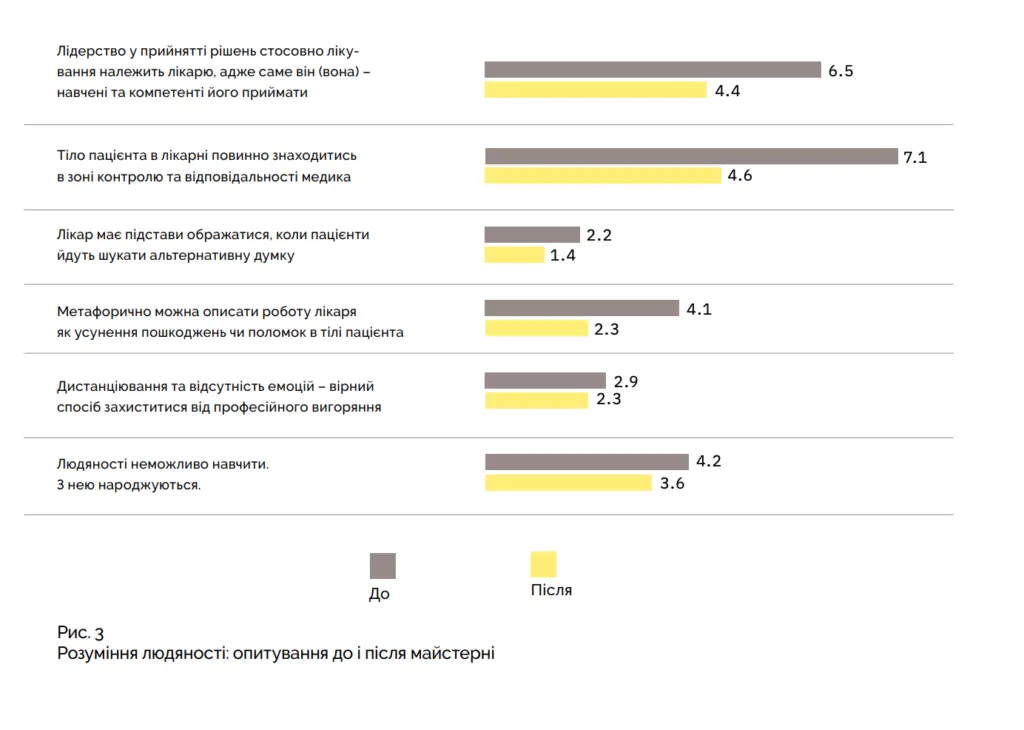
This table summarizes the results of the measurement (to what extent the respondents agree with the statement) before and after the workshop. Yellow is after, Grey – before. The statements read as (in the same order):
Leadership in decision making regarding treatment belongs to a doctor, its the doctor who is trained to make such decisions.
The body of the patient must be controlled by the doctor, as it is under his/her responsibility.
The doctor has reasons to get upset if the patients want to get a second opinion.
It is possible to describe the doctors work metaphorically as removing damages and breakdowns in patient’s body.
Distancing and lack of emotions – the right way to prevent professional burnout.
Its not possible to train how to behave in a humane way, one must be born with it.
Feedback from the participants also confirmed the well-chosen training format (more horizontal/equal). Here, all participants had the opportunity to actively participate in the process.
As a result, the sincere involvement of each of the co-developers changed the attitude towards many aspects of the studied topics. For example, after participating in the workshop, female participants agree much less with the following statements: “Leadership in making decisions about treatment belongs to the doctor, because he/she is trained and competent to take it.” “The patient’s body in the hospital must be in the area of control and responsibility of the medical worker.” “Metaphorically, the doctor’s work can be described as repairing damage or breakdowns in the patient’s body.”
The course is structured along the following topics:
- Patient-centered approach
- Empathy
- Trust in medical professional-patient relationship. Consultation as space to build trust.
- Patient’s autonomy. Professional boundaries
- Confidentiality
- Crisis situations and bad news
- Difficult conversations and conflict
- Tolerance and Diversity.