‘The medicine is already within the pain and suffering. You have to look deeply and quietly. Then you realise it has been there the whole time’.
Saying from Native American oral tradition.
With gratitude and deep thanks to…………
Dear Ellen my coach, for these past years. You teach me so much. I deeply appreciate your love, your support and your gentle, insightful and wise coaching. I never leave a session with you without an incredible deep learning and for this I am forever grateful. Dear Stephie and Bo my guiding team coaches. Stephie, my dear friend, I so appreciate and love your openness and your courage to explore together the many parts of our friendship. Thank you to Max, the leaders and the diplomats in the DDI community, my beloved friends and my peers and all the parts and roles within us all that we love and hate, include and exclude and that are welcomed into our DDI community and support us all towards making this world a better place.
I struggled to identify a topic for my thesis that I could really relate to, I mean I would relate in one moment and then in the next moment, I would lose my fire and enthusiasm around the topic. In my work with Ellen, she patiently supported me to find the topic that most resonated with me. Thank goodness! And thank you dear Ellen.
And finally thank you to you, for reading and considering my journey. I understand that the topic itself is a hotspot in the world, and for me personally, particularly now. I am in some ways comfortable with and used to this.
The activist part of me wants to bring forward the topic that is most dear to my heart now, that is in me and that is in the world as a global hotspot. I am also interested in the challenges of questioning and potentially finding the inner resources, roles and support that enables us to decide which path we want to take and how we may choose to move away from some of the beliefs and ways of being that we are brought up with and that are passed down to us from generation to generation.
Through sharing my own journey, it may in some small ways support others who are in similar processes. Whatever childhood pressures we have grown up with, to believe in certain ways and to prioritise certain roles, I am hopeful for change. I can really start to see how the changes in me have and continue to shape every aspect of my work and my life.
Having spent much of my life working around Inclusion and Exclusion I want to try and make this writing as accessible as I can, so I’ll start by trying to explain some of the key Process Work concepts that I refer to:
Process Work was developed by Arnold Mindell. It’s a therapeutic awareness approach that focuses on the process of that is happening right now, where everything that is happening in this moment is seen as meaningful and part of an ongoing process that if we follow it can bring us healing and greater insight.
A Global Hotspot – A term developed by Arnie Mindell and others that describes where the world’s most charged conflicts and tensions are currently concentrated.
My life as an activist – who am I……
My Life Myth
One of my earliest memories as a child was being asked at school to write a story on the topic of what we wanted to be when we grew up. I remember so clearly what I wrote:
“I want to do something great for the (Jewish) people……..”
I have carried the dreaming in my story with me throughout my life and it is though learning about Process work and within this paradigm, understanding the importance of our Life Myths, that I am able to see and realize it’s significance.
I am shy to reveal this part of my childhood self, a part of me asks…who did I think I was!! For as long as I can remember, I have carried deeply inside of me a sense that my place in the world is to work towards bringing about change, this is the role and the dream that I am born into. Through my work with my dear coach Ellen, I learnt how I can replace ‘Jewish people’ with ‘people who are from communities that are marginalised within the mainstream’, and ‘something great’, with activism. This learning has helped me understand more clearly how my dreaming at this young age, has informed my whole life and this fills me with amazement.
A Life Myth is – a guiding theme or pattern that continues to show up across our life journey. It can come from our dreams, our childhood stories or our fantasies. Understanding our Life Myth, can help us to better link and understand the decisions we make in our lives and how this links with the direction of our lives.
My primary Identity growing up……….who am I?
The identity I have always been the most aware of alongside being a woman, is my JEWISH identity. This is my Primary identity; it’s one of the parts of me that I identify with most strongly and it’s how I show up in the world. Over time my relationship to my Jewish identity has changed, it’s not become less significant or more significant, it’s just enabled me to grow into a different way of being and understanding its significance for me and for others.
Some of what I’m going to be exploring here, are these changes in me.
Entwined with my Jewish identity there is also my experience and that of my family, from generations back, of antisemitism.
Antisemitism is prejudice and discrimination directed at Jews simply because we are Jewish. It is one of the oldest and most persistent forms of hatred in human history.
As a Jewish woman I feel in many ways that I am a citizen of the world. I can see how antisemitism plays out in my own history, in the world and in the current genocide in Gaza, in Israel and within all of us.
My Jewish identity comes with many processes both primary and secondary and many edges. I am proud to be Jewish and of my Jewish heritage and culture. I grew up within a strong religious Jewish community. I loved being part of the community and I loved everything that went along with it, Jewish festivals, traditions, history and culture. These parts of me feel very familiar and are a deep part of me, it’s how I was brought up. I can feel my ancestors in me, generations of Jewish families and communities celebrating and continuing to celebrate these traditions.
Entwined and alongside my pride and love of being Jewish, I have a deep and at times unbearable pain. My ancestors came from the Pale of Settlement, living in Shtetls, making their homes in the lands of what is now Eastern Europe. They lived alongside non-Jews in small village communities until they were forced to flee from pogroms and antisemitism. They fled from their lands of birth becoming refugees, experiencing loss and displacement arriving in the UK by boat, some of them believing that they were going to America.
Shtetl
Shtetl, the Yiddish word for ‘town’, especially towns where Jews lived in large numbers, encouraged by the nobility who encouraged Jews to settle there. Shtetls flourished during the 17th and 18th centuries and towards the end of the 19th century, nurtured new Jewish political movements and modern Jewish culture alongside a more traditional way of life.
Vanished Communities – The Hidden Shtetl of Sedova – A Museum in Lithuania I visited that honours and respects the Shtetl communities:
“Before the second world war there were 297 Jewish communities dotted throughout Lithuania. The Holocaust destroyed the Shtetl communities that had been nurtured for centuries…… “Not a single Jewish shtetl recovered after the war. Noone remains in the shtetls to bring new Jewish life into the world. There is no one left to bury”
A history of persecution is an integral part of my identity and these stories shared by my family and community are held within me and have and continue to shape my personal journey.
I have a deep sense of belonging to the different communities I am part of while at the same time there is also a strong part of me that has always felt excluded from the mainstream. I know the pain and fear that comes with being marginalised, hated and othered.
Growing up experiencing antisemitism as a child and young adult I felt conflicted. Within the mainstream I felt ashamed and defensive of the Jewish part of me. I internalised the antisemitism I experienced and the part of me that was different felt weird when I was within the mainstream. I saw the one other Jewish girl in my year at school and thought she was ‘strange’, too studious, too odd, too different. It wasn’t until I left school years later that I realised how I’d internalised the antisemitism directed towards me and placed it on her.
Many of these roles /parts I marginalised in myself. They were secondary to my strong identity of being proud that I was Jewish. I found these difficult feelings too hard to speak about. I felt ashamed to have them, and I had no framing or understanding of what it meant to go over my edges to explore and integrate them within me and therefore in the world around me. When I saw other Jewish girls also experiencing antisemitism, I felt angry at them, that they had somehow betrayed me by being so ‘other’.
Being Jewish – what it means to me.
I can’t remember a time when I didn’t know that I am Jewish, my family and my ancestors are all Jewish.
As I was growing up our stories were shared about how my family came to the UK, about the Jewish Holocaust, I went to Hebrew classes 3 times a week and as I got older, I taught at Hebrew classes. I went to the synagogue regularly, celebrated Jewish festivals, ate kosher food and grew up with Yiddish and other languages being spoken around me.
Yiddish – is a historical language of Ashkenazi Jews, that is Jews whose ancestors came from Central and Eastern Europe. Yiddish developed about a thousand years ago in Central and Eastern Europe and blends elements of German, Hebrew, Aramaic and Slavic languages. It became the everyday language of millions of Jews in Eastern Europe. It was also a cultural world of theatre, humour, literature and songs. Before the Holocaust 11 million people spoke Yiddish.
I had a deep and meaningful sense of my Jewish identity. I loved that I belonged to my Jewish community. I felt safe, relaxed, easy and confident with everything about being Jewish. Outside of this community I grew up with a fear of and experiences of antisemitism. I felt different to and not fully part of the wider mainstream community. I learnt that it was often safer and easier to hide my Jewish identity.
Being Jewish was as integral to my identity as being a woman.
I loved being with my Jewish friends. There was no explaining to do, I could be totally and fully me. Some of the feelings I had around being Jewish I marginalised, and the antisemitism I experienced marginalised in me the uncomfortable feelings I also associated with being Jewish.
Outside of the Jewish community, as I went to university and became more aware of other’s stories, I started to feel a sense of responsibility for the actions of the Israeli government. If I said I was Jewish, I was often asked:” What do you think about what the Israeli government is doing?” It was hard, I didn’t feel responsible for what happens in Israel…I am British…and yet I also did and I do feel some sense of responsibility and shame.
Growing up I learnt about my Jewish history. I heard stories of the 6 million Jewish men women and children who were murdered. The Holocaust happened relatively recently, within the lifetime of the elders in my family. In the Jewish community and part of my primary identity was that it could happen again …. at any time.
Because of my experiences of antisemitism at school as a Jewish girl and young woman, I understood that being Jewish also meant being hated.
My family arrived in the UK as refugees from across the shtetls of Eastern Europe…as in many Jewish families we’re not sure exactly where from, only that they were forced to leave their countries of birth. Family myths and stories shared between us through the generations; a baby from our family thrown from a train for safety to be brought up by villagers; my great grandma who came from somewhere that was in the Pale of Settlement, where many Jews were forced to live, survived by rolling coloured cigarettes from a kiosk in central London for wealthy English people, despite only speaking Russian.
Feelings of persecution, always the victim, were handed down to me, formed me and shaped me, reinforced by my own family history and the long history that we celebrated and learnt about during the different Jewish festivals.
Pale of Settlement – A large region of the Western Russia Empire where most Jews were forced to live by law. It covers Lithuania, Belarus, Ukraine, Moldova, Poland and Western Russia
Many times, in our history as Jews, we have fought against this hatred and fear of annihilation. I realize that a part of me also felt deeply and unconsciously that I had no right to be here. A part of me felt deeply ashamed that I was Jewish. I felt that there was something wrong with it, with me. I learnt that to be accepted and to feel safe it was better to hide that I was Jewish. As a young girl I often hid my Jewish identity. It was hard to explain anyway, and I wanted to be part of the mainstream. Although I felt these things, I couldn’t speak or articulate them. They influenced who I was, they were shared unspoken roles in the field within the Jewish community, a given, an influence of how we were to behave in the world.
Ghost roles – A role or a viewpoint or an energy that’s present and influences a group or a community but that’s not openly spoken about, so it becomes marginalised and taboo. In my story and my community growing up, there’s often a tension between the unspoken roles of the Antisemite or Persecutor and the role of the Assimilated Secular Jew.
I felt as a child that I belonged in the Jewish community, but I didn’t have that same feeling of belonging in the world around me.
As I grew up and my parents divorced, I started to question the unspoken rules of the orthodox Jewish community I was part of. When I came out as a lesbian in my early twenties, I quickly realised that belonging to a community is often conditional and that I can belong to many different communities representing the different parts of my identity and beliefs. Within the Jewish community I grew up in, I realised that you must stick to the spoken and unspoken rules to be part of the community, ….no divorce and no lesbians…. if you break the rules, the community and God will be your judge.
There are strong roles in the process work paradigm within many communities, including within the Jewish community. For me, identifying and understanding these roles, the edges and edge figures, has helped deepen my understanding of a process that I’m part of but that’s also much bigger than me and has often been there for generations. It helps me see how attached I am to each role, primary process, edge, and what it might take for me to go over my edge and switch to another role.
Within my community and within me, I can see the role of the Insider. What do I need to do to stay the Insider. I can switch roles to become the Outsider, or I can choose to only reveal the parts of myself that enable me to remain the Insider within a community.
I am the Challenger, the Disruptor, the Critic, it’s part of my primary identity and a role that’s very strongly aligned with the Activist in me. In communities I am part of and grew up in, I see the Gate Keeper, the Tradition holder, alongside the one who leads change.
As I grew up, I lost the deep sense of belonging that I had to a mainstream orthodox Jewish community and began feeling more an outsider…being Jewish wasn’t enough because I am also a lesbian, in the lesbian community I am sometimes marginalised because I am a Jewish lesbian….
As the American writer, poet and activist Audre Lorde wrote:
Being women together was not enough. We were different. Being gay girls together was not enough. We were different. Being black together was not enough. We were different. Being black women together was not enough. We were different. Being black dykes together was not enough. We were different.
Zionism and me
It was part of my identity as a Jewish young woman and a given in the Jewish community, held deeply within our history of oppression, that we needed and depended on having a Jewish state in order to feel safe. Without a Jewish state, there would without doubt, be another holocaust. As Jewish people, we had a right to a land in which we could experience self-determination because of our long history of persecution.
As I grew up the roles of colonization, dispossession of the Palestinians, Palestinian people as an indigenous community, were all ghost roles. As a Zionist I could only see one side, I didn’t see any of these other roles.
The role of dispossession belonged to Jewish people. The role of the soldier there to protect us in the land of Israel against the enemy should have been allowed to be present during the Holocaust but then they were ghost roles embodied as resistance fighters, now they were visible and present in us and in Israel.
This awareness was hidden and disowned by the Jewish community I grew up in because the role of being a refugee and victim of a genocide was so strong and present. We were, I was and had always been the victim and never the persecutor.
I was brought up with the slogan…… that we were …” A people without a land and that Palestine/Israel was a land without a people”.
I grew up with a powerful and emotional relationship to Israel.
Zionism and Israel, 2 roles that were and are part of my Jewish identity, how I experience those roles in me has changed my life, alongside my relationship to being Jewish.
As a young Zionist and within that framing, I grew up very strongly and proudly in the role of Defender of a Jewish State which I did from the position or role of being a Diaspora Jew.
A Diaspora Jew – This refers to the scattering and settlement of Jewish communities outside the ‘historical homeland of Israel’.
Zionism – Zionism is a political, nationalist and colonialist movement that began in the late 19th century with the aim of establishing a Jewish state in Israel/Palestine. In 1948 the state of Israel was proclaimed an independent Jewish state.
In 1950, Israel’s parliament passed new legislation – The Law of Return.
The Law of Return gives every Jewish person across the world, the right to emigrate to Israel and receive automatic citizenship.
As a young Zionist, I grew up believing that the role Israel played in my life was hugely significant. Israel was my country, even more than England, my country of birth. It was a dream land in which everyone who lived there was Jewish. A land free from persecution for me as a young Jewish woman, a land in which antisemitism didn’t exist.
Growing up we had a blue and white ‘Jewish National Fund’ box by our front door in which we collected money for ‘building and developing Israel’. This box symbolized hope and every time there was a family celebration, we collected and sent money for trees to be planted in Israel. Some of my own family were living in Israel. Whenever Israel came on the news we stopped talking, we were silent, we listened. We prayed for Israel every week in the synagogue and we would proudly say: “Next year in Jerusalem” every year at our Passover meal.
Planting Trees in Israel – The idea of planting trees in Israel for Diaspora Jews was to celebrate and remember key family events. It was for us, a link to ‘our’ land, the land of Israel.
I now see the truth of a very different story.
These trees were planted to conceal war crimes. Trees were planted to further dispossess the indigenous Palestinian communities from their land and their traditions. Trees were planted to hide the ethnic cleansing of Palestinians and to prevent Palestinians from returning to their homes.
The trees that were planted were traditionally pine trees. This process of planting pine trees affected the biodiversity of the land and has deeply affected the mitigation of climate change in the area.
Writing this I recognize the impact on me of what it means to grow up with a set of beliefs that I now understand are colonialist and utterly oppressive.
I pause and I stop to take it in.
I am filled with such deep grief and sadness; I cannot find words. Grief for the Palestinian people. Grief for the beautiful land. Grief for other Jewish people who believed and who still believe this narrative and grief for myself who believed so passionately in the story I was told.
At 16 I went with a Jewish youth group for a month to Israel. We travelled around the country, I worked on a kibbutz, we sang Hebrew songs and we danced at the Western Wall. I was indoctrinated, brainwashed and intoxicated with a deep and passionate love for Israel. I was moved, drawn in and fully embraced my world of Israel and of Zionism.
Within my Jewish identity and community, I see many roles, unspoken dynamics, marginalized identities and disowned social forces that influence the community and myself within that. Roles that are both visible and I can identify and ghost roles that carry our collective ancestral trauma in the background, roles that we don’t often speak about.
It is our memory of pogroms and of the Holocaust that deepens our fear of antisemitism and the pressure to survive whatever it takes which we don’t speak about. There are within and outside of me, the roles of religion, culture, community, life in the UK outside of a Jewish state, and the role of Israel as a Jewish state and a land that offers us the opportunity to emigrate at any time to a country free from antisemitism. It offers ‘safety’ for Jews, its army ‘protects’ us from the constant threat of annihilation that we carry deep within us.
In the background were the ghost roles in me and in the community. I am part of the ‘chosen people’ that’s why we are so hated. We have a right to a safe Jewish country in Israel because of the trauma we experienced of the holocaust, and because of all the other pogroms our ancestors experienced in the past.
There were also secondary roles in me, the need to hide who I was because of I was fearful of antisemitism, exclusion and annihilation and a part of me felt shame around my identity.
And of course, within all this mixture I had my edges, my primary U energy and my X energy.
What are X and U energies – Our U energy is what we can see, hear, measure. It is body movements, symptoms, conflicts. It’s the main story we experience and the roles we are already in and familiar with. Our X energy is the feelings we often have in the background that our experiences come from but that isn’t yet identified or expressed and which might come out in our dreams. U energy tells us what is happening now and when we can go over our ‘edge’ our X energy tells us what is trying to emerge within us. Our X energy is where our learning and transformation is, learning that supports us to become more integrated and include the parts that are trying to make themselves known to us.
Growing up, my X energy, that of the role in me of the oppressor of the Palestinian people was far too painful and too far over my edge for me to see.
There were no stories of the Palestinian people and their lives.
I never heard about the Nakba, Palestinian land, Palestinian history, culture, music, food and the lives of Palestinian people.
Nakba – means ‘catastrophe’ in Arabic. Nakba refers to the mass displacement and dispossession of 700,000 Palestinian Arabs who became refugees in 1948 when the State of Israel as a Jewish state was proclaimed. This happened through a combination of the Zionist movements efforts to establish a Jewish homeland, The British Mandate ending and the UN partition plan.
At 16 I went with my Jewish youth group to Israel for a month and I felt free! I didn’t have to think about antisemitism, everyone I met was Jewish. I understood this world. In Israel I found a place where I felt free to be me.
I realise how I internalized the role of antisemitism that I and my parents and grandparents and for generations back, had experienced. This was a ghost role in me and in the field around me of fear, secrets and annihilation that was embedded in my and other Jewish people’s family stories. We lived within this hidden framework of potential annihilation; it affected how we lived our lives but was never named and spoken about in a way that we could process.
We were the ‘chosen people’. Exceptional, and part of this exceptionalism was that we were the victims of everyone. Everyone hated us. Yet in Israel…I didn’t feel like that. I fell in love with the aggressiveness of the Israeli military culture, the sheer beauty of the land and the joyful, wonderful feeling of freedom from experiencing antisemitism.
I feel such deep grief, sense of shame and unbearable sadness when I say that Palestinians and Palestinian life, Palestinian culture, art, history food, dance, music, the Nakba, the apartheid system, the Occupation, it was invisible, never mentioned and growing up… I did not know to look.
Jewish people passed our fear of annihilation onto the Palestinian people, we were eroding their lives, their land, their visibility, their history and their culture.
I didn’t see it …….. In fact I loved the militaristic Israeli society, the macho army young men……I grew up with the internalised antisemitic belief that all Jews were geeky and weak, pictures from the concentration camps embedded in my mind……..we were weedy, we didn’t fight back….I know that we did fight, but the victim role was so strong that the role of the activist resistance fighter was also marginalised in me. In Israel at 16, I saw young Israeli men and women everywhere carrying guns dressed in military uniform and I felt safe, strong and proud.
At 18, I went to university and became very close friends with an Iranian woman, a Kurdish woman and an Egyptian woman. We were a four and in the depth of our friendship our love and trust in one another and the stories we shared, I heard a different story. I learnt about the Palestinian people, their lives, their history, their culture and their land.
How on earth did I not know?
I started to question the stories I’d been told and realised how I had been so indoctrinated into the world of Zionism by the intense and powerful ghost roles of fear of annihilation and Jewish safety.
My dearest Arab friends opened the beginnings of a paradigm shift in me; they literally turned my world upside down.
I understand why I was told only one side of the story of Palestine. I believe that at that time many Jews couldn’t bear to witness what was happening to the Palestinian people because of our collective historical trauma, pogroms, the Jewish Holocaust, centuries of statelessness and our ongoing displacement. It was a collective edge, and the voice of the Palestinian people was a ghost role too dangerous to hear.
Edge – an edge is the place we often feel stuck, where our identity is challenged and it becomes a block to our potential for growth and transformation. The other side of the “edge” holds our potential for growth. When we go over our edge and understand it more deeply, we can integrate the other side and develop a more complete sense of ourselves. When we go over our edge, we understand ourselves more deeply. This leads us to transform and integrate those parts of ourselves that we had marginalised and not yet expressed.
There was only one meaningful justifiable side, only one strong primary identity, only one victim, only one people, only one land. My young open mind was deeply, passionately and emotionally charged and encouraged and supported to fall utterly in love with the Jewish state.
There were no Palestinians.
Their lives, their history and their culture simply did not exist. It was that easy. There was no external role of the coloniser, no role of inequality, no role of who qualifies as a human being, those roles only existed in my own Jewish history and only as ghost roles playing in the background.
From Zionist to anti-Zionist – the change in me
Human suffering anywhere, concerns men and women everywhere
Elie Wiesel
During my university days and my ‘waking up’, I started to become involved in supporting Palestinian rights, while still supporting the idea of a Jewish State. I believed what we as Jewish people needed to feel and to be safe and that for this to happen we needed a Jewish state. I believed also that the Palestinian people needed a separate state for them to feel safe.
I moved through these years, trying to bring my son up as a secular Jew. I wanted to share with him the long Jewish history of secular Jewish socialism and activism. Before he could walk, we went on pro-Palestinian marches, opened our home to asylum seekers, and were part of a growing community of Jewish lesbian mums. It’s interesting now for me that my son doesn’t identify as Jewish in the way that I do. He says he has ‘Jewish ancestry’. That role and identity that’s so strong in me just isn’t present for him in the same way.
It made me think further about what all of this means when at the first anti-Zionist Jewish Congress in Vienna I attended, one of the speakers, the Palestinian academic writer and activist, Ghada Karmi asked the largely Jewish audience…
What does being Jewish mean to you? What does Jewish mean if you don’t actively follow the religious beliefs embedded in the Jewish scriptures? she asked, “Why don’t secular Jews relate as having Jewish ancestry. What does it mean to say, ‘I am Jewish’, if you don’t follow the religion?”
Becoming more aware of the one in me that must fight for the right to exist, combined with my life myth, of being an activist, I realize the significance of always having been drawn to others who’s right to exist is also challenged by society. It helps me to see why all my life as an activist, I have been and continue to work alongside people from marginalised communities who are experiencing a similar fear that they don’t have a right to exist. For many years I have worked alongside people with intellectual impairments supporting them in their fight for justice, inclusion, rights and equality.
People with intellectual impairments are the only group of people in the UK who’s right to exist is questioned at birth. Currently, pregnant mothers can choose to have an abortion at any stage of their pregnancy based on discovering that the foetus they are carrying is disabled. It is within this paradigm that mothers are encouraged by the medical profession to abort their disabled foetus because their child may be born with a significant disability.
In Iceland, this has led to the near eradication of people with Downs syndrome.
Working alongside people with intellectual impairments supporting them in their fight for equality and human rights, I have been invited to work in many different countries.
Just before lockdown I was invited to work in Ramallah, in the West Bank of the Palestinian territories. Myself and my colleague, a man with intellectual impairments, were invited to work with Palestinians around the topic of disability inclusion, empowerment and human rights. We worked with Palestinian friends and colleagues to make the changes for equal rights for Disabled People within legislation, in society, in organisations, in families and within employment rights. Together with families, policy makers, human rights activists, NGO’s and people with intellectual impairments, we explored ways of embedding the human rights for all disabled people in Palestine within legislation, systems and organisations.
This was a life changing experience for me. It moved and touched me deeply. I felt a deep connection and love for the Palestinian people I met and worked with, women, people with intellectual impairments and human rights activists.
Behind everything we did was the constant everyday impact of the roles of colonization, othering, oppression and of the Occupation. The inhumanity and terror that I witnessed was deeply troubling. Being with the Palestinians living every minute of every day with threats of death, imprisonment and the inescapable roles of power, rank and privilege was devastating. At the same time, the strength, support, humour and generosity of the women and the sense of community we developed during our time together took my breath away. It was incredibly moving; it touched the depths of my soul and was deeply transformative.
While there I also met with Palestinian human rights activists and was deeply touched and inspired learning from them about their work and their lives. I met Palestinians who had spent years in Israeli jails and who now spend all their time working alongside Israeli Jewish activists, hopeful for a different world, a world of freedom, justice and liberty for both people.
I could see how the Israeli soldiers dehumanised themselves by dehumanising the Palestinian people. Roles of the fighter, against the role of the fear of annihilation and the role of the Zionist they were encouraged and pushed to take on since birth. From my own experience I understand how this role based on fear and othering can be reinforced by families, within the school curriculum, within the culture, the media and on the streets.
Palestinians are seen in the role of the enemy. Israeli Jews must dominate them to survive. In this paradigm, the role of the annihilator of Jews is no longer actively held by Nazis, it is imagined in the Palestinian people. Young, Jewish, Israeli and Zionist, the roles emphasised from birth, is a frightening and dangerous mix of patriotism, rank, power and privilege…. I know it, I see it and I understand it.
Suddenly I am in the role of a Jewish witness as I bear witness to Israeli soldiers coming onto the bus I am on and holding rifles directly at the heads of Palestinian men women and children forcing them off the bus at the checkpoint that leads to East Jerusalem. There is fear and hatred on all sides, power and subservience, each side fighting for their life. The Palestinians are then forced at gunpoint through a metal cage to check their ID.
Roles of inequality, dehumanisation, control, power and authority play out at every checkpoint every day of every week in the lives of young Israeli soldiers and Palestinian men women and children who are travelling from place to place. The soldiers are the oppressors, experienced by the Palestinian people as representatives of a state that controls every aspect of their lives, imprisons them unlawfully and steals their land.
The soldiers in turn see every Palestinian as a potential terrorist. I understand how it works, if you have a role of Occupation, the Occupier, you also have a role of resistance, the freedom fighter. The polarity of these two roles that oppose each other and cannot be separated. The powerful and the powerless. In the dreamworld the role of the powerful is also the role of the powerless and within the role of the powerless is also the role of the powerful, each side disowning the ghost roles they don’t identify with within the other.
In that moment, travelling on the bus from Ramallah into East Jerusalem, being Jewish and therefore not being forced at gunpoint to show my papers and get off the bus, I was sat in the role of the oppressor and the one who bears witness. As an activist it felt unbearable to witness such dehumanization and as a Jewish woman, I felt deeply ashamed to be confronted with the role of the privileged Jewish oppressor in me.
I felt ashamed of my rank, my power and my privilege that my white European Jewish identity afforded me.
I started to separate more of the Jewish part in me…I hated the two-tiered apartheid system I witnessed first-hand in Palestine and in Israel. I easily slipped into hating the Jewish Israeli Zionists and that part in me. While at the same time I felt a complicated and deep belief, which meant I couldn’t separate myself from the fear of antisemitism and a defensiveness if people questioned Zionism.
On leaving Ramallah I went through Occupied East Jerusalem into West Jerusalem and met with 3 childhood friends. One of these friends, my closest friend growing up, emigrated to Israel at the age of 18, got married, had 5 daughters and moved to live in a Jewish settlement in the West Bank where she brought up her girls.
I felt such a deep love and care for Palestinians, a love for my friends and at the same time a hatred of the Settlers who had built Jewish communities on Palestinian land. The Settlers see all Palestinians as terrorists who want to annihilate all Israeli Jews. They see Palestinians as less than them. How could I manage these different worlds outside and inside of me when one of these Settlers was my dearest and closest friend when I was growing up.
A Settler – a Jewish Israeli citizen who lives in a settlement built by them and Israel, in territories regarded since 1967 under international law as Occupied Territories. The settlements are considered therefore illegal by most of the international community and are primarily in the West Bank, including East Jerusalem and the Gaza Strip.
Switching sides from victim to perpetrator…. how to take responsibility…
A German Jewish conversation.
In the process of becoming more aware of and open to my edges, my internal conflicts and my deep-seated attachment to the role of Jewish victim in me, I have become friends with Stephie, a German Process Worker.
For Stephie it is also her first time developing a close friendship with a Jewish woman.
As a Jewish child, I was raised with the belief that all Germans were the enemy, in the role of the Nazi oppressor. I must stay clear!
It’s been such a joy and so freeing for me to deepen my understanding and empathy of how it feels for the next generations of Germans after World War 2. I am learning what it means for younger Germans to grow up with the devastating history of the Jewish Holocaust within their own families and in their communities.
Through our deepening friendship, I have learnt how I can take responsibility for my understanding of this history. I’ve learnt how I can switch roles and feel empathy towards the ‘Oppressor’. I’m feeling more resilient to bear to go over my edge and find the role of the Jewish oppressor in me, alongside the strong role I have in me also of the Jewish victim.
Getting closer to Stephie is very timely in terms of deepening the roles in me of victim and perpetrator. It helps me learn how I can bear witness to the genocide of Palestinians in Gaza and the West Bank.
As part of our deepening friendship and curiosity we decided to make a podcast together.
Here it is, please click on the link!
A German Jewish conversation
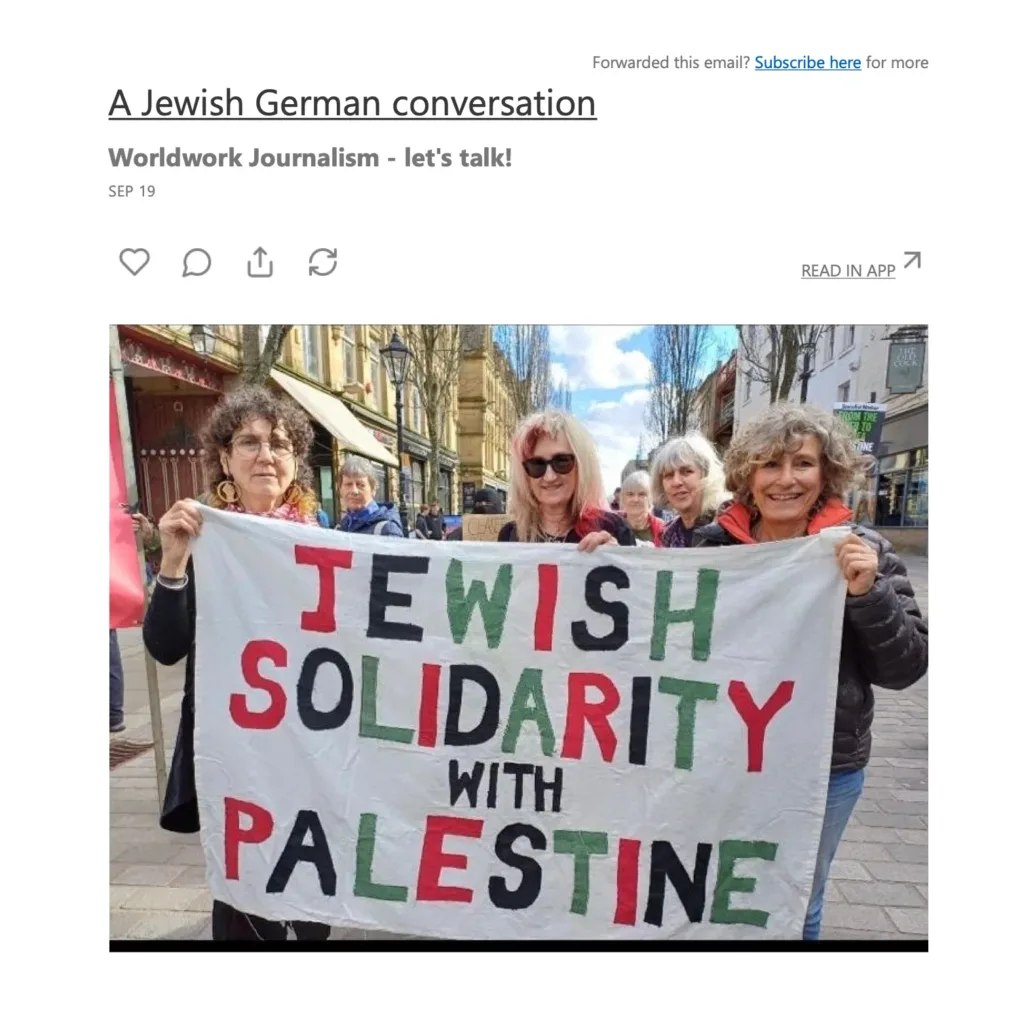
Listen here to our conversation:
My after-reflection – Philipa
Doing this podcast with Stephie …2 women, one German, one Jewish ….felt such an honour. To have the time to talk, listen, share and be curious to ask questions that maybe I’ve carried with me consciously and unconsciously for a long time.
Of course, I know, but hearing Stephie say….but there were no Jews to be friends with … they had been killed or left Germany….I felt devastated, it’s so shocking. I feel deep sadness to imagine how could this happen and to hear it so directly from Stephie. I realise also that I never think of younger Germans as being Jewish.
Doing this podcast while holding the war in Gaza and the Occupation in Palestine so close in my heart feels very hard….a part of me is wondering who am I to talk about antisemitism when the Israeli army and state that claims to represent Jewish people seem to hold so much power creating such a danger to themselves, to Palestinians and to the world. How can I talk about anti-Semitism when there is a genocide of the Palestinian people happening now?
When we finished the podcast Stephie and I sat together…2 women, German and Jewish. We were both silent. Then Stephie said sorry to me for what Germany had done to Jews in the past. Such sadness and at the same time a deep healing. In that moment and in my connection to Stephie and our conversation, I felt I could love Germany and also deeply love my Jewish self.
My after-reflection – Stephanie
Beginning this year Philipa asked me: Can we have a conversation, I want to know how it is/has been for you to be German.
Sure, yes, Let’s talk.
Starting the conversation I felt my voice shy and weaker than normal, and there were moments I could not say much more, then give space to shame, acknowledge the darkness of what happened and stay present in the conversation at the same time …
Did you have a Jewish friend when you were young? No, I did not … at the time.
How much do I feel responsible for what happened? An important question. And how important it is, to also not get stuck in this role and still speak out about the human disaster that Israel’s decisions are causing in Gaza these days.
I notice how the history, and my relating to this dark period informs my deep wish to find the courage to speak out, to make unspoken visible, and to work with the tensions this courage creates.
When we finished the recording, Philipa asked me: how do you feel about our talk?
Heaviness on my chest, I could not easily answer, I needed to connect to this sensation … grief. Giving space to it, tears started running down my chin and I said: ‚I am so sorry, what my people did to yours.‘ And I see Philipa in tears too. It is good after this open, playful and challenging talk, to meet in the depth of the pain, not to forget, but to release a bit of it.
Healing and deep connecting across past, present and future identities.
Listen here to our conversation:
And so, to today….
We share the same sky, water, earth.
It’s not just Israel and Palestine.
It’s all of us.
It’s the truth
The genocide of the Palestinian people in Gaza, the West Bank, Palestine and Israel, has and continues to fill me with an indescribable grief for both Palestinians and for the many Israeli Jews for whom the role of humanity seems so out of reach.
We were chasing
Mohammed Moussa – Gaza Poets
a lost homeland,
then a lost city,
then a lost camp,
then a lost house,
then a lost tent,
then a lost grave.
The situation has changed my relationship to my primary identity of being Jewish. The roles within me have shifted. Within the field of Zionism and our fear of annihilation which culminates in our and my need for a Jewish state to stay alive and to be safe from antisemitism, I have gone over my edge.
In my heartbreak, which I know is shared with so many others, I have dropped my worry and fear of antisemitism, and I have completely switched sides and roles.
In this role switching process, I have hated and wanted to annihilate the Zionist living both inside and outside of me. I didn’t care about the role of antisemitism. I developed an overwhelming hatred towards anyone who’s primary identity was that of Jewish Zionist.
I felt an ongoing and urgent need to speak out against the genocide as a Jewish woman. It felt imperative to me, as an activist, that I must, along with others, speak against the mainstream traditional Jewish voice. The voice that puts all Jews together as having one voice, that voice being the belief in the need for Israel as a Jewish state.
It felt like a deep waking up and a surprising freedom. A more flowing open, easy state of being. I no longer felt I needed to hang onto the belief and the need for a Jewish homeland for Jews to feel safe in the world. I saw the roles of colonization, racism and othering. I realized the impact of how identifying with Zionism denies the history of the Nakba and the ongoing human rights and freedom of the Palestinian people.
I understand how hard it is for people who identify as Zionist to acknowledge the Palestinian Nakba and I also understand why many Palestinians do not know about Jewish history of the Holocaust.
I felt the pressure in the field from Jewish people who strongly identify with the role of Zionism to promote that role as primary in all Jewish people, including me.
It has been a long journey for me to completely understand from a meta position the interlinking roles of the Zionist and of the antisemite in me. I know when people are using anti Zionism as a vehicle for their antisemitism. I can catch the antisemitism of people believing that what the Israeli government is doing I, as a Jewish woman from the UK, am somehow responsible for.
As one Palestinian woman recently said at a workshop I was in……
Many people come up to me on pro-Palestinian marches expecting me to collude with their unquestioning, generational, deep-rooted antisemitism. Putting antisemitism on the altar of the Palestinians is not liberation for anyone.
During the current war and indiscriminate killing across Palestine, I along with many other Jewish activists in the UK and internationally, have been supporting Palestinians and Israelis who are working together and who have been doing so for many years.
More recently I’ve set up and coordinate a Circle of Support as part of The Gaza Support Network. The Gaza Support Network is grassroots, people-powered initiative responding directly to the urgent humanitarian crisis in Gaza. Initiated by Jewish and Israeli women, it currently runs support networks for over 60 families in Gaza as well as several community initiatives and Al Anwar displacement camp.
Jewish activists and anti-Zionists have been making our voices heard against the mainstream Jewish narrative and we are getting louder. I therefore don’t find it surprising, that many of the Westerners doing some of the most active work in opposing this genocide are Jewish anti Zionists. I feel that as Jews, borne through our history of pain and persecution, many of us have an urgency and a love towards the Palestinian people and their human and land rights and freedom.
We know what it means to be nearly annihilated. It’s unbearable for me. I see how Israeli Zionist Jews, so strongly identified with that role, are caught in the field of their own history. It’s heartbreaking to witness how they believe that to annihilate, kill, murder and torture Palestinian men women and children, will bring them safety. Palestinian people are seen as “the existential enemy”.
It seems to me that maybe in their need for safety in the world and in response to generational trauma, many Zionist Jews see the world in absolutes:
- All Jews are Zionists.
- If you are not a Zionist you must be antisemitic, including if you are Jewish.
- All Palestinians are the enemy.
All my life I have been an activist, it’s what drew me to Process Work. I’ve always been curious about the magic of edges…not initially mine! where different worlds collide. I love the richness and learning in our edges…. where the earth meets the sea, the flow of the river and the land. Through learning about Permaculture, I learnt about the richness of the edges and what they can teach us. I love to become more aware of the marginalised parts of nature and communities, what secrets do they hold, what can we learn, what is visible and what is invisible.
I had the privilege of setting up and leading a human rights-based disability organisation that worked across the UK and internationally. In my role as leader, I was learning ways to step over my edge and become more open to being challenged about my rank, power and privilege. People with intellectual impairments became my teachers.
Working here gave me the opportunity to understand and step into the roles I was less used to knowingly occupy…. those of oppressor, policy maker, government, as well as that of the marginalised person in me. I learnt about the importance and the power of my role as a leader in addressing these issues in me and outside of me.
I was leading a charity that had a Board of mainly Disabled People. We employed people with intellectual impairments in key roles within the organisation to co-lead on different projects. We worked together, disabled people and non disabled people, campaigning for human rights, justice and freedom for all people with intellectual impairments.
Themes of power rank and privilege were daily challenges for us and considerations in how we worked together as a team. How we embedded and highlighted the way we worked and campaigned, sharing our learning as co-workers within the charity, became an opportunity for deep change within each of us, within the organisation and within wider systems and organisations in the UK.
Embedded within me were my roles of both leadership and of activism. When I began training to become a therapist, I was particularly interested in exploring ways in which the therapy world and the activist world could become more integrated.
I didn’t realise at the time, my own social rank and privilege amongst the other therapists on the course. I didn’t see my privilege of having had so much opportunity to learn about issues of rank, power and privilege. I was shocked and upset to see how issues of inequality were marginalised and therefore not being clearly identified within the therapy training and within the wider therapy world.
As I was learning and trying to bring these issues forward, I was often in the role of the marginalised community within the therapy group I was in.
It was therefore such a joy when I saw a DDI Process Work Intensive advertised…. and in Cairo!
Being an activist in relation to the current war.
Arnie Mindell, just after the Hamas attack on Israeli Jews on October 7th, talked about the importance of focusing on learning about working with conflict within our communities, within our relationships and within ourselves. How can we catch it and work with it.
As a young activist I would have been furious at this suggestion. I had a deep sense in my worst nightmares of what was about to unfold and I would have thought….’How can he say this when there is a genocide unfolding!’. Learning more about myself, therapy and Process Work, I deeply appreciate and understand the wisdom and importance of his words. They resonated with my soul, and they gave me direction at a time I felt so lost.
Through Process Work I have learnt how to deepen my understanding of the roles outside in the world, that are also in me. I have learnt to become more open to expressing my vulnerability.
Over the last 2 years of the war in Gaza, on the protests and vigils I have been to, I have can see how compelling it is for people to hook their antisemitism and antisemitic tropes onto the current narrative and story of what we see unfolding.
It hurts me deeply. I experience a very familiar feeling of rage and fear in my body. Not being silenced, remembering to breathe, to not judge and to challenge without alienating people is an ongoing learning for me.
My lifelong awareness and experience of antisemitism and deepening my understanding of process work over the years, has taught me the power of my dreamworld and my edges. Working with my dear coach Ellen, supported me to understand with empathy and not judgement, how and why I was so attached and embedded to the roles of being Jewish, victimhood and exceptionalism…. seeing ourselves as different.
When I was invited by the Muslim and Jewish anti-Zionist communities to give a speech at a large pro-Palestinian protest near to where I live, it felt an honour as well as in that moment one of the most important things I could do. It was the first time a Jewish speaker had talked at an event like this. I was terrified.
My speech initially felt hard to write, what could I say amidst such horrors. I wanted to be open. I wanted to show the unquestioning support of the Jewish communities I am part of, towards our Muslim and Palestinian brothers and sisters. I wanted to ensure my speech brought our Muslim and Jewish communities together. I wanted to reflect what was happening.
I didn’t want to get it wrong.
I could feel the role of Jewish hatred in the background, including in me, and I understood very well how the role of the British media and the Israeli and British governments, used the role of antisemitism to condemn voices that spoke out and supported the rights of the Palestinian people. I could also see the polarisation that was being presented in the mainstream between Jewish and Muslim communities that have traditionally in the UK understood and supported one another.
I felt the responsibility of representing many Jewish voices in my area and more widely that are not part of the mainstream and are often invisible and unheard. I wanted to highlight the role of secular Jews who can see, name and be openly opposed to this genocide.
I wanted to show support and love for our Muslim brothers and sisters, to highlight what we have in common as 2 communities living side by side in the UK.
I wanted to be clear and strong and to not give double signals.
I wanted to take responsibility for representing the anti -Zionist Jewish community I’m part of.
I wanted to speak out and condemn and name what is going on.
I wanted to stand in our power as anti-Zionists, needing and wanting to condemn the atrocities and making it very clear that…….
This is not happening in our name.
Here’s my speech at a Palestinian March……
https://www.instagram.com/reel/C6rlQ9tr01J/?igsh=NzZ2bXRqa3pvcz
After I gave my speech, a religious Muslim woman came up and thanked me. I was touched and we have since developed a friendship. We saw how the Muslim and secular Jewish communities that we were each part of are so separate. We realised that each of us hadn’t had a close friendship with the ‘other’, me with a religious Muslim woman and her with a Jewish lesbian …who is also a mum.
There were challenging roles that we each identified more strongly with within ourselves and our relationship…the role of homophobia, judging religious belief systems, culture, how we address our differences. There were many shared roles between us, we were both changemakers, we were critics of how things are, we were both open and able to connect deeply and easily. It was initially focusing on our shared roles that brought us together and enabled us to talk about more challenging topics with love and empathy.
Deepening our friendship, especially when there is such polarisation between our communities in the world, led us to set up a Muslim Jewish women’s listening circle and protest group. Muslim and Jewish women came together, sharing food, talking about our lives and our histories as well as more difficult topics like radicalism, our relationship as Jews to Zionism and anti-Zionism. We protested together.
Accept the one sidedness of the everyday mind. If its limitations bother you, seek the solace of a more encompassing view…..
In a way the human world is characterized by victimhood: virtually everyone denies being an oppressor
Arnold Mindell
I have become more aware and at the same time not aware, how deeply I hated the Zionist Jewish part in me. I hated the Zionist Jewish role in Israel and internationally. I have to bear to recognise and accept my X energy and learn to go over my edge.
For a while I secretly found some relief and comfort in dreaming of the whole of Israel being blown up along with all the Zionist Jews living there. A part of me felt utter contempt and deep shame for the Jewish Zionist in me. I wanted to blow up that role that’s in me too. I wished I could go back to the part of my identity that identified so strongly with the Jewish Holocaust victim who has always experienced antisemitism, and how awful that is. Identifying the Jewish oppressor in me felt so painful.
Talking About a Land with Many Names
It’s a Monday evening in August and I’m attending a workshop session online, as an Empathy supporter. The workshop has been set up by a Palestinian woman, A’ida al-Shibli and an Israeli woman, Miki Kashtan founders of the Women in White Project.
The Women in White Project is set up to engage “in conversations about tough topics that are rarely talked about between Israelis and Palestinians”.
I was there to offer support to anyone who might be triggered by what comes up.
Women in White Project – to organize and train large masses of women in the basics of nonviolence and self-organized collaboration, so that when a war starts anywhere. 100,000 women dressed in white will mobilize from all over the world to come to the war zone to form a large collective non-violent human shield designed to stop the war and create a foundation for a peaceful approach to addressing the conflicts that led to the war.
The idea for the conversations is “about mobilizing the power of women to stand for ‘life first’.”. The speakers want to offer “a pathway of deep understanding as a response to the horrific situation in the land we come from”.
I am immediately moved and feel my unfolding grief as A’ida al-Shibli talks about her experience on pro-Palestinian marches and of the decades of hatred, she experiences many people have towards Jewish people. This is also part of my story having experienced antisemitism on some of the pro – Palestinian marches and vigils I’ve been on. Something in me feels acknowledged and relieved in her naming it.
Then A’ida al-Shibli talks about how by “ putting hatred of Jews on the alter of creating a Palestinian solution isn’t solving Palestinian liberation”. She emphasises that Palestinian liberation must show us a way forward towards liberation for all.
Miki Kashtan then asks us, the participants, how can we create a message of love for both sides, including the extremists on both sides. In that moment, I have a deep understanding and feeling of how much I have hated the Zionist and religious Jewish part in me.
I can find in me the extremists from both sides.
I realize that by switching sides and wanting to annihilate the other means I am embodying the process I’m trying to stop.
It has been so much easier to identify with the roles of resistance fighter, freedom fighter and activist. I couldn’t bear to listen to the disturbing voices in me of the extremist, the Zionist oppressor, the Settler.
How can we love all sides, a light bulb moment for me. Of course! This is the only way towards hope and peace.
I realized the extent to which I had marginalised the Jewish Zionist in me. I hated this part of me. I marginalised this role, which reflected my hatred towards Jews who are Zionist.
I suddenly felt such relief and lightness! I felt a humanizing, uncritical, unjudgmental loving of the part of me that recognized how I internalized antisemitism. I can see it now, how I put the hatred inside of me onto Jewish Zionists…. I am feeling free!!!
Israeli Jewish Zionist. I judged the role, I wanted it gone, I hated it.
As Miki spoke, I immediately start to feel an indescribable sense of relief and comfort. It was as if something had been lifted off me. I could go over my edge. I felt a deepening love towards my whole self. It was like a thunderbolt, an awakening. I could find a role of the one in me who gives permission for all the roles to have equal value and humanity, empathy, understanding love and not be judged.
I was suddenly experiencing the essence of absolute pure love in myself; a love so deep that it goes beyond roles.
Since then, I feel more integrated and more whole. Having an experience of what it feels like to love these parts that I had marginalised feels freeing, flowy and empowering. I can slow down. I can remember to draw on this essence of pure love when I’m struggling with the roles externally.
I have understanding and empathy towards the roles I polarised and rejected within me: the racist, the Jewish Zionist, the oppressor, I feel into all of them.
I go deeper, beyond roles, edges, primary and secondary processes and I feel the essence of pure love. Beyond the role of Israeli Occupier, Palestinian freedom fighter into a space in which I feel a deep and bright gentleness, acceptance and indescribable love.
I feel into a sense of flowing and freedom.
I feel free. I can step into the roles of Palestinian, Israeli, Zionist, terrorist, freedom fighter, activist, antisemitic activist, Jew, oppressor, victim, the Occupier and the Occupied.
I feel all the roles inside me. I witness them all around me in the world. I experience them as roles and when I give space to these roles, I am able to feel beyond roles to the depths of my soul and the essence of pure love.
It is from this place, I can catch glimpses of the beauty of our common humanity, the joy of our unwavering love for one another and the power of our deep connectedness.
History, despite its wrenching pain, cannot be unlived, but if faced with courage, need not be lived again
Maya Angelou