
Acknowledgements
Even diploma theses need a whole village to thrive. Many people helped, carried, inspired, or simply endured the space that this work was allowed to occupy over the last two years.
My deepest thanks go to Dr. Max Schupbach, my principal coach, teacher, and mentor, magician and keen observer of the spirit of the times. You accompanied me, taught me, and challenged me. You offered strong and clear criticism and lovingly supported and encouraged my attempts to move forward. Together we can follow thoughts and discover our shared love for the world. This work is only a temporary point in a process, on a path that has made my life richer, deeper, and simpler, and one I could not have walked without you. I would never have dared to jump so deeply into the flow.
We would never have met if my friend Barbara Burkhard had not walked this path before me and encouraged me to get in touch, supporting me lovingly through the first steps. My heartfelt thanks to you, Barbara!
My thanks also go to Dr. Ellen Schupbach. Your clear way of leading and remaining true to yourself was a role model for me and helped me stand before groups and speak. Thank you!
Many thanks to my Guiding Team, who accompanied me throughout my years of training and examination phases so well. Magdalena Schatzmann, I thank you for the many deep Sunday conversations, for the joy of shared discovery in nature, farming, and music. My thanks also go to Dr. Josef Helbling. You guided me patiently and, with your structured clarity, repeatedly gave me solid ground beneath my feet. During this work, too, you provided clear feedback on both its unfinished and finished forms.
Special thanks go to Gabrysia Basiuk. Your enthusiasm and intellectual clarity helped me navigate countless edges and boundaries that arose during this work. You inspired me to go deeper and to recognize inner and outer processes as interconnected.
Last but not least, I would like to thank my peer group: Simone Brecht, Brigitta Joost, and Magdalene Schatzmann. Week after week, year after year, we accompanied one another. You gave me courage and continually encouraged me to look inward, to sense, and to feel, especially during the thesis phase. Without your encouragement, support, and insight, I might have given up.
I would like to thank my husband, Jürgen Kesler, who once again endured this long struggle of writing and accepted that my thoughts revolved around this work for long periods of time, whether I was actually writing or merely talking about it.
My heartfelt thanks go to my wise friend and companion Katja Mahal, so experienced in regional development. You accompanied this work from the very beginning, inspired me to give greater attention to the theoretical section, and reviewed the final manuscript once more with a critical and editorial eye.
Many thanks also to Caspar Fröhlich, who spontaneously agreed to critically review my work in its rough stage. His knowledge of organizations and his clear comments helped me write this final version in such a way that I could finally say, “it’s done”. Thank you!!
And then there is this larger village: the community of Processworkers at the Deep Democracy Institute. Yulia Filippovska, Anton Yermolenko, Beatrice Leone, Anastasiya Leukhina, Karin Bagge, and Suse Meffert — we have been accompanying one another on this path for so long. Not only during our shared housing projects on the DDI intensive courses, but throughout this journey of training, I felt your loving presence and support.
My thanks also go to the music of the world. Whenever I struggled to find words and structures, Judas Priest, Ivy Green, The Idels, and St. Paul & The Broken Bones helped me. The world of dreaming and feeling, and my heart, were repeatedly opened by Giacomo Puccini, but also by Bukhara, the wonderful Black Sea Dahu, and Nina Simone. Their support is reflected in the different rhythms of my writing.
1. Introduction and Approach
1.1. Preliminary Remarks
Today is December 21, 2020. It is a special day: the sun is turning, and the days are growing longer again. I have just learned that the European Commission has taken action. It is permitting slaughter on the farm of origin and thereby introducing a paradigm shift. An animal may be killed on the farm, on the pasture, and, crucially, bled outdoors. All further steps then take place in the slaughterhouse.
Tears come to my eyes. None of us expected such a far-reaching decision.
Although I have been writing about this for almost two years, only in this moment do I feel the immense web and swarm of the many people, animals, and tools that contributed to making it possible for animals to be slaughtered with less stress in the future. Only now do I see the full extent before my inner eye: for many years, at least twenty, these entanglements, relationships, this struggle and shared effort, the experimenting, failing, the small successes and major steps. So many were involved. No one can claim sole credit for this outcome. Certainly, the Timespirit1 of animal protection played a role. Presumably the Covid-19 virus also contributed, as it intensified social criticism of industrial slaughter, the associated labor conditions, and long-distance animal transport, while at the same time strengthening those working to rebuild regional food supply systems.
I see our Project Extrawurst right in the middle of this network, actively shaping the web of relationships, processes, and years. I can say this: this project has contributed to making it possible for cattle to be slaughtered on the farm in the future. As this news spread, even the otherwise skeptical and rather anxious officials accompanying the project from the Ministry of Agriculture’s veterinary department said: We achieved this here in Hesse! Proudly. This We cannot be clearly separated, yet it can be named.
This diploma thesis revolves around Project Extrawurst and this We, this “web and swarm” of people, animals, processes, and relationships. It also explores my I, my role, my actions, and thus my outer as well as inner connection to this field and its processes.
As I write these lines, I am placing a provisional full stop at the end of a process that has lasted more than two years: a process of exploration, doubt, writing, discarding, and rewriting. Now, on this night of the winter solstice, I want to place that full stop. It is a provisional result, a brief snapshot of a process that continues. If I were to begin writing again next week, different parts would move to the foreground and others would recede. I leave that to future work. This contradictory work has left me eager for more.
1.2. Intentions, Processes and Methodology
At the beginning, the idea was to write about my current project Extrawurst. I was right in the middle of it and working together with a group of mainly farmers to bring something new into the world: the low-stress slaughter of cattle on the farm rather than in the slaughterhouse. What is new is that the first slaughtering steps are to take place on the farm itself, thereby avoiding the transport of the live animal to the slaughterhouse. I had co-initiated the project and led it together with my long-time colleague Hans-Jürgen Müller, himself an organic farmer and direct marketer. Together we were part of a larger project group whose members represented the most important actors2 in the field: farmers, butchers, and veterinarians. Between 2017 and 2019, the project received public funding from rural development programs financed by the State of Hesse and the European Union.
My training in Processwork and the long-standing support of my coach and mentor Max Schupbach played a significant role in the emergence of this project and in my ability to act within the fields in which the project operated: the broad field of agriculture and food systems, as well as the field of regional development, which as a public funding instrument is intended to help transform agriculture and food systems.
This project operates within a field shaped on the one hand by extensive regulation and on the other by the often-precarious economic situation of producers. Tensions and conflicts are part of everyday life. In recent years, my work has focused on the meeting points of key areas of society, and more specifically on their interfaces3: the interface between economy and law/politics, or between farmers/butchers and the veterinary authority as the control and enforcement body of the legislator, as well as the larger underlying interface between society and nature. The slaughter of an animal and the subsequent processes of meat cutting and marketing, the transition from animal/nature into human food, is a highly regulated field under public law that originated in disease prevention and food safety. Here we see one example of the relationship between society and nature. Farmers, butchers, and others work precisely at this interface, engaging with nature in order to obtain food from it.
Within this relationship, we wanted to give the animal a stronger position and slightly change the process of slaughter, thereby bringing something new into the world within the existing situation. The state provided the funding and, viewed from that perspective, we were state-funded social activists.
Because of the project’s long history, we were prepared for strong forces to oppose our work.
As I write these lines, the project has been successfully completed and we are working on the further implementation of this innovation. One important reason for writing about this project was that I experienced the conflicts within it as partly typical of regional development projects in general. My personal story is intertwined with the emergence of what is now understood as rural regional development and has been publicly funded for the past thirty years. Over the last four years, I have had the opportunity to accompany projects in this field in a much deeper and more practical way, together with numerous colleagues employed by district authorities as regional managers, working to rebuild regional food value chains and thereby advance what is regarded as a necessary transformation of the agricultural and food system. Their projects, too, operated within comparable fields of tension. Through this thesis, I wanted not only to formally complete my training but, above all, to gain a deeper understanding of this field and of the work carried out within it. That is also why I place our project at the centre of this study, because projects, as my friend and colleague Horst Luley likes to say, are unique in their circumstances and at the same time representative. In other words, through projects we recognize and experience social conditions both in their particularity and in their totality.4
My decision to place this project at the centre of my inquiry therefore gave rise to two questions:
The first guiding question concerned whether the application of Worldwork5—the branch of Processwork concerned with large-group processes, organizations, and especially the dynamics of collective change—is possible within these highly complex and heavily regulated fields. Are there limits, and if so, where? In other words: can Worldwork facilitate processes of change within the field of regional development?
Since Processwork (and consequently Worldwork) views processes and conflicts in the world as inseparably connected with inner processes and conflicts, a second question moved into focus: my own actions and capacity to act. Through writing this thesis, I touched my own wounded places. To understand my role and task within this project, I had to cross several internal boundaries. Although I have worked in this field for decades, one central question had always remained unanswered for me: What is my role here, really? When I speak of We in the project, what part of that We is my I? All I ever knew was that I could not identify myself as belonging to any of the stakeholder groups. I was clearly not a farmer, not a butcher, not a veterinarian… but then who was I? This not-being had blocked me for many years. Again and again I found myself wondering: Why did this or that predecessor project choose me? What role does this project need? These questions are connected to an old and deeply personal longing and question in my life: “How can I act in the world? How can I make something happen? How can I participate in the world by acting and bringing about change?”
The answer to these questions also determines the answer to the question of Worldwork’s effectiveness in the field of regional development. For it describes the inner place from which I act, from which I encounter difficulties, blockages, and conflicts—both inner and outer.
I would like to say this in advance: over the course of this thesis I come to know my inner team and the various figures who say I: my social activist, my researcher, and my facilitator within me.6 At the same time, a deep connection unfolds with the not-I, with the actors, farmers, butchers, and veterinarians—but also with the animals. Acting, I learn, takes place within this relationship, in the space between “I” and “You.” Ultimately, I recognize my place within our external team and within the wider field of our project, its actors, institutions, and timespirits: we negotiate, we collaborate, and I am an inseparable part of this We. More cautiously, I also dare to assume a field that grants effectiveness and agency to all actors in the world, including non-human beings. I sense this. In this We, we humans may one day cease to be elevated above everything else.
Writing this diploma thesis was itself a Transforming Act, challenging me to understand my work, and thus my way of acting in the world (World Channel from the perspective of Processwork), more deeply and clearly: my limits and conflicts, my dreams, and my learning. Today I am both different and the same person I was at the beginning of this process, more precisely at the beginning of 2018.
The greatest challenge of this thesis, however, is to describe these intertwined and mutually conditioning inner and outer processes and to shape them into a text that is, at least to some extent, linear. While writing, phases of exploring the project processes alternated with phases of inner work and the exploration of my own processes. Accordingly, this work went through many stages, drafts, and new beginnings. It is not truly finished, and yet I would like to place a provisional full stop here.
This was not only a challenge for me. I am aware that it is also a challenge for readers, especially for those who have had little contact with the theory and practice of Processwork/Worldwork. I must ask a great deal of you. Because it is important to me to present the high complexity of the outer world in detail, it may also be challenging for those primarily interested in inner processes. For I assume that we who work in these or similar fields must understand precisely these details and their historical becoming in order to navigate them more effectively.
The theoretical foundations of this thesis are based on the publications of Arnold Mindell, seminar notes from the Deep Democracy Institute with Max and Ellen Schupbach, as well as records from coaching sessions with Max Schupbach, Josef Helbling, Magdalena Schatzmann, Gabrysia Basiuk, and Caspar Fröhlich.
From the very beginning, this team was joined, as a kind of inner advisory council, by both living and deceased philosophers, sociologists, and natural scientists. Armin Nassehi, a student of Niklas Luhmann and himself engaged in the political sphere, led me to the idea that my work takes place at societal interfaces. Andreas Reckwitz’s fundamental reflections on the structural transformation of modernity7 helped me better situate the current regional movement. Again and again, I felt inwardly relieved when I found connections to Processwork and could observe that the practice of Processwork is capable of contributing solutions that are only hinted at in the analyses and recommendations of the social sciences and philosophy. Particularly stimulating for me was sociology’s cautious approach to the body (that is, to matter). Hartmut Rosa’s Resonance as Sociology of Humanity’s Relationship to the World8 revealed many insights into the body that are relevant to Processwork practice.
I was especially drawn to the work of the American scholar Jane Bennett on Vibrant Matter9, developed on the basis of feminist research, as well as to the ideas of the French thinker Baptiste Morizot10 on reading traces. Both build on the earlier work of Bruno Latour and his Actor-Network Theory, which attributes agency of its own to non-human actors. Their reflections on better relationships between humans and non-humans/nature inspired me to recognize and acknowledge the researcher within me more clearly in her passion.11 The strict researcher within me condemns this approach as eclectic.12 My passionate researcher, however, disagrees. She argues that meaning and energy can only arise from what inspires her. The strict researcher says it is good to question one’s methodology, but that it should not be determined solely by what appears personally important. Courage for this approach came to me through Ellen Schupbach’s doctoral dissertation13 and the thesis she developed there: that you can only truly research what you love.
I am writing in German, my mother tongue, and I thank Max Schupbach for the generosity with which he encouraged me to do so. I write in German even though my training took place almost entirely in English and the processes of perception and feeling associated with that training unfolded over the years largely in connection with English terminology. English opened up access to previously wordless areas within me. Even when I can find adequate German words for these experiences, they cannot fully express the quality of the experience associated with them. Nevertheless, I chose the German language because only through writing was I ever able to gain clarity about myself and the world.
What comforts me is this: whether in German or English, language is always limited when it comes to describing experience. It can provide orientation, like a map. Yet it is never the landscape itself, and all words derive their meaning only from other words. They have no organic relationship to the material world. The meanings of German words are familiar to me, and I would like to struggle alongside them in portraying these processes.
I leave the central technical terms of Processwork in the original language. Whenever German is insufficient to describe a new quality of experience, I use the English terms.
In its structure, this thesis follows the central moments, conflicts, and challenges of Project Extrawurst in chronological order:
Chapter 2: Why we failed for years to secure funding for the project. We become acquainted with the field and come to understand the forces that oppose the new and the good.
Interlude I: I come to know myself better, exploring why I am able to remain patient and persistent for so long, and I pursue the question: “What drew me into this project?”
Chapter 3: We achieve an initial rapprochement with the funding authorities and the veterinary authorities. We come to know our opponents better and begin a dialogue. Conflicts arise. I also come to know myself better and discover what connects me with the others.
Interlude II: My inner team is now complete, and I become aware of my connection to my partners and to what binds us at a deeper level. This inner team helps me better understand the external team and the wider field of our project and allows the processes to flow more smoothly.
Chapter 4: The project is approved, and we enter negotiations with the funding authority. Conflicts escalate and we encounter our own limits as well as those of our negotiating partners. Eventually, solutions are found that allow the trial slaughters to begin.
Chapter 5: We move into the practical phase of the trial slaughters and confront ethical questions surrounding the killing of animals. Toward the end of the successful project, a conflict escalates within our team. Economics and technology make their voices heard, revealing their limitations and seeking better integration.
Chapter 6: The insights gained from the two central questions—Worldwork in regional development and my own capacity to act—are brought together. I venture an outlook toward a possible expanded collaboration between humans and non-humans.
Theory I: How Processwork Developed
Process-Oriented Psychology (today: Processwork) is based on the work of Carl Gustav Jung (1875–1961) and his students, such as Marie-Louise von Franz. Together they founded analytical psychology. Arnold Mindell, a physicist and trained Jungian analyst, is the founder of Processwork. In the 1970s, he expanded Jung’s approach through the experience of a field uniting dreams and body signals, the so-called Dreambody. Together with his students, Arnold Mindell developed a signal-based method for following experiences and information hidden, for example, in bodily symptoms, dreams, and similar phenomena. These processes are unfolded in order to learn to understand the information they contain.
The focus of Processwork eventually expanded to groups, relationships, and organizations. Are there dream processes operating here as well that, once made conscious, could facilitate work with conflicts? In work with highly diverse groups (Worldwork), Processwork broadened its scope to include dynamics that are effective within groups and societies: the marginalization of groups and individuals, power, and rank. The term Deep Democracy ultimately came to describe both the method and the inner attitude of perceiving all voices, which is necessary in conflict situations. It is at the same time a spiritual and psychological method of awareness.14
In the late 1990s, the work began moving more deeply toward awareness and consciousness work. In doing so, Processwork moved increasingly away from the emphasis it had in the Western world: the focus on personality development and behavioural problems. Today, the work concentrates on becoming aware of the dream level and the non-dual deep level of reality (the essence level). This shift makes it possible to step out of the often rigidly fixed everyday identity and to draw upon the wisdom of our bodies and dreams, as well as the rising flirtations and fleeting ideas from the essence level, using their information and energies to develop a changed and expanded perspective on our everyday life, conflicts, and problems, whether individually, in groups, or in entire organizations and communities.15
Arnold Mindell’s work is sustained by a great hope and vision: to show new and practical ways of working with oneself, relationships, organizations, and countries in such a way that there is more community and less violence.16 According to Mindell, this also requires deeper collaboration on the level of knowledge.17 “Present knowledge is NOT enough to create needed world change. However, if we begin to put the sciences and belief systems together in a Big TOE (Theory of Everything, AFK), perhaps we can deal with world issues better (…) The world’s future needs us to work together, and we need to bring our science, psychologies, and our religions together.”
His dream speaks to me as a new scientific shamanism — a new and passionate science that includes experience and dreams!
Developed during the late 1960s and 1970s, and still very much rooted in the tradition of C. G. Jung’s psychology, this first draft of a building block for a Big Theory of Everything (TOE) in The Leader’s 2nd Training from 2019 represents, for me, a much deeper and more creative path. Caspar Fröhlich once wrote that this theory and practice is a kind of “open source” — it continues to evolve with its users.18 It is, as Julie Diamond and Lee Spark Jones so aptly called it in their book, a Path Made by Walking.19
1.3. A Shamanic Science and What Drew the Researcher in Me into Processwork.
First, I would like to make my starting point more understandable. I believe that what has deeply touched and inspired me in all these years of encounter with Processwork and in my training was the hope for a deeper access to the world. Connected with this, for me, was also the hope for a new kind of research, one that goes beyond my previous understanding of the world, shaped as it was by the natural sciences.
It helped that Arnold Mindell is a physicist. In his work, fundamental for me, Quantum Mind – The Edge between Physics and Psychology (2000), he unfolds the aspects measurable within physics together with the non-measurable aspects and, to do so, draws on analogies in the findings of quantum physics with experiences from psychology, so to speak as a continuation of the Pauli-Jung dialogue.20 For me, Quantum Mind became the gateway through which I, as a trained agricultural engineer in the natural sciences, could pass. This gateway allowed both the researcher in me and the social activist to find a path that, in the future, may include myself and my own experience. This relativized the claim of “objective observation,” just as it did that of neutral moderation, and at last allowed the inner demand to have to stand up for the good in the world to move into the archive of my personal history.
The physicist’s struggle in Arnold Mindell, his crossing of disciplinary boundaries21, and finally his hope for a Big TOE (Theory of Everything), which also overcomes the boundaries between disciplines, have created a deep resonance in me. He expresses his hope as follows:
“But if physics changes as I predict it will, if it goes back to its authentic purpose, which was to comprehend the nature of the experienced as well as the measurable world, physicists will not only observe the river but also enter it. Then we shall have a new science, which explores, like Alice in Wonderland, the other side of matter, its non-consensus reality. The new physics will unravel new principles about NCR (Non-consensus reality, AKF) events typical of shamanism and magic.”22
Mindell alludes here to a Zen story. Two monks met on a bridge spanning a deep river. One monk asked the other how deep the river might be. Instead of answering, the other threw him into the water. This brought him profound insight.23 For Mindell, this means jumping across the boundary/edge of our everyday understanding into “Alice in Wonderland,” that is, into the dream level and unbroken wholeness. Only by including this other level of reality can science be expanded and thereby become a TOE. This new science is not necessarily shamanic, but it will include experiences and dreams and may dissolve my I, if only for moments, so that I may become entirely other.24
Theory II: Boundaries/Edges
Mindell developed the concept of Edges to describe the boundaries or obstacles that shape inner processes. They shape them much as rocks shape the course of a mountain stream. Edges are neither good nor bad. They merely divide us into different worlds: the world, experiences, feelings, and viewpoints with which I identify and call the world / feelings / experiences / viewpoints with which I identify, and the world / feelings / experiences / viewpoints with which I do not identify.25 The edge is the boundary of my I. Beyond the boundary begins the not-I. Edges protect our I from the unknown, from the unfamiliar.26 The same applies to groups and societies. Crossing a boundary means having new experiences and, for a moment, entering a state of altered awareness.27 These boundaries may be culturally conditioned or personal in nature. They arise from family values, personal trauma, or from what is socially speakable and unspeakable.
To continue the river metaphor: such a new, shamanic science does not merely observe the river. It jumps into the river after first describing and measuring it while standing on the bridge. It supplements observation and measurement with information that can only be gained through direct bodily-sensory experience. What does the water feel like? Can I still breathe or find support? What is it like to move within the whirlpool of the river and be moved by it? Who or what is swimming with me in the river, or living there? What does it feel like?
But what exactly does it mean to jump into the river? Or, like Alice following the rabbit, to enter Wonderland and explore the other side of the material world?
The very idea of crossing over to the other side of the material world, generally recognized as reality, seems extraordinary. At the same time, it shocks me that this leap into Wonderland had already taken place in physics more than one hundred years ago, while our everyday understanding still clings to the notion that only measurable and tangible reality is true reality and that everything else is merely fantasy.
Even before 1900, physics had begun searching for the structure of matter, the atom, and its electrons, only to encounter mysteries. Max Planck discovered the quantization of light rays, and Albert Einstein simultaneously developed the theory of relativity. According to this theory, space and time are no longer fixed entities. The idea that the world could be completely predicted through numbers and measurement – and thereby controlled – (the foundation of the Newtonian worldview and the basis of the fantastic engineering achievements of the nineteenth and early twentieth centuries) was shaken by these new discoveries. Quantum mechanics revealed perplexing observations in experiments: particles (matter) could behave like waves (energy) and vice versa. Elements of chance entered measurement, leaps occurred, and the behaviour of observed particles/waves could not be fully determined (wave-particle dualism). Changes could occur instantaneously and were not bound by the speed of light (the only fixed constant according to Einstein). Furthermore, phenomena appeared that could not be assigned to any specific location (non-locality).
It is comforting for me that not only I struggle to express Processwork in language, but that physicists themselves already “failed” at language back then, because the new discoveries could be expressed only mathematically. Language itself, however, remained rooted in the physics of the nineteenth century. Werner Heisenberg pointed this out as follows:28
“(…) and we must remember that what we observe is not nature itself, but nature exposed to our method of questioning. Our scientific work in physics consists in asking questions about nature in the language we possess and attempting to obtain an answer through experiments that we are able to perform with the means available to us.”
The language, according to Heisenberg, is based on classical physics, which assumes that the world can be described without speaking about ourselves, and thus corresponds to the intellectual development of humanity that emerged as dominant in the nineteenth century. The new experiences and the theory built upon them must therefore be described in the language of the old Newtonian worldview and, as Heisenberg continues, this is an insoluble dilemma.29
In reality, at its deepest level, the world does not consist of a wave-particle dualism, but rather of a sea of possibilities or potentialities.
According to Heisenberg, the probability wave or wave function meant:
“something like a tendency toward a particular event. It represented the quantitative formulation of the old concept of δυνατικός, or ‘potentia,’ in Aristotle’s philosophy. It introduced a peculiar kind of physical reality that stands midway between possibility and actuality.”30
Mathematically, this can be described through Schrödinger’s wave function. As soon as this wave function interacts with an observing system (that is, it is measured), only one of its countless possibilities becomes a measurable and therefore perceivable fact. Mathematically speaking, the wave function collapses from a reality with infinitely many dimensions into a three-dimensional reality, because only that reality is perceptible to us.
The mathematical wave function corresponds to an indivisible whole. Here it touches spiritual traditions, especially Taoism,31 and thereby approaches the Tao of Asian philosophy, the Tao that cannot be spoken. The collapse creates what we experience as measurable reality. Alongside it continue to exist all the possibilities and realities that have branched away from it.
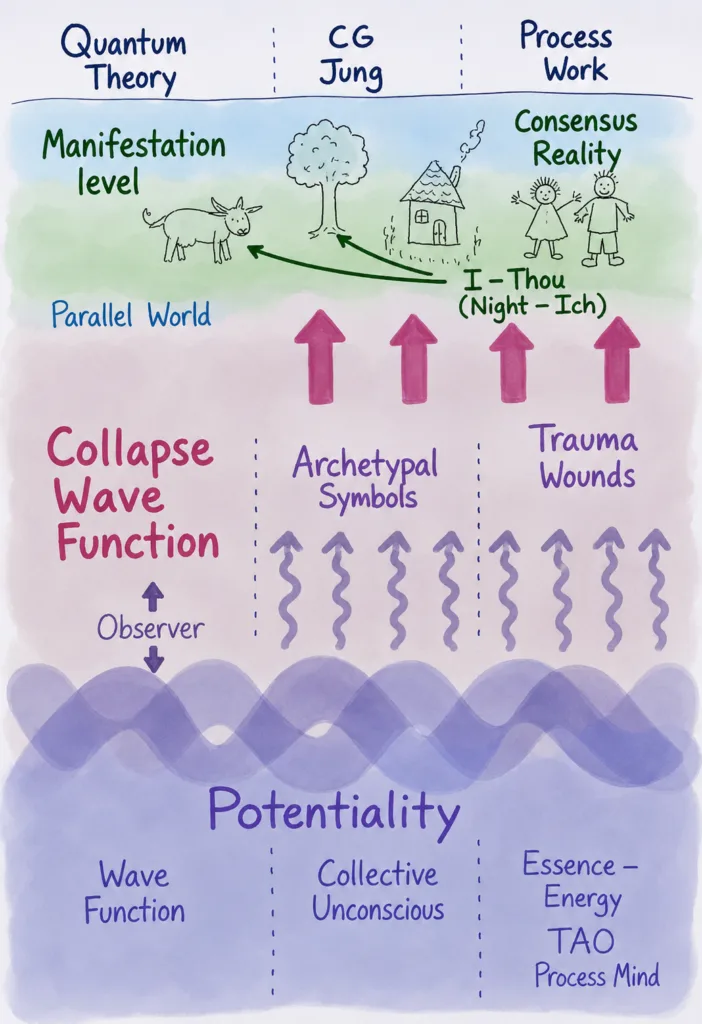
Consequently, there are three levels of reality,32 which are interconnected and enter into relationship with one another. Both quantum physics and the depth psychology of C. G. Jung, as well as the Processwork developed from them by Mindell, assume this.
I once tried to present this in a visual framework (see Figure 1):
- The foundation is the essence level, the indivisible whole – the wave function of quantum physics, the collective unconscious / Unus Mundus of C. G. Jung, and the essence level of Processwork.
- The everyday reality appearing above shows the measurable manifestations of quantum physics and the consensus reality of Processwork (CR level). Here my I is distinguished from everything I can perceive as not-I: other people, animals, plants, buildings, technical objects, smells, microbes, and chemical substances, etc.
Between these two levels lies the dream or emergence level.
- In quantum physics, this intermediate realm is where the observation-triggered magic of the collapsing wave function takes place, creating an observable reality.
- According to C. G. Jung, archetypes, symbols, and similar phenomena crystallize here – bundling particular energies into patterns of order.
- In Processwork, this intermediate level is referred to as the NCR level, or Non-Consensus Reality. Here, subtle, feeling-like perceptions occur, which through reflection can eventually become part of reality and thus appear within conscious everyday or consensus reality, where they can be perceived and ultimately accepted (or not). This places both the nature of our perception and our language at the center.33
- In my work, I also explore the interconnections of these levels. This takes place primarily in the two interludes What Draws Me into the Project? and My Inner Team Is Complete. However, this level is also addressed whenever I speak about roles and timespirits – they too are manifestations arising from the infinite sea of potentialities.
2. No: Not Eligible for Funding.
Why we spent years failing to secure funding for the project. We learn to understand the field and the forces that oppose the new and the good. I learn more about myself and why I am able to persist so patiently and successfully.
2.1. More Animal Welfare in Cattle Slaughter!
More animal welfare in cattle slaughtering – that was our goal. Cattle should be allowed to be killed on the farm in order to spare them the stressful separation from the herd, transport, and entry into the slaughterhouse. They should then be transported to the slaughterhouse only after death, where all remaining slaughtering steps could be carried out until the animal has become meat.
Under current law, this is not permitted. EU Food Hygiene Regulation No. 853/2004, which governs the transition from animal to meat, stipulates that (1) animals may only be slaughtered in EU-approved slaughter facilities and (2) slaughter animals must be transported alive to the slaughterhouse. This applies to all commercial slaughtering operations.34 Exceptions exist only for the emergency slaughter of injured animals on the farm. This rule naturally makes sense, since nobody wants to eat meat from animals that died during transport.
All regulations concerning food safety and hygiene are now developed directly at the EU level and enacted as regulations that are immediately valid in every member state. Individual member states can make only marginal modifications (primarily in the form of restrictions). Fundamental changes can therefore only be achieved at the EU level.
We wanted to add another exception to this rule. For reasons of animal welfare, it should be possible to divide the slaughter process both spatially and temporally, so that the first part, stunning and killing the animal, takes place on the farm, while the second part of the slaughter process (skinning, evisceration, butchering, chilling) takes place in the slaughterhouse itself. This avoids stress for the animals. Because cattle are herd animals, separation from the herd is stressful for an individual animal. Stress also arises from loading onto the transport vehicle, the transport itself (sometimes together with unfamiliar cattle), and above all from unloading into an unfamiliar environment. Entering the restraining unit in the slaughter area often causes panic. Time and again, butchers are injured by cattle. Some animals even manage to escape, which occasionally makes newspaper headlines. Stress for the animals, stress for the people involved, and more than that: meat quality also suffers. Stressed animals do not produce good sausage, nor a well-aged cut of meat.
Hence the idea: this final step from life to death should be carried out as stress-free as possible on the farm, ideally within the herd and at least in a familiar environment.
It was not our idea. We had predecessors and courageous pioneers. In 2011, they succeeded in persuading the German legislature to allow cattle to be killed by rifle shot while out on pasture. From their perspective, they wanted the entire year of the animal’s life to be spent outdoors and not in a barn. From the perspective of the EU Commission, however, this German exceptional path already represented a crossing of boundaries. Germany and breaking rules – that still surprises many people today.
We wanted to take the next step. We wanted to make on-farm slaughter possible for cattle kept in barns as well. To achieve this, we aimed to develop a procedure and a technology accepted by the authorities that would make it easier for butchers and farmers in the future to carry out this final step for both their animals and themselves with as little stress as possible.
Such a project never begins from scratch. In fact, we had already been working on it for a long time, essentially since 2010, when we founded the Association for Farmers with Artisan Meat Processing.
There was my colleague Hans-Jürgen Müller, an organic farmer, cattle keeper, and direct marketer from Lindau, who had once worked as a butcher (and now manages the farm formerly run by Hans-Jürgen’s father); Lea Trampenau, who built the slaughter trailer for on-farm killing; and Lea and Sven, who together with the pioneer of pasture slaughter by rifle shot, Hermann Maier, developed a transport vehicle and, with the University of Kassel, were involved in the research. Sven gave seminars for years on the subject of “Animal Welfare in Cattle Slaughter,” while Lea remained actively involved. Yet she did not want to lecture alone and thereby attract attention. Since the beginning, however, she had encouraged me, and motivated by the many farmers who attended our seminars, I began pursuing the idea of obtaining public funding for a project that would further develop this technology and make a mobile slaughter facility for cattle possible. Year after year, more farmers attended our seminars. We had countless conversations with them about how they repeatedly kill their animals themselves. “We love these animals and make sure they have a good life. Now we want to take responsibility for this final step as well and make it as dignified as possible.”
For three years I wrote funding applications for various funding bodies. Year after year, once the deadlines had passed, we received a commentless no.
Meanwhile, however, the political landscape had changed: our federal state government had shifted from the Green Party to a Green Minister of Agriculture who was trying to set new priorities, and my colleague Hans-Jürgen had, in addition to running his farm, become managing director of the Association for Ecological Farming in Hesse and had worked hard to build strong connections with agricultural administration and politics. The European Commission had also launched a new program in agricultural support, one that not only encouraged farmer participation in projects but paid for it as well. “We have to get this!” I said, and in 2015, for the fourth time, drafted a funding application. Unlike previous years, we had finally found more fertile ground, and we gave our project group the name Extrawurst. During a session with Max Schupbach in Amsterdam, a name emerged as he encouraged me to live my “cheeky science.” Everyone could remember this name! We quickly attracted attention from the Ministry of Agriculture, advanced to the second application phase, and eventually submitted a comprehensive proposal. The Extrawurst group was to bring together seven farmers, one butcher, two slaughter-trailer builders, two scientists (one of whom was me), and various representatives of environmental, direct-marketing, and farmers’ associations.
Then another no arrived. I can still see it today, the phone call that came while I was sitting in the cultural center at a volunteer’s breakfast and listening to a presentation on funding. A government official from Giessen called and said: “We had to submit the application to our veterinary department. And they said, ‘No – this is not possible under EU law.’ Please withdraw your application.” We had to find a solution. “We will withdraw the application.”
How could it be that such a good idea, one that would clearly increase animal welfare, was consistently rejected with a commentless no? And what in the world drives me to spend years dealing with such an unsuccessful story, accepting rejection after rejection, only to get up and try again?
2.2. When Something New Wants to Come into the World…
The social activist in me long failed to understand why this resistance exists when one is working for the “good.” Doesn’t everyone see that Newton’s apple falls because of gravity and that the Earth revolves around the Sun? Has the Enlightenment lost so much of its persuasive power?
2.2.1. Resistance Unfolds
I do not want to make this bigger than it is and simply ask: Why this resistance from the authorities against greater animal welfare in slaughtering? Doesn’t everyone want things to be better? Are we not part of a larger societal debate about animal welfare? Some demand veganism, others no longer want to keep livestock. We simply want to kill animals better. How do we bring the idea of low-stress slaughter into the world, and how do we deal with the conflicts that this manifests and announces?
The theory of Processwork, and especially its offspring Worldwork, provides me with both a deeper understanding and practical guidance for these dynamics and for individual as well as societal transformation processes.35 Worldwork is a field theory: we are organized by fields just as we ourselves organize them. On a deeper level lies the field of potentialities, possibilities. This field expresses itself in the consensus-reality level as roles within the field. The field recruits people, organizations, and groups in order to reveal and manifest the information it contains. For societal (as well as individual – or group-level) dynamics, it is therefore essential to recognize the interaction between processes that are already manifest and those that are only beginning to emerge (emergence level)36. The manifest counts as our measurable reality (consensus reality). In a society, these form the so-called “mainstream,” the prevailing patterns of thought and action.
In our case, we keep animals, use them, and eat their products. We kill them for that purpose. An entire structure of agricultural science, advisory services, funding programs, politics, businesses, and culture has been organized around this since roughly 1820. Giving up animal-based food has always been only a minor theme. Today, however, the actions and protests carried out in its name increasingly take the form of societal conflicts. Something is emerging from the emergence level, something previously displaced, not perceived as true. It wants to raise its voice, be seen, and be heard.
Theory III: Fields, Timespirits, and Roles
Processwork uses a field approach comparable to systems theory: much like an iceberg, what we call reality is only the visible tip. Beneath the surface are invisible influences, tendencies, feelings, moods, problems, conflicts, repressions, and marginalizations, extending all the way to unspeakable taboos. Fields organize us much like magnetic fields do. People and groups are unconsciously guided by them, even when we distinguish ourselves from others through an us and a them. They assign roles to us without our being identical to them. Roles are assumed, changed, and exchanged depending on context and time.
The notion of an organizing field also exists in other spiritual traditions. In Taoism, for example, there is the field of the Tao, that which cannot be spoken – encompassing all tendencies and possibilities, known there as Inner and Outer.37 Fields evolve, remain in constant processes of change, and with them change our ideas and feelings. Some remain in the background for a long time, while others come to the forefront. In our case, the idea of animal welfare is currently moving to the foreground. This development of the field takes the form of polarizations, conflicts, and tensions. A common misconception is that we humans create conflicts. From the perspective of Processwork, however, the field itself unfolds the polarities, much like Yin and Yang, the ever-recurring opposing forces through which the Tao manifests itself.38 More than that, the field reveals itself in roles through which, like mirrors, parts of itself become visible. Arnold Mindell introduced the term timespirit for this in 1992. These timespirits are like dream figures that energize us. Mindell wanted to make it clear that every role adopted by a person or group is always only temporary and not permanently tied to that person.39 When timespirits of marginalization are brought to speech, they enter the world as a transformative force. Timespirits should therefore be understood as processes.40
“The term timespirit is an update of the role concept; it describes and emphasizes the temporal and transitory nature of roles in a personal or group field better than does the term role. Timespirit is meant to remind us of the transformation potential of the world around us. Timespirits are like figures in our dreams (…) they attract you, suck you into their swirl of energies. When you identify with a timespirit in a given field, you actually experience the emotions of that spirit.”41
Although Mindell no longer used the term timespirit in this sense in his later works, or abandoned it altogether, I like the concept because, unlike the term role, it attempts to express that particular roles can appear in very different guises over long periods of time. For my field observations, I therefore use the term timespirit. When referring to individual persons or organizations, I use the term role.
One further note: Although it may seem natural to translate timespirit using the German word Zeitgeist, this would lead in the wrong direction. The term Zeitgeist is also used in English as a loanword (like kindergarten or rucksack) and refers to a dominant pattern of thinking and feeling within a particular era. Goethe describes the Zeitgeist as a societal overpowering force, as a dominant or hegemonic condition. “When one side becomes particularly prominent, seizes control within the crowd, and imposes itself to such a degree that it hides in the moment and must conceal itself from view, then one calls this excess the Zeitgeist, which then drives its essence for a time.”42
What Goethe still described as a “hegemonic condition” is today often referred to as the mainstream. What is meant is the dominant way of thinking about and perceiving things at the societal level. Timespirits that represent the marginalized therefore come into conflict with the mainstream or Zeitgeist.
The conflicts between the mainstream and what has so far been marginalized (and is now emerging from the dream or emergence level) are necessary – both for individual levels and for societal transformation. The marginalized contains information that we can recognize and make use of within conflict. This understanding is essential for enabling diversity of opinions, ideas, and ways of life, as well as for navigating the conflicts that arise from them and the developments they generate.
It now becomes clearer: whoever, like us in the role of social activists, advocates one-sidedly for greater animal welfare in cattle slaughter automatically provokes opposition from those who represent the status quo, that is, the mainstream: the entire meat industry, butchers, slaughterhouse operators, legislators who have already enacted animal-protection and slaughter regulations, as well as the authorities responsible for enforcing those laws. It was their no that we had to acknowledge. At the same time, our project moved into the broader field of societal debates about the future of our food systems and our future relationship with farm animals. Timespirits43 are therefore also in conflict with one another.
2.2.2. …and It Has a Transformative Force
The new, the marginalized, possesses transformative power within society. Since our project was partly shaped by it, I would like to illustrate this through the development of organic agriculture. Afterwards, I will explore the timespirits within our project field in greater detail.
The Marginalized Drives the World Forward and Introduces New Distinctions
The history of organic agriculture demonstrates how the force of the marginalized introduces new societal distinctions: Around 1900, the life-reform movement emerged as a counter-movement to industrial society, into which Germany had been transformed around 1870 through the rise of the agricultural sector. At first, this movement expressed the dream of a better relationship between society, humanity, and nature. After the First World War, clearer new tendencies emerged in agriculture: rationalization along industrial lines (division of labor and Fordism) and the intensification of crop cultivation, initially through the use of synthetic mineral fertilizers and pesticides.44
In the 1920s, organic farming was first formulated as a counter-model. The first farms began operating according to Demeter principles. During the 1970s, as the mechanization of agriculture continued and its negative effects on the environment and animals became increasingly visible, more farms converted. They founded additional organic farming associations, all sharing the dream of a social and ecological redesign of agriculture and consumption. Farmers sought income alternatives, wanted to preserve their farms, and resist the growth pressure intensified by industrialization and the resulting concentration of farms. The movement was strengthened by direct marketers who withdrew from dependence on large processors and developed their own markets for organic products. To cushion the planned opening of European agricultural markets to global competition and the resulting price pressures, organic farming was legally defined in 1992 and has since been supported through public policy.45 Today, organic products are available in all supermarkets and discount stores. What began as years of struggle against established farmers’ associations, has become mainstream. Each new scandal, the BSE crisis, and the coronavirus crisis contributed new momentum. Through a high degree of societal recognition and continuously growing demand, the movement has become integrated into international supply chains.
Organic farming also produced a new societal differentiation46 within the market for traded food products: the legally established distinction between organic and conventional. This in turn organized new markets, new areas of administration, training, continuing education, and marketing. It became one of the most important agricultural innovations within the tension field between society and nature.
Meanwhile, new movements are emerging that continue the old dream, for example direct producer-consumer relationships: community-supported agriculture and organic regional supply chains. At the same time, new farmers’ demonstrations are directed against what they perceive as the dominance of the organic sector.
2.3. Timespirits in the Field of the Extrawurst Project
2.3.1. The Marginalized Animal
For our project, the timespirit of the animal as a fellow creature, the marginalized farm animal within agriculture, is particularly relevant. Since this timespirit is represented today by the animal-rights movement and the associated refusal to eat animals, it appears in forms ranging from protest to violent incursions into barns. Slaughterhouse operators fear hidden cameras and the publication of images that reveal conditions. Because this timespirit stands against the politically, economically, and socially supported mainstream of mass animal production at the expense of animals, it unfolds considerable transformative force. This timespirit is also active within our project.
At the same time, the mainstream has already begun taking initial steps toward this timespirit: EU legislation has, among other things, enacted animal welfare regulations and new regulations governing transport and slaughter. Yet the conflict is escalating. Our project sits directly within this conflict, because older hygiene regulations secure the risks of conventional meat production and are legally anchored, while animal welfare was not integrated into the older, hygiene-oriented regulatory framework. This becomes very concrete: within the administration, different departments are responsible for meat hygiene and animal welfare, and in some cases even different ministries.47
Animals are usually silent for us. They do not speak our language. Yet anyone who truly watches them can see how they react to social marginalization, illness, and death.48 Someone must translate the voice of animals into our language and make their concerns visible. And yet it remains mediated through humans and therefore open to misinterpretation.
Our project, too, is a response to what has happened to animals kept in agriculture over recent decades. I do not wish to claim that the relationship between humans and so-called farm animals – and here specifically cattle – would at any time have met today’s standards of animal welfare, or that the human-animal relationship (whatever exactly that may be) was a better one. Yet meat was always a privilege, something special.49 Only in the first decades after the Second World War did the dream of good, plentiful meat consumption for everyone come into the world. The rationalization of agriculture and meat production enabled a level of abundance in Germany and Western Europe that had previously been unknown.
The rationalization of agriculture and the downstream sectors that process its products needed until the 1960s to fully assert itself, until everyone had become accustomed to the fact that what had once been rare and expensive meat had become cheap and available in large quantities. American-style backyard barbecues became part of summer sociability, and fast-food burgers gave young people a new independence from parental lunch tables, which consequently lost some of their importance. Yet behind consumer behavior, profound changes took place: farm animals became efficiently exploitable production factors for generating raw materials for the meat industry, for out-of-home consumption, and for inexpensive quick lunches. Regional butchers and slaughterers were displaced. Their work moved from villages and towns into a few centralized slaughterhouses hidden from view. In supermarkets, pre-cut and packaged meat no longer had any recognizable connection to the animal. In return, relationship work, domesticity, and kitchen culture moved into our living rooms.
In this process, society forgot its special responsibility toward its domestic and farm animals. Forgotten was their status as fellow creatures, their significance and support for human life over thousands of years, and their special abilities (e.g., the dog’s sense of smell, the cow’s rumination, the horse’s strength, the wool of sheep, etc.), which they placed at our service.50
On the dream level, this timespirit of the animal is closely connected with human dreams – dreams of a good cooperation beneficial to both sides. It is ancient. Ten thousand years ago our ancestors domesticated dogs; the aurochs followed.51 The first settled humans and herders began to tame this dream. These large, powerful, heavy, and wild aurochs were deadly to humans and at the same time so gentle that they left the steppes of North Africa and the Middle East and placed themselves under human care in order to serve as cattle (more precisely, as domestic cattle): as labor power, sacrificial offering, and food. This relationship between humans and cattle made possible, alongside herding culture, the development of settled agriculture. Cattle and, with them, oxen. Together with farmers they ploughed the earth, pulled wagons, and transported building materials and provisions for war. Cattle, cows, calves, oxen, and bulls cultivated meadows and pastures, converting grass into milk and meat. Not by chance did early cultures celebrate the cow as a symbol of fertility and power.52
Times of crisis bring the marginalized animal and thus the repressed side of our human-animal relationship, as well as our shared history, into the light. The first profound social crisis came in the 1990s: BSE (mad cow disease). Cattle, whose nature is to eat grass, were fed protein meal made from recycled animal remains, and this drove them mad. More than 1.5 million animals were killed.
More recently, the Covid-19 virus and infection hotspots in the slaughter industry brought into view the connections between miserable working and living conditions of migrant laborers, the suffering of animals during transport, industrial stunning and killing of animals, the profits of the meat industry, meat surpluses and discount offers in social consciousness. They reveal the consequences of the devaluation of labor in agriculture and the butchering trade, as well as the associated dissolution of regional supply structures.
As every crisis does, these two crises also bring initial pathways toward solutions into political action: the BSE crisis led to organic farming being incorporated into the regulatory framework of European agricultural policy. The coronavirus pandemic increased awareness of workplace safety (ban on contract labor), animal welfare in slaughter, and the necessity of regional slaughter facilities. Our project therefore attracted considerable attention. Yet when a similar initiative, IG Schlachtung mit Achtung, received the Animal Welfare Prize in Baden-Württemberg in 2019 for a comparable development of a slaughter box, opponents mobilized under the slogan: “How can an animal welfare prize be awarded for killing an animal – you are murderers!”53
2.3.2. Reappropriation and the Marginalized Collaboration of the Living
Another marginalized timespirit is the farmer as the one who produces food through direct engagement with nature, in direct dependence on it, and also in resistance to it. Parallel to the marginalization of the animal as a fellow creature, this work of farmers with living beings was also pushed to the margins. In the course of urbanization and the separation of living and working conditions, as well as the further functional separation of state and society, the role of farmers shifted from food producers to specialized raw-material producers. Today, food comes to us from industrial facilities. Conflicts over the reappropriation of the old role and of direct market access have accompanied this process from the beginning. Our project is part of this conflict: may the farm carry out the first slaughtering steps itself, and may the meat it produces in this way enter the market? I call this timespirit “the reappropriation of farmers’ autonomy.”
The timespirit reappropriation of farmers’ autonomy is very old – older than the official liberation of farmers from feudal rule at the beginning of the 18th century. Even today, deep experiences of dependence on authority, memories of the peasant wars of the 16th century, are still felt among farmers: resistance against domination, against masters, against exploitation and dependency! Just as nature demands humility (no one can command the weather), farmers also carry resistance toward those who impose conditions on them, enforce legal regulations, and wish to deny them independent market access (for example, as direct marketers). The latter is also relevant to our project. From this spirit of resistance and self-help, the Independent Regional Movement emerged in the 1970s in one of its successful regions, the Waldviertel. It opposed the marginalization of rural areas and the loss of farmers’ autonomy, the decline of food craftsmanship, and the independent access to markets through being assigned the role of raw-material producers.
For farmers, this also involves very tangible economics: those who only supply raw materials stand at the end of the chain. The added value created between raw material and finished product goes to processing and trade. As the weakest link in the chain, the price paid for the products is usually determined by processors, and the scope for negotiation shrinks. Similar freedom of action exists only through associations, cooperatives, or producer communities. In direct marketing of their products, however – regardless of whether this occupies only a small niche in the total market – there is the direct experience of self-empowerment.
Access to the market, whether directly from the farm or through the supermarket, is nevertheless heavily regulated by legal provisions. These serve primarily to ensure food hygiene, but also to ensure fair competition. These legal provisions are implemented and monitored by state control authorities, veterinary administrations, conflict-resolution procedures, and courts.54
From the perspective of farmers and butchers, these regulations are aligned with the mainstream of the division-of-labor, increasingly global industrial food system and its safety requirements.55 And this mainstream is an industrial process of meat production, with globally divided production and a food retail sector concentrated in a few large companies.56
The timespirit reappropriation has therefore accompanied the process of industrializing food production from the beginning, in waves and with each further push toward expanding reference and sales markets. While the food trade almost entirely forced agriculture into specialization, especially in connection with organic farming, farmers developed their own and direct markets.57 Since the beginning of the 1990s, this timespirit, similarly to organic farming, has been taken up politically and is now supported through state-funded EU regional policy for rural areas, which promotes the development of regional value chains. Our project was funded through this program.
On the dream level, this timespirit of reappropriation is closely connected with the collaboration of all living beings that produce and consume food: the soil and its microbiome, plants, and animals. Only through this collaboration does our human food arise. What has been marginalized are the living processes that make this possible, as well as our dependence on them. For a long time, the dream of abundance displaced this awareness. Only in times of crisis do consumers wake up and shake their heads in bewilderment. Then they ask themselves: why is this food so artificial, so full of additives, or full of residues such as antibiotics, etc.? Consumers then reconnect with the timespirit of living, natural, and healthy food. Today, with the climate crisis and droughts that everyone can experience, this awareness is also reaching the middle class, which initially did not seem so endangered by climate fluctuations.
INTERLUDE: What Draws Me Into This Project?
Looking back, I see that the project already existed when, ten years ago, Lea asked me to assist her in seminars on animal welfare in cattle slaughter, which she and Hans-Jürgen had organized nationwide through the Association of Farmers Engaged in Artisanal Meat Processing. Lea was reluctant to speak publicly. I was simply supposed to be there.
Once again, something drew me from the future. Again and again in my life, something has pulled me toward actions and decisions. This something is stronger than I am and has often resisted my good intentions. It can only be recognized in hindsight. In this interlude, I would like to trace this something. I would like to open myself to it more fully than was possible for me in the past.
Something Draws Me and Will Not Let Me Go
Shortly after beginning my studies in general agricultural sciences at nearby Stuttgart-Hohenheim in 1974, a group of former agriculture students appeared there. They had set up a book table in the cafeteria to recruit new members. One book immediately caught my attention: yellow-red was the book by Bernard Lambert. It was called Farmers in the Class Struggle: Suggestions for the Forgotten Analysis of Exploitation. It had been published in Paris in 1970 and translated from French in 1971 as Red Book No. 42 by Wagenbach Verlag. O. Poppinga wrote an appendix on the agrarian question in the Federal Republic. Bernard Lambert was a farmer in western France, Poppinga came from a farm in East Frisia. There was no choice. I was drawn into what the book promised. The group of former agriculture students became my group.
As I write these lines, a young hedgehog is staggering out of its winter quarters beneath our terrace. Never before have I seen a hedgehog in our garden so late in the afternoon. Normally they are nocturnal. Still visibly weakened from the winter, it searches the meadow for food. My first impulse is: “I must save this hedgehog.” But from what? It will find food. The rain has brought the worms to the surface. Why do people actually say hedgehogs are cute? They are covered in spines and, when they feel threatened, roll themselves into a prickly ball.
My longing was directed toward effective action in the world. I grew up in the spirit of the 1960s, a time of upheaval and action, of images of anti-colonial liberation struggles around the world, of the raised fist of the Black Power movement in the USA, and of student protest movements in Europe. Action – that was imaginable only as resistance and as a struggle of good against evil. It planted the seed of a social activist within me.
Despite many attempts to let it go, the connections formed during that period with the emerging agrarian opposition, with farmers, rural women, church people, and political activists have remained to this day. Everything I learned and experienced together with them forms an important foundation of my work today.
Why do I commit myself to this group? I am not a farmer! Attempts to follow another path repeatedly failed. But why can I not let it go?
Lifemyth / der Lebensmythos
In Processwork, this force or energy, this it draws me, has a place of origin: this force comes from the essence level or from the unbroken wholeness of life itself. It is called Process Intelligence, or Processmind, and corresponds to the Tao that cannot be spoken.58 This force creates the polarity of the fundamental and repeatedly emerging energies (Yin and Yang). These energies and their polarities create our own dance in life. This dance appears in early childhood dreams and is a Lebensmythos/lifemyth (see the following box).
Theory IV: Processmind and Lifemyth
The processmind – this spirit – is life itself.59 From it we receive our impulses. Through it we are connected to everything. We understand this not intellectually, but we sense this spirit that moves us, inspires us, and encourages us to act. One could also say: it drives our lives forward and allows us – if we inquire into it – to understand ever more deeply what our possible task in the world might be.
This force requires resonance within us in order to carry out the quantum leap that is necessary in each moment. Similar to my encounter with the copper beech (see Theory VIII), this force of life organizes itself by bringing something into contact with us, capturing our attention, and awakening our passion.
“Your own awareness shows that your deepest, almost unconscious prayers are organized by the things that catch your attention, by connections to the infinite, the mind of nature. Your mind is entangled with that of God.”60
From this emerge our dream figures, our inner images and ideas, which we can then bring into the world (or onto the manifest, consensus-reality level).61 On a personal level, this force of life unfolds as a dance between different polarities. This force moves us in unpredictable ways and reveals itself simultaneously as a recurring pattern in our lives.62
These patterns appear early. Carl Gustav Jung pointed this out already in 1936/38.63 They become visible in early dreams during childhood, often even in recurring dreams or early memories. Today I know: my early childhood dreams reveal my Lebensmythos (lifemyth) – yet only now, through this work, do those early patterns gain meaning through the periods of my own life.64
My Lebensmythos appears in this dream from childhood days, so disturbing and recurring. I remember it well:
I am on the upper floor of a dark factory building. My friend (Margret?) is standing next to me. In front of us, countless wounded soldiers lie on field beds. Bleeding, laboriously bandaged stumps of legs can be seen. There is great suffering, a great shared pain. The end of the dark room cannot be seen, and so the field beds with the soldiers reach far down into the dark depths of the hall. We are only standing there. We are there. We say nothing, we do not move, we do nothing.
Then I notice that on my left side, in one whole wall, there is a window. It reveals a view of a high-rise building and the blue sky. I jump out. As I jump, I wake up.
The dream shows me: on one side there are the soldiers wounded, mutilated, and suffering from war. Infinite suffering, with no end in sight. I am not alone; a friend accompanies me. I am witness, distanced and uninvolved, and yet the suffering can be felt and weighs heavily upon me. This is one part of the world, including my inner world. A world that has only just survived, shortly before my birth, a violent killing. We learned to be patient. We live despite injury and pain.
And then there is suddenly this open wall and the radiant blue sky, as well as a newly built high-rise building. The girl jumps out, into the light, light world, and into a newly built world. I jump; for a short time I fly. I take what I need. Like a leopard or a cat, I have endured for a long time and patiently. Now the right moment has come to leap. This is it, the way a lightning bolt strikes me and pulls me in a new direction. The resolve and the freedom that action requires.
It took me a long time to accept the aspect of enduring. To endure something patiently, not to run straight toward change, to protest, or even to let go – this fit neither the zeitgeist of the post-1968 years nor my dream image of a heroine/revolutionary. Only slowly did I begin to understand and accept the quality of enduring contradiction, difficulty, and what is initially not changeable.
Only today, while writing this thesis, do I notice that I have always avoided perceiving two important aspects of the dream:
I am also the soldier. I am also the sensitive one, the injured one, and the one sensing suffering.65 I know this soldier, or rather this soldier within me. She is reliable. She accepts the task and does not ask whether the weather is good for swimming. The soldier is faithful. She does not simply jump out the window when something else tempts her. She stays with it. She is the one who remains true to the task for years, even when the project sponsors fail.
And then there is the sensitive one in me, the wounded and suffering one. I know her even less than the soldier. More than that: I have always fought her. She fit neither the soldier nor the Swabian-South German culture from which I come, with its rural-artisanal world, with the Protestant-pietistic work ethic entangled with it. You did not make such a fuss about diligence and reliability – the soldier, in other words. Sensitivity has no place there. And yet it is precisely this sensitive one who senses the new, who opens up to questions and to non-humans.66
All my life, these energies have disturbed one another: the soldier disturbed the freedom-loving one, the sensitive one felt disturbed by the soldier, and the one who endures the world felt disturbed by the one who jumps ahead, the one who does not want to listen and does not want to follow any rules. They disturbed one another and again and again prevented each other’s intentions and ideas. At the same time, they did not fit into the mainstream. Least of all did the one who endures patiently fit into the zeitgeist of the post-1968 years and into my dreams of being a revolutionary, who patiently endures. Nor did she fit into our society’s heroic myth that attributes progress to great courageous men and women. At the same time, the one leaping into the new era was demanded by a family past that demanded the preservation of tradition and wealth. The feeling one, in turn, did not fit into a society that measures its progress by external criteria and fixes happiness in life to professional status.
These figures are also present in my familiar role of social activist and in the role of researcher. They too disturb each other. The activist who calls out for a good cause may not like it when the researcher urges her to dig through libraries for fragments and to find a deeper sense of being embedded, in order to understand deeply what was decisive for working through the theoretical background of Processwork, especially quantum physics. Waiting and packing up. Jumping – that may begin.
These energies are the song, the song that wants to be sung. Following them in daily action and dreaming gives me the chance to allow these energies to become productive and fruitful for the world. I am in harmony with this song, with its rhythm, its melody – and, even if only for a few moments, the world appears as it did in my childhood days, in a state marked by a feeling of apple, in which my action becomes effortless (effortless action or WuWei in Chinese).
The Joyful Forces
Reconciliation with these energies, initially recognized only as figures or roles, came only when Max Schupbach said: These energies are the part in you that is new and the least known or appreciated and not understood by your family and by yourself. They are those parts of me that neither I nor my family understand and that appear as obstacles. In fact, they are my allies, for they free me from my personal and cultural history and thus grant me freedom.67 I particularly liked this last aspect!
Real access to the energies of my lifemyth and their respective power came through translating music. As long as these energies were occupied by terms such as Soldier, Sensitive One, Jumping One, Social Activist or Researcher, an inner debate and evaluation remained within me. Value judgments connected with these terms by family and society fit too well and ensured that the energies contained within them could not simply flow. Only when, in a session with Max Schupbach, I learned to make music, did I become free in relation to their actual quality. Only then were they truly detached from inner voices and their eternal You must not do that! You should do this instead! Stop that! and the associated feelings of guilt and shame and their blocking effects.
My energies are punk music and heavy metal as well as the operas of Giacomo Puccini. For me, both energies are connected in their passion and romanticism, which in their portrayal of a cruel world do not evade it.68 The hard beat and shouting of Rob Halford, singer of Judas Priest, repeatedly opened my inner toughness while writing, just as the classical punk of Ivy Green did. The great arcs of tension in Puccini’s operas, by contrast, opened my heart to the Sensitive One within me and thus to dreams.
Only this decoupling from the terms and this opening toward energies revealed paths to actual action, that is, to a feeling of I act. Now I no longer debate whether something may or may not be. Instead I ask: Who is speaking in me? Which force and which energy want to show themselves? These energies are not primarily bound to socially defined roles. They can intermingle everywhere.
I understood this recognition, this living and allowing energies to flow, only when our son Paul told me the following story:
He would always play table football with a journeyman during his lunch break while working in the body shop. Always in the defender role (the mother in me thinks: that’s not how I know my son!). One day, however, he took on the role of striker. And from then on he played better day by day. Everyone was amazed. Most of all he himself. But what had really happened? The attacker-energy of the table football player had entered his life: he would organize his daily life more decisively, continuously cook for himself, do sports more regularly, tackle his dreams, and had begun making music again.
In my dreams, my energies increasingly appear as animals.69 The dog represents his/my instinctive side, the wild boar his/my wild and often uncivilized energy. This untamed, uncivilized wild boar energy tended to manifest behind my back in the form of biting remarks, awkward actions, discontented gestures or as headaches and eventually as pain in my hip, carving out its path. Over time I learned to know this wild boar within me better and even began to feel comfortable with it, although it had to abide by rules that I set.
In recent years I have also encountered the monkey more often in my dreams and within myself:
A woman showed me her young monkey, who was wildly romping through the room, jumping around and pulling faces. The woman was very strict, like a GDR official or a concentration camp guard. Wearing a grey costume and with her hair tightly pulled back. She told me I could not trust the monkey and bought him a little bed. At first the bed looked like a dog basket. Then it looked like a waffle iron. There the monkey lay, pressed completely flat in the steam… and was happy.
This strict, rule-abiding person and the uncivilized, playful person or energy. This energy needed rules (a little bed) – only then did the waffle iron make it happy. Waffle iron, waffles with applesauce and cinnamon!! Oh, how wonderfully that led me back to childhood, a time without responsibilities.
The monkey within me is my relaxed side, detached and free to make cheeky comments and comedy. The monkey in me observes closely. It sees the humor in situations. The monkey has the necessary distance.
The better I got to know my wild boar and learned to “civilize” its energy, the easier it became for me to let go of pressure and act, to love worldwork and the intense inner and outer passionate activity connected with it. The more I learned to trust and love all that wanted to reveal itself within me and through me, the more at home I felt within myself and in the world. Then I sensed all the forces in the great world fabric that simultaneously act within me and through me, wanting to become effective together. I am not alone in acting. I do not have to do anything anymore; I can let things happen and simply be present. The co-creation of the world is a shared concern of the whole world.70
An One Call Was Enough
It was exactly one day toward the end of 2006 when the action began and I could find no excuse not to act. Georg Bohnet, an organic farmer from the northern Black Forest, called me. “Andrea! They are setting up community slaughterhouses! You have to help us! I have already spoken with Wolfgang Reimer, he referred me to you.” No more was needed. As soon as I hung up the phone, I knew: the time for expert reports on paper was over. I was afraid and excited at the same time. I called Hans-Jürgen Müller. Did we have to prepare in any particular way for this moment? Not really.
After several unsuccessful attempts, in 2006 we finally received the necessary financial resources and project approval that enabled us to work precisely at this interface between craft-based slaughter and processing enterprises (mostly on agricultural farms) and the veterinary administration (supervisory and regulatory authorities). We began mediating between the two sides, translating information on the new legal framework for practitioners and developing practical proposals for veterinarians to implement the regulations. In short: we helped businesses that now needed a new EU approval for their slaughter facilities obtain it.
Both energies now worked hand in hand: the persistence required for applying for public funding (also my former profession), the openness toward my non-knowledge in all practical matters concerning slaughter, and the ability to pick up signals and act quickly and clearly: convening meetings, writing understandable language for practitioners, and ultimately helping advance the ideas of my colleague Hans-Jürgen, the founding of an association, so that in the future there would be an interface not only between practice and legal regulations, but also enabling me, as a researcher and social activist, to move things forward.
3. Erste Annäherungen
We achieve an initial rapprochement in the Extrawurst project with the licensing and veterinary authorities. We get to know our opponents and begin the dialogue.
As already shown in the previous chapter on Timespirits, two current social conflicts overlap in the field of the Extrawurst project, because the issue was not only greater animal welfare (from the project’s perspective), but also whether meat could gain market access if the established pathways of slaughtering were modified. The No – not eligible for funding accompanies us once again.
3.1. A New NO and Preliminary Negotiations
After our funding application received another No – EU law does not permit this in the summer of 2015,71 a meeting took place in February 2016 between the licensing authority responsible for approving slaughter facilities, the Kassel Regional Council, representatives of the project, and a representative of the funding authority. The meeting was held in Kassel on neutral ground (the State Office for Agriculture). Dr. Jürgen Becker from the Giessen/Central Hesse Regional Council (the funding agency) had previously informed us unofficially about the rejection. It had been the veterinary department of his authority in Central Hesse that had signaled the No. To resolve the conflict, he wanted the veterinary authority of the Northern Hesse Regional Council to examine the matter with us. Only then should we submit a new funding application. He relied on the fact that Hans-Jürgen and I had maintained good relations for many years with Dr. Ingo Franz, the head of that authority,72 and at least expected the authority to engage more deeply with our application rather than simply signaling another No.
The meeting began and we explained our plans. To our surprise, our good relationships helped only insofar as we were at least allowed to speak this time and listen to the opposing side’s (negative) arguments. The authority initially maintained its No. Surprisingly, they did not justify it with the categorical statement No – EU law does not permit this, but rather as follows:
“We have never before been asked to approve an agricultural project in advance. Our task is to determine whether the mobile slaughter unit is capable of obtaining EU approval or not.”
We replied in astonishment:
“But the goal of our project is dialogue with you!”
This was not understood by the authority. And through this it became clear to me: an authority does not engage in discussion. Nor does it develop new ideas with anyone. An authority decides, issues orders, and provides the corresponding rulings (administrative decisions). Its way of acting in the world is assessment and the granting or withdrawal of permits. Communication takes place through applications, forms, and official notices. There are clear procedures, responsibilities, and accountabilities.
Our offer of dialogue had been formulated somewhat naively. For the authority, agreeing to a project in advance could only be understood as obligating itself to guarantee EU approval for this new procedure beforehand. That was impossible for them. The EU approval process requires that an application for EU approval extension and a technical outline of the trailer already exist. Our project, however, asked them to depart from this usual procedure and, together with the project group, enter an undefined intermediate space between approval and non-approval, to cautiously explore this uncertain territory with us, to determine what might be possible, what steps the participating slaughter enterprise and farmer could take, how far the limits of the regulations extended, and at the same time leave open the question of whether the mobile unit under development would ultimately be approved.
I clearly felt the political pressure in the room: the state of Hesse, as the highest authority and therefore of very high rank, was investing money in this project. The four representatives of the veterinary department of the Kassel Regional Council who were present were able to present their concerns. Yet by merely agreeing to participate in this discussion, they had effectively closed off the possibility of issuing a firm No.
We withdrew the application. For the new application, according to the agreement, we committed ourselves to regular coordination meetings with the veterinary department of the Regional Council responsible for Northern Hesse. This was what we had wanted from the beginning – only now it was described differently and formally anchored as an obligation. I rewrote the application, submitted it before the deadline, and in January 2017 we received approval for the project funding.
We clearly felt that without the political will of the government, acting as funder and supervisory authority/ministry (albeit through a different department), this preliminary agreement to participate in the project would not have existed. Our good and friendly relationships with the technical experts alone would have achieved little. The boundaries became very clear.
This conversation stayed with me for a long time. In the room sat not only people occupying certain roles (activists advocating greater animal welfare in slaughter, veterinarians ensuring compliance with the law, and myself as moderator representing the funding authority and thus the government), but we were also confronted with institutions. In worldwork I had learned, and often experienced, that strongly polarized roles and positions can sometimes shift. Such role shifts occur on a personal level and bring the group deeper mutual understanding, dissolve blockages, and enable solutions in conflicts. Here, however, something was somehow different: the authority remained an authority and a necessary representative of law and legislation. There were clear boundaries. That is a good thing, because otherwise we would find ourselves in a lawless space governed by arbitrariness. The recognizable roles of applicant and approving authority are largely fixed because they must operate within a legal framework. A role shift, such as we practiced under laboratory conditions in processwork seminars, was not possible here.
The authority’s clear position gave me the opportunity to identify more strongly with this/their role, to learn more about the role of this institution, and also more about the people who work within it. For an authority is also a social system in which people work, make decisions, accelerate or delay processes, promote or prevent developments.
3.2. Learning to Better Understand Our “Opponent”
3.2.1. Traditional Conflicts Between Farmers, Butchers, and Veterinary Authorities
The authority and its administration, as representatives of (governmental) power, of authority, as Max Weber so aptly described at the beginning of the 20th century, holds a high social rank.73
The concept of rank is an essential part of Worldwork, especially for better understanding conflict situations (see Theory V). In contrast to the common rural understanding of rank, the concept of rank in Processwork is much broader and goes beyond all personal privileges. Rank is always context-dependent – that is, never fixed.
Theory V: Rank
Rank in Processwork is understood as the sum of all personal privileges.74 These privileges can exist both on the social everyday level and on the psychological and spiritual levels. In every group and community there are differences in rank, and with them differences in influence and power. Rank is therefore never absolute, but always dependent on context. Thus, in negotiations, the department head of the authority can hold high rank in one context and lower rank in another, compared with the farmer who is present. Rank is like a potential energy that may or may not be used. Rank differences, or imbalance, within a society or groups always create polarization and thus group processes that try to change this power imbalance. This leads to conflicts. At the same time, awareness of one’s own rank is a key to contributing to the resolution of conflicts.75
What matters are the social rank differences between farmers/butchers and the officials of the veterinary authority, since the authority has co-decision power over the exercise of their economic activity. This high social rank is also reflected in the fact that representatives of the authority are always addressed by their title, Doctor. Food business operators, farmers, and butchers are therefore always petitioners before the authority. They apply for the approval of a procedure or, as in our case, for EU approval of a slaughter facility. These applications may be decided positively or negatively. Approvals are usually tied to conditions that involve investment and control production. Approvals can be withdrawn. If conditions are not met, fines may be imposed. Everything connected with the economically active production of food must be controlled. Internal inspections must be carried out and their documentation checked repeatedly by the authority. A change in the authority’s representative can bring new interpretations and, with them, new requirements.
The applicable legal foundations are developed through comparatively non-transparent processes and are only slowly becoming more democratized at the European level.76 Changes and adjustments arrive late at the bottom, that is, at the level of food craftwork, and for many appear as arbitrary or merely adapted to the risks of the food industry. Many food craftspeople find it difficult to integrate themselves into this process. In other words: the authority always has the longer lever.
From this situation of necessary compliance with legal requirements, dependencies, lack of information, and the high social rank of the persons involved, persistent conflicts arise between economic actors (farmers, butchers, food craftspeople) and the veterinary authorities. The timespirit of reappropriation urges the economic actors again and again to cross boundaries (for example, selling raw milk, or sausages from home slaughter). There are no moderators, no mediation offices. Therefore, the conflict situations are enduring.
At the same time, we were dealing with five authorities, all of which belonged to the veterinary authority of Hesse, but had different tasks or were responsible for different regions:
- The lower administrative level of the district: the district veterinarians have to inspect the slaughter process.
- The middle administrative level of the administrative district: the regional councils. In Hesse there are three of them. They are responsible, among other things, for EU approval of a slaughter facility. Since our farms (farms, butchers) were located in two regions/districts (in northern and southern Hesse), these regional councils were represented twice.
- The upper level of the Ministry of Agriculture and the Environment of the federal state of Hesse. Here, two specialist departments were responsible: the department for meat hygiene and the specialist department for animal welfare within the Ministry of Agriculture.
In total, five authorities were involved, and at least six to ten people – once everyone had arrived at the meetings.
The Veterinary Authority as Guardian of Law and Order
Food law and, increasingly in recent years, animal welfare are among the core responsibilities of these authorities. Unlike centralized states such as France, in Germany each federal state has a certain degree of sovereignty in this area. Nevertheless, the member states of the European Union have only limited room for their own legislation. Since 1986, food hygiene law has been harmonized at the European level to facilitate trade within Europe, and since 2004 it has consisted of regulations that are directly applicable in all member states. Germany can only issue supplementary or restrictive additional regulations in the areas of food hygiene and animal welfare. EU law, the supplementary law of the individual federal states, and the specific interpretations of local authorities create a complex situation for economic actors. In addition, the legal foundations for food hygiene and animal welfare are set out in separate regulations and are processed by different specialist departments. This must be understood if one is to understand the conflict situations we encountered in the project.
What role does this authority play? I could describe it as the guardian of state order and security. This role can also be assumed by other state institutions such as the police, public order office, or traffic authority, since they too are responsible for enforcing the law. At the same time, this role can be represented not only by institutions but also by individuals. In a certain sense, any of us can step into this role.
An example: I am standing at a pedestrian crossing, and the traffic light is red. Someone nevertheless walks across because they think they do not need to obey it. In that moment, I step into the role of the guardian of state order and security. The other person automatically takes on the role of the rebel who consciously ignores a rule that appears patronizing and, from their perspective, nonsensical. Through my remark, I step into the role of the guardian of state order and security within this field. But part of the rebel must also be conscious within me (otherwise I could not assume the rebel’s role). In other words: all of us sometimes occupy the role of guardian of order or rule-breaker, even offender. Here the role is fluid. Roles can shift and change.
And yet the role of the veterinary authority is fixed, because it assumes a responsibility delegated by governmental authority. This gives it clear boundaries that it must not cross. In the project we struggled with one another precisely at these boundaries.
In the following section, I would like to explore this fixed role of the veterinary administration, and administration in general, in order to understand it better.
Between Law Enforcement and Responsivity
The task of the authorities is the enforcement of laws and thus an activity of the state (beyond legislation, jurisprudence, and government).77 According to Niklas Luhmann, they must produce binding decisions. And they have their own logic, clearly distinct from other social domains such as politics, science, religion, and culture, in order to carry out the tasks assigned to them.78
Administration must perform its social task without regard to the person and only in a manner oriented toward the issue at hand. It is accountable to parliament, the courts, and the court of auditors. The actions and omissions of individual civil servants must be understandable, so that administrative action remains transparent and traceable.79 Administrative action must also be documented in files, and decisions are carried out hierarchically. For in a democracy, there must be no spaces in which administration is free from responsibility – in other words, there must be no arbitrariness, no corruption, and no distinction between persons in decision-making (the opposite would be favoritism).
Brief historical excursus: Administration in this form has existed only since feudal rule bound to persons was dissolved in Europe. With the development of a state apparatus, the “bureaucracy” emerged at the same time. The power and resources of the state were transferred to this bureaucracy, and it had to use them rationally and effectively on behalf of the state. Over the last 200 years, this current and highly complex administrative structure has developed. In Germany, state administration has a special feature: in the 18th century, a compromise between the crown (emperor) and the landed nobility (territorial princes, duchies, etc.) produced a division between central and decentralized administration that still exists today. The landed nobility received rights of local and regional self-administration. This self-administration still exists today at the level of the federal states, districts, and municipalities. To this day, there is no central steering of administration through parliament. Legislative drafts are instead developed at the level of ministries and their administrations, and not by parliament. For this reason, Germany has a “special disposition toward integrating the interests of social groups” into state action.80
Through its involvement in decision-making processes and in the distribution of power and resources of the European Union, the complexity of state administration has increased considerably, especially in the fields of agriculture, food, and the environment.
For our project this means: enforcing and monitoring compliance with legal provisions, and also safety standards, in the slaughter of animals is the task of the veterinary authorities on site or at the level of the federal state. This role cannot be shaken. At the same time, the actual decision-making competence also lies at the EU Commission level.
Our hope was to have a procedure approved within the valid regulations. To do so, the authority had to be willing to interpret the applicable regulations very broadly. That it could do so depended, in turn, on whether a “responsive” form of administrative action could be expected in Germany.81 This means it should also take the individual case into account, recognize and respond to it according to the circumstances. It should – as in all democracies – also have an ear for the circumstances and developments of the social and political environment (responsivity).82
On the other hand, the required responsivity found its counterpart in the European Union’s hygiene and animal welfare regulations that applied to our project. Since the reorganization in 2004, EU law has opened itself more strongly to individual cases and has moved away from the earlier practice-oriented definition of detailed regulations, piece by piece (flexibility). In order to regulate all 27 member states uniformly, the EU today primarily states: “The objectives of food safety and animal welfare are clear – the path is open.” The food business operator bears responsibility for achieving the objective. The detailed interpretation of legal provisions is then handed over to specific offices (for example, what is a “small producer”? May raw milk be sold?) either in the member states or to the negotiation process between the food business operator and the local authority.83
3.2.2. First Approach: Speaking in the Language of the Other
I had now learned: the role of the authority is relatively fixed and it has defined channels of communication. In other words: a public authority decides not – as a rule – by means of notices and permits. A new application had to be written. Yet I still did not truly understand in depth why the NO was so categorical.
Then I was invited to participate in a field visit and negotiation with the highest veterinary authority in the neighboring federal state of Baden-Württemberg. Together with the Baden-Württemberg initiative for on-farm slaughtering, we were invited to the ministry to discuss our ideas on how mobile slaughtering could be approved in the future. We struggled for a long time. Somehow we could not come together. The department head, Dr. Edwin Ernst, was visibly inclined toward solutions. Then all of a sudden I understood. First I slowly began to grasp the logic behind it, from which their arguments arose. I understood: he operates within the valid legal framework. Must he? We, however, argued from the farm and from the animal. Therefore we did not meet. We said: “We want to slaughter on the farm.” As a representative of the veterinary administration he heard: “We farmers want to slaughter ourselves.” This contradicted the legal logic, which stated: “We want to carry out home slaughter.” Home slaughter is legally defined and is not subject to major hygiene requirements or approval obligations. However, meat from home slaughter may only be eaten by the family, i.e. the meat may not be marketed. Therefore he said: “What you want is not possible, because then you may not market the meat.” It had already been clear to me that, legally speaking, only an EU-approved slaughtering enterprise may carry out slaughter. But I had not said this; instead I had described our concerns, how farmers experience the process. The legal regulations address slaughtering enterprises exclusively; they know slaughtering only in connection with the slaughtering enterprise. Farmers do not appear there. If a farmer builds a small slaughterhouse and obtains EU approval as well as proof of expertise, then at that site he is not a farmer, but a slaughtering entrepreneur.
I learned that we literally had to “translate” our concerns into the language and logic of the veterinary authority in order to be understood. The new key phrase was therefore: “We want to slaughter on the farm, and for that purpose the EU-approved slaughtering entrepreneur comes to the farm and carries out the slaughter there using an EU-approved slaughter unit.” Whether this slaughtering entrepreneur could also be a farmer interested the authority about as much as who owned this slaughter unit.
3.2.3. Escalation – I Come to Know the Jurist Within Me
This knowledge of the language was sufficient for writing the application, but not for conducting the subsequent negotiations with the funding authorities well. It was really only half enough to sharpen the verbal weapons. In reference to these negotiations,84 I would like to describe a conflict there that was essential for me. Only it helped me really understand the laws and discover them in this side of myself. In other words: it was the right moment at the beginning of the project to get to know the monster within me (see Theory VI below).
Theory VI: Inner Work, or Getting to Know the Monster Within Me
“If you want sustainable solutions, then you must get to know the monster in you and the monster outside. If this monster begins to take interest in you, you will receive sustainable solutions and relationships in the world” – “If you want sustainable solutions, you must relate to the ‘monster’ inside and outside. If that monster gets interested in you, you will have more sustainable results and world relationships.”85
One of the central instruments in Processwork is Inner Work – working with oneself and with the points that disturb and trigger me, which I would most like to push away – in short: the monster or the definitive not-I. Since I can only recognize, know, and reject in myself what I already know and what disturbs me, for example in relationships, this is the monster within me. I must get to know it, its essence and thus its energy and information. Only then can I enter into relationship with the monster outside in the world. In order to truly get to know the monster, it is not enough merely to perceive its influence into the opposite. I must become the monster myself, even if only briefly. I have to. To do this, I must jump into the flow, set my everyday I aside for a brief moment and allow myself to see and understand with another side. This is more than empathy; it is seeing through the eyes of the other. Only then do the non-linear solutions emerge from the deeper levels, from the emergence or dream level and from the essence level.
In a conflict, it is often the case that I know my own position as little as I know that of the other. The four phases Mindell describes in The Leader’s Second Training are therefore helpful:
- Enjoy life just as it is.
- Defend and fight for what feels right to you.
- Switch roles and take on the role of the person, or of that which disturbs you.
- Relax yourself and let everything go.
We place too much value on the outer dialogue, and we neglect the inner dialogue between me and myself, Mindell writes. In all conflicts, the dream aspect of the dialogue is neglected, that is, at least for a short time, seeing with the eyes of the other.86 We and the other, or what disturbs us, are only different within everyday reality, and there we separate life worlds, beliefs, and language. On the dream level, however, this polarity first shows that what attracts us, positively as well as negatively, is always also a part of myself and at the same time a part of the outer world. The emerging roles are therefore neither local nor entangled.87 As a consequence of non-locality, the role is not always a form only for me to inhabit in Worldwork: all disturbing, critical points that I work on inwardly also have an effect in the world outside. The inner figures I find and learn to love will improve my relationships in the outer world. Worldwork therefore functions only when I have done my inner work with relationship work. Essential to this relational work is something double: I truly take my own standpoint (Phase 2), and then (Phase 3) I open myself in order to see and learn about the other and their world through that other’s eyes.88 Through all phases, I must keep learning to let myself flow, and this is the goal: daily, in conflict, in group work, or in a project like ours.
Already during our first meeting, a fierce dispute unfolded between the project group and the authority representatives. The issue was whether the first steps of the slaughter process, the restraint and stunning of the cattle, could take place outside the mobile slaughter trailer and thus physically on the farm, or not. We had believed that the May 2017 opening decision of the federal states’ working group on consumer protection, i.e. the highest veterinary representatives of the federal states, regarding mobile slaughtering would be sufficient to allow the project. It stated that, in exceptional cases, restraint and stunning of cattle outside the slaughter trailer could take place.89
But what exactly is the exception? Does the exception apply when the animal is not led into the trailer? Could an exception generally apply to all cattle within a herd? And finally: who decides what constitutes an exception and what does not?
Each of our arguments raised further objections and concerns. Above all, Dr. L., representative of the South Hessian licensing authority, the Darmstadt regional council, remained persistent. The legal situation left no room for interpretation beyond it. The others remained equally persistent, because for us there was no room for maneuver in this question either. If restraint outside were not permitted, we would have to abandon the project. If we were forced to lead the animal into the trailer for restraint and stunning, then we could just as well drive it to the slaughterhouse. Our argument was: this causes precisely the stress (separation, leading, restraint in a dark and enclosed space) that we wanted to avoid.
Sven and Hans-Jürgen remained calm. They played to their strengths as practitioners and contributed their experiences with loading and unloading cattle to the debate. My contributions, by contrast, became increasingly irritated in tone. Eventually I became aggressive.
Later Sven and Hans-Jürgen criticized me: such a tone was not conducive to negotiations. I was ashamed and reflected on it. What had gripped me? Why this aggressive tone? Why this fight over being right? Why this legalistic stubbornness?
That was the moment when I began looking at the monster within me. Admittedly, I do like being right, I like having right on my side. But being argumentative (bossy) – I would not have described myself that way. Yet in this first negotiation round, the monster had seized me: I wanted to be right. I wanted to defeat Dr. L. with better arguments.
Argumentativeness is a derogatory term for rigidly holding on to one’s own position, a stubbornness that can escalate into quarrelsomeness. Who is speaking here? Who judges me as argumentative? Why does that person not simply say that I tried to assert myself? That sounds more positive, doesn’t it?90 Yet I admit: it was also argumentativeness. This monster appears from time to time. It tends to appear when I do not feel sufficiently seen in groups and at the same time feel insecure.
Quite fittingly, the argumentative figure was described by Ludwig Tieck, a poet of the 19th century:
“He delights in arguing and is as contentious as a candidate after his first sermon.”91
Like a candidate after his first sermon! That struck me immediately: just having something to say, and still inexperienced in everything and everyone, “green” behind the ears. It captures this first round of negotiations exactly for me.
I now enter the situation, try to understand both myself and Dr. L. better, and in doing so also switch roles. Before my inner eye I see myself struggling with Dr. L. Since neither of us can represent the practical side of cattle husbandry and slaughter, we argue about the legal situation. We both know it well. However, Dr. L. is the head of her department. This authority has the authority to interpret the law. Her rank as a representative of the authority, which can grant or deny approval, is significantly higher than my rank. I am indeed the leader of the project, but in the position of the one submitting an application.
I try to explore her side. What is her deep conviction, and what feelings arise? In my imagined conversation with her, she says: “I am the head of the department and I represent the applicable law here. I know the law thoroughly. My interpretation of the law must not be vulnerable to challenge. Furthermore, I have the final word here: we grant or deny EU approval to you.”
I reply from my standpoint: “Yes, that is so – and at the same time we ask you to take our animal welfare arguments seriously and consider them. Merely formal decisions do not move us forward. For reasons of animal welfare, restraint outside is better and does not impair the purpose of the legal framework, namely ensuring hygiene.”
She responds: “I take that seriously, but my hands are tied. I must implement the applicable law here. That is my task.” I reply: “Defending the law is important. I understand that very well.” She answers: “I hear the accusations from your group that I am inflexible, have no idea, and want to harass you unnecessarily. I admit that I have never in my life led a bull into a trailer or slaughtered one. Therefore I cannot make suggestions, because I do not know at which points in the process these men could actually do something differently, or how they could better adapt to the legal requirements. As a woman and a non-practitioner, no one would accept suggestions from me anyway. I can therefore only threaten with legal regulations, with withdrawal of approval, with sanctions, requirements, new inspections, and fees. That is my only weapon. I do not know how I can cooperate with these people.”
In response I admit: “On my side it looks very similar. I am afraid too. I do not know the practice of farmers and butchers, except through hearsay. I too am a woman and find myself exposed to this male aggression and the accusation of having no idea. I cannot make suggestions either. I also know only the legal situation, and this knowledge gives me a certain position and strength.”
For the first time I feel how important Dr. L.’s task is. She must set boundaries, enforce compliance with the applicable law, and do so even when practitioners and food businesses disagree. She must be uncompromising. I say: “I see the responsibility you carry. In cases of doubt, you will be held personally responsible for this decision. I also see how difficult it is to develop implementable solutions and to develop them together with practice. This is not an easy role, but it is a necessary one. Someone must ensure that the rules of hygiene and animal welfare are observed.”
I go once more deeper into this position. Now I feel the power of boundaries and regulations. The reliability and security they provide. They are like the guardrails of a motorway or the red light at an intersection, which brings cars to a stop and gives me, as a pedestrian, a green light and thus safety when crossing. I feel their structuring force for our society, our economy, and our coexistence. I see the agreements embedded within them and also that we must repeatedly negotiate and renegotiate them. It occurs to me that I had already written in my dissertation about the interconnections between society and the economy and about the hygiene and quality laws in the dairy industry that developed step by step. I was fascinated by how legislators and governments, over more than 100 years, repeatedly attempted to create a balance between the divergent interests of milk producers, dairies, trade, and consumers.
Now I begin to recognize the jurist within me. It will still take some time before we love one another. She was my monster. Now the monster is beginning to take an interest in me. I feel that in the future solutions will become possible that go deeper than merely speaking the language of the other.
This inner work also allowed me to recognize the strength of the farmers and butchers, the rank of the practitioner. They know about this rank and bring it into the field whenever inspections occur. They complain that the veterinarian has no understanding of practical reality. That is true. In this field they hold a very high rank. They possess knowledge and experience in handling animals, herd behavior, transporting animals, slaughtering them, and all further processes until the animal has become meat and sausage. They know the market, the prices, and the customers. They know the conditions of their work and the existence that depends upon it. But the veterinarian knows the legal framework, and that too deserves respect.
Veronika, the district veterinarian working within the project group, later told me how afraid she had once been to enter butcher shops in order to inspect them. She had forced herself to do so. Yet through conversations with the butchers she learned more and more. Now she is no longer afraid and develops solutions together with the butchers that respect both the legal framework and the realities of economics and daily work. “Many of my colleagues,” Veronika said, “do not take this difficult path. They remain trapped in their fear and therefore sit behind their desks, making decisions based on records. When they do have to visit a business, for example for a necessary on-site inspection, they immediately threaten sanctions. They are afraid of the butchers. The butchers are afraid of them. There is no bridge.”
This inner conversation with Dr. L. helped me better understand the conflicts that often unfold between farmers/butchers and the supervising authorities, frequently with great stubbornness on both sides and sometimes over long periods of time.92 I came to know my own fear, but above all I recognized that the task of the authority to enforce the applicable law is a necessary one. Practice, too, must take steps toward the other side.
At the same time, I felt more deeply the power that language possesses when it can align itself with someone of high rank or speak “in their name.” “Brussels does not allow it!” – We heard this sentence endlessly. It was the answer given to farmers who approached district veterinarians, and it was the sentence behind the rejection of our funding applications. Full stop, conversation over. Brussels stands for “European law” or, alternatively, for the European Commission that developed these regulations. Anyone who possesses knowledge of the legal situation feels the power of the state behind them. Yet Brussels does not speak – it is the ghost role in the background. Referring to “Brussels” is a calling upon the Third, the Powerful One.93 Quite often, this appeal to the highest authority functions as a knockout argument and really means nothing more than: “Leave me alone, I do not want to deal with this matter, and I do not want to burn my fingers on it either.”
Through this language, which closes discussion and permits no dialogue, farmers, artisanal food producers, and slaughterers find themselves confronted.
Thus I not only learned to read, understand, and interpret legal texts. I also discovered that I enjoy engaging veterinarians in conversation on this level, when I can see their surprise that a person not identified with the veterinary authority understands these matters. Yet I also experienced that I can misuse this power and employ it as a weapon. In other words: the jurist within me is a strong figure. Welcoming this new role within myself makes work easier in the team, within the project, and in relation to the issue itself. I was able to translate, empathize, adopt the position of the legislator, but also accept, endure, and communicate the necessary boundaries. The feeling of possessing a powerful instrument also speaks to the soldier in my lifemyth.94
INTERLUDE: My Inner Team Is Complete
My inner team is now complete, and I can feel my connection to my partners and to that which connects us at a deeper level. This inner team helps me understand the outer team and the field of our project better and allows the processes to flow more smoothly.
Having come to know the jurist within me, my inner team is provisionally complete. Together with the inner roles already familiar to me, the social activist and the researcher, they form an inner team. I can now allow all of them to step into the world and assume their roles. By asking why this project needs me in particular, I feel my love and deep connection to the farmers and the animals.
Becoming the Expression Channel of the Other
With the help of Anna-Gabryjelska Basiuk, who accompanied my work in such an inspiring way, I feel this deeper connection even more strongly and yet strangely differently, and the door opens for our team relationship: we are different channels through which a shared dream can express itself. No one can say to whom the dream belongs. More than that: the more I open myself, the more I can become a possible expression channel for the other.
“It takes courage to let yourself be a potential channel for someone else.”95 It takes courage to become an expression and channel of another person. Perhaps that is why I needed so long before I could relinquish the search for an independent identity (who am I if I am not farmer, not researcher…). Maybe it took me so long because I wanted to connect more consciously with the shared dreams of these others. Might this side of the Sensitive One, the One Who Feels from my lifemyth, which I long ignored or experienced merely as disturbing, be at work here?
The fact is: the time of old struggles and doubts is now over. I no longer need to set boundaries toward the farmers and – more importantly – no longer need to sacrifice myself for them or serve them, as the social activist within me long believed I had to do for the sake of the relationship. Now we share the dream of a fruitful autonomy (freedom, a leap in my lifemyth) and of a connection to the earth and its fertility (my soldier in the lifemyth). I may love and feel connected to the animals without having to devalue myself as a cat’s paw. Farmers and animals – they are channels for my specific and my own processes, and I am a channel for their respective processes. That is how we work together. A common ground connects us and sustains the relationship. This You is also an expression of the act of love. Therefore, at this point I would like both to reflect on this relationship-based receptivity in theory (see Theory VII) and to explore the two relationships, the one with the farmers and the one with the animals, and what follows from them for my actions in the world.
Theory VII: The “You”: Relationships and Acting in the World
In the old worldview – the one in which I grew up and in which I taught as an agricultural engineer (!) (including at university) – the universe was a great machine and followed the laws of physics. It was believed that the occurrence of events could be calculated (and that this was quite useful in engineering as well!).
The new worldview shaped by the discoveries of quantum physics, by contrast, consists of potentialities, probabilities, and chance. This has consequences for the answers to my question about relationships and action in the world. In the old worldview, the world obeyed the laws of nature. Human beings were viewed as standing outside nature. They were given the biblical task of subduing the Earth and shaping the course of the world through their intellect and will. This became possible because God had to vacate this role in our Western worldview and make room for the new scientific perspective. In this view, I was clearly separated from You and from everything that was not-I, especially from non-human beings (or what were called nature).
This worldview, developed during the Renaissance, had to struggle from the outset with contradictions, namely that human beings are not only mind but also possess a thoroughly material body and therefore belong to nature as well.96 If we assign human beings entirely to the material world because of their physicality, then they are subject to the laws of nature, have no free will, and no possibility of independent action. In this old world, it is the task of science, objectively through observation, experimentation, and analysis, to bring a truth into the light (a truth that was previously represented by God and the Church, wasn’t it?).97
In the new worldview initiated by the experiences of quantum mechanics, this old dualism of mind and matter (which still occupies philosophy today) is dissolved. Static thinking, which assumes that natural laws (such as gravitation, the laws of thermodynamics, etc.) make movements and effects calculable, is replaced by process-oriented thinking. This assumes that the constitutive elements of reality are change and flow. Here we see historical connections to ways of thinking in antiquity and the Middle Ages (stream of life)98 and to Asian traditions of thought such as Taoism. The Tao is the principle that permeates the world and gives rise to the polar energies (Yin and Yang) as the source of all manifestations of reality.
The question, “Who acts now?” becomes a question of relationship and process. There is no single actor: no I, no ruler, no all-powerful God – neither within me nor in the world – who alone could determine the outcomes of action. Rather, it is an interaction of all participants and thus a co-creation of the world, as it manifests itself from the sea of possibilities and from the dream level.
Action thus revealed itself as a more subtle process and one intimately connected with consciousness, awareness, attention, and decision. In this process of acting, the body serves as our instrument of sensory perception and experience, and information gathering assumes an independent role. I would like to illustrate this in the following example of my encounter with a copper beech tree:
Quantum Handshake with a Beech Tree
Two weeks ago, the copper beech, or purple beech (Fagus sylvatica f. purpurea), in front of the engineering school in Kassel said hello to me. Or was it I who greeted it? The fact is that I noticed this mighty old copper beech for the first time. I stood before it in amazement and felt the force with which its branches lowered themselves into the thick trunk. I have lived here in this district of Kassel for 30 years, and only now have we greeted one another. It seems strange to me today that I had never noticed it before.
This beech tree flirted with me. In the midst of the Corona pandemic, marked by great uncertainty and social conflict, this large tree flirted with me through its expansive branches. I stand close to the trunk and look up into the crown. A place of safety. I feel the energy of the beech, its equanimity, and its trust in the cycles of the seasons and of time. Like a rock in the surf or a guardian, it stands between the entrance road to the engineering school for electrical engineering and the broad thoroughfare. It survived both world wars. On my morning dog-and-wife walk, I now greet it with respect and at the same time as an old friend and think to myself: this Corona crisis too shall pass.
What happened? Had I grown up in the tradition of the Australian Aboriginal peoples, I would not ask myself this question. It would then be self-evident that trees interact with us and that the world emerges from dreams.99 While my everyday understanding still struggles with this, physics offers its own explanations of the processes of observation and becoming conscious: the common ground, physically speaking the wave function,100 consists of complex numbers: a real number (a) = tree and its irrational component (ib) = dream of the tree.
For a measurable particle to emerge from the sea of possibilities/potentialities, the wave function must be conjugated, that is, mirrored.
(tree/a plus dream of the tree/ib) multiplied by (tree/a minus dream of the tree/ib).
(a + ib) × (a – ib) = a² + b² = A²
The result of this conjugation (or reflection/mirroring) is a measurable quantity, that is, the real number A². The irrational component (ib, or the dream of the tree) appears to have disappeared.
Observation therefore involves a kind of quantum handshake. One wave says hello and the other responds, okay, great – you may transmit. This can also be understood as a resonance – a mutual touching and being touched.101
Before observation and conscious perception take place, a kind of flirtation occurs, a hello from one side and an okay from the other, without knowing who is who. This flirtation takes place on the NCR level/non-consensus reality level (dream level/emergence level). It cannot be measured, but it can be felt. That this response occurs is, physically expressed, the conjugation of the wave function: hello = (a + ib) and okay = (a – ib). There is an intention to say, “Hello – I want to see you,” and an ability to respond: “Okay – look at me!”
The result is this: I consciously saw this copper beech for the first time. But it may very well be that it chose me! After all, it was not the case that I walked through this small park intending to find a copper beech. On the contrary. It was as if someone had tapped me on the shoulder from behind and drawn my attention to it. Somehow this old copper beech was there and almost pulled me toward it. And for the first time, I truly saw it consciously!
The entire process therefore consists of several steps:102
- a flirtation on the dream level, then
- lucid dreaming, still located on the dream level, which allows this flirtation. Only then comes
- a conscious decision to look more closely (Oh, there is something) and then
- the conscious perception of a tree, its identification as a copper beech, an estimation of its age, reflection on its position in space (guardian of the university), and a sensing of its energy, together with the question of why this tree wishes to be seen by me at this particular moment and what information it holds for me. On that day the question was: How can I survive the Corona crisis?
Action therefore takes place on different levels: sensing and allowing the flirtation (b); the decision (c) to take this signal seriously enough to look more closely; and finally the decision (d) to take what I see seriously as information for myself, my day, and my life. To move through all of these steps, several so-called edges/boundaries must be crossed:
- The edge/boundary of entering the flow/process at all (or entering the shared dream level with the tree): noticing that I feel something.
- The edge/boundary of admitting that what I feel/perceive might have meaning or might contain information for me.
- The edge/boundary of taking this information seriously enough that it can become meaningful and helpful for my life.
- The final and greatest boundary is opening myself to the world in such a way that I bring this new attitude or this new awareness into the world in a helpful way.
Animals Like Me
While searching for the traces and signals that drew me into this project and into this task that has lasted for years, I discovered my long-hidden love of animals. Only during the course of this diploma thesis did I come to recognize it. Perhaps it took so long because it does not reveal itself very openly. Nor does it manifest itself in the way that would have matched my image of an animal lover (Oh, the poor and sweet little animals). My deep love is somehow different. I would like to trace it.
Through the young French philosopher and naturalist Baptiste Morizot103, I recently received clues that my particular way of loving may have something to do with the long shared history and co-evolution of animals and humans. I encountered Morizot one night in a programme on Arte. As a researcher driven by curiosity, he follows the tracks of wolves and bears in the Pyrenees. “We humans are also only flesh,” he said, and this is true not only from the predator’s perspective. Because we humans share our evolutionary and prehistorical past with animals and had to face comparable challenges (for example, obtaining food through hunting/prey-making), we also developed comparable behavioural solutions. One example is the hunter’s particular form of patience, taming desire and observing prey with concentrated attention. According to Morizot, the patience of the leopard can also be rediscovered and activated as a force within one’s own body.104
“Whoever employs the patience of a leopard also invents a new way of being a naturalist: one practices the art of observing an animal without forgetting that one is oneself an animal.”105
At the centre of his reflections is the reading of tracks. In their demanded openness, they remind me of reading signals in process work and of the experience of entanglements / interconnectedness of everything with everything else (see Theory VII):
“Reading tracks, a new attentiveness toward the animal world, plant communities, the alliances between bacteria and roots, and the idea of how all these forms of life are interconnected, both so foreign and yet so intimately close, opens up another way of inhabiting nature. We can now understand our environment as a still unexplored diplomatic community.”106
I set out in search of animals like me.
For many years we have had hunting dogs. Independent, passionate huntresses completely devoted to their task and their passion. I love their dedication. I witness their pride after a successful hunt and their vulnerability to criticism and disrespect. I am continually amazed by how they seem to understand our thoughts before we have spoken them. Their different kind of intelligence surprises me again and again, although only gradually did I learn to accept their desire to serve us. In them, and in myself, I recognize the soldier.
Last night I dreamed of our young dog Cora. She too is a passionate huntress. In the dream she ran along a high metal fence. Her nose was pointed toward the ground. Full of concentration, searching for tracks, reading the signs of other animals, searching for prey. Or perhaps she was looking for a way through the fence. The dream reassures me. I will find tracks, I will make a catch, I will find a way through. The evening before I had felt somewhat desperate because this diploma thesis had once again completely escaped my attempt to structure it and I no longer knew how to proceed. During my morning walk I found a new trail, and once again this thesis took on a new shape.
I also shared a female bond with our dog Eika. I can still see myself sitting beside her on the white bench in front of the house. We were watching the eight-week-old puppies in the kennel. A hunting family had come to pick up one of the dogs. Eika sighed deeply. I was sad as well. Two mothers sharing the pain of parting. During the first weeks Eika gave everything she had and then, to my surprise, began taking food away from the puppies whenever we were not paying attention. She set clear boundaries. I learned that from her.
I remember my silent encounters with the black raven.107 It lived in one of the aviaries in Bremen’s Bürgerpark. When I lived in Bremen in the early 1980s, I often visited it while cycling through the park after work. It attracted me. I did not know why, but I felt a strange attraction through a kindred soul.
A few years ago – I am sitting on the underground train travelling to one of Berlin’s eastern districts. I am on my way to meet Mrs. M. She has seen my husband’s painting The Red Huntress in his exhibition catalogue. She wants to buy it, and I am supposed to bring the painting. The train emerges from the tunnel. I am sitting facing the direction of travel. It is a hot day.
Endlessly, houses pass by me. Half-dozing and gazing into the blue sky, I grow wings. I rise, feel the updraft beneath my belly, and let myself be carried by the wind. I am a raven and I fly. Even today I can still summon into my skin the memory of the wind’s power that carried me as a bird.
Did I also dream of a relationship with cattle – as farmers and farm women, and once shepherds, did? Is the wildness of cattle and their gentleness perhaps connected to my lifemyth, to this fundamental rhythm of my life? Does it draw me toward cattle and the flat countryside? Does the glow in my eyes touch it when I come into contact with them? I find the first traces: many years ago a seminar leader pointed it out to me. During a break I had gone outside and, more by chance than intention, spent time watching the cattle grazing across from the building. I felt recognized when she said it, yet in the very same moment I pushed it aside again. It did not fit my self-image, somehow being animal-like. And yet it kept drawing me. After studying agricultural sciences, I ended up in northern Germany. Early one morning I drive across the countryside. The cattle grazing on the lowland moor pastures stand belly-deep in the morning mist while the sun slowly rises. On a Demeter farm we fill cattle horns with cow manure and place them in a pit lined with birch trunks. We fill freshly slaughtered cattle skulls with oak bark, seal them with clay, and sink them into a muddy pit constantly soaked by rainwater. In spring we are rewarded with fragrant substrates permeated by fungal mycelium. They contain healing and vitalizing forces that strengthen compost and the next sowing.
The wild and the gentle. Our domestic cattle still embody these energies today: a sudden deadly force and the calmness, even sluggishness, of the ruminant on a green pasture. Only a few are castrated today, because their labor has been replaced by tractors. To the extent that cattle today often no longer have to provide milk for humans but only raise their calves (cow-calf husbandry), they once again have more space to live out their old wildness in a new form.108
Farmers Like Me
I continue to follow my trail. Why do I work with and for farmers (and more recently also butchers)? As long as I have been professionally active, I have struggled with whether, as someone who is neither a farmer nor from a farming family, I am entitled to speak for farmers and farming families or to conduct research about them.109 Yet I have never stopped working in this field. I have always worked together with farmers and farming families and have also spoken in their name.
Max Schupbach once answered the question of how one can recognize one’s lifemyth: “You cannot stop doing it.“110
So I continue searching.
Are there clues, first encounters? Mindell describes this connection to the lifemyth as a kind of inner map:111
“You find the deep experiences of the processmind in the first feelings and stories of how you got together with a friend or how an organization was created (…) The first story, dream, or myth of a friendship is partly a deterministic map. It predicts the big things, but the moment to moment way it operates in reality can’t be predicted. The processmind appears as the story pattern behind organizations, but it can’t tell exactly when or what will happen. (…) the processmind of an organization is the essence of or feeling behind that story. It is the space, the atmosphere, between us.“
I begin to understand.
The first farmer I consciously remember had two horses. I assume he ploughed with them or at least transported things. In any case, I met him in the field behind the settlement, and he promised that one day I could sit on the horses. I was very excited, but my mother forbade it because she feared he might not mean well. Perhaps the horses were the bridge to the farmers. Or perhaps it was the earth itself, the smell of the heavy, dark reddish-brown clay soils after ploughing. I still carry that earth within me today.
I loved visiting the pigsty of our relatives in the hilly Gäu region west of Stuttgart. The stable stood behind Uncle Werner’s butcher shop and behind the inn run by several aunts. The women worked in the kitchen. It was one large steaming whole: the stable, the kitchen, the butcher shop, and the inn full of smoking men, women, and children, Spätzle, roast beef, and clear meat broth.
“We farmer girls,” Herta Malsholder once said to me. Herta cultivated a vineyard next to ours. Against my mother’s declared resistance, I had begun regularly helping in our grandparents’ vineyard. We farmer girls – that was a beautiful compliment to me, a deep recognition of something that was still hidden from me, for after all I belonged to the other side, the side of the townspeople and of one of the region’s formerly large employers. Yet she came from a family of worker-farmers and dreamed of a bourgeois life filled with literature and good conversations. The war had made her a widow, and her family took her into their care. Later, as a pensioner, she remembered that dream and invited townspeople into her home. To do so, for many years she operated a seasonal inn in her living room, known locally as a Besen-Wirtschaft. She served her own wine and cooked dishes from home slaughtering. Everyone met there: craftsmen during their lunch break, doctors, lawyers, entrepreneurs, the young and the old. I was allowed to work there for one season – and I was happy.
Her longing for bourgeois life and my longing for rural life – here we share something, and that was stronger than the social differences.
Over the years I have become more and more deeply involved in research driven by practical questions, and in the collaboration with farmers connected to it. Farmers became my friends, companions, and colleagues and somehow also stand in between. They run farms and are at the same time politicians, work in administration, write, organize, and put new ideas into practice. As a non-farmer, I am right in the middle of it: I write, organize, and put new ideas into practice. I believe we share a longing for the other.
I try to understand this even more deeply. On the essence level, I visit the farmer girl. She answers my Hello from farmers, rural women, farms, tractors and stables, fields and meadows, and animals. According to Mindell, I can recognize, love, and hate only what is present within myself and what I encounter within myself.
“Your own awareness shows that your deepest, almost unconscious prayers are organized by the things that catch your attention, by connections to the infinite, the mind of nature. Your mind is entangled with that of God.”112
I see Heiner Gröschner before me, how during an activity I had organized for the school, he reaches into the soil of his field to dig up the potatoes the students had planted months earlier. I love this bodily-being-in,113 the grasping, touching, intervening – whether it is the animals or the soil they reach into, to feel ripeness or attach themselves under the tractor, loosening a screw by touch. They get on with it. At the same time, they wait; they hold out long and patiently – they do not rush ahead with quick theories. They test for a long time, think about what the better solution might be, and do not give quick answers. Standing on the earth – everything is connected back to the needs and conditions of the farm. They take the freedom to shape things and are at the same time humble toward an inner earth, the plants, animals, and sky.
In the everyday world, we are different – the farmers and I. Their working and living world differs markedly from mine: they manage their farms, while I sit at my desk and organize. In return, many farmers know less about my work. Sometimes I think the same about myself and then go into the kitchen to bake bread.
And yet: this energy of immersing oneself in matter, of fully engaging and surrendering, and the patient resistance – I know them only from within myself and from my work. A new topic, a new challenge – I do not spare myself. I go in. I have my experience. I curse, and sometimes I lick my wounds. But I cannot let it go.
In the evening I speak with Lea Trampenau for a long time. Ultimately, she drew me into the everyday/consensus-reality level of this project. For years we worked on the issue with the Ministry: Lea belongs to the pioneers of pasture slaughter. I did not know my way around, got involved, and learned the practical and legal situation. We became a team. We speak about our dreams. We sense our dreams. We are connected in dreamland, Lea and I, the cattle, the butchers like Karl Ludwig Schweissfurth and the farmers who keep these cattle, care for them, and want to give them a good death. I have not learned the craft of killing, nor the art of cattle husbandry. Lea loves the animals, has learned how to handle them, and also knows the art of guiding a trailer. She could lead cattle into the slaughter trailer. We speak for a long time about the love within us and what connects us with farmers and butchers and their roles, which we assume in the everyday world in order to give more space to the good life of animals, gentle slaughtering, and respect for meat.
Coming Home
“Apple feeling” – that is what I called it as a girl. A rare feeling of being completely content, happy, inwardly light and at the same time fulfilled, round, red, firm and juicy like an apple. This feeling was not attributable to anything; it was a gift that simply arrived and disappeared again just as quietly. When it came, it was connected with a deep feeling of freedom and happiness. Without effort. No house had to appear – the apple feeling is not tied to a place. There is no inner place either, but rather an inner action, an action within me and around me: to be able to give a home, to welcome. This is process-oriented mediation. It stands between two or more parties and greets them all: “Come, have a cup of tea with us! After all, we all belong to the same family!”
„If you can help all the parties to feel more or less at home, without any further skill, many of the difficulties are already resolved. Come home, have a cup of tea, do this or that. If you feel a shared sense of connection with others, that all parts and people are aspects of your universe family, then a kind of community atmosphere helps to resolve problems. Can you make a home when you are in a muddle with somebody, with others who you don’t like very much?“114
Mindell does not distinguish here between the inner parts and the people. My inner voices, my inner team, belong in their diversity to the same large world family as the people around me. Giving them a home, a feeling of being welcome, no matter what you look like or whether I agree with your opinions.
With my team, I feel at home.
4. Collaboration: Negotiating with the Inner Team, the Outer Team, and the World Channel
The project has been approved, we enter negotiations, and the conflicts escalate. I get to know our dialogue partners and the roles in the field better, but also myself.
In January 2017, almost one year after the first conversation with the authorities,115 the Extrawurst project was recognized and funded as a European Innovation Partnership project (EIP-Agri) for the period from 2017 to 2019. Two-thirds of the funding came from the European Union and one-third from the federal state of Hesse, where we all live. We were a large group founded specifically for this project, consisting of farmers, butchers, slaughterhouse builders, veterinarians, researchers, and associations that supported the initiative. I was co-initiator and project leader. When I speak of we in the following, I mean the active core: Hans-Jürgen Müller, my long-time colleague and organic cattle farmer; Sven Lindauer, farmer, master butcher, and later organic farmer; my friend and founder of ISS Innovative Slaughter Systems, Lea Trampenau; and Dr. Veronika Ibrahim, district veterinarian and specialist in pasture slaughter.
This EIP funding program had only recently been established, and we were among the first groups formed under it. A prerequisite for funding was that farmers join together to bring an innovation into the world and do so jointly with all actors necessary for its implementation.
4.1. Edges, Roles, and the Question: What Is the Exception?
4.1.1. Edges – Boundary for the Authority
Our innovation was the temporal and spatial separation of the slaughter process for cattle in order to spare them (and in the future, as far as possible, other farm animals as well) stress and suffering during transport and slaughter. To make this possible, the applicable EU regulations – the EU hygiene regulation for food of animal origin 853/2004 and the national provisions supplementing it – would have to be interpreted as openly as possible. The following boundaries are established by these EU rules for commercial slaughter:
- Animals may only be slaughtered in EU-approved slaughterhouses (boundary to home slaughtering116).
- Slaughter animals must be transported alive to the slaughterhouse (boundary: no animals that die during transport may enter the food chain). Exceptions exist only for emergency slaughter of animals that, for example, have been injured on the farm, and for fallow deer.
Germany had now independently established, while bypassing EU regulations regarding exceptions, a special rule for pasture slaughter.117 This rule applies to cattle that live outdoors all year round (primarily on nature conservation land). They may be stunned by rifle shot and killed on the pasture before being transported to the slaughterhouse.
Our project, however, aimed to make on-farm slaughter available to all cattle and to do so within the framework of regular slaughter as defined by legislation. The way to achieve this was not for the animal to be transported to the slaughterhouse, but for the slaughterhouse to come to the animal. We wanted not only to ensure that the slaughter process was interrupted spatially and temporally, but also that part of it could take place on the farm itself. Specifically, the animal should be restrained and stunned outside the mobile slaughter unit.
For the veterinary authority, a slaughterhouse consists of walls, doors, and a solid floor, and the slaughter process includes restraint and stunning within that space.
Our restraint unit, however, was not located in the mobile slaughter trailer but on the farm itself (used and set up by the farmer). It was therefore definitely not part of the EU-approved slaughterhouse. This not only created a new spatial connection between the farm and the slaughter enterprise, but also gave the farmer a role in the slaughter process (guiding the animal into the restraint unit). In addition, after stunning, the animal had to be transferred across the farmyard into an EU-approved trailer. This piece of ground, over which the animal had to be moved, became the subject of countless debates and on-site inspections. To ensure easy cleaning, we installed a metal plate between the restraint stand and the trailer ramp and cleaned it with water before slaughter. Powerful old images of the dirty farmer emerged in the background, along with the associated mistrust that the farmer merely wanted a quick and cheap solution.
Only gradually did I come to understand that this precise point was what had previously led the authorities to their categorical No. This was exactly the difficult-to-cross boundary, the edge. The issue was not the mobile slaughter unit – namely the trailer – which had to be recognized as part of the stationary EU-approved slaughterhouse. The authorities already knew this from emergency slaughter cases. There were decrees and legal interpretations for it. Nor was the interruption of the slaughter process itself really the problem. That too was known from emergency slaughter of injured animals on farms.
It was precisely this new interface: the farm provides the restraint unit (and the animals should trust it, for example when ear-tagging, blood sampling, etc.), and therefore the first slaughter steps take place on agricultural premises: restraint and stunning. Only then does the stunned animal enter the mobile part of the EU-approved slaughterhouse, where, in accordance with all applicable regulations, it is killed through exsanguination. That was exactly the boundary the authority was unwilling to cross and, according to its interpretation of the law, was not permitted to cross.
Seen from their perspective, the situation was as follows: slaughter is always subject to EU approval by the authorities if the meat is to be marketed. There are only very few exceptions.118 Granting EU approval and monitoring it is the authority’s only means of influencing the slaughter process. In this way, it is ensured that the process proceeds correctly and in accordance with the law, that is, that animal welfare is also observed.119 In slaughter, animal welfare is focused, legally speaking, on the question of effective stunning of the animals.120 Restraint and stunning of the animal are the central first steps of slaughter, and they must be carried out within an EU-approved slaughter facility. If these first steps take place outside, this process is withdrawn from control and thus from the possibility of sanctions. The loss of control is part of the boundary experience.
In addition, with the idea that part of the slaughter takes place on the farm, old images immediately arise: the unhygienic slaughter on the dung heap.
Two of the three project years were needed to negotiate this new interface and to find solutions that would represent viable compromises for all four groups: farmer, animal, butcher, and veterinarian/law-giver. Our project group was not able to negotiate this alone. We still needed the actual project beginning, a decision by those who were able to decide here. We had to achieve this first step politically and obtain the participation of the highest veterinary authority of the individual federal states in order to coordinate the future conditions for mobile slaughter within the framework of the AFFL working group of the federal-state working group on consumer protection. In the later course as well, we needed a decision-maker, that is, politics or government.
Roles in Conflict over the Exception
In May 2017, the minutes of the AFFL working group finally arrived. It stated: in exceptional cases, stunning may take place outside the slaughter mobile. Now the project could begin! But what was the exception? And who can decide on the criteria for exception and who is responsible?
From the beginning, different roles unfolded within the veterinary administration through this conflict:
Leading the negotiations that began in June 2017 was Dr. Ingo Franz, department head of the veterinary authority of the Kassel Regional Council. On our side, Hans-Jürgen, Sven, district veterinarian Dr. Ibrahim, and I took part in the meetings. The invitation to the regular appointments went to everyone: the district veterinarians of the two districts, the colleague in his own office responsible for EU approval, as well as the Darmstadt Regional Council and both ministries there: meat hygiene and animal welfare. The ministry followed the invitations, but did not participate.
The South Hessian Regional Council (RP) Darmstadt had to be involved because the sponsor of our slaughter mobile was based in South Hesse and its own animals were also to be slaughtered in this way. We therefore also needed the approval of the Darmstadt/South Hesse Regional Council. The third Hessian Regional Council, Giessen, was initially left out.121 Interested, I noticed that exactly this institution, which at the beginning had opposed our project in a rejecting manner, now began to invite itself to our negotiations. They felt left out (even though we had not left them out), and Dr. S., who invited herself to the meetings, was obviously offended. She did not hide this and even brought her technician to the follow-up meetings so that he could assess the slaughter mobile.
The Darmstadt Regional Council was known for its strict positions. As expected, the representative of the South Hessian licensing authority, Dr. L., assumed the role of sceptic and bearer of concerns. She demanded that the animal must be restrained and stunned in the trailer; otherwise, the requirements of the regulation would not be met. Only if an animal could not be led in would this be an exception. This conflict escalated almost immediately.122
The representatives of the Kassel/Northern Hesse Regional Council who were present, especially Dr. B. and the Northern Hessian district veterinarian, assumed the role of those quite willing to compromise and connected with the practice. Their position: the exception may be granted for one farm and its herd. Since the district veterinarian saw that she would in future have to make such decisions herself, she insisted on a clear catalogue of criteria defining the exception: Which farms? Which cattle breed? Which circumstances? She referred to the unknown third party: “The lawyers will have to clarify that in court.”
We did not want to draw up such a catalogue, but replied that these criteria should say exactly what we wanted to achieve together in the project. In fact, however, we were of the view that it should be sufficient if the farm manager and his butcher agreed, saw that this was how it could be done, and did not want to do otherwise.
4.1.2. Internal Conflicts
The negotiations were also shaped by internal conflicts. The three levels of authority with which we dealt directly – the district veterinary office at county level, the veterinary departments of the two regional councils, and the two specialist departments of the ministry – actually stand in a hierarchical relationship to one another. However, the question of rank was by no means settled: there is no clear authority for the higher level to issue instructions to the lower one, since part of the responsibilities had been assigned to specific levels, without the level above them, or even the ministry itself, being truly able to challenge the decisions made at those levels.123
By contrast, the authorities operating at the same level stand in a competitive relationship with one another. Each district veterinarian makes their own decisions and clearly distinguishes them from the decisions of colleagues in neighboring districts. The three regional councils likewise do not coordinate with one another but instead identify themselves as independent authorities and define themselves through differentiation from the other two. We often had the impression that these were separate territories of rule, into which other rulers from neighboring districts or administrative regions were almost forbidden to enter.124 The ministry itself has little actual room to assert its rank.
Theory VIII: Between Role and Interface.
In the theory of Processwork, the term is not societal interfaces, but fields in which roles and timespirits appear, and these structures can also change. They appear in polarized form and are fluid. They bring change into the world.125 But how is the role of an institution to be understood, since it is obviously not truly fluid, but relatively fixed? How is the role of entire social groups to be understood? In practice, in projects and regional development, we do not encounter only institutions, but entire social domains. In our case, these are the economy (agriculture, food craft) and the control of law (veterinary administration). They assume specific and relatively fixed roles and have their own hard boundaries.
As I have shown using the example of veterinary administration, the role of this institution can tend, within a given framework, more toward one polarity or another, that is, at times strictly according to the legal situation, at times responsive and connected to practice. This is part of a democratic constitution. At the same time, there are clear and legally anchored boundaries.
The role assigned to the economy of farmers and butchers means that they want to use their investments and labor power profitably. In trade, altruism may sometimes prevail more and sometimes less, but at the end of the day the revenues must be right. That is the fixed part.
How can I better grasp this aspect of these roles that remain relatively stable in our society without forgetting their role character? This has preoccupied me greatly. Inspiring for me was, as already mentioned in the sociological theory of societal interfaces, the idea of functional differentiation and different logics.126 A current representative of this systems theory is Armin Nassehi. Accordingly, a logic and language that shields itself from every other functional domain (law, politics, science, religion, culture, etc.) emerges from each functionally differentiated domain.127
Although we know that this sociologically developed idea of order is only a framework or construct for better classifying certain dynamics of our highly complex societies, I nevertheless find it helpful. It allows me to better understand the conflicts in the project, including the idea of functional domains that seal themselves off from one another through logic and language, as well as my experience from the world of science and now from the world of regional development.
Following this approach (and only here128 does it correspond to the theory and practice of Processwork!), there is no conceivable central authority, nor any criterion by which the harmonization of different perspectives could take place. Social solutions must therefore develop again and again through confrontation between different logics/perspectives and in each new present129. In contrast to many sociological approaches that hope for change through good and just awareness and agree accordingly on who the actor for such social change could be130, the theory and practice of Processwork consciously developed concrete proposals, instruments, and attitudes for accompanying social change. What is essential is that the relationship is placed at the center. It would be tragic if we could hear and acknowledge all voices/roles within and outside ourselves and thereby have better relationships and less violence in the world.
The place of the idea of a designability of change is taken by the process of bringing-into-relationship. The different roles (within the person as well as outside) and with them also the role of societal domains (here: economy and law) are brought into relationship, in order to facilitate the tensions and the conflicts arising from them in social change. The term used by sociology, work at societal interfaces, means for me: relating, establishing, and improving relationships. In this context, Max Schupbach pointed out to me that these are the conditions and possibilities of collaboration.131 This collaboration, according to Schupbach, is always only temporary, never final, self and process, and often also a fragile process. At the center of this process were the relationships of the participants. These relationships too are processes and fragile.
In other words: constant work at these interfaces is therefore required in order to facilitate social change.
4.1.3. Ghost Role: Responsibility and Decision-Making
One of the most powerful roles in the field proved to be the ghost role – the role of the absent one. In our project, it was the ghost role of the person who assumes responsibility. Farmers and butchers signaled that they were entirely willing to take responsibility, that is, to slaughter in this low-stress way if they were permitted to do so. However, they were not authorized to make that decision. This decision could only be made by – well, by whom? The veterinary department of the regional council, which would normally make such a decision, did not want to decide in this particular (exceptional!) case and referred the matter to the ministry. The ministry, they said, would have to assume responsibility, a lawyer would have to make the legal basis watertight, and the ministry would have to issue a corresponding decree. Decisions that could actually have emerged from the negotiations were therefore postponed by referring to the absent ministry, which did not respond to emails and inquiries from the intermediate authorities. The central question could not be resolved in this round, nor even in a smaller setting, that is, without the other regional councils. The voice of the ministry – the supervising authority and the highest-ranking body – had to be brought into the discussion.
However, the head of the ministry’s meat hygiene department remained silent. He was responsible. The head of the animal welfare department also remained silent, although she could at least have participated informally in the decision. The role of the person who assumes responsibility became a ghost role, that is, a powerful role, because it was not represented by any person or voice. In practice, the role of the decision-maker was passed around like a hot potato. The ministry maintained that the regional councils had to decide on their own, because through the so-called municipalization process they had been granted the authority by the state government to make such independent decisions. The ministry, they argued, had no direct authority to intervene.132
One hundred years ago, the matter would probably have been simple: the official veterinarian would make the decision. He was the executor of the legislator’s will, and the authority above him133 would have given him clear instructions. Max Weber described this aptly in his analysis of economy and society: “Domination in everyday life is primarily administration.”134 The rank of the state representative was clear and high. In 2017, this decision was no longer so easy to make.135 We experienced rank conflicts and the dilemmas of modern public administrations.
The silence of the official from the ministry’s specialist department followed its own logic: the colleagues in the corresponding departments of the ministries in the neighboring federal states of Thuringia and Lower Saxony were determined opponents of all forms of mobile, semi-mobile, and pasture slaughter. He feared their criticism and that the matter would get out of control if we, together with the mobile slaughter unit, were to venture into these neighboring federal states. Since the state of Hesse was funding this project, there was no real return to old routines to be expected. It merely required time and corresponding political interventions.
4.1.4. Playing Over the Heads of the Authorities – Bringing Politics In
We realized that neither the administrative level nor the project level could make the decision. We therefore had to play over the heads of the authorities and bring politics into the process, that is, involve the government. Hans-Jürgen had, through his role on the executive board of the Hessian Association for Ecological Agriculture, excellent contacts within the Ministry of Agriculture, which was by then led by the GREEN Party, as well as with the Green State Secretary. We met with them and asked them to accelerate the decision-making process, especially since the project itself had only a limited duration. In the end, it became possible because pressure in favor of a decision came from the head of the Rural Areas Department, who had approved the project funding. In addition, another powerful actor had emerged: public media attention.
While the head of the ministry’s animal welfare department continued to remain stubbornly silent, by the end of 2017 the head of the meat hygiene department could be persuaded to issue a decree and thus make a binding decision: cattle may be restrained and stunned outside the unit, and this exception applies to an entire herd or operation.
This was the “breaking of the dam.” In January 2018, we were finally able to begin constructing the slaughter unit. Together with representatives of the authorities, we organized site visits to the unit at the premises of the company building our slaughter trailer. This helped calm critical voices. The project became tangible. The next step was to obtain an EU extension approval for the two butcheries and to conduct the trial slaughters at the farm with the slaughter trailer in exactly the way we had envisioned. In November 2018, the first slaughter took place at Gut Fahrenbach. With great success: the legally required 60-second interval between stunning and bleeding/slaughter could be maintained. Even the skeptics, and especially the district veterinarian, were convinced by how quickly, low-stress, and well the procedure worked.
Our next goal was now to obtain a permanent EU approval for the trailer. Shortly before the end of the project in June 2019, a shift in roles occurred – unexpectedly for us. The regional council in the north and south switched positions. The regional council of Darmstadt in the south suddenly had no major concerns and quickly granted permanent approval of the trailer for use in its district’s slaughter facilities without imposing significant conditions. By contrast, the regional council of Kassel in the north still had concerns, delayed the process for a long time, and ultimately granted permanent approval only with more extensive conditions.136
4.2. Brief Excursus: The Lifemyth of the Authority, or Why Is the Animal Welfare Department Silent?
It was strange for us: especially in this case, we would have expected clear support from animal welfare, specifically from the ministry’s animal welfare department. From a purely formal perspective, however, it was not responsible for the decision demanded of the ministry; rather, as with food hygiene regulation, the meat hygiene department was responsible (and not the Animal Welfare Slaughter Regulation!). Yet animal welfare grounds did speak in favor of our project. We had therefore made use of their voice. Yet Dr. G. remained silent. She answered no emails from the Kassel regional council and did not attend any meetings. The animal welfare departments of the regional councils also remained silent. Only slowly did I understand their nonetheless high rank, compared with the weak position in the overall field.
Still viewed at the consensus-reality or everyday level, animal welfare is a new task for the authorities, since their traditional responsibility is to ensure food quality and hygiene. There are now separate legal foundations and enforcement rights for animal welfare. But these alone are not enough to understand this. It becomes more explicable when we look at the founding myth of the institution. At the level of the institution or enterprise, this corresponds to what the lifemyth means at the personal level137: a deep path that is followed.
Protection against animal diseases and safeguarding food quality – this timespirit is very old and has an outstandingly long history. At first it was the counselors of cities who sought to regulate slaughter. In the growing cities of the Middle Ages, keeping livestock in households138 and therefore the associated slaughtering due to contaminated waste posed a health risk. The first attempts to establish public slaughterhouses, and to provide corresponding slaughter regulations for being able to slaughter cattle in a way appropriate to living, date from 1350 in the southern German city of Ulm.139 Cattle plague repeatedly spread, brought in by oxen driven from the steppes of Hungary to the Rhineland. The countless wars in Europe also brought epidemics with them, especially the much-feared cattle plague as well as foot-and-mouth disease. Yet only in the 19th century did the timespirit of food safety acquire the face of doctors, hygienists, and market inspectors. The recurring cholera epidemics and scientific discovery of bacteria (and viruses) as causes of disease and their transmission from animals to humans (zoonoses) brought forth, among other things, a new profession: the official veterinarian. From 1900 onward, state regulations on hygiene and disease control existed in all Western industrialized countries. The newly founded and officially controlled slaughterhouses, as well as municipal dairies, were established as progressive improvements to hygiene in the food supply of growing cities. Official veterinarians were masters in their own house. However, in the course of structural change, the closure of these slaughterhouses, and the takeover of slaughtering – especially by large enterprises – they lost this position of control. Now they are only tolerated in their control. Their central role has been lost.
How strongly the old founding myth still lives in the hearts of the veterinary administration became clear to us in a conversation with a district veterinarian on the margins of a meeting. He said: “We are so proud that we were able to move slaughtering away from the dung heap and into orderly, hygienic conditions at the slaughterhouse. And now you want to reverse that and have slaughtering take place on the farm again!”
For farmers and butchers, this statement – we moved slaughtering away from the dung heap – carries not only a fundamental mistrust. It sounds as if farmers were incapable of doing their work competently, respecting the law, and carrying out responsible food hygiene. It is a powerful traditional image that appears in the background: the image of the dirty farmer. That is hurtful. With the help of this image, over the course of the 20th century (and still today), the modernization and the accompanying reassignment of roles were pushed through140: dirty farmers’ milk has to be transformed by pasteurization in the clean white factory into safe food. In this way, too, a healthier diet was produced, and rightly, in 1936 Professor Winkler, who was persecuted by the state, defended the closure of small dairies during the Nazi Reich.141 What is slaughtered on the farm is considered not fit for consumption. In tendency, all animals and substances supplied by farmers require industrial transformation into food. With hygiene arguments derived from this, smaller farms are still deliberately closed down in order to create room for larger and more efficient processing structures.142 The resistance of small processing structures therefore also fights against this image. At the same time, social respect for the consumer expectations improved by this image has also increased in this area. Hygiene allows longer shelf lives. In view of long supply and processing chains and consumer expectations, this can hardly be undone. A return to old times can therefore no longer happen. And yet: these inner images gave a certain coloration to the course of the negotiations and touched injuries handed down over generations.
4.3. Speaking Many Languages and Building Bridges
The inner team worked well together with the outer team. It enabled the practitioners in the team to always take the lead, attended meetings after appointments, prepared meetings with initiatives pursuing similar goals in order to coordinate with them, and relaxed: technical development was in the hands of Hans-Jürgen, Veronika, and Sven. I was able to enjoy the fact that the experience from the previous project was so sustainable: all important actors are needed in the team!
Since we actually wanted to get something approved this time, unlike in the last project, building good relationships with the veterinary authorities was of fundamental importance. It required bridge-builders – one on each side. I built the bridge from the side of the farmers. I knew the legal framework, communicated it to the farmers in the group, and they related their practice to it. But we lacked any experience of what the practice on the other side might be.
Our bridge-builder was Dr. Veronika Ibrahim, district veterinarian and member of our project group. She knew the practice of the veterinary administration, its procedures, its rules, and its people. She explained to us the perspectives of her colleagues, facilitated personal conversations between the various administrative units (district veterinary office, regional councils, veterinary department of the ministry) through the informal channel.143 Together with us she developed forms tailored to the authority’s mode of communication that could provide the necessary control mechanisms for our new slaughtering procedure, for example a possibility for inspection and approval of the restraining stand provided by the farmers. She also showed us how to submit applications correctly and on time.
An old lesson revealed itself once again: Franz Rohrmoser, the son of mountain farmers and a pioneer of Austrian regional development as well as co-founder of the Austrian farmers’ opposition movement ÖBV, had drawn my attention to this many years earlier. Something new, he said, does not emerge only from “below”, from the grassroots (for example farmers), as ideology often likes to claim. For the new to fall on fertile ground, below and above must work together. It requires at least one person from above, that is, from politics or administration, who is open to the issue and helps a movement or idea reach the ground. The idea of a revolution from below must be complemented by the idea of a revolution from above. In other words, change happens when bridge-builders work together across all involved levels and social sectors at the interface in order to bring the new into the world. Our bridge-builder on the side of the institutions was Dr. Ingo Franz. In official meetings he represented the position of the authority. In our informal after-work gatherings in my office, he explained how we could best proceed and how the processes could now be mastered. I thank him with all my heart!
5. Sowing the Seed: Solutions and New Conflicts
The trial slaughters144 begin and I am afraid of killing. We find shared solutions. Almost at the end of the successful project, a conflict escalates within our team. The economy and technology increasingly demand a voice and want to be better integrated in the future. Now it is time to sow the new seed.
5.1. Partial Mobile Slaughter on Gut Fahrenbach
Even though we call it low-stress, the killing of cattle remains at the center of our project.
I had always been somewhat worried about what feelings might arise when I attended the first slaughter. I had never seen the slaughter of cattle before, but I had not wanted to avoid it either. To prepare myself, I wrote a short text with which I would like to open this chapter. Then I will report on the first slaughter at Gut Fahrenbach before moving on to broader reflections about killing and eating animals.
5.1.1. Thoughts on Life, Death, and Killing Before Our First Trial Slaughter of a Cow
Our old dog has become agitated. His front legs tremble slightly and bend outward. His neck has become thin, I think, as I stroke him and feel his vertebrae. Bony, old, worn out, and in a strange way also supple. His limbs are stretching outward and inward at the same time. Thinking about death. No – I do not have death before my eyes. In silence we wait until it comes to our old dog.
Falko was a passionate hunter. He was afraid of wild boars; he grabbed them by their ears, held them down while the hunter approached, until the latter finally came crashing through the bushes to kill the boar with his knife. Falko fought the boars and often carried wounds from them. When the hunter sets off early in the morning with the new young hunting dog and Falko stays behind, he mourns the old dog and refuses to eat.
Death cannot be bitten. The dog eats a little meat that I carry to him in a bowl placed in his basket. He turns his head from right to left – but these are no signs that he is full or that the meat tastes bad. In almost unobserved moments he reaches for his long yellow teeth after the meat. He struggles to swallow it. Who knows where the cancer has already spread.
I stroke him. I fetch the old brush and brush his fur. He always loved that. Now we are old and soon he will no longer be able to move. We can do nothing for him. We wait together for death. Death cannot be bitten. For several days now Falko has no longer gone out for walks with me. I lift him in my arms, carefully reaching under his belly and supporting his hindquarters so that his warm pain no longer reaches the children. I feel his breathing, the accelerated heart caused by fear and pain, and would like to place him in his basket. Like a heat lamp in a chicken coop, I carefully set him down on his long outstretched legs and continue to hold his body a little until his legs can touch the ground and support his narrow, wasted body. Then he slowly staggers along the garden path, unable to decide where he wants to lift his leg to urinate. He suddenly turns and runs back into the house and into his basket. Still, this is life.
I touch the warm old bony body and think of the men and women in nursing homes and how much they miss being touched and stroked. So I stroke the dog.
When will we have to kill the dog? Do we kill him ourselves? Traditional hunters go into the forest with the dog and fire the shot. Do we call the veterinarian with an injection? We say no to killing. We say “we release the suffering dog” and we have a duty to do so. It is in our care and we have the obligation to make this decision.
The slaughter of cattle is the release of a suffering animal. Killing the cow is not killing in order to eat. We would not starve if we did not kill this cow. The farmer and nature lover within me says: We kill the cow because otherwise too many cattle would live on the pasture. Every year calves are born and then killed. Do we want to manage the pasture without cattle? Should the forest grow where pasture once existed? How many insects would disappear if cows no longer grazed? And how many birds would we miss? Would we ultimately have to give up milk and cheese as well?
Last week a wild boar came into the barn. The old wild sow had a smile around her snout and was sleeping. Peacefully, they said, she always slept peacefully. Her eyes and cheeks were slightly sunken, making it look like she was smiling. Jürgen had not met her in the night. It happened immediately. Says the hunter. My husband. But death is not peaceful. Not every shot hits its mark.
As soon as the hide has been removed and the head and legs have been cut off, the animal is only meat. Haunch, backstrap, foreleg, neck, and ribs. I enjoy eating wild boar roasts. At Easter the family gathers and we bring the two small haunches of the sleeping wild boar and prepare them together.
I am afraid of going to our first slaughter within the framework of our project tomorrow. What will I feel?
5.1.2. Slaughtering
In fact, everything was calm. Sven led a group of cattle into a somewhat separated area of the barn and one of them into the restraining unit. Angus cattle are naturally somewhat nervous animals. Jörg Rohde, the butcher, calmed the animal, stroked it over the head. He is an experienced cattle slaughterer. He now places the captive bolt device against the forehead, pulls the trigger, the bolt penetrates the skull and causes severe brain concussion (and also partial destruction of the brain) (see Figure 2).
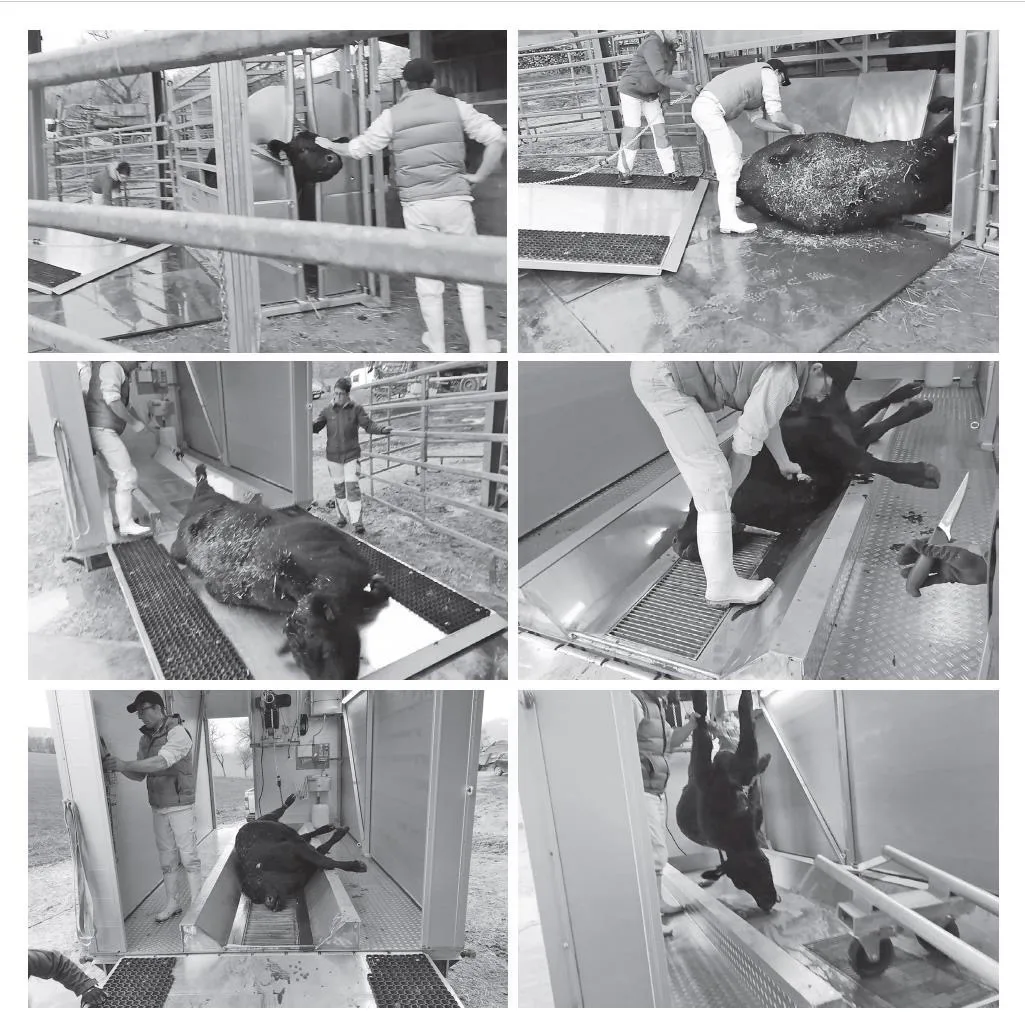
The cow immediately collapses unconscious. Jörg checks the effectiveness of the stunning by examining the eye, opens the trap, and pulls the cow out of the restraining unit and into the trailer. To ensure that the animal does not regain consciousness, the cut into the heart must follow immediately. A gush of blood pours from the body. Lifeless, the tongue hangs from the mouth. The eyes stare open. The veterinarian looks at the clock. Exactly 60 seconds. From life to death. How calm I am. Less than three minutes ago the cow was still with its group. The slaughtering specialists and Jörg now drive to the slaughterhouse to carry out the remaining steps. Sven will pick up the cattle quarters tomorrow, where they will hang in the cold room. Orders from customers and shops are already waiting.
The act of killing is not simple. Farmers and butchers make their living from animals being killed and turned into meat and thus into something that nourishes us, but also into a commodity with a price.145 Yet society continues to return to the question: What justifies the killing and eating of animals?
5.1.3 But What Justifies the Killing and Eating of Animals?
Militant animal rights activists storm barns, install cameras in slaughterhouses, document violations of animal welfare regulations in slaughtering. In 2019 alone, two of the few remaining artisanal, medium-sized slaughterhouses in Baden-Württemberg had to close as a result. Demonstrations against the killing of animals are being organized, and radical voices dream of an agriculture without farm animals.146 Killing animals in order to eat them is, for them, an aggressive act, and consequently the keeping of animals for food purposes is as well.
In the eyes of farmers and butchers/slaughterers, however, this timespirit has the quality of a terrorist. They no longer understand the world at this point. How could it happen that the former pride of farmers – cattle have always been counted among the highest-ranking possessions of farmers, and rural breeding of these animals was their pride, their recognition – today experiences such negative evaluation?
The timespirit that rejects the killing and eating of animals is very old. Today it appears as militant as the marginalization of animals has become radicalized.147 Killing animals in order to eat them was already discussed by philosophers, ethicists, and theologians in antiquity148. This timespirit was discussed again, and with greater intensity, only in the course of the 19th century. It says: “Animals have a soul and feelings,” and it calls upon human beings to observe “justice toward animals.”149 Feelings of guilt arising from the killing of animals for food purposes were to be satisfied through abstaining from meat and through abstaining from what also came from animals: milk products and eggs. The counterplayer-timespirit is the voice that defends and justifies the killing and eating of animals. Its tradition naturally reaches back into antiquity as well.150
Presumably, people in pre-moral thinking did not yet have any moral concerns about killing animals in order to eat them. Hence the sacrificial ritual and the many references to slaughtering, cutting up, and preparing meat being described as a sacred activity carried out by priests.151 Not so very long ago, at least, many rural inhabitants had the experience of home slaughter and the associated slaughter feast with its freshly brewed kettle soup. Does not every animal sacrifice bear traces of the communal meal connected with animal sacrifice? Nearly every culture has a ritual for pointing out to the gods the smoking scent and the grilled meat. Michael Pollan writes in his book Cooking that eating is not sufficient nourishment.152 Cooking, Pollan continues, is at the same time a deeply cultural act, for only human beings have tamed fire in order to prepare their food, and only this distinguishes them from animals.153
Perhaps this is what is special about human beings: they are the only animal that values not only eating their food well, but also thinking well, as Claude Lévi-Strauss puts it. To know that the animal has led a good life and has been killed and prepared with respect and good craftsmanship gives a different meaning to a piece of meat on the table.154
5.1.4. Life from the Life of Others
“The bird eats the mosquito and transforms it into bird flight,” writes Klaus-Michael Meyer-Abich, physicist and natural philosopher (1938-2018), in his essay, which I find remarkable.155 We human beings, too, stand in this metamorphosis, according to Meyer-Abich. We kill life in order to live, and we ourselves become earth again and are eaten by others. Every stage brings something into the world through which it could become better. There is no justification for killing when the human being sees and thankfully understands their joy and gratitude as an animal of the earth and uses the power given by this to become human and to bring about a creative transformation of the world.
Karl Ludwig Schweisfurth,156 a passionate butcher and pioneer of species-appropriate husbandry and advocate of the craft, described killing as something he feels with all his heart, and which still touches and almost justifies him after an inner justification:
“It is probably a fundamental law of life that we take life and kill in order to live. Life lives from other life in an eternal cycle. (…) It is a tragedy of life that food is life that should live loudly, according to an Eskimo shaman. This sentence occupied me for many years. (…) When today I kill a cow or a pig, I experience every phase with my whole heart and full attention. One shot, the collapse, a stitch that opens the connection; with the blood, life escapes. I feel this with my hand, over which the warm blood runs. I speak with the animal; I tell it that it is sorry to me, that it is tragic, and I comfort it by saying that another power will one day kill me too. One last trembling, and the soul has probably vanished. Now it is meat. I am deeply moved within. It works for a long time afterward. I find calm only slowly within myself and the inner justification; I feel well only when I know that the animal I have just killed had a good life. Whoever has the right to kill, in my view, also has the obligation to care for the animal, to give it a life in harmony with its nature.”
“I feel well only when I know that the animal I have just killed had a good life.” How often have I heard farmers say this sentence – not only in Germany, everywhere Lea and I have given lectures to people committed to a gentle way of killing their animals.
Does this shrill protest and consumer movement, this timespirit No Blood Shall Flow for Me, not need to be turned into a creative transformation, in order to move forward so that we can in the future have a better life for farm animals, a transformation of the entire system of meat production and consumption, and a reconnection of animals to the earth and of meat consumption to the festive meal?157
5.2. At the End of the Project: A Guideline, a Serious Conflict, and the Solution
From the beginning, we had planned to document the compromises and solutions we found in the form of a guideline and make them available to all interested farmers, butchers, and veterinarians. Shortly before its completion, however, a deep conflict arose between a farmer from the group and me. I understand that both sides must take a step toward one another if a solution is to emerge.
5.2.1. The Guideline for Partial Mobile Slaughter: The Outcome of Our Process
The development of the guideline was largely my work and that of my inner jurist. Because of the new interface between agriculture and slaughter enterprises, the responsibilities had to be separated and described in a legally clear manner for each work step. As far as possible, we tried to describe the procedure we had chosen rather than make it overly specific. As many other technical variants as possible, including those not yet invented, should also be able to use it.
Over many months we coordinated not only with mobile slaughter initiatives, but especially with representatives of the veterinary authorities. In this context we met committed district veterinarians in Bavaria and the far north. They reviewed and supplemented our draft, which we then revised together with the Kassel Regional Council and finally with the ministry.
Our goal was achieved: the ministry granted us permission to describe the guideline as coordinated with them. Since the guideline was to be published in the name of the Extrawurst project and the ministry was not prepared to issue it as an official decree, this was more than we had expected.
I was satisfied: the guideline was one of the central outcomes of our project. It described the legal framework, the process of partial mobile slaughter, the distribution of responsibilities between agriculture and slaughter enterprises, the critical points, the inspection options, and the documentation requirements. It also contained templates and tables developed by us, intended to help as many farms as possible obtain approval for the procedure in many German federal states.
5.2.2. Compromise with the Authorities – Conflict with the Farmers
Shortly before the end of the project, an unexpectedly deep conflict arose within our project group. Everything that had been approved during the project period – the guideline, the EU approval, the technology, and the positive media coverage. But Burkhard Ernst, who had brought in the idea, felt like a misused extra by one of the leading project groups and felt that his concerns – being allowed to slaughter animals on the farm in an economically viable way and without excessive bureaucracy – had been overlooked. My apology only upset him further.
I began researching the matter: indeed, he had written to me twice a year earlier. He had submitted proposals that I had overlooked. To be honest, I had seen them, but at the time I was too focused on driving the project forward. I did not want to stop and think again. Yet that is exactly what his request would have required. Burkhard is a sheep farmer, and his project goal, anchored in his application, was to develop low-stress slaughter not only for cattle but also for sheep and goats. Because of his objections, this idea had been set aside at the end of the first project year (individual slaughter, without sheep) without us explicitly making that clear. For us, it was no longer an issue. For Burkhard, however, it remained one. Burkhard is a good debater. He was afraid of conflict, but he did not avoid it.
Trying to avoid the conflict only poured oil on the fire. Typical of this situation: the conflict surfaced only shortly before the project ended. The guidelines we had developed were nonsense, he said. If he came to the farm of a veterinarian, all he would receive would be trouble, because the veterinarian could derive excessive demands from them. In addition, the trailer was too large and too expensive and unsuitable for a small-scale operation.
We had to sit down together! An extraordinary group meeting was called, and we began listening to Burkhard. He had prepared thoroughly. He had spent an entire Sunday afternoon going through the document line by line. What word in these guidelines could be interpreted by a district veterinarian to the disadvantage of a farm? Where were we unnecessarily restricting ourselves to a particular technology or a particular procedure? Burkhard had read the document precisely from the perspective of the farmer and slaughterer (Burkhard is also a trained butcher) and had drafted alternative wording.
At the end of the day, Hans-Jürgen and I had to admit that with this guideline we had moved too far toward the authorities and had lost sight of the practical perspective. Burkhard had brought us back to reality, point by point. We revised the document and, at strategically important places, created room for the practices of traditional slaughterers and livestock keepers. The conflict was resolved and the missing aspects were incorporated. Later, this solution gave Burkhard the confidence to negotiate directly with the veterinary authorities himself – something he had previously strongly opposed.
This conflict showed me the power of marginalized voices – even within our group – and confirmed that creativity emerges through conflict. Our guideline became more open, better, and more broadly applicable. The ministry ultimately accepted it in this form.
5.2.3. Each Side Must Cross a Boundary
The negotiations with the authorities, as well as the conflict with Burkhard, made it clear to me that in such processes both sides have their boundaries. These boundaries are part of the role itself. To reach a sustainable solution, both sides therefore have to cross a boundary: not only did the veterinary authority have a boundary that it could not really cross in this conflict. The farmers in the group also had to cross their own boundary and accept that the procedure would be more labor-intensive and expensive than they had originally hoped. The necessity of this double crossing of boundaries is often overlooked and leads to persistent conflicts (see Theory IX).
Theory IX: Crossing Both Boundaries – Going Over Double Edges
Most organizations and groups are unaware of their one-sidedness, Mindell writes in his foundational work on large-group processes.158 In the deepest sense, every communication system therefore has at least two boundary areas/double edges. Solutions in conflict situations require a going over double edges. If two groups are in conflict and only one of the two crosses its boundary while the other does not, then the facilitator of the second group would be accused of favoring the first. Both sides must cross their respective boundaries, otherwise neither is being served.
That is exactly what happened: the veterinary authority crossed its boundary, and the accusation from the other side, the farmers, directed at the project leadership was: you have joined the side of the veterinarians and crossed over!
In fact, the shift in the interface between farm and slaughter enterprise envisioned in the project also required compromises from the farmers: they had to accept that the procedure became more complicated. They had to accept that the stunned animal could not simply be hung from a front loader for bleeding, as had been done in legal practice during on-farm emergency slaughter. They therefore had to accept that it would be more laborious, more expensive, and, from their perspective, less practical than necessary, and that the butcher, who had previously acted as a service provider, would assume a more substantial role in the application process and in obtaining EU approval for a mobile trailer. Thus, I too had to get into the boat, and their own resistance (too expensive, too much work! What do I tell my customers if you are no longer carrying out supposedly better slaughter?) also had to be overcome.
The veterinary authorities had to accept that restraining animals outside the slaughter facility did not represent a greater risk to hygiene than within it, even though the stunned animal had to be pulled about one meter across agricultural ground in order to reach the trailer.
5.3. Economy and Technology Want More Attention
Time, labor, and money are scarce resources on farms and in artisan businesses, and at the end of the day one must not only work but also generate profits and income. At the threshold of practical implementation, the autonomy of the economy and the technology closely linked to it became visible. They raised their voices: “It has to pay off!”
5.3.1. The Economy Shows Its Boundaries
The economy had already revealed itself in practical and conflict-laden ways during the course of the project.
In a publicly funded project, the economy is initially disguised, hidden in a shadowy existence, because money from the project fund flows toward labor services. These funds sharpened rank differences: the rules governing project funding forced us to record and account for the hours devoted to the project according to the logic of public service. This created differences in compensation for work performed on the project (ranging from about 20 euros to well over 40 euros per hour), and discussions arose within the group about what would constitute appropriate compensation and how these contributions should be converted into billable hours. This concerned not only the work of the trailer manufacturer but also that of the butcher. His publicly funded additional effort during the trial slaughters became the subject of endless conversations and fueled the village gossip that some people had only let their animals be slaughtered because of the project. Was it too little, as he thought? Or was the project providing too much money for such slaughter, as others believed? He feared that, once accustomed to high compensation, farmers would raise the slaughter price for their cattle in the future.
But now, after the project had ended and implementation was approaching, the actual economic questions suddenly stood in the room.
How much higher would slaughter costs be? By how much would the actual workload for the butcher increase, or would it perhaps remain the same because the work of loading and unloading at the slaughterhouse would no longer be necessary? Would customers be willing to pay a premium for lower-stress slaughter? How many slaughters would be required before it became worthwhile to enter the system and invest in the expensive restraining unit (6,000 euros)? Or could there be cooperative models for sharing restraining units and trailers? Or would one forever have to transport them from one place to another, load and unload them, and who would pay for the repairs?
Every decision made by the authorities and every compromise we reached had immediate economic consequences. Any other decision would have done so as well, only differently. Would it not have been simpler to stun and bleed the animal directly from the front loader? Would this requirement mean that the butcher had to stand inside the trailer to carry out bleeding on the slaughter table? There were many possible approaches, where either outside the box thinking or more complex solutions followed the requirements of the veterinary authority and led into a closed slaughter room. Depending on the requirements for restraining and the slaughter trailer, the necessary investment ranged between 18,000 and 100,000 euros.
5.3.2 Technology Also Has a Say in the Economy
As a result, technology also gained a decisive voice in the discussion. It forced us to recognize that it too plays a crucial and at times highly independent and self-willed role.159
The trailer (5 meters long, 2.5 meters wide, and 2.7 meters high) became impressively large (see Figure 3). Its width was dictated by road traffic regulations. Its height was determined by the requirement that the slaughtered animal had to be suspended upon arrival at the slaughterhouse so that a trolley could be moved underneath it and the animal brought into the slaughter room. Normally, only the slaughtered animal enters the slaughter facility. In this case, however, the cattle had to be driven into it. Not every slaughterhouse was prepared for such a modification. And because the animal (weighing at least 800 kilograms) could be transported inside either on its forelegs or hind legs, the trailer required exceptional stability. That made it heavy (2,700 kilograms)!
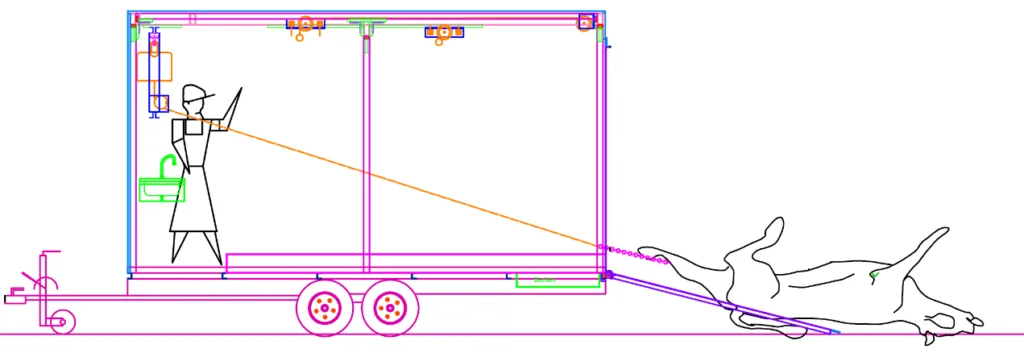
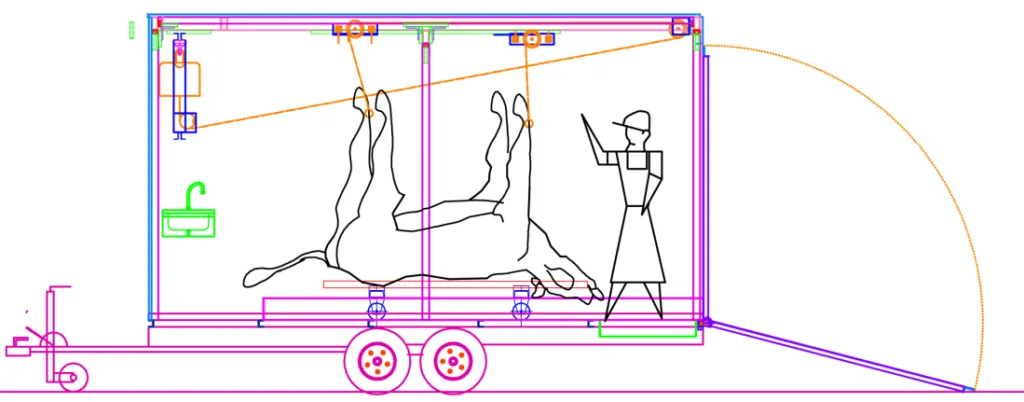
The size appealed to the veterinarians. This was how they envisioned it: large, washable lightweight metal construction, lighting, and a hands-free washbasin.
The size and weight of the trailer did not appeal to the farmers at all: too heavy, difficult to maneuver, too expensive, too complicated, and the washbasin unnecessary.
In fact, the blood collection tray proved to be very practical during slaughter, as blood flowed out through the grating and out of the trailer as soon as the butcher made the fatal incision to the heart. The farmers liked that. The blood collection tray should have been wider, but its width was determined by the vehicle frame. It had to fit between the wheels. There was no changing that.
The restraining unit had to operate on several levels simultaneously: it had to be open enough for the animal to walk in and out. For example, in order to place ear tags on a cow or take blood samples. It also had to close in such a way that the animal’s head remained relatively still, allowing the stunning shot to be placed accurately. At the same time, it had to open quickly enough after stunning so that the animal would not become entangled with its horns. It was also not supposed to collapse directly after stunning; instead, it had to fold together slightly to one side so that we could quickly attach the hind legs and pull the animal into the trailer. After all, we had only a few seconds for this, as no more than 60 seconds were allowed between stunning and killing by bleeding. Exceeding that time limit would have meant that our procedure did not work.
We continued developing all major technical components: the blood drainage from the collection tray was improved, a more powerful motor winch was installed, the head restraint of the restraining unit was enhanced, and the rolling mechanism, the trolley used to transport the dead animal into the slaughterhouse, was improved so that the animal could be lowered more smoothly.
Bruno Latour160 would say: the inherent logic of the “actant” persisted and shaped future action. The restraining unit is an example. Because it has to do so many things well, it is not only expensive but also heavy. A slaughterer cannot simply bring one along. Even purchasing one is feasible only for farms that process at least one animal per week. This makes subsequent work necessary. It limits the use of the system and therefore the economic viability of the entire procedure and its rapid adoption. Developing new solutions will remain a task for the future.
5.3.3. The Efforts of the Different Levels – What Comes Next
The project has now been over for more than a year, and the time has come for the seeds planted in the ground to grow.
Countless inquiries are reaching me, as the COVID-19 pandemic of 2020 has also brought movement to the prevailing spirit of the times. Large slaughter companies emerged as infection hotspots among poorly paid contract workers from Southeastern Europe. The politically demanded transformation of livestock farming toward greater animal welfare is now accompanied by a similarly demanded transformation of the slaughter industry toward regionalization and relocation of slaughtering into the regions. The re-regionalization of food supply is being publicly discussed, funding programs for regional slaughterhouses are being launched. Inquiries from the press, associations, politicians, and still from farmers continue to reach us. I am learning about further initiatives and the obstacles they encounter on their path, and there is growing interest among authorities in how such requests should be handled.
Since the legal situation has largely been clarified and public opinion has shifted favorably toward animal welfare, butchers and slaughter companies are now launching their own projects for mobile slaughtering and expressing interest in public funding.
Meanwhile, Switzerland has generally approved both pasture slaughter and on-farm slaughter, and, quite unexpectedly, in March 2020 the European Commission already began working on a proposal to amend the legislation. Since 2020, Article 3 of the EU Hygiene Regulation for food of animal origin No. 853/2004 has been supplemented by a new chapter, introduced in June 2021, containing an exemption that permits slaughtering on the farm of origin! Who would have believed it? And who would have thought that this great steamship could be moved in such a highly complex field?
In the newly begun year of 2021, the focus will be on supporting practical implementation in Germany. I am therefore working on the next project proposal. However, I will not continue doing this unpaid as I did this year. My own economy has finally made its voice heard!
6. Summary and Outlook
In conclusion, I provide a summary of my learning experience and my new understanding of the field in which we have been operating. I also venture an outlook toward a possible expanded collaboration between humans and non-humans.
6.1. Summary and Recommendations
By deciding to place the Extrawurst project at the center of this work, two questions emerged: Can Worldwork facilitate change in the field of regional development, and can Processwork also transform my own capacity to act?
I first explored the field and its dynamics, observing what unfolds when something new seeks to enter the world. I identified roles and timespirits and thus the driving force of the social activist within me. I was then able to feel myself as part of a network of different and opposing forces, forces that enable and constrain, that make my own actions possible and impossible, that limit and support them, make outcomes unpredictable, and thereby correct assumptions about how things supposedly must be.
I experienced that my actions are supported by something deeper through the inner work connected to my Lifemyth and the way it manifests itself in an independent inner team of different roles, voices, and forces. The rigid separation of roles that had often disturbed me in the outer world became more fluid. This made me more flexible, more resilient, and increased my inner acceptance of the processes unfolding both within me and around me, including within the project. Alongside the already familiar roles of social activist and researcher, I now also encountered the facilitator.
The project raised for me the question of how to deal with the relatively fixed roles of social sectors and especially of institutions and organizations. A simple role switch was not enough. Through Worldwork, the position of the other animal became understandable to me, and I was able to find this role within myself. I found the jurist within me. Exploring the Lifemyth of an institution deepened my understanding of its actions and its limits. During negotiations, the boundaries of both groups and sectors became visible. There were conflicts, and the long-silent role of the decision-maker acted as a Ghostrole. This role fostered conflicts and in practice delayed the project by more than two years. Other roles in the field were politics and the media/public sphere. I did not explore these in depth. Yet they were effective and, through their presence, helped us lead the negotiations toward compromise, enabling both sides to continue living. An important lesson was that both sides had to take a step beyond their respective boundaries in order to reach a sustainable solution together.
Shortly before the end of this work, I was able to experience what it feels like when the field truly moves: at the end of 2020, the decision of the European Commission to permit slaughter on the farm of origin and to create an enabling legal framework was published. This news immediately and physically affected me. I could feel the entire field bodily: the trailers, the web of relationships among people, animals, legal regulations, transport wagons, knives – the years-long dream, wishes, struggles, and efforts of all the forces acting with and against one another at the same time.
Before turning to this bustling field and the question of action, I would like to add a few practical reflections on what we are all feeling: Something has to change!
On the one hand, the COVID-19 pandemic, while I was writing an essential part of this dissertation, has shown me how quickly and sustainably a crisis can change public awareness. The attention that society directs toward the treatment of animals, transportation, and slaughter has sharpened and opened the door to alternatives. Our project is benefiting directly from this.
Yet the question of how something changes remains. It is becoming increasingly clear that simply setting goals is not enough. At the same time, implementing those goals in the face of social complexity appears to be a major puzzle. Public discussions increasingly emphasize that somehow the different perspectives must be brought together, round tables must be established, and broad commissions must be formed in order to discuss the problem openly and from all sides.161 But the question of how we actually bring things together remains largely unanswered.
Processwork has developed not only its theory and tools for this purpose, but also the format of the open forum.162 On an informal basis, an open forum creates a space in which not only organized interests (as in round tables) but also inner perspectives, voices, dreams, and myths can become visible. This enables people to jointly experience a new relationship with different perspectives. According to Max Schupbach, an open forum is already a political act because it opens a field and, through interconnectedness, produces initial solutions. Since roles are non-local, there are no formal resolutions, only a growing experience. This is precisely where the responsibility of all participants begins: The world is everyone’s task.163
From this work, I have drawn the following conclusions for myself and for my future work in the field of regional development:
- Processwork has not only provided the necessary theoretical framework, but also developed tools that allow us to act from a new inner standpoint and to recognize the forces operating in the field.
- Inner work and the attitude of deep democracy are central in giving a voice to all perspectives – both within ourselves and in the outer world.
- The information and energy necessary for transformation are hidden within conflict. It carries the potential for a solution within itself.
- It is essential to build relationships on all levels – above all with decision-makers. Decision-makers from different levels need to be brought together.
- It is worthwhile to undertake projects that work experimentally at the interfaces of society, seek something new, and gain experience with the processes that emerge.
6.2. Answer to the Girl Within Me
At the beginning of this dissertation, I wrote: “One of the great questions in my life has been the question of possible action in the world. I sensed that something was missing. The girl within me asked whether there might be more than simply being there and behaving properly.”
Now, having reached the end of my journey, I understand not only the girl better, but also what she was searching for and why, for her/me today, action in the world means living what she always wanted to live and what she still must live.
The girl of that time believed that action was an act that took place outside the home, in a male-dominated world, and primarily in the political and economic sphere. Her role models included Winnetou, Che Guevara, and Rosa Luxemburg, and they point me today toward the aspect of political action as an emancipatory act of liberation. This understanding of action was shaped by the spirit of an era of departure and upheaval during a major social crisis, and it was also reflected in my childhood dream: overcoming the injustice and suffering of the past, the guilt and devastation of the Second World War. A new society was to emerge. For that, too, a leap through the window into a bright, newly built future was required.
Action as a political act and as a contribution to changing the world – this view brought me early into the role of the social activist. Yet I came into inner conflict with this role. I could never fulfill it in the way I believed I should. There was always a resistant remainder.
Only Processwork and its application in my professional life showed me the interaction of all these and changing roles, their often contradictory energies, and allowed me to recognize them as part of my Lifemyth, showing that action is experienced and expressed on many levels of the world. An earlier working title for this dissertation was Ich – Du – Wir (I – You – We). Yet the work on this thesis itself revealed to me the depth of these three pronouns.
Therefore, at the end of this path and having arrived at a conclusion, I would like to answer the girl of long ago:
When, during your studies, you cut out the picture of the young Hannah Arendt from the newspaper and glued it onto the cover of your diary, you did not know much about her. The picture captivated you because a girl in a foreign city was sitting in it. It resonated with you. Not only the foreignness in this world, but also what you always wanted to show me: that action can manifest itself in writing. With this form of action, the philosopher Arendt also showed you a possible future. She later writes of the active life / vita activa.164 Human beings enter the world through their own initiative and responsibility and act within it. At the same time, every person is woven into the fabric of the world and into what existed before them. Human beings, Arendt says, are not born merely to die one day, but to bring an impulse into the processes of the world and to shape something new. Your leap into the world as part of your childhood dream and Lifemyth was exactly that. Your actions, your sensitivity and empathy, and at the same time your persistent resistance and your loyalty to the soldier in relation to the tasks placed before her – these are your gift to the world.
Because as a young woman you believed that action occurred only through strength and courage and only on the level of the visibly outer world, the sensitive disturbance, the inability to fit in, opened the way for you to discover that inner and outer experience are connected. This opened a path toward yourself as a sensing and experiencing being in the world. This inner work became the prerequisite for action within everyday and consensus reality. Through the project, you first encountered a monster: the anxious attachment to being right and to order, the argumentative one within you. Only then were you able to recognize the concern of the other side and, above all, acknowledge it. This inner work led you, in your own way, to a new form of action in the world and thus to an impulse that influences the processes of the world.
Only this work opened your eyes to your sensitivity and showed you that it can provide another possibility for action when you open yourself and become a channel of expression for another. You experienced this through the examples of the animal and the farmer.
Therefore, I would like to conclude: relationships and action arise between us. There is no simple cause and effect, no single person who had the thought first, but rather a shared Co-Creation of the World. That is precisely what you love: entering into thoughts with your counterpart and creating the world anew together.
6.3 On Action in the World: An Outlook
At the beginning of this dissertation, I was drawn to Mindell’s vision of a shamanic science. It invites us to jump into the river instead of describing it from a safe shore or from a bridge above it. In this image too, the human being and human action remain central: one jumps into the river and allows oneself to be carried, permitting oneself to lose control.
I would now like to take a small step further. To do so, however, one must consider the insights of quantum physics and then ask whether all matter and all non-human beings owe their most manifest existence to a handshake of quanta. These insights call our conception of human beings (or of a God), their intentionality, will, purposes, and thus their capacity for action radically into question. They also challenge our idea that all non-human beings (including our own waste products) are merely lifeless matter, soulless objects without their own forces, intentions, and therefore without agency.
If the concept of agency or effectiveness is expanded to include everything and everyone that shares this earth with us, then the concept itself changes. Action then depends on cooperation and the mutual effects produced by other actors, bodies, and materials. There is no longer a central actor (human/God), but rather an uncontrollable process of mutual influence and being influenced.
There are several approaches known to me that seek to explain and describe this collaborative action of humans and non-humans. One current example is Vibrant Matter by Jane Bennett.165 Bennett follows the intellectual traditions of Spinoza, active matter, and postwar philosophers such as Gilles Deleuze and Felix Guattari. The latter speak of a Gefüge (or assemblage), whose effects can produce entirely new things. Researchers had already introduced me to Bruno Latour’s Actor-Network Theory. According to Latour (*1947), action occurs through the connection of humans with nature and technology.166 There is no commander.167 Action unfolds under the influence of non-human beings. Latour draws on ideas from Michel Serres (1930-1998), who describes this interaction in a striking way as a process that follows its own logic.168 This logic, he argues, operates “in politics as in physics, in economics as in biology.”
I also recognize many similarities to Mindell’s concept of the processmind in Processwork. He too speaks of recurring patterns in personal life and of a system mind in organizations and politics.169 Yet the processmind is ultimately the organizing principle.170 It is what we experience on the level of everyday life as a flowing process, a process that unfolds both personally and socially and throughout the universe, without a human-directed, central controlling force. Yet it is experienced as a driving force – whatever one may call it – perhaps even as a higher intelligence. For Mindell, this force organizes our perception, our consciousness, and our life, giving every person a unique quality in the way they move through life, a “unique way of moving through life”.171 This force and its rhythm become perceptible in fields of energy, in dreams, in relationships, in conflicts, and in life circumstances. It is non-local and not measurable. It connects me with everything.
If there is no centrally controlling force that can be organized by humans, but only a buzzing multitude, swirling processes, and a processmind experienced as a force – how can we make use of this knowledge to find new paths out of ecological and social crises?
Arnold Mindell emphasizes here the necessity of 2nd Training, that is, the development of process awareness and a feeling for the flow of things and people, especially in the midst of difficult personal situations and societal crises. The world, according to Mindell, does not need great leaders and rulers, but rather you and me. It needs each of us who has become aware of our deepest self and our fundamental energies and patterns and who can place them at the service of the world in a helpful way for sustainable development and change, facilitating processes, vortices, and conflicts.172
At this point I would like to draw attention to the non-human actors participating in these processes, vortices, and conflicts, not least because they have become part of my inner team. What kind of relationship can we develop with them? Even out of elementary self-interest, we humans must ask ourselves this question. Can there be a new relationship between humans and nature, or between humans and non-human matter? Félix Guattari argues that we must learn to think transversally, because humans are not only in nature, but also of it.173 We must direct our intellectual gaze both toward the human realm (society and subjective interiority) and toward the non-human realm (environmental ecology and the sphere of technology).
How such a perspective might look is demonstrated by the young naturalist and philosopher Baptiste Morizot through his vision of a new cosmology, in which humans become reintegrated into the cycle of energy, matter, and thus nature and all non-human beings.174 Such a practice would begin, according to Morizot, with an extreme sensitivity toward the vitality of other species. Their own centers of consciousness, their inner worlds, remain invisible to us, but they leave traces. These traces, whether left by herbs, worms, or leopards, can once again be learned and read. In view of a universe rendered mute by modernity, this tracking of traces is ultimately an art of coming home.175
The methodology developed within Processwork, a heightened attention to signals and the decoding of their information (2nd Training!), may point toward a path that includes nature, matter, and technology. In Processwork, the tracking of signals, the decoding of their meaning, and the utilization of their energy or information are applied in order to increase the fluidity of a process and expand the agency of a person or group. It may also be possible to interpret this information as information arising from the entire assemblage or swirling process, understood as a sphere of the non-human communicating with us, and to use this information to create a better coexistence with precisely these non-human beings.
Using the example of animals and the stubborn agency of the slaughter technology we developed, I was only able to begin exploring this new perspective. Neither the energy nor the time were sufficient to delve deeper into it. Yet it is important to me to continue investigating how the methods of perception developed in Processwork might provide access to the question of how we can live together in the future not only with other humans, but also with all non-human beings, and how, in Bruno Latour’s words, we might “admit beings (such as animals, stars, prions, cows, robots, and chips or dust particles …) into the interior of our political space” in order to keep the planet inhabitable for all of us in the future.176
7. Epilogue
Now, at the end of this work and after a long process of self-reflection, I asked myself: what was a high point in recent years, when did you deeply feel that you were in the right place, in the sense of coming home.
I see myself together with Lea on the station square in Montabaur. We stand in a circle with five organic farmers from Loire-Atlantique, France. They are looking for ways to practice mobile cattle slaughter on their own farms, and at short notice I had organized this small excursion for them to two farms and a veterinarian. Now our paths are parting. We all have tears in our eyes as Françoise and Guylain say goodbye on behalf of the group and thank the two of us for our support. Lea and I are deeply moved by this encounter and by the fact that we were able to offer support across borders. Building relationships and sensing that our concern is becoming a European one gives meaning to what we do. In that profound moment Lea and I felt: yes, we are in the right place! It was a coming home. If a lifemyth reveals itself in those moments when one simply must do something despite all reason (no time, no honorarium, cancelling other appointments), and at the end of the day stands there with tears in one’s eyes, then that was exactly such a moment.
I met Guylain again in December 2019 at a major French conference, Abattage de Proximité (Regional Slaughtering). He told me how important the experience in Montabaur had been and how valuable my suggestion had been to consciously engage with the language of veterinary administration and its legal logic in order to negotiate with the ministry and the slaughterhouse. They had already achieved considerable success and were now planning to establish mobile cattle slaughtering on a large scale.
His initiative was one of many that came together at this conference to discuss a réappropriation, a reclaiming of slaughtering. The French Ministry of Agriculture had provided a four-year moratorium and financial support so that these groups could continue developing their ideas and models of regional slaughtering and prepare for a future ministerial decision. The initiator of the moratorium was the Confédération Paysanne (CP), the agrarian opposition movement that emerged around Bernard Lambert177 in the 1970s. It was Bernard Lambert’s book that first drew me, as a young agricultural student, into this movement of farmers. On the final day of the conference, Jean-Jacques Bailly sat beside me, an elderly farmer, activist, and former member of the CP board. Speaking more to himself than to me, he said: „Je pense, c’est une révolution! At the end of the 1990s, when the producer-consumer movement and solidarity agriculture began, everyone laughed. Now they are established. I sense something similar. This here, this will become a revolution!”
8. Literature and Sources
Hannah Arendt, Vita activa oder Vom tätigen Leben. 7th edition, Munich 1981.
Günter Altner, Tierzucht zur Fleischproduktion? in: Leben. Töten, Essen. Anthropologische Dimensionen. Heike Baranzke, Franz-Theo Gottwald and Hans Werner Ingensiep (eds.); Stuttgart, Leipzig 2000, pp. 270-273.
Jane Bennett, Lebendige Materie. Eine politische Ökologie der Dinge, Berlin 2020.
Martin Buber, Das dialogische Prinzip, Gerlingen 1994.
Julie Diamond and Lee Spark Jones, A Path Made by Walking. Process Work in Practice, Portland, Oregon 2004.
Andrea Fink-Keßler, Milch – Vom Mythos zur Massenware, Munich 2013.
Norbert Elias, Über den Prozess der Zivilisation, 32nd edition, Frankfurt 2010.
Fröhlich, Werkzeugkiste Nr. 28. Deep Democracy, in: OrganisationsEntwicklung, issue no. 2, 2011, pp. 81-85.
Jacob and Wilhelm Grimm, Deutsches Wörterbuch, Leipzig 1854-1961, online version of 11.8.2020.
Yuval Noah Harari, Homo Deus, Munich 2015.
Werner Heisenberg, Quantentheorie und Philosophie. Vorlesungen und Aufsätze, Jürgen Busche (ed.), Stuttgart 1979.
Hans Werner Ingensiep and Heike Baranzke, Introduction, in: Leben. Töten, Essen. Anthropologische Dimensionen. Heike Baranzke, Franz-Theo Gottwald and Hans Werner Ingensiep (eds.); Stuttgart, Leipzig 2000, pp. 22-69.
Wieland Jäger, Was leisten gegenwärtige soziologische Theorien aus der Perspektive des sozialen Wandels? in: Sozialwissenschaften und Berufspraxis, 28(2) 2005, pp. 157-168.
C.G. Jung, Kinderträume, supplementary volume of the collected works, Olten 1987.
Gabler Wirtschaftslexikon on the keyword “Behörde”, https://wirtschaftslexikon.gabler.de/ accessed 5 June 2020.
Bruno Latour, Die Hoffnung der Pandora. Untersuchungen zur Wirklichkeit der Wissenschaft. Frankfurt 2002.
Bruno Latour, Making Things Public. Speech at the finissage of the exhibition Making Things Public on 2 October 2005 at KZM Karlsruhe, www.zkm.de.
Klaus Michael Meyer-Abich, Was sind wir dafür schuldig, daß wir von anderem Leben leben? in: Leben. Töten, Essen. Anthropologische Dimensionen. Heike Baranzke, Franz-Theo Gottwald and Hans Werner Ingensiep (eds.); Stuttgart, Leipzig 2000, pp. 227-235.
Arnold Mindell, River’s Way. The Process Science of the Dreambody, Portland, Oregon, 1985, new edition 2011.
Arnold Mindell, The Year I. Global Process Work, London 1989.
Arnold Mindell, The Leader as Martial Artist, San Francisco, California 1992.
Arnold Mindell, The Shaman’s Body, San Francisco, California 1993.
Arnold Mindell, Sitting in the Fire. Large Group Transformation Using Conflict and Diversity, Portland, Oregon 1995.
Arnold Mindell, The Deep Democracy of Open Forums. Charlottesville, Virginia 2002.
Arnold Mindell, Earth-Based Psychology, Chicago, Illinois 2007.
Arnold Mindell, ProcessMind. A User’s Guide to Connecting with the Mind of God, Wheaton, Illinois, 2010.
Arnold Mindell, Conflict: Phases, Forums, and Solutions, North Charleston, South Carolina 2017.
Arnold Mindell, Dance of the Ancient One, Portland, Oregon 2013.
Arnold Mindell, The Leader’s 2nd Training for Your Life and our World, Columbus, Ohio 2019.
Arnold Mindell, Quantum Mind. The Edge between Physics and Psychology, Oakland, California 2000.
Baptiste Morizot, Philosophie der Wildnis oder Die Kunst, vom Weg abzukommen, Ditzingen 2020.
Armin Nassehi, Soziologie. Zehn einführende Vorlesungen, 2nd edition, Wiesbaden 2011.
Armin Nassehi, Die letzte Stunde der Wahrheit. Kritik der komplexitätsvergessenen Vernunft, 2nd edition, Hamburg 2018.
Michael Pollan, Kochen. Eine Naturgeschichte der Transformation, Munich 2015.
Andreas Reckwitz, Die Gesellschaft der Singularitäten, 6th edition, Frankfurt 2018.
Andreas Reckwitz, Am Ende der Illusionen. Politik, Ökonomie und Kultur in der Spätmoderne, 3rd edition, Frankfurt 2019.
Hartmut Rosa, Resonanz. Eine Soziologie der Weltbeziehung, 2nd edition, Frankfurt 2020.
Wolfgang Seibel, Verwaltung verstehen, Frankfurt 2016.
Ellen Schupbach, The Gold at the End of the Rainbow, PDE, Portland 2004.
Max Schupbach, Worldwork – ein multidimensionales Change Management Modell, in: OrganisationsEntwicklung, issue no. 4, 2007, pp. 56-64.
Annette Christiane Springorum, Eine kurze Abhandlung über die lange Geschichte der Tierhygiene, in: Berliner und Münchner Tierärztliche Wochenschrift 126(3/4) 2013, pp. 90-95.
Rudolf Steiner, Geisteswissenschaftliche Grundlagen zum Gedeihen der Landwirtschaft. Landwirtschaftlicher Kursus, Acht Vorträge gehalten in Koberwitz 2014, Basel 2016.
Hans J. Teuteberg and Günter Wiegelmann, Der Wandel der Nahrungsgewohnheiten unter dem Einfluss der Industrialisierung, Göttingen 1972.
Ueli Hurter, Unser neues Verhältnis zum Tier, in: Perspektiven und Initiativen zur Coronazeit, Ueli Hurter, Justus Wittich (ed.), Dornach 2020.
Maike Weißpflug, Hannah Arendt. Die Kunst, politisch zu denken. Berlin 2019.
Florian Werner, Die Kuh, Munich 2009.
Wikipedia, Zeitgeist, in: Georgi Schischkoff (ed.): Philosophisches Wörterbuch. 14th edition, Stuttgart 1982, p. 768.
- Definition see Chapter 2.3, page 26. ↩︎
- In regional development, the term “actors” means roughly the same as “socially acting persons” — representatives of particular social groups or subsystems (see note 3). In Processwork, people do not speak of actors but of roles (see also note 3). ↩︎
- The concept of the “societal interface” was adopted from Armin Nassehi, a student of systems theorist Niklas Luhmann (A. Nassehi, 2018). Originally, the term “interface” described the physical boundary between two states of a medium. Today, in communication technology, it refers to a point of contact between subsystems through which communication takes place. In Nassehi’s account, societal interfaces are the points of contact between functionally differentiated social subsystems such as science, law, politics, and family. These subsystems follow their own logic and modes of thinking and also organize social behavior and perception. Therefore, there is no central actor responsible for societal change. According to Nassehi, work at interfaces is necessary because otherwise the interconnected subsystems would have little connection to one another. Nassehi, ibid., p. 200 ff. ↩︎
- Prof. Dr. Horst Luley, personal communication, December 2020. ↩︎
- Worldwork is a “daughter” of Processwork and was developed specifically for working with large groups of high diversity. See also the section “How Processwork Developed” and Chapter 2.2. ↩︎
- See also “Jumping into the Flow – Perception, Reality and What Fascinates Me About Processwork,” pp. 12 ff. ↩︎
- Andreas Reckwitz, The Society of Singularities, 6th edition, Frankfurt 2018; and the same author, The End of Illusions, 3rd edition, Frankfurt 2019. ↩︎
- Hartmut Rosa, Resonance: A Sociology of Our Relationship to the World, 2nd edition, Frankfurt 2020. ↩︎
- Jane Bennett, Vibrant Matter: A Political Ecology of Things, Berlin 2020. ↩︎
- Baptiste Morizot, On the Animal Trail: Philosophy and the Art of Tracking, Ditzingen 2020. ↩︎
- Another source of inspiration for the question of whether writing itself can be political action is Hannah Arendt and, in particular, Maike Weißpflug’s discussion of her work in Hannah Arendt: The Art of Thinking Politically, Berlin 2019. ↩︎
- In the humanities, eclecticism refers to a method that combines elements from different systems, theories, or worldviews into a new whole. The often pejorative use of the term reflects a preference for self-contained theoretical systems over the selective adoption of useful insights from different theories despite unresolved contradictions. Here, however, the term is used positively, with the aim of bringing together different fields of knowledge such as physics, psychology, and sociology (see also the section “Theory I”). ↩︎
- Cf. Ellen Schupbach, The Gold at the End of the Rainbow. PDE, Portland, 2004. ↩︎
- “Deep democracy was not only a sociopolitical method of addressing conflict and other social issues, but also a spiritual and psychological awareness method, that enabled people to find fluidity and wholeness in the midst of social tension”, Julie Diamond and Lee Spark Jones, A Path Made by Walking. Portland 2004, p. 12. ↩︎
- Ibid., p. 12 ff. ↩︎
- “My goal is to show new and practical ways to work with yourself, relationships, organizations, and countries for more community and less violence.” Arnold Mindell, The Leader’s 2nd Training for Your Life and Our World, Columbus, Ohio, 2019, p. XI. ↩︎
- Ibid., p. 251. ↩︎
- Caspar Fröhlich, Toolbox No. 28: Deep Democracy, in: OrganisationsEntwicklung, Issue No. 2, 2011, p. 81. ↩︎
- Julie Diamond and Lee Spark Jones, A Path Made by Walking: Process Work in Practice, Portland, Oregon, 2004. ↩︎
- Carl Gustav Jung (1875–1961) had a dialogue with Nobel Prize winner and quantum physicist Wolfgang Pauli (1900–1958) in Zurich in 1931, concerning a new and profound understanding of the relationship between psyche and matter/body/world. C. G. Jung had found connections to astrology, alchemy, the world of fairy tales and myths, quantum physics, and spirituality in Pauli’s dream and mythological-material associations in his search. He wrote: “We discover that matter has yet another aspect, namely the pre-psychic. This is alive with the world within it. It is, as it were, matter not of a different aspect but inwardly psychic. This is the new thing we encounter here. It is as if, side by side with consciousness and its world, an unconscious psyche were to come forward from within matter.” Quoted after Richard Evans (1967), Conversations with C. G. Jung and Reactions from Ernest Jones, p. 75, cited according to Wikipedia. ↩︎
- Impressively presented in Arnold Mindell, Quantum Mind, Oakland, California, 2000, p. 28 ff. ↩︎
- Ibid., p. 210. Anyone who wishes to recognize only measurable aspects should be told that even fundamental assumptions of physics, such as “black holes” (dark matter) or the wave function of quantum mechanics, are not directly measurable; cited from Arnold Mindell, Leader, p. 253. ↩︎
- Quoted from Mindell, Quantum, p. 23. ↩︎
- See also Arnold Mindell, The Shaman’s Body, San Francisco, California, 1993. See also the interlude in this thesis: My Inner Team Is Complete, p. 41 ff. ↩︎
- Mindell, Quantum, p. 57. ↩︎
- Ibid., p. 61. ↩︎
- Ibid., p. 57. Mindell cites Castaneda. The shaman Don Juan described this crossing beyond the edge as an experience of “stopping the world” and entering the “Nagual.” ↩︎
- Werner Heisenberg, Quantum Theory and Philosophy. Lectures and Essays, edited by Jürgen Busche, Stuttgart, 1979, p. 60. ↩︎
- Heisenberg draws attention to this dilemma in his essay The Copenhagen Interpretation of Quantum Theory; in: Heisenberg, ibid., pp. 57 ff. ↩︎
- Ibid., p. 17. ↩︎
- Among contemporary physicists, Hans-Peter Dürr (1929-2014), director of the Max Planck Institute for Physics and Astrophysics in Munich, pointed to this spiritual background in particular: “Primary there is connectedness, the connecting principle without a material foundation. We could also call it spirit. What we experience only spontaneously and cannot grasp. Matter and energy appear only secondarily – to a certain extent as frozen, solidified spirit.” ↩︎
- Strictly speaking, it would be more accurate to speak of “aspects” of a single whole and all-encompassing reality, because when I say “level,” it suggests a hierarchy that does not actually exist. ↩︎
- See also Theory of Perception and the Quantum Handshake of a Beech Tree, p. 49 ff. ↩︎
- Clearly distinguished from this is on-farm slaughter for private use. In this case, the entire slaughter process takes place on the agricultural holding. However, the meat may not be sold and may only be produced for private household consumption. ↩︎
- See the following box Theory III, p. 21. For those interested in the deeper connections between Processwork, quantum physics, their relationship to C. G. Jung’s depth psychology, and the many links between paradigmatic shifts in conceptions of reality, I recommend the extensive section Theory I on the development of Processwork and Worldwork, as well as the interludes What Draws Me into This Project?, p. 29, and My Inner Team Is Complete, p. 49. ↩︎
- Max Schupbach, Worldwork – a multidimensional Change Management Model, in: OrganisationsEntwicklung, No. 4, 2007, p. 57. ↩︎
- Arnold Mindell, The Leader as Martial Artist, San Francisco 1992, p. 16. ↩︎
- Ibid., p. 22 ff. ↩︎
- Ibid., p. 21 ff. Consciousness researcher and process trainer Jo van den Broek points out that the term role is often misunderstood as if people or groups permanently filled a particular role and were therefore responsible for it. Yet roles are not static; they change over time and can be assumed or relinquished. Unfortunately, in later developments of Processwork this equation of role and timespirit was abandoned. ↩︎
- Schupbach, Worldwork, p. 61. ↩︎
- Mindell, Leader as a Martial Artist, p. 25. ↩︎
- Quoted from Wikipedia. The citation itself quotes from the entry “Zeitgeist” in: Georgi Schischkoff (ed.), Philosophisches Wörterbuch, 14th edition, Stuttgart 1982, p. 768. ↩︎
- See Theory III, p. 21, and Chapter 2.3. ↩︎
- Rudolf Steiner, Geisteswissenschaftliche Grundlagen zum Gedeihen der Landwirtschaft. Landwirtschaftlicher Kurs, Koberwitz, 1924. ↩︎
- A unified European organic label with associated standards was introduced. This opened markets for organic products and created transparency for consumers. ↩︎
- Cf. Armin Nassehi, Die letzte Stunde der Wahrheit. Kritik der komplexitätsvergessenen Vernunft, Hamburg 2018, pp. 61 and 119. Nassehi argues that every new distinction creates new differences. Distinctions divide the world into areas of interest. Existing distinctions are examined until new and competing distinctions emerge (new timespirits). They create increased complexity and, like Yin and Yang, define the boundaries of individual domains. Examples include religion (salvation and damnation), law (right and wrong), science (true and false), and so on. ↩︎
- See also Chapter 4.2. ↩︎
- Thanks to Magdalena Schatzmann, who drew my attention to this aspect. The short lives of many dairy cows (many are kept for only two lactations or die after their first lactation) are also a response to the overall husbandry and feeding system, and to the role imposed upon them as mere producers of raw materials in an industrially organized dairy economy – a role that overwhelms and disregards their nature. ↩︎
- Hans J. Teuteberg and Günter Wiegelmann, Der Wandel der Nahrungsgewohnheiten unter dem Einfluss der Industrialisierung, Göttingen, 1972. ↩︎
- On this aspect see especially Ulrich Ditt, Unser heiles Verhältnis zum Tier, in: Perspektiven und Initiativen zur Coronazeit, Ueli Hurter, Jutus Wittich (eds.), Dornach, 2020. ↩︎
- Bos primigenius primigenius. The last aurochs died in Poland in 1627. In addition, Asian aurochs, Bos primigenius namadicus, still exist and are regarded as the biological ancestors of domestic cattle. Florian Werner, Die Kuh, Munich, 2009, p. 186. ↩︎
- Cf. Andrea Fink-Keßler, Milch – Vom Mythos zur Massenware, Munich, 2013, pp. 19 ff. Notably, in many cultures cattle appear in a hierarchy close to divinities, while pig and pig’s head are associated with demons. Dairy products such as sour milk, yogurt, kefir, and many others are accorded a much higher status than can be explained by household economy alone. ↩︎
- Personal communication with Sandra Kopf of IG Schlachtung mit Achtung. The initiative developed a comparable slaughter model, parallel to ours. See: www.schlachtung-mit-achtung.de ↩︎
- See also Chapter 3.2.1, page 38. ↩︎
- Example: As a result of the BSE crisis, cattle owners were required to identify every cow with an ear tag. Lost ear tags must be replaced. The origin of beef can therefore be traced if necessary, so that in the event of processing-industry incidents, it is not the scandal itself but horsemeat instead of beef in frozen lasagna that attracts symptomatic attention. ↩︎
- The difference between craft and industry lies in artisanal individual slaughter and automated line slaughter, in some cases already using robots. ↩︎
- Food craftsmanship, on the other hand, struggled by trying to keep pace with industry and yet, step by step, lost ground. ↩︎
- In the development of the theory of Processwork, this force was given many names: Dreambody (1985), Organizing Principle (1988), Space-Time-Dreaming and Quantum Mind (2000), but also Intentional Field or Big U or The Earth Field (2007), and finally, since 2010, Processmind. The years refer to the publication dates of Arnold Mindell’s books (see bibliography, page 72). ↩︎
- “We don’t really understand where your dreaming excitement comes from, or what life is”, Arnold Mindell, The Leader’s 2nd Training, 2019, p. 257. Here, on these last pages of the 2019 edition, Mindell first speaks of “life” as the force we sense and do not have to measure in order to understand it. ↩︎
- Arnold Mindell, Quantum Mind, Oakland, California 2000, p. 585. ↩︎
- Mindell, Leader, p. 255. ↩︎
- Ibid., p. 204. “Phase 4 (the essence level, AFK) moves you unpredictably. But how you move is predictable. Basic movement patterns repeat themselves again and again over your lifetime.” ↩︎
- C.G. Jung described recurring dreams as evidence of the fundamental nature of life. In them, according to Jung, the core of one’s lifemyth would be revealed. See C.G. Jung, Children’s Dreams, Supplement to the Complete Works, Olten 1987. Mindell expands this idea to include the information contained in early memories. ↩︎
- Mindell, Leader, p. 205–207. ↩︎
- Thanks to Max Schupbach, who helped me in one of the last sessions to finally look here! ↩︎
- Many thanks to Simone Brecht for this hint! ↩︎
- Max Schupbach, oral communication, DDI seminar in Amsterdam, March 2018. ↩︎
- The operas of Giacomo Puccini count among the so-called verismo operas. According to music historian Derek Balling, a defining feature of verismo is a heightened realism (DE) that combines passionate action, sweeping melodies, painterly orchestration and dramatic climaxes with an unvarnished portrayal of cruelty. ↩︎
- See also the chapter Animals Like Me, p. 53. ↩︎
- See also the chapter INTERLUDE: My Inner Team Is Complete, p. 49. ↩︎
- See Chapter 2, p. 18 ff. ↩︎
- Years earlier we had carried out a joint project, Support for Craft Slaughterhouses Seeking EU Approval (see also: An One Call Was Enough, p. 29). ↩︎
- Definition of authority according to Gabler Wirtschaftslexikon: state organization unit that is integrated into the structure of external administration on a legal basis and is the bearer of public rights; it possesses state authority in relation to citizens. ↩︎
- Arnold Mindell, Sitting in the Fire. Large Group Transformation Using Conflict and Diversity, Portland, Oregon, 1995, p. 49 ff. ↩︎
- Mindell, Quantum, p. 554 ff. ↩︎
- The EU Commission has the right to propose legal texts. In the consultation procedure, these are adopted by the European Parliament and the Council of Ministers. ↩︎
- Definition according to Otto Mayer (1924): Deutsches Verwaltungsrecht. First volume, Munich, Leipzig, p. 7, cited after Wolfgang Seibel, Verwaltung verstehen, Frankfurt 2016, p. 11. ↩︎
- Cf. Armin Nassehi, Die letzte Stunde der Wahrheit. Kritik der komplexitätsvergessenen Vernunft, Hamburg 2018, pp. 61 and 119. Each of these domains follows its own logic, its own codes, and its own way of perceiving things, which move within that domain. The respective logics/codes do not translate into the logic of another domain. Thus, within society, many worlds emerge that are never congruent. Therefore, according to Nassehi, communication must begin at the interfaces. ↩︎
- Seibel, Verwaltung, p. 18. ↩︎
- Ibid., p. 71 ff. ↩︎
- Other countries have different traditions and expectations in this respect. When I spoke with farmers in France, they could not imagine conducting dialogue with the authorities. In France, administration is traditionally regarded as “Jacobin”; that is, what the linguistic elite and technocracy in the writing desks of Paris consider reasonable and feasible is introduced rationally and through state policy. In other countries, hierarchies between authority and citizen seem much lower, so that, for example, one orders one’s driving licence in Denmark as one would order a new pair of glasses. ↩︎
- Cf. Seibel, Verwaltung, p. 78: if administration acted only “according to rules,” it would be a “cold” organization – in a dictatorship that was to be feared. Although Seibel writes about “machine-like” processing here, this would not only be responsive and democratic in an individual case, but would also lead – like the organization – to a form of corruption, favoritism, and preferential treatment. ↩︎
- A typical passus in legal texts (here Regulation (EU) on food hygiene for food of animal origin No. 853/2004) is, for example, the required room temperature of a maximum of 12 degrees Celsius in cutting rooms for meat. According to Annex III, Chapter V, paragraph 2(b), this must be ensured by an “alternative system with equivalent effect” if this specified room temperature cannot be maintained for certain types of meat cutting for reasons of processing technology. One could bring in an alternative system that makes it possible to remove chilled meat from the cooling room in portions and bring it into the cutting room so that the temperature of the meat does not exceed 7 degrees Celsius during cutting. ↩︎
- See Chapter 4, p. 59. ↩︎
- Mindell, Leader 2nd Training, p. 142. ↩︎
- Ibid., p. 33. ↩︎
- See also Non-Locality and Entanglement, p. 51 ff. ↩︎
- Ibid., p. 142 ff. ↩︎
- The opening decision referred to, which had been adopted jointly by the federal states’ working group on consumer protection and the Federal Ministry, allowed restraint and stunning outside the trailer under certain conditions. However, it did not define what constituted an exception. This was our central point of interpretation, over which we argued fiercely: the animal must not be led into the trailer if we want to avoid stress. ↩︎
- https://wiki.yoga-vidya.de/Rechthaberei ↩︎
- From: Isaac Bashevis Singer and Ludwig Tieck, quoted in: Deutsches Wörterbuch, Leipzig 1854–1961, Online version of 11.8.2020. ↩︎
- As a representative of the Association of Farmers with Artisan Meat Processing (Verband der Landwirte mit handwerklicher Fleischverarbeitung e.V.), I am repeatedly called upon in such conflict situations by farmers. Apart from administrative court proceedings, there are no mediation bodies for these disputes. The conflicts can escalate to such a degree that veterinarians are attacked (and even killed), and both farmers/butchers and veterinarians request police protection before visiting certain businesses. ↩︎
- For more on the power of the ghost role, see Chapter 4.1.3, p. 65 ff. ↩︎
- For my lifemyth, see INTERLUDE: What Draws Me into This Project?, p. 31 ff. ↩︎
- Arnold Mindell, The River’s Way, Portland, Oregon 1985/2011, p. 38. ↩︎
- This old Cartesian dualism, according to which body and mind are two different substances existing independently of one another and causally interacting with one another, this mind-body dualism occupied generations of philosophers! According to Hegel, it is spirit (consciousness creates being), and according to Marx, it is being (being creates consciousness). Today, natural scientists dominate the debate – above all biologists and neurologists (brain research). Cf. Hartmut Rosa, Resonance, Frankfurt 2020. Bruno Latour offers a theoretical approach that crosses these boundaries in Pandora’s Hope: Essays on the Reality of Science, Frankfurt 2002; see also the final section of this thesis, Chapter 6.2, p. 72 ff. ↩︎
- Currently, in managing the Corona crisis, we are having the necessary debate about whether epidemiologists and virologists should have the say over politics and, above all, over society, or not. The call for “experts” instead of politicians to lead a society also stems from the fact that we – still attached to the old worldview – continue to believe that only science can determine the truth. Greta Thunberg conveyed something similar with her appeal: implement the findings of science! ↩︎
- In a certain sense, this reconnects with traditions of thought and worldviews such as those that prevailed in antiquity and the Middle Ages and that were never abandoned in the Asian tradition: according to Aristotle, humans, animals, and plants were equally animated and places of the living. Nature was never detached from human beings, and therefore there was no separation between matter and the immaterial (spirit). This ensoulment of everything was a conception of the world that remained effective far beyond the Middle Ages. “A self around 1500 was embedded in a stream of life that equally encompassed material and immaterial, physical and metaphysical substances and connected the members of a community to one another in a way determined by resonance and influence, a way ultimately no longer really imaginable even to individuals living around the year 2000.” Quoted after Hartmut Rosa, Resonance, Frankfurt 2020, p. 64. ↩︎
- Arnold Mindell, Quantum Mind, p. 230. ↩︎
- See Chapter 1.3, p. 11 ff. ↩︎
- According to Hartmut Rosa, Resonance, p. 282 ff., resonance arises only when the vibration of one body stimulates the natural frequency of another. This presupposes that the two bodies are not completely isolated, so that the movement of one body evokes a reaction in the other. Every body must be able to speak with its own voice, and this can lead to a mutual strengthening, so that the effect of a vibrational impulse becomes many times greater than the original oscillation. Resonance is therefore not a state of feeling (ibid., p. 288) but a mode of relationship. Here, too, points of contact can be found with the philosophy of Martin Buber: “The entities of the world and the lifting up of the world are not in me; they are also not outside me; they are simply not. They happen continuously, and what happens depends on me, on my life, my decision, my work, my service together with them.” Martin Buber, The Dialogical Principle, Gerlingen 1994, p. 95, quoted in Rosa, Resonance, p. 290. ↩︎
- Mindell, Quantum Mind, p. 65 ff., adapted from Josef Helbling, E-Class session “Perception and Marginalisation” on 19 September 2019. ↩︎
- In his book Philosophie der Wildnis – oder die Kunst vom Weg abzukommen, Baptiste Morizot explores in depth the relationship between hunter and hunted, naturalist and tracker, and together with shepherds develops practical concepts for coexistence with wolves and bears in the Pyrenees and Alpine regions of France. Baptiste Morizot, Philosophie der Wildnis – oder Die Kunst vom Weg abzukommen, Stuttgart 2020. ↩︎
- Morizot cites the anthropologist Eduardo Viveiros de Castro, who researched the significance of metamorphosis in the context of animistic traditions: “It is not about drawing an animistic form of appearance into human existence, but about activating within oneself the forces of another body,” quoted in Morizot, Wildnis, p. 84. The biologist refers to this as “evolutionary convergence.” ↩︎
- Ibid., p. 91. ↩︎
- Ibid., p. 123. Animals also invent new forms of life within this jointly inhabited chaos: tits that place nicotine-containing cigarette butts in their nests against mites, foxes roaming through Berlin, mouse buzzards patiently waiting for prey along motorways, and so forth. See also Josef H. Reichholf, Stadtnatur. Eine neue Heimat für Tiere und Pflanzen, Munich 2007. ↩︎
- Ravens (Corvus corax) had been exterminated in Europe through human persecution. They are highly capable learners, possess a sense of self-awareness, and can even engage in perspective-taking. Wikipedia. https://de.wikipedia.org/wiki/Kolkrabe ↩︎
- According to statistics from the Agricultural Social Insurance system, nearly one in four agricultural accidents in 2018 occurred in livestock farming. Overall, 8.6 percent, or 6,306 people, were injured while working with cattle, five of them fatally. Around 80 percent of these accidents occurred in dairy and suckler-cow farming. The accidents happened because the animals felt threatened. Source: top agrar online, 17 March 2020. Walkers also frequently underestimate cattle when crossing their pastures. Fatal attacks continue to occur. ↩︎
- These questions of identity are discussed increasingly today: for example, is a white person entitled to speak about the situation of people of colour? ↩︎
- Thanks to Gabrysia Basiuk, who passed this quote on to me. Taken out of context, it points more toward a longing not yet lived, from which one should detach and then bring into life. ↩︎
- Arnold Mindell, Dance of the Ancient One, Portland, Oregon, 2013, p. 168. ↩︎
- Mindell, Quantum, p. 585. ↩︎
- This is not to be misunderstood! I am not speaking here about “the farmers,” but about what appears in me through enthusiasm and love – that is, about the energy that connects us. ↩︎
- Mindell, Ancient One, pp. 196 f. ↩︎
- See Chapter 3.1, p. 36 ff. ↩︎
- Home slaughtering is clearly distinguished from this. See note 34. ↩︎
- Section 12(2) of the National Animal Food Hygiene Regulation permits the transport of a dead bovine to a slaughter establishment following pasture slaughter and allows the use of a firearm for stunning, even when that firearm causes the animal’s death. ↩︎
- See also note 117. ↩︎
- That in reality things often look different and that controls are not or not sufficiently carried out until a scandal arises (for example through video recordings by animal welfare organizations that document inadequate stunning and improper handling of animals on farms and then approval has to be withdrawn under public pressure) is written on another page. ↩︎
- See the Animal Welfare Slaughter Regulation (EU) No. 1099/2009 and the national Animal Welfare Slaughter Regulation. There is also an Animal Welfare Transport Regulation, which regulates animal welfare during transport and the long-distance transport of animals. ↩︎
- See Chapter 3.1, p. 36 ff. The Giessen Regional Council was not involved, since the planned trial slaughters were to take place only in the administrative districts of Darmstadt and Kassel. ↩︎
- See my inner work on this in Chapter 3.2.3, pp. 43 ff. ↩︎
- In Hessen hat eine sogenannte „Kommunalisierung“ dazu geführt, dass wesentliche Aufgaben der Behörde auf die Ebene des Landkreises verlagert wurden. Die Mittelbehörde, d.h. die Regierungspräsidien haben auch eigenständige Aufgaben, wie u.a. die Erteilung der EU-Zulassung. In anderen Bundesländern ist dies teilweise anders bzw. zentraler organisiert. ↩︎
- Ein ungeschriebenes Gesetz ist, dass ein Kreisveterinär niemals in einen anderen Landkreis öffentlich zu Lebensmittelhygienefragen eingreift. ↩︎
- See also Chapter 2.2, p. 20 ff. ↩︎
- Armin Nassehi, Soziologie. Zehn einführende Vorlesungen, 2nd edition, Wiesbaden 2011. From this, the sixth lecture on society, p. 113 ff. This observation of functional differentiation was made, in historical terms and using different concepts, by Archimedes (being), Emil Durkheim (division of labor), Max Weber (cultural spheres of value), Talcott Parsons (differentiation in systems of function), Niklas Luhmann (differentiation in fields such as politics, economy, law, etc.). According to Nassehi, each subsystem obeys codes of its own, “which become visible within society through different logics and show that these logics relate to one another and that one cannot proceed from the fact that such logics function congruently.” ↩︎
- Armin Nassehi, Die letzte Stunde der Wahrheit. Kritik der komplexitätsvergessenen Vernunft, Hamburg 2018. ↩︎
- Arnold Mindell, The Year I. Global Process Work, London 1989, p. 74 ff. Mindell criticizes the idea, derived from systems theory, of subsystems with an inner logic and a specific connection to one another. A change to rigid orders can occur. Processwork, however, is not only theory but also practice; unlike systems theory, it shows how to understand societies, and precisely how change, chaos, and conflicts come about. More importantly: it shows us how we can work with chaos and conflict and find solutions. ↩︎
- Nassehi, Soziologie, p. 117. ↩︎
- Cf. Wieland Jäger, Was leisten gegenwärtige soziologische Theorien aus der Perspektive des sozialen Wandels? In: Sozialwissenschaften und Berufspraxis, 28(2), 2005, pp. 157–168. ↩︎
- Max Schupbach, oral communication on 20 November 2020. ↩︎
- Following a major listeria scandal involving fatalities, caused by a meat-processing company in the German state of Hesse, the intervention rights of the highest supervisory authority were strengthened in 2019 and additional positions were created for this purpose. ↩︎
- According to Gabler’s Business Dictionary, a public authority is defined as a state organizational unit integrated into the external constitutional structure of the state on the basis of law. Public authorities are holders of public rights and are entrusted with carrying out state affairs through state authority. ↩︎
- Max Weber, Economy and Society, 1922, p. 126, quoted in Seibel (2016), p. 19. ↩︎
- See Chapter 3.2.3, p. 38 ff. ↩︎
- This change in roles was probably also related to the fact that, during our project, deaths caused by listeria-contaminated sausages from a processing company in the administrative district of our Kassel regional council became known. At that time, the authority was criticized both legally and publicly for not having intervened sooner and, in hindsight, was accused of having failed to exercise proper oversight. ↩︎
- Max Schupbach, oral communication at the DDI Intensive in Kyiv, October 2017. ↩︎
- The family of my grandmother still kept animals in the middle of the city of Stuttgart before the First World War (1914-1918): horses for commercial delivery services, goats, poultry for self-sufficiency. ↩︎
- Annette Christiane Springorum, Eine kurze Abhandlung über die lange Geschichte der Tierhygiene, in: Berliner und Münchner Tierärztliche Wochenschrift, 126(3/4), 2013, pp. 90-95. ↩︎
- See timespirit Reappropriation, Chapter 2.3.2, p. 28 ff. ↩︎
- Cf. Andrea Fink-Keßler, Milch – vom Mythos zur Massenware, Munich 2013, p. 185 ff. The dirty farmers’ milk was to become healthy, white, clean dairy milk through pasteurization, and large, well-established dairies were to bring sufficient butter and quality improvement as healthy nutrition. As a legal scholar, Professor Winkler rightly defended in 1936 the closure of small farms enforced by the state during the Nazi Reich. ↩︎
- Cf. here also the discussion by Norbert Elias, Über den Prozess der Zivilisation, 32nd edition, Frankfurt 2010. ↩︎
- Seibel, Verwaltung, p. 55. Strictly speaking, every procedure within an administration must follow the official chain of command, i.e. the administrative hierarchy. Every administrative unit has a reporting obligation within a hierarchical structure. Messages therefore have to pass through all levels, from the highest to the lowest rank: from bottom to top and then back from top to bottom, or vice versa. Since this is usually very time-consuming and inefficient, the “informal channel” is often used instead, involving direct contact with another department in a different administrative unit by telephone or email. ↩︎
- There is no slaughtering of test carcasses here – every animal is valid. In this context, trial slaughter means that the EU extension approval for our slaughter trailer is provisionally granted. If the slaughtering is successful, the mobile slaughter unit receives final approval. ↩︎
- Approximately 70 percent of agricultural income comes from livestock farming (excluding EU farm subsidies). ↩︎
- There are already corresponding motions and forces, for example within the GREEN party and thus on their way into the institutions. Reasons for vegan eating are provided by PETA at https://www.peta.de/warumvegan. ↩︎
- The radicalization refers to the idea of a world-improvement project: that killing the unusable male animals in dairy production must be avoided. Culling male chicks, young goats, and lambs is radical and should not be killed by this animal welfare law (no animal may be killed without reasonable cause). See also Chapter 2.3.1, p. 20 ff. ↩︎
- Hans Werner Ingensiep and Heike Baranzke, Introduction, in: Leben. Töten. Essen. Anthropologische Dimensionen, Heike Baranzke, Franz-Theo Gottwald and Hans Werner Ingensiep (eds.), Stuttgart, Leipzig 2000, p. 57 ff. ↩︎
- Reference to the Bible: Proverbs 12:10: The righteous person has mercy on his cattle; but the heart of the godless is merciless. ↩︎
- Bible, Genesis 9, 1-7: Then God blessed Noah and his sons and said to them: Be fruitful, multiply, and fill the earth! Fear and terror of you shall fall upon all the animals of the earth, upon all the birds of heaven, upon everything that creeps on the ground, and upon all the fish of the sea; they are delivered into your hand. Everything that moves and lives shall serve you as food. All this I give you, just as I once gave you the green plants. Only flesh with its lifeblood, that is, its blood, you shall not eat. ↩︎
- See Michael Pollan, Cooking. A Natural History of Transformation, Munich 2015, p. 66; references to this can already be found in the Bible/Moses and Homer. ↩︎
- Ibid., p. 52 ff. ↩︎
- The distinction between raw and cooked, according to Lévi-Strauss, is in many cultures a metaphor for the distinction between human and animal. According to Claude Lévi-Strauss, human beings define themselves not only through the transition from nature to culture, but also through the human existence that emerges through cooking. It is through cooking that we leave our natural state, rise, as it were, above nature, and thereby become human. Quoted after Pollan, Cooking, p. 67. ↩︎
- Ibid., p. 65. ↩︎
- Klaus Michael Meyer-Abich, Was sind wir dafür schuldig, daß wir von anderem Leben leben? in: Leben. Töten. Essen. Anthropologische Dimensionen. Heike Baranzke, Franz-Theo Gottwald and Hans Werner Ingensiep (eds.), Stuttgart, Leipzig 2000, p. 223. ↩︎
- Karl-Ludwig Schweisfurth, master butcher, head and owner of a sausage-factory empire, devoted the second half of his life to species-appropriate animal husbandry, gentle slaughtering, and a good sausage-making process. The Hermannsdorfer Landwerkstätten he founded became a model and guide for a future way of treating farm animals and for a renaissance of the food craft. Quoted in Günter Altner, Tierzucht zur Fleischproduktion? In: Leben. Töten. Essen, op. cit., p. 272. ↩︎
- Thanks to Magdalena Schatzmann, who drew my attention to this role dynamic in the field. ↩︎
- Arnold Mindell, Sitting in the Fire. Large Group Transformation Using Conflict and Diversity, Portland, Oregon 1995, p. 209. ↩︎
- See also the discussion in Chapter 6.3, pp. 87 ff. ↩︎
- Bruno Latour speaks of non-human actors capable of action and therefore of “actants.” See the more detailed discussion in Chapter 6.3, p. 85 ff. ↩︎
- Reinforced by the discussion about animal welfare and intensified by future commissions on agriculture. See the recommendations and conclusions of the sociologist Wehnsen, Letzte Stunde der Wahrheit, p. 206 ff., and also Reckwitz, Gesellschaft der Singularitäten, p. 440 ff. On this topic, see also Hannah Arendt, cited in Weißflog, p. 22 ff. ↩︎
- Arnold Mindell, The Deep Democracy of Open Forums. Charlottesville, Virginia, 2002. ↩︎
- Mindell, Leader, p. 6. ↩︎
- Hannah Arendt, Vita activa oder Vom tätigen Leben, 7th edition, Munich 1981, p. 165 ff. ↩︎
- Jane Bennett, Lebendige Materie. Eine politische Ökologie der Dinge, Berlin, 2020. ↩︎
- Bruno Latour, Die Hoffnung der Pandora. Untersuchungen zur Wirklichkeit der Wissenschaft, Frankfurt, 2002. ↩︎
- The concept of the commander may refer to God, nature, Homo Faber, structures, discourses, or anonymous fields of force; ibid., p. 366. ↩︎
- Michel Serres, La naissance de la physique dans le texte de Lucrèce, Paris, 1977, cited in Bennett, Lebendige Materie, p. 195. ↩︎
- Arnold Mindell, ProcessMind. A User’s Guide to Connecting with the Mind of God, Wheaton, Illinois, 2010, p. 245 ff. “The processmind is the organizer of our awareness and consciousness. As far as I know at present, the processmind force field can be felt, but its experience has not been measured. In physics, the processmind appears in Bohm’s idea of the pilot wave, in Aboriginal experience as totem spirit, and in organizational work and politics as system minds.” ↩︎
- Ibid., p. 44 ff. ↩︎
- Mindell, Leader 2nd Training, p. 229f. ↩︎
- Ibid., p. 230. ↩︎
- Félix Guattari, The Three Ecologies, Paris, 1989, cited in Jane Bennett, Vibrant Matter, p. 189. ↩︎
- Baptiste Morizot, Ways of Being Alive: A New Philosophy of Wildness and Human-Nature Relations, Ditzingen, 2020, p. 138f. ↩︎
- Ibid., p. 130. ↩︎
- Bruno Latour, Making Things Public. Speech given at the finissage of the exhibition Making Things Public on October 2, 2005, at KZM Karlsruhe, www.zkm.de. ↩︎
- See Theory IV, Lifemyth, p. 30ff. ↩︎