
To.. My Dearest Mother
Acknowledgement
I am deeply grateful to the many people and spirits who have supported and guided me in the process of writing my thesis. I would also like to acknowledge and thank all of the unseen vibrations and information which I have sensed around me.
First of all I would like to thank my guiding team: Max Schupbach who has many missions on his hands, accepted to be my guiding team, Ruth Weyermann, my lovely, sweet, and kind supervisor who read and edited my thesis with patience and composure, and Magdalena Schatzmann, my coach who supports me in everything I ask for and in every possible way. ขอบคุณมากค่ะ
I feel thank Ellen Schupbach for supporting in all of my learnings with DDI. I would like to thank Lynn, Chalobon Chatchaiwong, who invited me and Thai DDI learners to read Mindell’s book, Dreaming While Awake: Techniques for 24 Hours Lucid Dreaming, together, because it inspired me to do this thesis. I feel deeply thank and grateful to Pracha Hutanuwatr who passes away. He brought Process Work to teach in Thailand, and gave Thai people the opportunity to learn in diverse ways.
Finally I would like to thank my family who supports me in every way.
The Origin of the Thesis.
When I started learning diploma with DDI, I had to set up my guiding team, Ruth, Magdalena, and Pracha from Thailand. Pracha brought process work into Thai society more than 10 years. He was a monk more than 10 years when he was young. But he passes away in May 2023, then I invited Max Schupbach to be my guiding team. I talked to Ruth and Magdalena many times about my thesis topic. We agreed that body symptom is very interesting issue for me. Because during I learned certified level, I coached with Magdalena and most of my coaching sections are about my body symptoms, asthma. But I found that when I started learning diploma level, my asthma does not disturb me anymore. Because it had already been worked through during the certified level, so I had to find the new topic for my thesis. One day at the end of my conversation with Ruth, she talked about Buddhism-uncertainty to me. I found that during this short conversation, I felt alerted and active very much. At this point I got my thesis’s topic, about Buddhism.
Since I was born and grow in Buddhism country, I have met the monks since I was a child. I remember that every time when I met the monk, I usually paid respect to the monk automatically. I started learning Buddhism formality when I was 10 years old, I learned at Buddhist Sunday School. But I had to resign in the next year because one of my friends opened his lecture book during the exams to be the best student in the class. I felt upset very much. Because I expected that everyone who comes to the temple or to learn Buddhism, should be the one who would like to be a good person and not to do bad things. But I went back to learn Buddhist Sunday School again when I was high school. At that time, I found that every people who go to the temple are not good people as I expected. They come to the monk or the temple with their high human passions. So I felt upset again. I decided that I will not go to the monk or the temple to meet the people like this. But I am still Buddhist, even though I do not go to the temple. Sometimes I give food to the monk in the morning, but I will not go to the temple for giving food to the monk except the special occasions, especially the funeral. 2 years after my mother passed away, I have given food to the monk every morning. Although I don’t go to the temple, but I think I am good Buddhist. Because I respect and follow to the core of the Buddha’s important teachings: “do good things, not do bad things, and purify my mind”.
Studying in this thesis challenges me very much, because my knowledge about Buddhism is general in Theravada Buddhism culture. From my old experience, the deep knowledge in Buddhism is not for layman, but only for the monk. If the layman can learn deeply in Buddhism, should be a good person who behave strictly according to religious principles. I am not a person like that. Even though I think I am a good person, but I don’t behave under the religious principles strictly as my idol good person. Now I have to learn deeply about the Buddha’s teachings by myself. Sometimes it makes me feel difficult to interpret because there are too many copies of the writers. So I will write this thesis based on my understanding in the Buddha’s teachings.
From reading one of Mindell’s books, Dreaming While Awake: Techniques for 24 Hours Lucid Dreaming, I found that some parts of process work theories are similar to the principles of Buddhism. This makes me feel interested and excited in studying this thesis.
Useful for the Readers.
From my thesis, The Mirror of Life. Swimming in the Cultural Soup, my dear readers will know about Buddhism from my Theravada experiences. That is different from the previous process work or deep democracy thesis about Buddhism, because no one writes about Theravada Buddhism.
I was born and grown up in Thailand which is Theravada Buddhism country with diversity believes. So my knowledges and experiences are not the real Theravada, but I hope they are at least 80% in Theravada experiences. Finally I hope you can get some inspirations from my thesis.
“When internal change occurs, we can’t go back to being the same person again.”
From the book, “Assemble And Create Identity: Pracha Hutanuwatr. Rebellious Intellectual Who Strives To Create A New Paradigm.”
A memorial to the passing of Pracha Hutanuwatr who brought Process Work to Thai Society.
Introduction of Process Work.
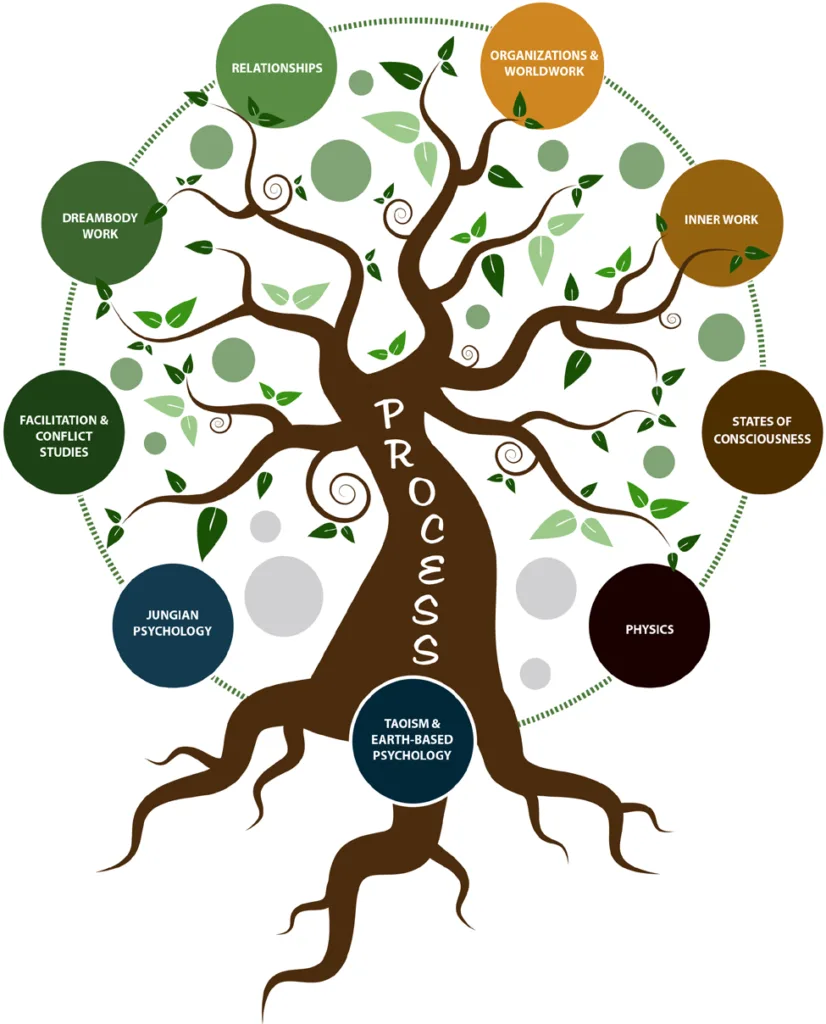
Process Work or Process-oriented psychology, is a depth psychology theory and set of techniques developed by Arnold Mindell, and associated with transpersonal psychology, somatic psychology, and post-Jungian psychology influenced by Taoism, shamanism, and quantum physics. It is also a multicultural, multilevel, awareness practice for individuals, relationships, and organizations in all states of consciousness. Arnold Mindell studied applied physics at the Massachusetts Institute of Technology, and at the ETH Zurich, Switzerland. He was trained as a Jungian analyst at the Jung Institute, finally he had a Ph.D. in psychology from the Union Institute. He developed this theory when he practiced at the Jung Institute in Zurich in the 1970s and 80s.
At first, it was developed with the concept of a “dreambody” that extended dream analysis to include work with people’s body symptoms and bodily experiences. The theory of process work centers around the idea of “process”: a meaningful, connected pattern over time that can be observed and tracked through non-intentional signals (e.g. non-verbal communication, body symptoms, dreams, accidents, conflicts)1. It is claimed that becoming consciously aware of the “dreaming process” may help to deal with disturbances including mental and physical distress, relationship troubles and social issues.
It also is described as an integrative and wholistic approach to understand human behaviors, from the concepts of the accepted and the rejected identities. Moreover, it is known of extending dream analysis to body experiences and for applying psychology to world issues including socioeconomic disparities, diversity issues, social conflict and leadership.
In addition, Mindell and his colleagues also developed the concepts of “deep democracy” and “worldwork” for working to group issues. Worldwork includes theory and practices for working with conflict, leadership, and social issues.
The concept of “deep democracy” refers to a “belief” in the inherent importance of all parts of ourselves and all viewpoints in the world around us. It aims to broaden the idea of democracy to include not only cognitive, rational viewpoints, but also emotional experiences and intuition. “Deep democracy” awareness welcomes inner voices and makes use of diversity and existing tensions to access subjective experience, deeper vision and tangible results of the participants.1 It is a timeless feeling of shared compassion for all living beings. It is a sense of the value and importance of the whole, including and especially our own personal reality. Deeply democratic people value every organ in their bodies as well as their inner feelings, needs, desires, thoughts and dreams.2
Whereas worldwork is a concept about group techniques for developing awareness of social issues like racism, and has been used to deal with post-conflict trauma. It has also been described as the attempt to apply psychotherapy in the sphere of political conflict without privileging the therapeutic over the political. Because it takes on the challenge of supporting all sides of a conflict while dealing with the real politics of inequality.1
From my experiences, I would like to emphasize the three levels of human experiences and perceptions which compose of: Consensus Reality, Dreamland, and Essence.
Consensus Reality is the level of everyday realities, i.e. the facts and figures of people including events, problems, issues, environment connected with the development of individuals, couples, groups, businesses and city, that are measurable and shared-aspects of reality that are ‘real’.
Consensus Reality level work is to notice what is considered real by a given person or group.3
Dreamland, the experiences at this level is dream-like experiences and imagination, e.g. subjective feelings or unspoken truths that we can talk about but cannot prove to someone else. Both Consensus Reality and Dreamland are dualistic.
Dreamland level work is to explore dreams, deep feelings, unspoken truths, unintentional body signals, ghosts or unrepresented figures and ghost roles in the stories and myths of individuals and organizations. History, visions, and transgenerational events are also important.
Essence, at this level it is a subtlest experience that occurs prior to any manifestation in the material world. The deepest experiences we have, are in deep sleep and pre-dreaming, including detachment.3 Deeper non-dualistic tendencies that can be sentiently felt to move us. They look like intangible dreamlike tendencies that are not yet easily expressed in words. At this area of life can sometimes be felt as a subtle atmosphere around people, events and areas of our planet earth. The essence level has nonlocal, quantum-like blurry overlapping states, and cosmological, space-time or gravity like experiences. For example, the Aboriginal Australian concept of the “Dreaming” lies behind and gives birth to the physical world. In Taoism, we find the concept of the “Tao that cannot be said”, which is the mother of all things. Other spiritual traditions might call it “oneness”, the spirit, or the sense of wholeness. This level is nondualistic.
Essence level work is to notice pre-feeling experiences that emerge later as images and ideas. Notice the atmosphere of a group or relationship. Explore field or system ideas in your own and other cultures including the gods, goddesses and spirits people have always believed in.3
About more details in concepts and a lot of process work’s keywords, I think all of the readers can search and learn from Mindell’s books you read, or from the websites: www.iapop.com, www.aamindell.net, www.processwork.edu, and www.deepdemocracyinstitute.org.
Introduction of Buddhism.
Buddhism is an atheistic religion, born from India. It is more than 2500 years old with the Buddha or Prince Siddhartha as the only prophet. There are 3 main components called “Phra Rattana Tri or The Triple Gems” consisting of 1) The Buddha, who is the prophet. 2) The Dhamma or the Buddha’s teachings, which are the main teachings of the Buddha obtained from Prince Siddhartha’s enlightenment. Prince Siddhartha is the Buddha on the full moon night of the 6th lunar month who is believed to help people escape from sufferings. They are called “The Four Noble Truths”, which are written in detail in a scripture called “Tripitaka or Buddhist Scriptures or the three baskets”. They compose of 3 parts of the Buddha’s teachings, namely (a) Vinaya-pitaka or the basket of discipline, (b) Sutta-pitaka or the basket of discourses, and (c) Abhidhamma-pitaka or the basket of sublime, higher, or extra doctrine). And 3) The Sangka or monk. It is part of the 4 Buddhist companies that are responsible for inheriting and spreading the religion. These 4 companies consist of monk, woman monk, layman, and laywoman. For people under 20 years of age, if they are ordained, it is called novice or Samane for men and Samaneri or Sikkhamana for women.
Buddhists have the main goal of reaching Nirvana. They need to escape from all sufferings and the cycle of rebirth of samsara through wisdom and diligence in one’s practice under the principle of “Law of Karma”, which is the law of nature regarding actions and results of actions. There is a consistent relationship between actions and their results, for example, “do good, get good”, and “do bad, get bad”. They believe that there are three main human passions: greed, anger, and delusion. The Lord Buddha gave advice to the followers that, “Whenever you hear or listen to any stories. Don’t accept it yet, and just refused. But listen and consider the reasons, and prove it. When the truth is proved, then you should believe it.”4 So you should study the teachings or Dhamma to understand first. Then put that knowledge into practice until you gain the wisdom to see that it is uncertainty-suffering-non-self. They are the principle of the three characteristics or “The three marks of existence”, which compose of uncertainty, sufferings, and non-self.
The Buddhism believes in the principles of “Itappacayata” or specific conditionality as well. The principle of Itappacayatā is also called “Paticca-samuppada”5 or dependent origination, which is the principle that “all things arise because they depend on each other”. All sufferings also arise because of interrelated factors. It is considered a law of nature, “when this exists, that comes to be”. Itappacayatā is a principle used to explain two meanings: it is used to explain the evolution of the world and life, to show the expansion of natural processes in a progressions and deteriorates according to various factors, and to explain the process of birth and death of life and the suffering for individual.
Buddhism is divided into 3 main sects as follows:
Hinayana Buddhism or Theravada Buddhism. After “Prince Siddhartha” attained enlightenment as Buddha, he had been spreading teachings in India for 45 years. Three months after his death, the Dhamma was first discussed6 with Phra Mahakassapa as the chairman, to collect and categorize the teachings to be the “Tripitaka”. The Hinayana sect has been the original sect of Buddhism since the Buddha was alive, mainly adhere to the Dhamma and Vinaya according to the Tripitaka obtained from the first council. Hinayana sect emphasizes liberation in a short time according to strict conservative guidelines, does not like change. Buddhists aim to train themself to be pure and free from defilements before attaining the Dhamma principles. Then they help others to be free from suffering7, by setting an example and teaching others. This helps less people to liberation. Hinayana Buddhism has been the predominant religion of Sri Lanka and continental Southeast Asia: Cambodia, Laos, Myanmar, and Thailand. It is also found in parts of southwest China, Vietnam, and Bangladesh, as well as in Malaysia and Indonesia.
Mahayana Buddhism. It occurred in the 6th – 7th Buddhist centuries, after the 2nd Dhamma-Vinaya Council, 89 years after the Buddha’s death. This Buddhism sect is influenced by Brahmin-Hinduism, because Buddhism had to compete to survive with Brahmin-Hinduism in India. So Buddhism had to be improved6. Mahayana Buddhism adheres to some of the Buddha’s teachings and dhamma-vinaya, according to the Buddha’s words: “In the future, after the Tathagata (the Buddha) has passed away, what disciplines are not convenient for monks to practice, they can be abstained.” This sect emphasizes to be Bodhisattva for helping others, and emphasizes the role of the layperson more than Hinayana sect. Because laypeople can also practice the virtues of becoming Bodhisattva. Buddhists don’t hold the precepts very strictly, and are not conservative. They can improve and change as appropriate. This sect emphasizes on love and kindness towards others, to create merit in order to lead a lot of people to liberation. Because they believe that they can practice to achieve liberation alone, and can perform services to others at the same time. This sect improves in lifestyles and practices to be consistent with the natural, social environment, and traditions of the countries. Phra Nagarjuna is one of important teachers of this sect. Mahayana Buddhism’s distinctive feature is that it can more easily adapt to the traditional beliefs that vary in each locality. As a result, it has spread from India to many countries in Asia6. It is found mostly in Tibet, Mongolia, Korea, Japan, Taiwan, Hong Kong, Nepal, Mongolia, Vietnam, northern India, and China.
Vajrayana Buddhism or Tantric Buddhism. It first emerged in the east of India around 700-1200 B.E., based on the same philosophy as Mahayana. But they differ in terms of the method or “upaya”, that combined with intuitions and yoga. It is influenced by the Tantra religion of Hinduism8. Vajrayana Buddhism in Tibet was founded by Venerable Padmasambhava around 1400 B.E.
Vajrayana Buddhism branched out from the Mahayana sect, which was mixed with some parts of the Tantra religion of Hinduism. It focuses on prayer, that makes it sometimes called “Montrayana”, which emphasizes amulets, talismans, and various occult qualities. This sect adheres to the principles of “Bodhicitta”, which is the mind that needs to attain Dhamma enlightenment for the benefit of all beings. Those who follow this path are Bodhisattvas and believe that, “All sufferings arise from selfishness. All happinesses come from wishing others to be happy.” Therefore, Bodhisattva has to exchange his own happiness for the sufferings of others. Bodhisattva must possess six virtues: charity, morality, patience, perseverance, concentration, and wisdom. When Bodhisattva practices to the utmost, he will attain full enlightenment and become a Buddha. This Tantra teaching is considered a secret teaching9, for transmission to those who are ready to practice at the higher level. Because if it is broadcasted to inappropriate people, it may also cause misunderstandings. These Vajrayana teachings are intended for those who have a strong foundation of Mahayana, and are able to understand the profound teachings. It is known in Tibet that Milarepa attained enlightenment through the practice of Tantra. Vajrayana practicing can bring us to attain enlightenment in a very short time.
Vajrayana Buddhism is divided into many sects. Each sect has a patriarch or supreme ruler of the clergy of that sect. But all sects hold His Holiness the Dalai Lama as their spiritual head. The various sects in Buddhism all adhere to the same principles, but they differ in the guidelines for liberation.
The heart of the Buddha’s teachings is “The Four Noble Truths”, from Prince Siddhartha’s Enlightenment. The four noble truths are:
1. Dukkha or Suffering or Unsatisfactoriness. It is all physical discomforts such as birth, old age, sickness, death, separation from persons or things you love, or various disappointments that occur according to the laws of nature. Under the law of “The Three Characteristics of Existence” that consists of:
- Uncertainty or Impermanence. This means uncertainty, not constant. Once it arises, it will decay. It is the impermanence of “Khandha 5 or The Five Aggregates”* or five groups of personality, which composes of corporeality, feeling, perception, mental formation, and consciousness. Change is eternal. It is normal. It is natural.
- Suffering. This is physical discomfort and discomfort that exists due to decorated factors, includes the intolerance according to the oppression by the power of nature. We can’t stand if everything in our life does not stable as we hope. Because of the factors that created the condition change. We can’t accept our imperfects. Since we always have lust or desire all the time, so we can’t stand if our hopes do not come true.
- Anatta – Non-self. This is the absence of essence. It is the absence of a self, not a self, not belonging to anyone, not having a true identity of its own. For example, non-existent power, but it can occur because of dependence on a lot of other things. This includes the inability to command to do everything as desired, such as the inability to force life to last forever.
2. Samudaya or the Origin of Sufferings. The major cause is the endless desire or lust. It consists of enjoyment, addiction, and continuously seeking for new pleasures. There are 3 types10:
- Kama-tanha: craving for sensual pleasures; sensual cravings.
- Bhava-tanha: craving for existence. Worldly desire for the state of one’s self; “to be attained”, “to be one or the other”, “want to be”, and “want to stay forever”.
- Vibhava-tanha: craving for non-existence; craving for self-annihilation. Desire in the worldly desire for the separation of oneself from a certain existence that one does not desire, wants to destroy, wants to extinguish.
3. Nirodha or Confinement or the cessation of suffering or Nirvana. The cessation of suffering is the cessation of endless desire from the mind. Therefore, it will truly end suffering. This is the state of nirvana, free from suffering, happy, and not dependent on craving and ignorance. Life will be fulfilled with wisdom, freedom, peaceful, clear, bright, and joyful.
4. Marga or Noble Eightfold Path or the path leading to the cessation of suffering. The method of ending suffering is a practice that leads to nirvana or the cessation of suffering. It is the principle of “Majjhima-patipada” or “The Middle Path” in daily life. This is to make life in balance, without making it too much difficult or too much comfortable. Living moderately with mindfulness as a matter of fact. There are 3 principles of mindfulness training based on the principles of “Three Sikkha” or “The Threefold Training” with 8 important paths of Marga.
The principles for practicing mindfulness or complete awareness in order to reach the cessation of suffering are the “Three Sikkha” or “The Threefold Training”. They are the principles for practicing the action, the speech, the mind, and the wisdom, to access the ultimate goal of Nirvana. They consist of:
- Morality: training in higher morality. It is a training for behaviors both in actions and speech to refrain from harming oneself and others. This includes controlling the mind not to fall into the dark side, and making a sufficient living, to have disciplines and honesty in both physical and verbally.
- Concentration: training in higher mentality. It is a training for the mind to develop virtues such as high concentration. It is a practice of concentration until peace (Samatha), in order to be mindful in perceiving things as a matter of fact (Vipassana). It is a practice of mental development, to cultivate morality and have good mental health.
- Wisdom: training in higher wisdom. It is a training for the wisdom to achieve enlightenment, and to consider nature until knowing that “all things are as they are (Tathata)”. The aim of this training is to awaken from the illusion that deceives the original mind (Thitibutham). It is a wisdom practicing to gain knowledge and understanding of things as they really are. Knowing the causes and factors makes us solve the problems according to logic. Knowing about the world, life, desires, passions, and ignorance support us to purify our minds, to be detachment, extinguish passions, and live with freedom, bright, and joyful mind.
The Nobel Eightfold Paths consist of:
- Samma-ditthi: Right View or Right Understanding (Wisdom). This means that the knowing of “the 4 Noble Truths” or seeing “the Trinity” or “Paticcasamuppada” in things and beings.
- Samma-sankappa: Right Thought (Wisdom). This includes 3 types of wholesome thoughts, which compose of thought of sacrifice, thought of kindness, and thought of compassion.
- Samma-vaca: Right Speech (Morality). These are 4 types of right speech conduct: not telling lies, not speaking sarcastic, not talking nonsense, and not speaking harshly.
- Samma-kammanta: Right Action (Morality). They are 3 types of good conduct in action: refraining from killing living beings, abstaining from stealing, and abstaining from sexual misconduct.
- Samma-ajiva: Right Livelihood (Morality). This means refraining from criminal activities and making the right livelihood.
- Samma-vayama: Right Effort (Concentration). They are 4 efforts or “Sammapadhana 4”: effort to prevent or avoid, effort to overcome, effort to develop, and effort to maintain.
- Samma-sati: Right Mindfulness (Concentration). They are 4 foundations of mindfulness: contemplation of the body, contemplation of feelings, contemplation of mind, and contemplation of mind-objects. Consciousness helps us to be aware of our body and mind changes.
- Samma-samadhi: Right Concentration (Concentration). This is the state of mind that is firm, stillness, calm, not aware of the body and breath. At this point, we will see that our bodies are not ours. Our minds are firmly in meditation, and are neutral minds. This is the original point to consider deeply in uncertainty-suffering-non-self.
For my daily life, I adhere only 2 principles. Because they are the core and the basic principles for normal Buddhist.
- The Three Admonitions or Exhortations of the Buddha which composes of (From the page 115 of citation no. 4):
- Not to do any evil.
- To do good, or to cultivate good.
- To purify the mind.
- The Five Precepts or rules of morality which composes of (From the page 193 of citation no. 4):
- To abstain from killing.
- To abstain from stealing.
- To abstain from sexual misconduct.
- To abstain from false speech.
- To abstain from intoxicants causing heedlessness.
* – “Khandha 5” or “The Five Aggregates”
Methodology.
Since this thesis originated from my own interesting in both Buddhism and process work, so I have to find more information in both theories. I have been interested in Buddhism since I was a child. At that time, there are less books of Buddhism for me to access, whereas nowadays there are too many books about Buddhism. This makes me feel difficult to choose the major books for my thesis. So I decide to refer to the general knowledge of Buddhism for daily life for comparison with process work theory. Because every time I have a problem or obstacle in my life, I can pass through with the law of karma and let it go if I can. Because the most certainty is uncertainty. These are simple Buddha’s teachings for daily life. Excepting these two teachings, I usually use other Buddha’s teachings for take caring my mind, i.e. Yonisomanasikara* – a systematic and analytical thinking in Buddhist style, etc., in many issues of my life.
In Thai Theravada culture women have less chance to access Buddhism (when I was a child), we can be only normal good laywomen who give food to monks every morning, and are ordained as nun. Whereas a boy can become a novice every time he would like, for example my younger brother was ordained as a novice twice when he was a child. My only choice is learning Buddhist Sunday school.
After learning process work with DDI, I use process work along with Buddhist’s systematic and analytical thinking for taking care my mind. Then I find that these two theories have many similar viewpoints. So I would like to compare these two theories from my experiences in practical. That may be useful to others who are interested in both theories like me.
Due to there have been the monks participated in the workshops of process work and deep democracy since the first process work workshop in Thailand, taught by Gill Emslie and organized by Pracha Hutanuwatr. After that there are monks participated in almost every process work workshop. This makes me think that if the monk compares these two theories, it should be interesting. So I choose two people for interview. One is the monk who participated process work workshop two times, Phra Chai Waradhammo, and he is Buddhist and gender teacher for junior secondary school. The other is a Natha Dannonthadharm who translated “Sitting in the Fire” into Thai. He was a monk more than 10 years when he was young, he was also be one of participants of the first workshop of process work in Thailand too.
I interviewed the two interviewees with these questions:
- Why did you enter the monkhood at such a young age? What made you choose to become a monk until now?
- At the first time when you learned process work, why did you learn, and how did you feel about it?
- Could you explain to me which aspects of process work add additional value for you as a person and as a teacher or a coach. This additional value could be in the area of:
- Theoretical concepts.
- Application in daily life.
- Spiritual growth.
- Supporting learning processes or coaching process.
- Anything else suitable for Thai society for instance personal, community, organizations etc.
Then I will compare these two theories from the interview scripts and my own experiences.
So I have 3 steps for doing my thesis:
- Researching from books/e-books, papers, and my direct experiences.
- Interview interesting persons.
- Analysis the information.
In this thesis, there are many specific words that we usually use in process work area. You, my dear readers, who are not familiar to them, you can find the definition of these specific words from https://iapop.com/glossary. For anyone who is interested in more details of Buddhism, you can download the book, Buddhadhamma, in both Thai and English versions from https://www.watnyanaves.net, and can find more details from another websites about Buddhism.
* Yonisomanasikara is a consideration in detail, carefulness, and thoroughness. By looking at all things with consideration, searching for the origin to investigate causes and effects throughout the route. Then separate them out and consider them with wisdom, with systematic analytical thinking, to see that thing or problem according to its condition and relationship of causes and effects or related factors.
Interview with Phra Chai Waradhammo
Interview with Phra Chai Waradhammo on February 2nd, 2024 at Wat Khian Khet, Rangsit District, Pathum Thani Province.
I am a monk and teacher, who teaches both Buddhism and gender for junior high school students and newly ordained monks. I also am a social activist monk that focuses on communicating about gender and social justice.
I began ordaining since the last semester of high vocational education, in my early twenties. Because my older sister dreamed that I had an accident that resulted in death. So I was asked to be ordained to pass through it. I had to take the final exam of my last semester wearing in a yellow robe. After that, I decided to continue my ordination, because I saw that my parents had little opportunity to make merit. During ordination, I studied the Dhamma for 3 levels; bachelor’s, master’s, and doctorate, which is the regulation of the Sangha that every monk must study about Buddhism. But I didn’t study to earn the sermon because I had to study Pali as well. Afterward I studied for a bachelor’s degree Major in Buddhism English section. Then I was assigned to teach newly ordained monks (Phra Navaka), and also to teach junior secondary school students.
During the ordination, I had a chance to travel many places without definite goal, as called wandering. Sometimes I would like to leave the monkhood, but I have some limitations. Because I don’t know what to do for my livelihood, whereas if I still is a monk, I have many activities to do.
In addition, I had a chance to attend many training courses with Semsikkhalai (SEM – Spirit in Education Movement). Then I decided to participate activities with the Sekhiyadhamma group, a group of monks who work to develop connections with society. This made me feel happy with writing articles for newspapers and journals and many activities. After that I published my book, “Peel-Shell-Gender-Buddhism” in 2011, collecting my articles on religion and gender during 2000-2008.
At present, I have hardly any free time at all. Because when the school opens, I have to prepare for teaching junior secondary school students. When the school closed, I have a course for teaching newly ordained monks. I am happy and feels good, because I love teaching.
I learned process work from Gill Emslie 14-15 years ago. At that time Gill was not calm as now, because she was a young woman. I remember that there were a lot of new vocabularies to understand, and I was confused during the course. But I could remember only about power, rank, and three levels of reality. I had to make more understand about process work after the course. But I forgot soon because I started learning Bachelor degree.
Last year (2023) I learned process work again because Natha Dannonthadharm invited me, then I participated with Max and Ellen’s two days course in October. These made me understand process work more. During Gill and Natha’s course, I worked with my unresolved issue, that made me feel better for myself. I learned about group process and hot spot for the first time.
I think that the core value of group process is self-awareness. Because every participant has to be aware of the role they would like to play in the activity, between a role of themself or a role of characters from the major issue. This activity is quite challenging, because it leads all participants to another world. Because the situation in this activity may not be your real world or your daily life. When you come to the other world, it is consistent with some of the Buddha’s teachings, “Everything in your daily life is an illusion”. If every participant understands this, the conversation won’t make him focus too much on his emotion.
So self-awareness will help participants to more understand the Buddhism principle, “Being mindful when going into the heated situation, you will have a choice to make it more intense or calm.” If all participants understand this, the conversation will give them some solutions after getting heated. This is consistent with the principle of democracy that, if you talk with too much emotion, you will lack of awareness. At this point, if the facilitator and participants understand in the same way, the conflict will get a consensus agreement. Because this activity need not to change any believes, but encourage every stakeholder in that issue to speak out and listen together. When the conflict is raised to be negotiate directly, it can reduce the lingering feelings of every stakeholder.
When I teach students, I usually teach them about political and social participation too. Because the teachers in public schools will not teach them. I want the students to understand of politics as well. So that they can compare between the real political situation to their ideal political situations. This can make them connect between their imaginary images with their actual environments.
Because Gill teaches about the realities that we are experiencing, consensus reality or the truth that we can feel with 5 senses (image, sound, smell, taste, and tactile sensation), which is different from essence or ultimate truth. The essence is the truth at the sixth sense level. It teaches to get some messages from the essence level to connect with the truth from 5 senses.
The sixth sense is the matter of mind that is very subtle, which is different from the 5 senses that can sense only the actual realities or objects from physical world. Whereas the sixth sense is deeper than that, but it really exists. This may be a matter of dreams when we sleep. In Buddhism, dreams can be interpreted in 4 ways:
- Coming from an anxious mind.
- Coming from the mind that perceives the future.
- Coming from a message that an angel or spirit from another dimension comes to tell, and,
- Coming from eating food that is incorrectly revealed, will cause the six sense to manifest in dreams.
Process work tells us to interact with the world beyond the five senses, including the sixth sense, which is the world that already exists but we have ignored. Therefore, Gill teaches us to realize about this sensation, so that we can use this sensation to be my ability for doing many things in our lives. For example, resolving our own sufferings, or using the five senses lead us to our inner wisdom or intuition. Intuition is the wisdom that does not come from thinking. And finally we can get this wisdom from the environment around us.
In Buddhism, intuition or Panyayanna is one part of the “Threefold Training” consisting of morality, concentration, and wisdom, which is the main goal that most Buddhists need to access. This wisdom can be accessed through many channels: from listening or Sutamayapanya, from thinking or Cintamayapanna, and from meditation or Bhavanamayapanna.
The wisdom in process work or the essence’s message is wisdom from meditation. Theravada Buddhism considers that Bhavanamayapanna is quite difficult to access. Because we have to practice hard in breathing meditation, or “Anapanasati”, to access this wisdom. We have to practice hard in focusing on inhaling and exhaling, until our minds are calm and still. After that our minds will be free from human passions and clinging thoughts. When the mind is free, the wisdom will emerge.
Because while the mind is free, at this space, there will be no boundaries to obstruct it. This makes the space perceive various things or information, it means that the wisdom can come to your mind. As well as when the monk sits in meditation, he will make his free mind to get some wisdoms to help people solving problems.
So most people consider that it’s difficult to access because they have too many things to do in their lives. For example, when I teach my students to meditate in the room without air-condition, but having a lot of disturbing environment around them. It is difficult for them to be calm or get meditative, so it’s difficult to make them enjoy meditation. But at least they will know how to stop thinking and take care of their minds. Just sit on the chair, close their eyes, and watch their breathing for 2-3 minutes, they will experience peace and be present with themself.
I personally think that the major key of group process is self-awareness. Therefore, before starting this activity the facilitator should tell the rules or how to play this activity very clearly to all participants. This can prevent participants from getting overly emotional, and can live out their emotions without any lingering feelings that arise in the group. I can’t use group process for organizing my teaching because I am still learning process work. At the same time I design my activity, similar to group process, to teach my students. For example:
Let’s the students do activity about “Why do students like to bully about their parents’ names?” by asking them 2 questions:
- What do we think of people who make fun of our parents’ names?
- If we want to communicate with people who make fun of our parents’ names, what do we want to tell them?
Then write the answers on the piece of paper and submit it. Then the answers will be typed and projected on a slide for the whole class. I found that the students enjoyed very much. Because they have already talked directly to the persons who made fun of their parents’ names, and designed how to punish them by themselves.
For example, “I wondered if their parents did not teach them”, “Punish them 2 times, first by warning, and the second by slapping their mouths”, etc.
If you would like to teach process work with group process activity, you should emphasize to all participants to have self-awareness for themselves during the activity first. So that the participants will take care of their emotions, especially their anger. Because this activity is good to every society with conflict, not only Thai society. The strength of group process is to give people more courage to speak out about their issues, and courage to face existing conflicts more.
Therefore, if you want to use this activity to Thai society, you should teach mindfulness as well. Because the heart of process work is self-awareness, so every participant should be aware of their pressing issues that can be raised at any time during group process activity.
For Thai society, Buddhism is still necessary because most of Thai people still believe in Buddhism. But it’s not ok that Thai government brings Buddhism to be their matters, being part of the nation.
Because it will not allow Buddhism to go further and further. This makes Buddhism become part of the state, become a hardened current. This makes people not appreciate religion, because the state destroys the spirituality of Buddhism itself. Sometimes it becomes a harsh religion. So it can’t be absorbed into people’s minds.
Personally, I think that now it can’t almost give any solutions for the new generation. It makes sense that many young people declare themselves to be without religion, and the number of them is increasing. Therefore, if you ask that who fault in this situation, it is the state’s, not the young people. Because if we look back, we will see that this situation is severe in every era. As days go by, this situation is more clearly. But there are few people that can see it, because most of them are not aware that they are dominated.
Since I was a child until now, I have felt that the state takes advantage of religion. But in the latter period it is more clearly than in the past. Both the monks and personnels are also complacent and happy with this situation, so it’s difficult to talk about it.
I choose to take responsible to communicate about gender after I met Ouyporn Khuankaew, Director of IWP – International Women’s Partnership for Peace and Justice, Chiang Mai. She taught me to be aware that gender is a very close matter to everyone. It is a framework that dominates every genders.
In the past, I was dominated, without being aware about how masculinity and femininity are built and shaped in people. When I grew up and learned more, I am aware that every people should understand gender as me. This makes me like teaching about gender and become my mission.
Being a monk and teacher helps me to be heard better than normal people. Because talking gender in public is also a hot spot in Thai society. Because everyone has pressure oneself, everyone wants to speak out but he can’t. This leads to family conflict, and domestic violence within ourselves, including in political issue.
Interview with Natha Dannonthadharm
Interview with Natha Dannonthadharm on 23 February 2024.
Natha Dannonthadharm, occupation is an independent facilitator and also teaches coaching process. I’ve been doing this work for 16 years. I’m interested in psychology, applying coaching to self-development and application to work with society.
I was ordained at the age of 25 and left the monkhood at the age of 40, for a total of 16 years. After being ordained, I spent the Buddhist Lent at a temple in my hometown, Nakhon Si Thammarat for 2 years. After that I moved to Mokkhaplaram Religion Practice Garden, Chaiya District, Surat Thani Province. I stayed there for 4 years to learn about Buddhism according to the guidance of Buddhadasa Bhikku. I stayed for the rainy season at Atammayatarama Garden with Santikaro Bhikku (at that time).
During that time, I had the opportunity to read the work of Acharn Sulak Siwarak and began to get to know social workers in the field of Engaged Buddhism through International Engaged Buddhism (INEB). Later I met Pracha Hutanawatra after reading “Told in the twilight years” (autobiographical book of Buddhadasa Bhukku, collected and written by Phra Pracha) for many years, and met Lek – Preeda Rueangwichathorn who gave me the opportunity to come and learn with many other people working in alternative education.
In addition to learning in Mokkhaplaram Religion Practice Garden, I still had the opportunity to practice in many places. For example, at Suanmettadhamma, Fang District, Chiang Mai Province, I went there with the Buddhadasa Suksa group, and went to study with Phra Paisal Visalo at Wat Pa Mahawan, Kaset Sombun District, Chaiyaphum Province. Finally, I returned to my hometown for several years before leaving the monkhood.
During my ordination as a monk, I had the opportunity to work as an apprentice in the communities of monks and nuns, giving training to villagers. I also worked with the Assembly of the Poor at Pak Mun Dam in the early days. These made me pay more attention to social sufferings.
During the time I came to study participatory training with Pracha, Ouyporn Khuankaew, Director of IWP – International Women’s Partnership for Peace and Justice, Chiang Mai, and George Leki. In the last years before leaving the monkhood, I learned process oriented work from Gill Emslie. At that time Pracha invited many talented facilitators from Findhorn Foundation, Scotland, to teach his Thai community including Gill Emslie.
After studying process-oriented psychology, I was very impressed, because it’s consistent with what I was originally interested in. It is how to organize a participatory learning process. In every training, there are conflicts arise. Whether it is the conflict between the students themselves or between students and teachers. This course gave me new tools to work with. Because in addition to working with conflict, process work also works in depth with the inner self and with the community as well.
In addition, Aunt Jane, Pracha’s ex-wife, gave me the book “Sitting in the Fire” because of my interest in conflict and social processes. I was very impressed because in the first chapter it talks about how to listen to black people. It also talks about how to work on racism, change yourself, etc.
After that I started translating “Sitting in the Fire” into Thai. I like Mindel’s work because he works with how to deal directly with the conflict. His work is used to create a new generation of leaders, who are leaders of marginalized people. Especially group process which is an activity that gives a chance to the voices of marginalized people to come out.
I think this activity will be beneficial to Thai society in the future, because we still don’t have good tools for dealing with or transforming conflict. The translation of this book helped me go deeper into it.
If I have to compare the concepts of Buddhism and process-oriented psychology, I think that Buddhism talks about the teachings of the Buddha, emphasises on the 4 Noble Truths, namely the issue of suffering and the cessation of suffering.
What is suffering? How does suffering happen? And finally, how can we end suffering? The occurrence of this suffering has been explained according to the Itappaccayata law. Both happiness and suffering arise from interdependence and are explained in two ways: the first is an explanation based on the Four Noble Truths, the second is an explanation based on the Itappaccayatā principle, or according to the principles of Paticcasamuppada.
In addition to talking about human happiness and suffering, Buddhism also emphasizes the human identity and how it came to be. The Buddha used the principle of Paticcasamuppada to explain the process of emergence of the “I and Mine”. Clinging with who I am and what is mine, is called in Pali, Panchuppathanakkhan*, to explain that I didn’t exist before.
But I exist because there are interdependent processes that occur together. Therefore, if you want to be free from yourself, you must come and look carefully about clinging with “I am mine”, that it occurs in which steps of the process of Paticcasamuppada, during the path that causes suffering. When we see it consciously, we can extinguish it there. Leave it there.
This process is called the process of Paticcasamuppada, the path to extinguishing suffering. This will make you realize the state of anattā or the feeling that one is not oneself. There is no meaning of identity. Finally, he became aware of the state of tranquility, or the emptiness from clinging with “I and mine”. This is the heart of Buddhism which offers the way to access this. We call this practice to reach independence from the self, “The Eightfold Noble Path”.
Comparison between the concepts of process work and Buddhism.
Processwork describes experiences or truths that we know at three levels:
- The first level is the experience that most people agree that this is true, consensus reality.
- The second level is the experience of dreams, hopes, desires, including emotions, feelings, and roles, we take them both consciously and unconsciously.
- The third level is the essence level, a subtle experience. That is the history of both one and two levels of experience I mentioned above.
Processwork also describes 2 types of process structure:
- The processes of explaining our identities that we know and choose to accept that they are us, are called primary process or primary identities or primary roles. They are our identities that we already know.
- The processes that are beyond our consciousness, are called secondary processes. They are things that we do not know. They are our identities that we don’t yet know.
The essence level of processwork is anattā and suññatā in Buddhism.
The levels of dreamland and consensus reality are what Buddhism calls “The Worldly or Conventional Truth”.
The primary process of processwork is the process of emergence of what is called “self and self’s” or “I and mine” in Buddhism. This can be explained by the principles of Paticcasamuppadā that creates self and ultimately results in suffering.
Both Buddhism and processwork emphasis on developing awareness. Similarly in Buddhism, there is an emphasis on mindfulness training, until able to have complete awareness in daily life.
Practicing mindfulness and meditation with the goal of entering emptiness. For example, processwork also practices inner work in order to have an experience at the essence level, or there is a temporary shift of consciousness to a state of non-dualism as well.
It can be said that both Buddhism and processwork emphasize education that is based on experience or something that we can manifest in life based on our own experiences. Conceptually, both Buddhism and psychology are similar, without contradicting each other.
Practical focus, Buddhism emphasizes the practice of mindfulness and awareness in order to enter the non-self or enter emptiness. When the mind is calm and has reached emptiness at some levels, the external sensing or what is called mundane matters, will disturb us less. More access to the end of suffering, or there is less mental suffering, we can cope with physical sufferings more easily.
Processwork emphasizes practicing to the essence level, by doing a variety of inner work as well. And use the state of reaching the essence experience to make understand or move into other roles or identities, that are your own identities or not your identities.
The heart of processwork is entering the essence state or phase 4 quickly, and can switch roles from primary process (primary identity) to secondary process (secondary identity) as quickly as desired.
The different of these two concepts, Buddhism is interested in working with the emergence of “I and mine” or primary process until one can see the illusion of the primary process and eventually enters emptiness, without division between I and others.
Processwork’s viewpoint is that primary process is OK. However, processwork tries to say that what the primary process knows is not the whole truth. Because there is another side of reality in the realm of the unconscious mind or secondary process, which is an entity that is far from our familiarity. Sometimes those identities can shake us (primary process) to be agitated.
Processwork aims to work with this disturbance or secondary process in order to be more friendly to this disturbance energy. To benefit from the difference of polarities, processwork does not view that the opposite polarities must be eliminated. But we must know what is the essence of opposite side, so that we can grow both in psychologically and spirituality.
Processwork does not deny the practicing of mindfulness and awareness according to Buddhism, but encourages everyone to practice mindfulness and awareness to enter emptiness, and realizes that emptiness is very useful. Because this quality will help us to flow into the others’ minds.
However, processwork tries to warn everyone that the empty state is not the final state we will stop.
The highlight of Buddhism is to practice to reach a state in which you can clearly see that your own identities do not really exist, and let go all attachments to your own selfs in order to enter true emptiness.
The precaution of Buddhism is when Buddhism is in the form of an organized religion, has priests, and calls itself a religion. There is often a tendency to be interested only in matters beyond the world, the ultimate truth which is considered the highest thing above anything else. Buddhism often overlooks worldly matters until separates itself from the poor world, and does not truly understand the political, economic, and social context.
Highlights of processwork is presenting itself as a theory for the combination of psychology, quantum physics and religion, to cope with the conflicts and differences that are the current crisis. There are three levels of experiences in processwork, which are equally important, and depend upon each other. This make processwork can answer the problems of people in the business sector, conflicts in organizations, relationships, including individual’s inner conflicts.
The precaution is when processwork says about the awareness revolution to make people of all sides have good mental health and reach true self-understanding. It is inevitable to be seen as resisting the mainstream power. This is to interpret processwork as a tool for the marginalized, and can make mainstream and conservative people suspicious. For this reason, processwork cannot be a bridge for connecting and integrating various knowledges to create a solution to the crisis that humanity is facing. Because finally processwork may be narrowed down to be just psychotherapy for people who can afford it.
In matters of spiritual growth, I think Buddhism is clear on this matter. Whereas process oriented psychology, I think it is called as the state of seniority, “eldership”, which consists of kindness and compassion.
When we have kindness and compassion in our hearts, we can help others, or play the role of the facilitator when conflicts arise. This state has developed a rank called spiritual rank, which is a rank that has awareness.
For example, Arnold Mindel, the founder of process oriented psychology, he doesn’t skimp on his subjects. But he has a very high contribution to the world. For example, when I asked for the rights to a book to translate and publish, he gave it without charge. But if we make a profit, he will ask for 10%. Even though we don’t make a profit, that’s okay. This is very interesting.
For Max, I see his high spiritual quality. He is patient and kind in answering questions, and grants to the learners from third world. I consider this to be an elder quality. I have not mentioned that many process workers who go to work in dangerous conflict zones around the world.
In other words, people who have eldership quality, are aware of their own primary processes, and are their own person with less ego. For example, “I’m the only one who’s right” or “Only my thoughts are correct” will decrease. In this aspect, it shows that they have the awareness of nonattachment to their own thoughts.
This is the spiritual aspect of process oriented psychology. If a process worker has high self-training, high inner work with himself, and high second training, then he will be very quick to be nonattached to himself. He hardly put himself as the center.
The detachment experience in processwork’s Phase 4 is very similar to living with physical suffering without suffering in Buddhism.
Especially, Mindel said that this is connecting with nature, connects with the mental state of nature which is called process mind. In Buddhism it is called liberation or a state of liberation. Liberation means liberation from attachment or freedom from attachment.
Free yourself from clinging thoughts: “this body is mine”, “this is Me”. Buddhism tells us that this body is not “Mine”, it’s just a natural element. This identity or ego comes later.
In processwork, this is temporarily letting go of the primary process. It means that you can release from yourself temporarily to be the other. Which, if you can do regularly, it would be very good because it would create what is called “flow”.
It means that we can move our consciousness into every phase, that makes you can understand phase 1, phase 2, phase 3, and finally we will become elders.
In terms of individual benefits, being a Buddhist training coach, I have tools to quickly become mindful and peace. When I coach, I have to be concentrated, because I have to take care and embrace my clients. If my mind is calm, I can focus and listen to my clients, and can take care of them. Finally, it helps me to come to myself, helps me to manage my own thoughts during coaching section.
Now I am a layperson, I still practice these things on occasion. I did not practice as intensely as when I was ordained. Because I live my life like a normal person, practice through daily activities such as drawing, playing music, writing poetry, and exercise with Qigong or Tai Chi. Personally, I’m interested in physical sensations. For example, right now I know it’s very hot like something is oppressing me. It looks like when you’re getting angry, which if I can see this before, I will not aware of it.
I would like to add to my recent understanding that, in the past I thought that processwork should be a tool to support marginalized people, especially group process activity. It is a tool to create elders from marginalized people. Let the voiceless speak out more, and encourage people to fight for their dreams. Because the dream can create change and freedom which is in line with democratic ethics. Whether it is fraternity, equality, or freedom. Processwork has the tool called Deep Democracy, that allows every voice to have its own space.
However, these are only some parts of processwork that I understand more. In philosophy, the process worker doesn’t hold back any sides. The group process facilitator does not let the role of the activist interfere him during the process. That is, facilitator has to be in Phase 4, independent from factions, without bias.
Because process worker believes that if the oppression is too cruel, the oppressed will rise up and create change. The role of the oppressor itself is not bad, but it appeared at that moment with some contexts. We do not get rid of the roles. Process workers don’t have to hate the oppressors and the capitalists. These are just roles that appear for some reasons related to the contexts of the system.
Process worker can only reveal these roles, organize the process so that different roles reveal themselves and interact with each other. In deeper, he can support to discover the deep meaning of human beings. This can help people to have more choices, to build a better relationship and create a better society together.
*Panchuppathanakkhan means all sufferings that come from corporealities, feelings, perceptions, mental formations, and consciousnesses.
Results.
The truth is always fresh all the time, and it’s never the same. Life is always changing. Only change is permanent, everything else changes. Only change does not change, that is true.
Osho, from his book ‘Forgiveness’
From the interview scripts:
From the two scripts of interviewing with, Phra Chai Waradhammo and Natha Dannonthadharm, I have many things to agree and disagree with both of them as follow:
At the first time when you learned process work, why did you learn, and how did you feel about it?
At the first time I heard about process work, Natha Dannonthadharm told me about the book, “Process Mind”, written by Arnold Mindell 10 years ago. A few years later I learned process work from Gill Emslie. My first impression was that this was the theory that I would like to learn most, even though I could not do the inner work exercises with body movement during the course.
But I could understand many parts of the concept because I reread my lecture note many times after the course. Since I would like to understand more this theory, many years later I met Max and Ellen in the six days course. At the first day of the course, I still could not do my inner work exercise, until Ellen introduced me how to do. At the last day when Max introduced about DDI’s courses, I decided immediately that I would study with DDI to understand process work deeply. I thought that meeting with Max and Ellen was the matter to confirm that this was the theory that I have to learn.
Because it might be the theory that gives many answers to my questions.
At this point, I agree with Phra Chai that there are many new words in this theory, but it is very interesting. At the same time I agree with Natha in some parts, and disagree in some parts. Because I agree with him that process work is an important tool for working with conflict, but it also a major tool for self awareness too.
I think that if I do not work with myself first, how I can teach or introduce others to resolve their conflicts. As if I have a good tool, but I don’t know how to use it. I agree with him that group process is a good tool to unfold and resolve the group conflict, but at the same time it is also the good tool to practice the process worker in deep democracy. Because if you would like to be a good and effective facilitator for group work, you have to practice more in deep democracy.
After learning with DDI, I found that there are many parts of process work concerning with the concept of Buddhism that I respect. This makes me feel interested to compare these two concepts, especially in concept even though I am not a specialist in Buddhism.
Being a Buddhist, could you explain about which aspects of process work add additional value for you as a person and as a teacher or a coach. This additional value could be in the areas shown below:
About the word “Paticca-samuppada” that Natha talks about, I am not sure that I agree or disagree to him. Because I think that Paticca-samuppada5 talks about the emergence of things dependently. When this thing occurs, that thing occurs too. When this thing goes out, that thing goes out too. Their relationship looks like a chain.
I think the Buddha use this word to explain about the “law of karma” (You will get what you have done.), and the relationship of everything. So when we talk about suffering, we should talk about Paticca-samuppada too. Because it describes about the sufferings and their causes, which are Dukkha and Samudaya in “the Four Noble Truth”.
For example, if you punch someone at the chest, you may have breath difficulty or may be punched at the chest from someone else in the future. This is the result of your action according to the “law of karma”. It seems like the third law of Newton’s laws of motion, action force is reaction force in subjective way.
Theoretical concepts:
For Phra Chai’s comment about the Buddha’s teaching, “Everything in your daily life is an illusion”, I agree with him too much, and I assume that process work thinks too. Because the deepest origin of the consensus reality is the sentient essence. It means that the consensus reality that we touch every day is not real, whereas the real one is the truth at the essence level.
As Natha said that the truths in consensus reality and dreamland levels are worldly or conventional truth, whereas the truth at the essence level is the ultimate truth in Buddhism. I agree with him very much because I think that consensus reality is the truth about actions and behaviors, and dreamland is the truth of states of mind about thoughts, feelings, and core believes.
The truth at the essence level is both the state of mind, Process Mind* or Buddha Mind, and the state of Nirvana or enlightenment as shown in the ultimate truth in Buddhism. It means that we can look through the illusion of the worldly or consensus reality and dreamland truths to the non-self or essence of everything.
The word “dream” in both Buddhism and process work are the same meaning. As Phra Chai says that, one of the meanings of “dream” is coming from the mind that perceives the future. At the same time, in the book “Dreaming While Awake: Techniques for 24-Hour Lucid Dreaming”, Mindell talked many times about this meaning11.
For example, when he talks about the place named “living stone”, or the computer which was out of order. He also says that “Dreams pattern consensus reality,12 which are nonlocal and nontemporal, and can be reflected in your body symptoms and your unintentional body signals”.
About the illusion in Buddhism, I have two ideas. First is about the real thing is not true at consensus reality and dreamland levels, but is true at the essence level as I say before. Second is “uncertainty is certainty”. Because Buddhism teaches us about the Trinity or the three characters of all things and beings composed of uncertainty, suffering, and non-self. This means that everything or every being is non-self and uncertainty, including our thoughts and feelings.
Additional to Phra Chai’s comment about intuition in Buddhism, I think the “tendency” in process work is similar. Both intuition and tendency need empty mind to sense, and need intense meditation practicing to access.
Likewise, Mindell describes intuition and tendency in his book, ProcessMind13. He said that “your insights, creative ideas, and spontaneity arise from the field” that he called “processmind”. Processmind is a “forced field” or space between the parts of ourselves, and between us human beings and everything else with which we connect. It is invisible but you can only feel and notice how it moves things around you.
It is the quantum aspect of our awareness notice the tiniest, easily overlooked “nano” tendencies and self-reflects upon these subliminal experiences.
Moreover, he also said that “Dreaming tendency is a kind of nonverbal knowing, a soft of feeling or sense that was there before the images or actions, a feeling that expresses itself in terms of the psychological parts and their relationship to one another14”.
Additionally, Fukushima Roshi said15, “Empty mind is creative mind because if you are totally empty, anything can pop out of you”. I think that if the state of mind when you meditate is an empty mind, that can sense anything pop up in your mind as in the essence level.
Application in daily life:
I agree with Phra Chai that group process is a good tool for conflict resolution in every community. But in Thai society, in some communities we can use this activity directly, whereas in some communities we can’t, depending on the communities’ cultures. I also agree with him that the core values of group process activity, process work, and16 Buddhism are the same, “Self Awareness”.
Furthermore, I love to do process work’s inner work exercise when I have some body symptoms. This helps me to get better soon. At any time when I feel annoyed or angry to someone else, I like to find my x-energy in that person urgently. My x-energy is the reason why I get annoyed or angry to that person, and helps me to understand her/him too.
I love to do the inner work exercise very much because it is a good easy exercise to meditate to access the essence of the body symptom or my inner wisdom. It is also a good tool to study about the mechanism of the three levels of truth.
– Spiritual growth.
I agree with Natha that Buddhism is very clear in supporting spiritual growth, and I think process work is too. Because when anyone else practices oneself to be aware of her/his U and X energies in daily life, it is as difficult as Buddhist practices her/himself to be aware of “I and mine”. The difficulty is not “how to access the X energy”, but is “how to accept that it is your own X energy”, as to accept ego or “I and mine” in yourself.
– Supporting learning processes or your career.
I agree with Natha that both Buddhism and process work can support us during working. Since I am a freelance facilitator, so Buddhism’s meditation helps me to be present. Whereas process work teaches me to trust in the flow, trust in the community that I am with at every moment. Before learning process work, every time I work, I have to prepare myself very hard. But after learning process work, I prepare myself only the theme concept of the workshop I will facilitate. Because the group and the participants will lead me to the theme purpose of the workshop, not only me. I love this very much.
– Anything else suitable for Thai society for instance personal, community, organizations, etc.:
I agree with both of them that Buddhism is still necessary to Thai society. I agree with Phra Chai that Thai government brings Buddhism to be their matters, being part of the nation. Because if the government is aware that many ways of respecting Buddhism of Thai people are not Buddhism’s ways, it should forbid them. For example, many temples build the big Buddha statues and others (e.g., Guan Yin or Ganesha statues) in their temples, for calling people to go there.
From my own viewpoint, Buddhism is still suitable to Thai society because Thai people are kind, and love to help and give the others. In theoretical, Mahayana Buddhism may be more suitable to Thai society than Theravada Buddhism. Because most of Thai people need to have emotional supporters such as Bodhisattva in Mahayana, whereas Theravada emphasizes on concepts of the Buddha’s teachings.
Most of Thai people are not interested in any concepts or philosophies, but they love to do the same things with the others. Moreover, they are not interested in learning deeply in Dhamma, whereas they are interested in making merit and worship, and asking for blessings from all sacred things including the Buddha statues. A few years ago, they are interested in practicing mindfulness, because many famous superstars are interested.
At the same time some cultures of Mahayana are included into Thai Theravada Buddhism through half Chinese culture in Thailand. For example, respecting ancestors and land lords in Chinese New Year festival, or eating vegetarian after the end of Buddhist Lent, etc.
When I was young, I was taught that if I would like to practice Dhamma, I have to leave my family to stay at the temple. When I grew up, I found that every temple does not emphasize on teaching Dhamma practicing. Even though there are many communities of Dhamma practicing in many temples, but they are not peace places. They usually are chaos communities as in organization.
So I decided that if I would like to practice Dhamma, I can practice everywhere, not only in the temple. The important factor for practicing Dhamma does not depend on the temples, the places, or the teachers, but depends on your intention.
From my own experiences, I learned sitting meditation from many teachers from the workshops I attended, and studied many ways for meditation. Now I choose to meditate in two ways, by sitting meditation and drawing and coloring mandala. When my mind is comfortable, I do sit meditation, but when my mind is confused, I prefer to use drawing and coloring mandala to meditate. If you would like to meditate, you should choose the ways you like to meditate. This can help you to be calm and focused.
From my own viewpoint, I think that Thai Theravada culture is not pure Theravada culture, it is multicultural. But it is Theravada culture that is very suitable for Thai society.
“Spiritual growth is only a temporary state. It is a situation that tests our strength in facing and bearing sufferings and pain in my heart. So that we may find ourselves conquering this sorrow of our hearts. At that time we still be happy, calm, and peace.
Chaiyos Jiraprerpkpinyо – Thai Facilitator for enneagram, Satir, and NVC, coach, psychiatrist.”
To Natha’s viewpoints.
I also have many issues to agree and disagree to Natha, as follow:
– From Natha’s thought: “When Buddhism takes a form of religion, will value to the ultimate Dhamma and overlook the worldly Dhamma, i.e., politic, economic, and social, etc.”
I don’t agree with him in this issue. Because there are a few monks teach the ultimate Dhamma in public. And when there are some monks share their ideas about politic, they will be monitored from the public and government. It is difficult for Thai monks to talk about their politic ideas.
I also think that half of Thai monks have been ordained since childhood, that is too young to understand the truth of the life. They have to learn about the Dhamma, not to learn for the possibilities of the world. They usually learn the reality of life from the treatise, not from the real situation. So they can’t understand life as deeply as general people. There are some monks who have a chance to learn in university, so they can learn more in worldly situations. Moreover, most of the monks’ teachings are about “to do good”, “not do bad”, “don’t cause yourself and others trouble”, “make your heart clear and full of kindness”, and “reduce attachment to I and mine”. Especially the monks in upcountry, they are usually not interested in both the Dhamma and the world. I assume that the monk realizes that he also does not access the ultimate truth, so he takes a role of inheritor of the religion in Thai society, not the Arahant. If there are some of Thai Buddhists interested in Buddhism more deeply, they will study from the monks who are specialists in specific ways, for example, specialist in Dhamma practicing.
– From Natha’s thought: “Mainstream and conservative people feel skeptical in roles of process work between the bridge connecting various sciences together in an integrated way and psychotherapy”.
I don’t agree with him. Since process work is an applied science that integrates various sciences together: quantum physics, Tao, Jungian psychology, and shamanism, that cannot be measured with scientific instruments or measurements. It’s easy to make the mainstream and conservative people not understand. Being a complex science, process work, makes people feel difficult to understand. It is not strange that people think that process work is one method of psychotherapies.
– I agree with him that if process workers understand the role of “the oppressors”, they will not hate the capitalists. Because if the process workers access the four phases of the conflict situation, they should understand both the roles of capitalists and oppressors and their thoughts and feelings. So they can understand why the capitalists did to the oppressed like that, and why they chose this method in this situation. At the same time, in Buddhism, we can use the principle of “Itappaccayata or Paticcasamuppada”, law of causation, to make understand of this situation.
– From Natha’s thought: “From Mindell’s finding the disturbance, it looks like finding the cause of suffering.”
I agree with him because at any time when it is found, my body symptoms will be better. This is similar to the Buddha’s teaching that, “the body and mind are related17”. All body symptoms are caused by the mind, from the state of mind that is angry, distracted, or what is called the evil mind. Therefore, if we practice to let our minds dwell only in merit, or honestly accept that there are evil feelings in our minds, without suppressing them. Various body symptoms that arise from these minds are likely to decrease as well.
– I agree with Natha that the state of “Process Mind” is the same as “Liberation” in Buddhism. I think it is the same state of phase 4, lucidity, awakened mind. Because they are states of mind without any human passions and understand the world as the “Trinity” law. It is the state of liberation from attachment, and from “I and Mine”. So there is nonduality at this state, likes the state of empty mind. But I disagree with him that it is a temporary detachment from our primary process. I agree that this is a secondary process. But I think that understanding both primary and secondary processes or your U & X energies, is very important. Because they are both of your. When you understand all sides of you, you can understand yourself in the new way. So this new way brings you to your new primary process, that is different from your previous primary process, significantly. As Mindell says in his book18 that “you can’t turn back” and “you will make your life easier”.
– About phase 3 in conflict, role-switching, I think this helps us to understand the others’ dreamlands, but does not help us to access the essences of the others. In my limited understanding, dreamland helps us to access the essences, if we do more inner work. Many times, conflict resolution helps the two sides to understand each other without accessing their essences. Because they are usually different in their dreamland (i.e., methodology, core belief, etc.), but same in their essence. I think in phase 3 it is important to be aware about the X-energies of both sides in conflict, especially your own X-energy. I also think that when you are in phase 4 of conflict, you can understand the essence of the conflict. For example, my younger brother and I usually have different believes, so we usually have a little conflict. Even though we focus on the same thing. Thus, when I switch role to my brother, I can understand him. At this point I can understand all of the conflicts we have. Nevertheless we usually forget the phase 4 because we still focus in phase 2 of our conflicts. So you don’t need to switch roles or take one side, because you understand all sides of the conflict, except you need to explore some roles in the conflict. From my own experiences of observing both sides of conflict, they don’t fight for their goals, but they fight for their standpoints or egos, and deny to sense the other’s viewpoint. Especially in Thai society, most of group process’s participants need only to voice out to someone else. This means that they avoid or escape to face phase 3 of conflict, role-switching. Because some of them feel devalued, when they don’t have their own standpoints.
– When Natha talks about “flow”, I think about “not doing” in process work and “be present” in Buddhism. Because when you are present, you will not think of the past, and be worried about the future. When you are present, everything around you will support you, as does the “not-doing” state in process work. Moreover, Buddhism said that “be present” is the state that we talk and do anything else with consciousness, without adhering to the past or the future. If we practice meditation or mindfulness, it is easy for us to be present. At the same time, process work tells that being present make us sense ourselves very clearly and deeply. For example, we can touch our body feelings in every moment. If we are confused, we can’t touch them anymore. Touching with our thoughts and feelings in each moment, is our self-reflection towards everything that affects us in each moment.
From my own ideas and experiences.
As I said in the first part of my thesis, I am interested in both process work and Buddhism. Not only because I am Buddhist, but also I think that Buddhism gives choice for the followers to follow or not after becoming familiar with. I am Theravada Buddhist. I love to be this because I think that Theravada Buddhism has no exact regulations to follow, and it looks like a concept. So this can be its weak point and at the same time, because every follower can respect it in her/his way, its strong point. Especially in Thai culture that has too variety to identify its characteristic exactly.
Why am I still Theravada Buddhist? Although when I have any troubles in my life, I usually think that the major cause is only Karma, not myself. But I still have questions to it. I have respected this sect since I was a child with my family. But when I was in teenage, I decided to respect this religion with its core, “do good things, not do bad things, and purify your mind”. Because I found chaos in people who went to the temple. So the sect is not important for me, especially Mahayana sect. Because this sect has too much rituals for the followers, that I can see from the Chinese rituals in half Chinese communities. This makes some followers, who can’t do all of these rituals, feel guilty. At the same time, if the followers pay attention to the rituals more than the core of the religion, how important is the religion?
Whereas I have less relationship to Vajrayana sect. I participated with the online meditation a few years ago, but I could not meditate. Because the leader introduced to meditate with the hated things, that made me feel distracted and confused. Because I am familiar with the meditation that makes my mind calm and peaceful. I usually meditate with sitting meditation. At any time that I feel confused during meditation, I usually stop sitting meditating. Because I am sure that my mind is too confused to meditate. Later I use drawing and coloring the mandala for meditation when I feel confused. Because I can focus only on drawing and coloring the mandala without thinking and expectation, this can make me feel calm. But I still meditate with sitting meditation when my mind is normal.
At this point, from the book, Working on Yourself Alone19, it says that I’m on the edge that makes me cannot meditate at the same channel. From my experiences, my big edge is over thinking. Because when I have any problems in my life, I usually think too much about this problem, even though it is not big any more. So if I continue sitting meditation, my mind will be full of many thoughts about the issue I worried and the other issues in my daily life at that time.
So I have to change the channel from proprioception to visualization for meditation, because my aim of meditation is to be calm and still. Mindell said that it means that at this situation I can increase my awareness of unused channels. He also said that the distraction during meditation is the ego that explore as the secondary process you can observe. I assume that when I change my meditation channel from sitting to drawing and coloring, my focusing changes. So this distraction is disturbed too.
Because when I am sitting meditation, my mind is still, so the distraction can explore easily. Whereas when I draw and color the mandala, my focus is at the mandala, so there is less space for the distraction to disturb. For sitting meditation, the teacher usually says that when some thoughts occur, I can do only follow them. But when my mind is not firm, there are too many thoughts occur during sitting meditation. They disturb my meditation because I hope meditation to help me to be calm, not nervous.
Since there are too many issues of process work that I can compare to Buddhism, I will choose only the issues that I have had my own experiences with to compare in this thesis.
From Phra Chai’s words, “in Theravada, every practicing is difficult”, I assume that this sect emphasizes on monks more than woman monks, laymen, and laywomen to practice to access Nirvana. But there are two books that changed my mind from this viewpoint. They are “Jonathan Livingston Seagull” written by Richard Bach, and “Siddhartha” written by Hermann Hesse. They tell me, that practicing seriously and regularly until getting to the core of what you practice, is the same state as you access the essence level of things.
I also assume that this is the same as the state of Buddhism’s Nirvana. Especially, Thai society defining that the king is representative of god, so accessing to the highest goal of Buddhism should be for only the king and the others with high social rank, not for general people. So I change my mind that “everyone can access Nirvana if she/he practices her/himself to attain that state of mind”.
From the book “Dreaming While Awake”, Mindell told that Lewis, an Aboriginal elder, could see the essence of Victory Square during he was talking with Mindells. I think Lewis’s state is the same state as Buddha’s and his Arahants when they lived after enlightenment. Because at that time the Buddha lived a humble life with people after enlightenment, and the Arahants did after achieved the Buddha’s teachings. Meanwhile they did not lose their ability to access their inner wisdom or intuition, as well as Lewis.
At this state, Aboriginal Australians call it “the presence state20”, depending on the processmind field of individuals and communities. Because they believe that everybody can feel the presence Dreaming (or the sentient essence), at which space and time and today’s consensus reality are also accepted by those people. There is also a consensus about the reality of Dreamtime. They also believe that there is a portion of every person that exists eternally, that was there before the person was born and continues after life ends.
From the book, The Leader’s 2nd Training. For Your Life And Our World, Mindell said, “being grounded means being in touch with the universe, with its emptiness, with its open and empty mind21”. Then our individual experience of the essence is a momentary experience of the field effect around us, where the essence looks like space. So it is your experience of space within you, as well as between and around us.
When you are in phase 422 the word that “you cannot turn back” means, that after you can role-switching in phase 3, that you can see your X-energies clearly. So in phase 4, you can see all of your parts that composes of both your U and X energies, that changes your viewpoint from the previous.
Even though the state of enlightenment and detachment is temporary, but I think that the state of mind after this state is more sustainable, as in phase 4.
About the “Law of Karma”, we usually think that “what we receive today is the results of what we did in the past23”. Moreover, in Buddhism, we can use “Yonisomanasikara” to consider the others’ actions, including our actions in the past. But in process work, what we receive from others, we have to consider the cause of their actions, especially their dreamland and X energies.
Mindell also said that “A chronic symptom that you cannot get rid of might be a gift, a kind of light to awaken you and detach you from your normal geocentric consensus reality self24”. Whereas Buddhism believes that, chronic illness is the result of past life actions. So we have to do too much good to heal it in this life. If you look at the surface, you may think that these statements are incongruent. But I think that they are congruent. Because process work believes that chronic symptom is a gift for us to be awaken, whereas Buddhism believes that chronic illness is a tool for us to do good things to redeem the bad things in the past. The good things that we can do for the past experiences are both apologizing and forgiving to the others and to ourselves for our past relationships.
From the words, “if you belong to a religion, that belief system is important to you25”, it’s very true for me. I am Buddhist because I don’t believe in gods, but I believe in the truth of nature, the four noble truths, and law of karma. I also believe that accessing to gods in many religions, is the same situation of accessing the Nirvana in Buddhism. I don’t believe in every word of the Buddhism’s teaching, especially in Thai Theravada culture. But I usually consider in every Buddhism’s teaching that I learn before I believe, including process work’s concepts. This is one important part of the Buddha’s teachings, “Kalamasutta”, the advice on how to investigate a doctrine or to deal with doubtful matters. In some cases that I believe the teaching suddenly, because this teaching is the same as my experience and observation. Theravada’s belief has also influenced to me in terms of “I have to be strong before helping the others”.
About the channels, in Buddhism there are six channels which composes of visual, auditory, smelling, tasting, body touching, and sensing. Whereas the channels in process work composes of visual, auditory, body movement, body feeling (proprioception), relationship, and world. About relationship and world channels, in Buddhism we have to use the deep contemplating method called “Yonisomanasikara”, to learn about these two channels. Because they are too complicated to be seen immediately. I also think that Buddhism’s channels are channels that have impact to your mind or your feelings immediately. Whereas process work’s channels are channels to perceive information to your psychological state of mind. That sometime needs time to become aware of, especially relationship and world channels because they are complicated channels.
Ego, both process work and Buddhism pay attention to ego, but in different way. If U energies in process work are ego, this means that this ego is not all of us. Because there are other parts of ego that we deny, X energies, that we usually project to the others. The projection of the denied ego is part of Buddhism as well. But Buddhism thinks that ego is the big barrier to access to Nirvana, so we have to get rid of. Whereas in process work we use both U and X energies to do our inner works, and as a tool for inspiring our minds. I have an idea that, if we look at the ego as the uncertain thing in our life, as it is, we will not adhere to it any more. In other words, if we use the ego as the tool to make good things in our life, it means that ego can support us to access to Nirvana without getting rid of, is it right?
For primary and secondary process, Buddhism believes that “I and mine” is illusion, just only arise-exist-pass away for a while. While process work believes that U and X energies, or “I and mine” in Buddhism, is not only mine. But they are the identities for all of us, it depends on you that you can accept or not. Whatever you accept to be yours, are primary process, whereas whatever you don’t accept are secondary process. Whenever you try to take the role of your secondary process through the shape-shifting process, at the end you may change this secondary process to be your new primary process. That helps you to feel oneness with the others. This means that the primary process or “I and mine” in process work is temporary, can be change all the time. This process occurs in dreaming state, so it is an illusion as well. The more you see that other self it is your own self, the less of “I and mine” in you can occur. Because these selves are not only yours, but they belong to all of us. So the adhering in “I and mine” will be decreased.
Every time when I have the problem in my life, I usually use “Yonisomanasikara” to solve and remind myself. I start from: 1) Remind what happens in this situation, the suffering. 2) Investigate about the factors, the stakeholders, and what is my role in this situation, the cause of the suffering. 3) If I need to leave from this situation, what should I do? What I feel if I do like that, it is my real need? And what is the impact to me if I do like that? At step 2, I usually use imagination to be the other roles in this situation, to understand why they do like this, i.e., what they feel, what they need, or what they expect, etc. At this point, I can see why I and the others feel unsatisfied with this problem, and finally I can see the options for resolution. Before getting to the optimal goal, we often feel pain which depends on how we value each situation. This is how I use “Yonisomanasikara” on the basic of “Ittappaccayata” or “Paticcasamuppada” in my daily life. Because when this exists, that comes to be. All things depend on each other, causal factors cannot occur alone. So “Ittappaccayata” is an important tool for considering the suffering, Dukkha, the causes of the suffering, Samudaya, and extinguishing the suffering, Nirodha.
From this experience, I assume that I have always used the principle of process work in my daily life unconsciously, especially role-switching in terms of “Yonisomanasikara”. After learning process work, when I feel unsatisfied to anyone else, I love to do the inner work to find out my X-energy in that person. This helps me to let go this story easily, and accept this X-energy in myself. The difficulty to let it go, depends on “how deep is this X-energy in myself” or “how big is my edge to this X-energy”.
Detachment or letting it go, Theravada Buddhism usually says that we have to let go the unsatisfying stories, so that they can’t hurt us anymore. But in reality, it is difficult to let them go. Because if I can’t understand the story clearly, I can’t let it go easily. So learning process work is a good tool for me to help me to let it go. Both inner work and role switching help me to understand the story or the person who makes me feel unsatisfied. I think there is another important factor for let it go, it is how I value it. If it is the story that I don’t value, it’s easy to let it go. Whereas if it is the story that I give high value, it’s difficult to let it go, even though I can understand it very clearly.
Process work talks about detachment in phase 4 of conflict. At this phase, when we understand the whole conflict situation deeply, we can solve it. I think this looks like the state of “detachment or let it go” in Buddhism. That means the detachment from “I and mine”, all human passions, and going to the empty state of mind. If we can really let them go, everything in our life will be more easily.
I think these two concepts talk about “oneness” in different way, but same meaning. Process work talks about oneness in terms of “U and X energies”. Both yours and not-yours are you. Finally you are the same as the others. Whereas Buddhism talks in terms of “non-self”. Because when you are aware that you are non-self, this means that you are the same as all thing and all beings.
For the signals, I think any signals that come into our perceptions, need to tell some messages to us, if we don’t decorate the signal, but receive it as the information. It’s easy to get the message from the signal, especially that signal relates to your recent situation in your daily life. For example, one day when I drove through the garage, I remembered that I had to changing car engine oil a few months ago. But I forgot it. So I turned my car into the garage to change my car engine oil immediately.
The other concept that I relate to the word, “signal”, is “flirting”. I have the experience of “flirting” with the mango. One day I saw the bright ripen mango in my refrigerator, what it wanted me to do with? I remembered that I found it under the mango tree without a bruise, that was different from the normal mango after falling from the tree. It was still beautiful. In Buddhism belief, I should give the best food to the monk. When it flirted with me again, I remembered that I should give it to the monk for breakfast that morning. Because my dead mother liked to eat this kind of mango very much. We, Buddhists, believe that giving food to the monk, can forward food to our dead loved persons.
Dreambody, in Buddhism body symptom is divided into 4 types based on the cause: 1) karma from the past life, 2) state of mind, 3) season, and 4) food. Whereas Mindell said that, body symptom is the form of experiencing a disturbance to the real body, in term of dreambody.
During my learning at the certified level, the issue of body symptom was the most important issue for me. Because the most frequent issue for the coaching sessions was about my chronic body symptom, my asthma. I found that the asthma that I have had almost throughout my whole life, is connected to my relationship with my mother. Every time when my mother felt uncomfortable, my asthma symptom arose.
When we talk about altered state, we usually think about the time that we do something unconsciously. In other words, I think that altered state is the same state as trance state as Mindell said in his book, Dreaming While Awake, at the same state when we meditate. That is also a secondary experience.
I have experiences about altered states when I do my housework. Once when I chopped the vegetable for cook and watched TV at the same time. A few minutes later, I found that I could not listen to any voices, including the voice from TV, whereas my hands were still chopping the vegetable. At that moment, I felt light, comfortable, calm, stillness, and peaceful, without any emotions. When I was aware of what happened to me, I found that I was in movement meditation. I think that this is an altered state of me, chopping vegetable, and also a secondary experience and trance state as well.
I think that both process work and Buddhism pay attention to mindfulness or consciousness in daily life at the same meaning. Because both of them believe that when you are conscious, you can see both the consensus and non-consensus reality. For example, in Buddhism, we may say that everything that we see is illusion. Because we can see the arising-existence-passing away of that thing. We can see our human passions arise before we do something for ourselves, as the fast cat catches flirt26.
About meditation, in process work’s inner work, we use movement meditation as a doorway to dreamland, to access the essence of that movement. At the same time, in Buddhism, meditation is an important tool to access Nirvana. We usually have 2 major goals for meditation: Samatha-for focusing, and Vipassana-for enlightenment. So I think these two concepts have same viewpoint about meditation. Because Vipassana can bring us to the essence level of things. From my viewpoint, I think that when we achieve to meditate in a trance state, our minds will be near to the empty state. Then our energy fields will open to receive any information as the particle coming to our energy fields, which are our intuition.
Nevertheless I would like to share my thoughts about the three levels of realities in process work and the threefold training in Buddhism, morality-concentration-wisdom. Because morality is the basic principle for taking care of human behaviors, that occurs in everyday life or consensus reality. Whereas concentration is a state of mind to focus on something else, that is in dreamland. Finally, wisdom can occur when our minds are in empty state. At this state, we can see the arising-existence-passing away and non-self of things, that leading to the wisdom or information in the essence level.
Because I am Buddhist, I have heard about meditation since I was a child. At that time, it was difficult to meet the monks who teach meditation. Theravada’s teachings made me think that, if I practice meditation intensively, I can’t live at home or work with competition. I should be in isolation, otherwise I might have the conflict with my daily life. So before I went to university, I stopped finding a meditation teacher, and practiced meditation for making my mind be calm in daily life.
I get familiar with only walking meditation, so when I have to do my inner work exercise with hand movement, I don’t understand how hand or body movement bring me to the essence of the movement. Because my purpose of walking meditation is for focusing and making my mind be calm. After learning process work, if I would like practicing being in touch with the non-consensus reality, practicing meditation is needed. When I practice meditation more frequently, I find that I am more aware and calm.
From my viewpoint, I think both process work and Buddhism value to direct experience of the learners for their inner works. For meditation practicing Buddhism, you need the mentor for meditation check, as well as you need your coach to guide for doing your inner work in process work, to examine what happens during your learning. Even though I learn process work for many years, but many times I need my coach to guide me when I do my inner work. Because it’s a complicated issue in my life, and my coach’s experiences help me to get the essence easier.
About enlightenment, in general Buddhist usually think about an eternal, divided place, without rebirth. In other words, this may be only the state of mind for self awareness. If we think like this, it means that all of us can access this state, depending on our state of mind. On the other side, if we think about the eternal place that is far away to access, this can make us feel hopeless to access.
Since I think enlightenment is the state to get to my inner wisdom or experience the essence state of things. So I love to do my inner work too much. Because inner work is an easy way to access the essence of things by myself with hand movement, including the earth spot exercise. The earth spot exercise is the exercise that empowers me when I feel exhausted.
From these two concepts, I think they have the same meaning of enlightenment. That is the way to make the truth of the world and the uncertainty of things understandable. Because at the nonduality of the essence level in process work is the same state as the non-self state in Buddhism, that we and things are unseparated oneness.
Both process work and Buddhism have the same viewpoint to non-self state. This means that our lives are temporary. They change all the time, especially the roles, the relationships, and so on. For example, the relationship between one of my friends, M and me. M was a government officer who supported GMOs, Genetically Modified Organisms, whereas I was the activist who worked against GMOs. At the seminars about GMOs, we were on the opposite sides, but we are still friends at the reunion meeting.
My own experiences during writing this thesis.
First of all, I would like to recall my experiences after I started learning with DDI, there are many things changing within me. In general, I can plan my daily schedule, and follow it exactly. But after learning, I can’t follow my daily schedule. I can only approximately plan what I’d like to do in each day without expectation. Because there will be unpredictable things interrupting my daily schedule almost every day. At the same time, there will be free time in each day to do what I’d like to do without expectation. This seems like “go with the flow”, or “be present” in Buddhism, indeed. Because the planning or expectation make me not to be present. When I ignore my thoughts or planning, I can really be present, and the intuition will support me to do many things in my daily life as “go with the flow”. Whenever I resist to the flash-like or flickering signals to do what I’d like to do, there will be an interruption. That is different from when I follow the flickering signals, because I can do everything smooth in short time. This makes me having more free time in that day.
Every time I have a coaching session, I feel very excited when I get some important messages from my inner work exercises. This makes me feel happy, excited, and aware that my inner wisdom or intuition and my body are very important. Because I have never known that my body can keep all of my thoughts and feelings and explore in terms of body symptoms. Moreover, the earth spot exercise makes me aware that my inner wisdom is not too far as the religion tells me. But it is in myself. It needs me to practice to perceive the incoming signals from every channel, to access my inner wisdom by myself. These channels are channels in both process work (auditory, visual, body movement, body feeling, relationship, and world) and Buddhism (visual, auditory, smelling, tasting, body touching, and sensing) concepts.
During writing this thesis, I found that some of my behaviors change. For example, in general when I do something seriously, i.e., writing the report, I will do it without taking a break. But this period of time, I have to take many breaks throughout the process. If I insist not to take a break, I have to take a nap all day, and can’t read any books about the thesis. When I follow my body signals to take a break, I will take a break for short time and I will get some ideas after taking a break.
Moreover, I feel like I’m practicing the Dhamma. I feel more calm and stillness than normal. For example, when I found one of my friends oppressing someone else who gave some service to her. Usually I feel angry to my friend for a few hours. But at this situation, I felt neutral to my friend’s behavior. Because I thought that this is her own behavior, I have not to worry about her behavior. I am only the witness of her behavior.
I find also a change in my body feelings. I have had stomach problems, if I don’t have meal in time. But I can have meal late for 30-60 minutes. But during this time, when I feel a little hungry, I have to get meal within 5-10 minutes, especially for breakfast. Otherwise I will have my headache, and my blood pressure will increase later. Finally, I have to take a nap for a few hours. For the meal, if there are too much monosodium glutamate (MSG) in food, I will get allergy immediately.
My body feelings are more sensitive than normal that I can’t ignore them when they tell something to me. In one aspect, this is good for me to be more aware to my body sensations. But in another aspect, this may be problematic for me if I am not at home. So I have to observe my body sensation further, to adjust my new life with my sensitive body.
Another issue is about my relationship to B (pseudonym), one of my friends, I usually have good relationship to B. But during these days, when I ask B to do something for me. He does it for me as normal, but I feel that he has something against me. This makes me have a headache and feeling uncomfortable to take a nap during day time many days. When I do shape-shifting to be him, I find that he feels envious of me. Many times when I find someone feels envious of me, I can’t understand him even though I understand why he feels envious of me. In process work, this means that I have an edge about the envy. I assume that my edge is, “I think that envy is bad thing”. If I feel envious, I will feel unhappy and uncomfortable. So I try not to feel envious of anyone else, and I usually forgive to everyone who feels envious of me. Because indeed I am afraid of “law of karma”. I don’t want to do bad things, because I don’t want to receive bad things back. About the envy, I assume that my character should be the X-energy of someone who feels envious of me. This X-energy is the identity that he would like to be, but he can’t. So when he sees this energy in me, he feels envious of me.
*Processmind: Processmind is a subtle intelligence that we all can sense in the essence level of truth or the wisdom of the field around us. Processmind is the deepest part of ourselves, associated with a part of our body and the power of an earth location, which knows how and when to move us to a particular direction. It is an invisible force field that moves and organizes our bodies and dream images in meaningful ways. It is the space around and between everything. It often brings insights and approaches to life problems that you may not have been able to imagine from your ordinary state of consciousness. It is everywhere, so you cannot be alone in this universe. Processmind is a nonlocal “oneness” experience and appears in dreams and reality as the diversity of things catching our attention interest. In phase 4 of conflict, all of us may sense a connection with something timeless, powerful, and infinite. It is the psychological experience behind most religions.
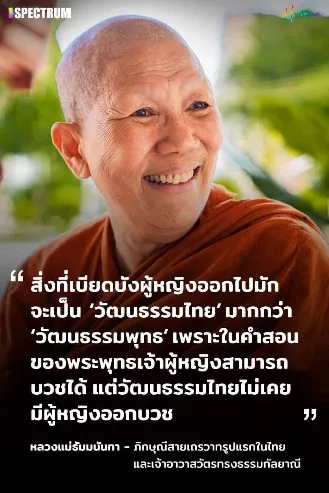
“What keeps women away is often “Thai culture” more than “Buddhism culture”. Because the Buddha’s teachings say that “Women can be ordained”. But in Thai culture, there is no women become ordained.”
-Dhammānandā Bhikkhunī-
The first Thai Theravada woman monk. But she and her temple are not accepted from “The Sangha Supreme Council of Thailand”.
Conclusion.
“Every time you have any conflicts with the others, it means that you are having your inner conflicts.”
-Max Schupach-
I personally think that both Buddhism and process work are important tools for self-awareness. Buddhism emphasizes in your purified mind from any detachments, and be present. Whereas process work emphasizes in connection between both with oneself and with surroundings to be oneness, at present as well. Both the teachings of Buddhism and the teachings of process work wish us to go with the flow happily.
They have the same major goal to understand oneself and world, and be present. Moreover, they concern about meditation in different forms as an important tool for practicing. Because this can help us to be aware of our human passions and of ourselves. If we understand our minds’ mechanism, we can understand the world’s too. Max said that every our outer conflict comes from our inner conflict. So, when we are aware that we are one part of the others and we have many parts in ourselves, we will understand the others. This makes less conflict in ourselves and with our environment. In addition to our inner conflict, it is originated from our human passions and clinging thoughts. If we can understand the world’s realities, we can detach our clinging thoughts and human passions.
So, whenever you are disturbed by someone, you look back into yourself as quickly as you can to find your X-energy. This will help you to become calm. At any times when you feel not comfortable with your body, just do your inner work to find out what disturbs you. Because it means that you ignore some of your feelings, and then nourish them to your body. That can make you get sick soon with your body symptoms.
Your body, your feelings and thoughts, your soul are all of you. If some parts of you are disturbed, you will be disturbed. Especially your body which is your closed friend, memorizes everything in your life in terms of body symptom.
I love these two theories very much because both of them need personal experiences. I love how to do inner work in process work. I think the essences of this process are my inner wisdoms that I have, but I don’t know or believe that I have them already. Whereas in Buddhism, I have to do good at the first time, then I will get the good things back later. If I would like to be in stillness and concentration, I have to practice meditation. If I practice meditation continuously, I can be equanimity to almost every event that occurs in my life. It means that I cannot be biased and can detach of many things easily.
In my personal life, I have used Buddhism to nourish my mind with the general Buddha’s teachings. For example, 1) you do good, you get good, 2) everyone has his/her own way or karma, 3) everything is uncertain, 4) if you would like to liberate yourself, just forgive to everyone who hurts you to cut off their karmas with you, etc.
When I learn process work, I can understand more deeply the mechanisms of everything that I meet. For me, Buddhism is theoretical, whereas process work is how to understand myself and my connection to both inner and outer worlds. Because accessing intuition in Buddhism after practicing meditation does not occur to everyone who practices. Because everyone has his/her own way, so he/she has different disturbances in his/her mind to face. Some can overcome, some can’t. Finally, find your own way to learn to connect with yourself and to the world, for peace in you and the world.
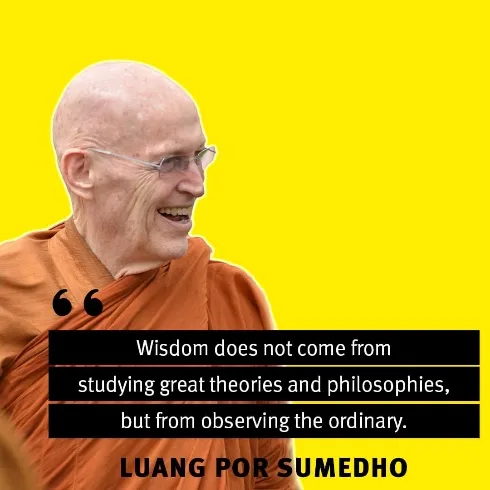
Appendix 1
Hand Movement Exercise.
- When I have some body symptoms. I find the characteristic of my symptom.
- I amplify this character with my hand movement.
- Continue movement for a few minutes until I can get some words or messages from this movement.
From this exercise; my body symptom is consensus reality, whereas my hand movement is the dreamland of the symptom because I focus on my hand movement as the movement meditation. Finally, the message I get during meditation, is the essence of this symptom.
Appendix 2
Earth Spot Exercise.
- Sit on your chair with your comfortable posture.
- Close your eye and imagine to the place you like most. If you have many places, choose one for this moment.
- Look around yourself, what is that place? What is the most attractive to you? Name it.
- Stay with this scenery for a while.
- Shape shift to the thing that is most attractive to you.
- Imagine that there is one person coming to you, you with your worried issue, who needs some advises from you.
- Give him/her some advises.
- Back to be yourself. Consider the advise you get to your present daily life.
Citations.
- https://en.wikipedia.org/wiki/Process-oriented_psychology.
- Mindell, Arnold. The Leader as Martial Artist. (English Edition) (p. 26, 27, 80) San Francisco: Harper. 1992.
- https://www.aamindell.net/process-work.
- พระพรหมคุณาภรณ์ (ป.อ.ปยุตฺโต). พจนานุกรมพุทธศาสตร์ ฉบับประมวลธรรม. พิมพ์ครั้งที่ 34. (Thai Edition) (p. 250) จัดพิมพ์โดยมูลนิธิการศึกษาเพื่อสันติภาพ พระธรรมปิฎก (ป.อ.ปยุตฺโต). ไม่ระบุชื่อสำนักพิมพ์. 2016. PDF version. Retrieved from http://www.watnyanaves.net
- พระพรหมคุณาภรณ์ (ป.อ.ปยุตฺโต). พจนานุกรมพุทธศาสตร์ ฉบับประมวลธรรม. พิมพ์ครั้งที่ 34. (Thai Edition) (p. 270) จัดพิมพ์โดยมูลนิธิการศึกษาเพื่อสันติภาพ พระธรรมปิฎก (ป.อ.ปยุตฺโต). ไม่ระบุชื่อสำนักพิมพ์. 2016. PDF version. Retrieved from http://www.watnyanaves.net
- https://th.wikipedia.org/wiki/%E0%B8%9B%E0%B8%A3%E0%B8%B0%E0%B8%A7%E0%B8%B1%E0%B8%95%E0%B8%B4%E0%B8%A8%E0%B8%B2%E0%B8%AA%E0%B8%99%E0%B8%B2%E0%B8%9E%E0%B8%B8%E0%B8%97%E0%B8%98 (The history of Buddhism).
- https://pantip.com/topic/36164928.
- https://pantip.com/topic/33417965.
- https://th.wikipedia.org/wiki/%E0%B8%A7%E0%B8%B1%E0%B8%94%E0%B8%9A%E0%B8%A3%E0%B8%A3%E0%B8%A1%E0%B8%8D%E0%B8%B2%E0%B8%AA%E0%B8%B2%E0%B8%A3%E0%B8%99
- พระพรหมคุณาภรณ์ (ป.อ.ปยุตฺโต). พจนานุกรมพุทธศาสตร์ ฉบับประมวลธรรม. (Thai Edition) (p. 173) พิมพ์ครั้งที่ 34. จัดพิมพ์โดยมูลนิธิการศึกษาเพื่อสันติภาพ พระธรรมปิฎก (ป.อ.ปยุตฺโต). ไม่ระบุชื่อสำนักพิมพ์. 2016. PDF version. Retrieved from http://www.watnyanaves.net
- Mindell, Arnold. Dreaming While Awake: Techniques for 24-Hour Lucid Dreaming. (English Edition) (p. 28, 31) Hampton Roads Publishing Company, Inc. 2000. PDF version.
- Mindell, Arnold. The Dreammaker’s Apprentice. Using Heightened States of Consciousness to Interpret Dreams. (English Edition) (p. 6, 26, 31) Hampton Roads Publishing Company, Inc. 2001.
- Mindell, Arnold. ProcessMind: A User’s Guide to Connecting with the Mind of God. (English Edition) (p. 18, 29, 38, 51) Quest Books, Theosophical Publishing House, Wheaton, IL. 2010.
- Mindell, Arnold. The Dreammaker’s Apprentice. Using Heightened States of Consciousness to Interpret Dreams. (English Edition) (p. 10, 21, 77) Hampton Roads Publishing Company, Inc. 2001.
- Mindell, Arnold. The Leader’s 2nd Training. For Your Life and Our World. (English Edition) (p. 192) Gatekeeper Press, Columbus, Ohio. 2019.
- พระภาวนาวิศาลเมธี ว. (ประเสริฐ มนตเสวี). การยกอารมณ์ฌานขึ้นสู่วิปัสสนา ตามแนว.. อานาปานสติภาวนา. (Thai Edition) (p. 62, 89) ตรวจชำระโดย สมเด็จพระพุทธชินวงศ์ (สมศักดิ์ อุปสมมหาเถระ ป.ธ.9, M.A., Ph.D.) ประยูรสาส์นไทย การพิมพ์. 2019. PDF version. Retrieved from https://digital.lib.ru.ac.th.
- พระภาวนาวิศาลเมธี ว. (ประเสริฐ มนตเสวี). การยกอารมณ์ฌานขึ้นสู่วิปัสสนา ตามแนว.. อานาปานสติภาวนา. (Thai Edition) (p. 144) ตรวจชำระโดย สมเด็จพระพุทธชินวงศ์ (สมศักดิ์ อุปสมมหาเถระ ป.ธ.9, M.A., Ph.D.) ประยูรสาส์นไทย การพิมพ์. 2019. PDF version. Retrieved from https://digital.lib.ru.ac.th.
- Mindell, Arnold. Conflict: Phases, Forums, and Solutions. For Our Dreams and Body, Organizations, Governments, and Planet. (English Edition) (p. xiii-xix) CreateSpace Independent Publishing Platform, North Charleston, SC. 2017.
- Mindell, Arnold. Working on Yourself Alone. (English Edition) (p. 63) Lao Tse Press, Portland, Oregon. 2002.
- Mindell, Arnold. ProcessMind: A User’s Guide to Connecting with the Mind of God. (English Edition) (p. 43) Quest Books, Theosophical Publishing House, Wheaton, IL. 2010.
- Mindell, Arnold. The Leader’s 2nd Training. For Your Life and Our World. (English Edition) (p. 195) Gatekeeper Press, Columbus, Ohio. 2019.
- Mindell, Arnold. Conflict: Phases, Forums, and Solutions. For our Dreams and Body, Organizations, Governments, and Planet. (English Edition) (p. 5, 13, 103) CreateSpace Independent Publishing Platform, North Charleston, SC. 2017.
- https://th.wikipedia.org/wiki/%E0%B8%81%E0%B8%A3%E0%B8%A3%E0%B8%A1
- Mindell, Arnold. The Leader’s 2nd Training. For Your Life and Our World. (English Edition) (p. 180) Gatekeeper Press, Columbus, Ohio. 2019.
- Mindell, Arnold. The Leader’s 2nd Training. For Your Life and Our World. (English Edition) (p. 204) Gatekeeper Press, Columbus, Ohio. 2019.
- Mindell, Arnold. The Dreammaker’s Apprentice. Using Heightened States of Consciousness to Interpret Dreams. (English Edition) (p. 127) Hampton Roads Publishing Company, Inc. 2001.
“Happiness, Suffering, and everything are brought about by one’s own actions.”
“Buddhists firmly believe in the law of Karma: ‘Good deeds yield good results, Bad deeds yield bad results.’”
“All things are subject to the law of nature.”
“Nature is fair; it stays the way it is all the time.”
The Buddha said “He who sees the Dhamma, sees the Buddha. He who sees the Buddha, sees the Dhamma. He who has attained to the Dhamma, has attained the Buddha.”
“Love and Kindness are the most important instruments.”
“True happiness is living in moderation.”
“True happiness comes from a calm mind, free from defilements.”
“The cause of suffering is in oneself, not from anywhere else.”
-Panyananda Bhikkhu-